

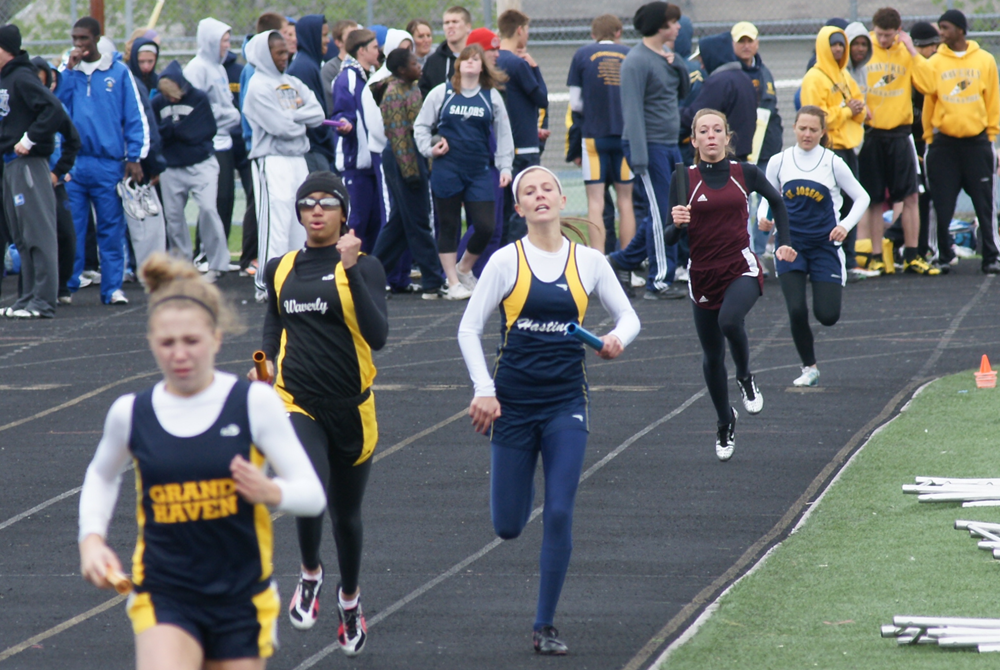
Hastings Relays Reigns as State's Oldest Continuous Track & Field Meet
By
Steve Vedder
Special for MHSAA.com
April 10, 2024
Bob Branch remembers dabbling in other sports, but his first love was always running.
 The Hastings High School graduate admits he could never hit a baseball, football didn't especially appeal to him and basketball was just another way to spend time with friends. But for Branch, now 93, there was always track. That's the sport where his fondest and sharpest memories remain. And if you're talking track, many of his favorite memories come from participation in the state's oldest continuous track meet, the Hastings Relays.
Always held in early April, the meet dates back to 1937 – a bygone time that saw the first hostilities of World War II, gas at 20 cents a gallon and a loaf of bread selling for a dime.
And at a dusty old track surrounding the county fairgrounds in Hastings, a small relay event that included a scattering of participants from a dozen high schools was taking its first tentative steps.
Branch recalls a time when kids would run home after track practice because there were no buses, inexperienced young coaches had little actual knowledge of running fundamentals, and athletes looked at the sport as an afterthought after spending most of their high school days playing football and basketball.
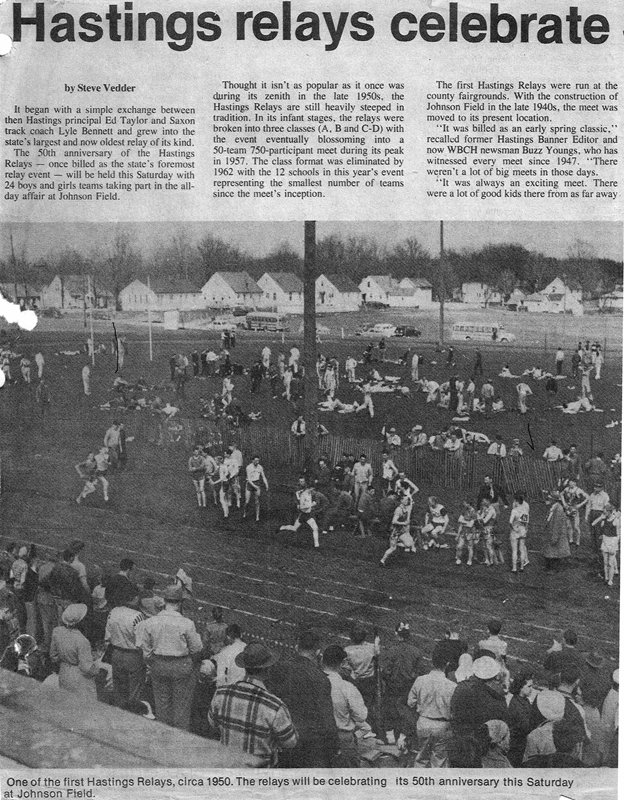 For Branch, the relays were the ideal way to ease into the track season.
"I just liked to run," said Branch. "I remember I anchored a relay with my brother, and it always seemed cold when we had that meet. I remember teams would come from all over and you saw a lot of good athletes. Everybody seemed to have someone who was really good. Track wasn't very popular at that time, but I have a lot of good memories from running."
The Hastings Relays, which has changed formats and even names during its nearly nine-decade history, would traditionally kick off the track season. The meet was originally held at a makeshift quarter-mile track which surrounded the town's fairgrounds and was part of the city's annual Hastings Carnival – the track would become the midway during fair time.
The meet eventually moved to Johnson Field when the football field was dedicated in 1949 and ballooned to as many as 50 teams at its peak in 1957. For more than seven decades it was known as the Hastings Relays and then the Hastings Co-Ed relays before becoming the current Hastings Invitational, with the latest edition scheduled for Friday.
Johnson Field had a cinder track before it became an all-weather surface in the 1980s. During a time long before computers would be used to organize meet heats in mere minutes, Hastings coaches of all sports – defined as "volunteers" by the athletic department – would meet on the Friday before competition to hash out events.
People associated with the meet still recall the camaraderie built on those long Friday nights, followed by working what would often become 10-hour meets. Steve Hoke has been involved since watching his father, Jack, who coached teams at 15 of the meets beginning in 1951 and also had run in the first Hastings Relays. Steve Hoke later competed in the Relays as well during the early 1970s before becoming an assistant track coach, later the Hastings athletic director and now a volunteer worker.
"It was always a huge deal," said Hoke, who said the meet began as a pure relay event before transitioning to its current team format in the 1990s. "I remember we'd line the track the night before, and all the coaches would come to the house to organize everything. There was a brotherhood.”
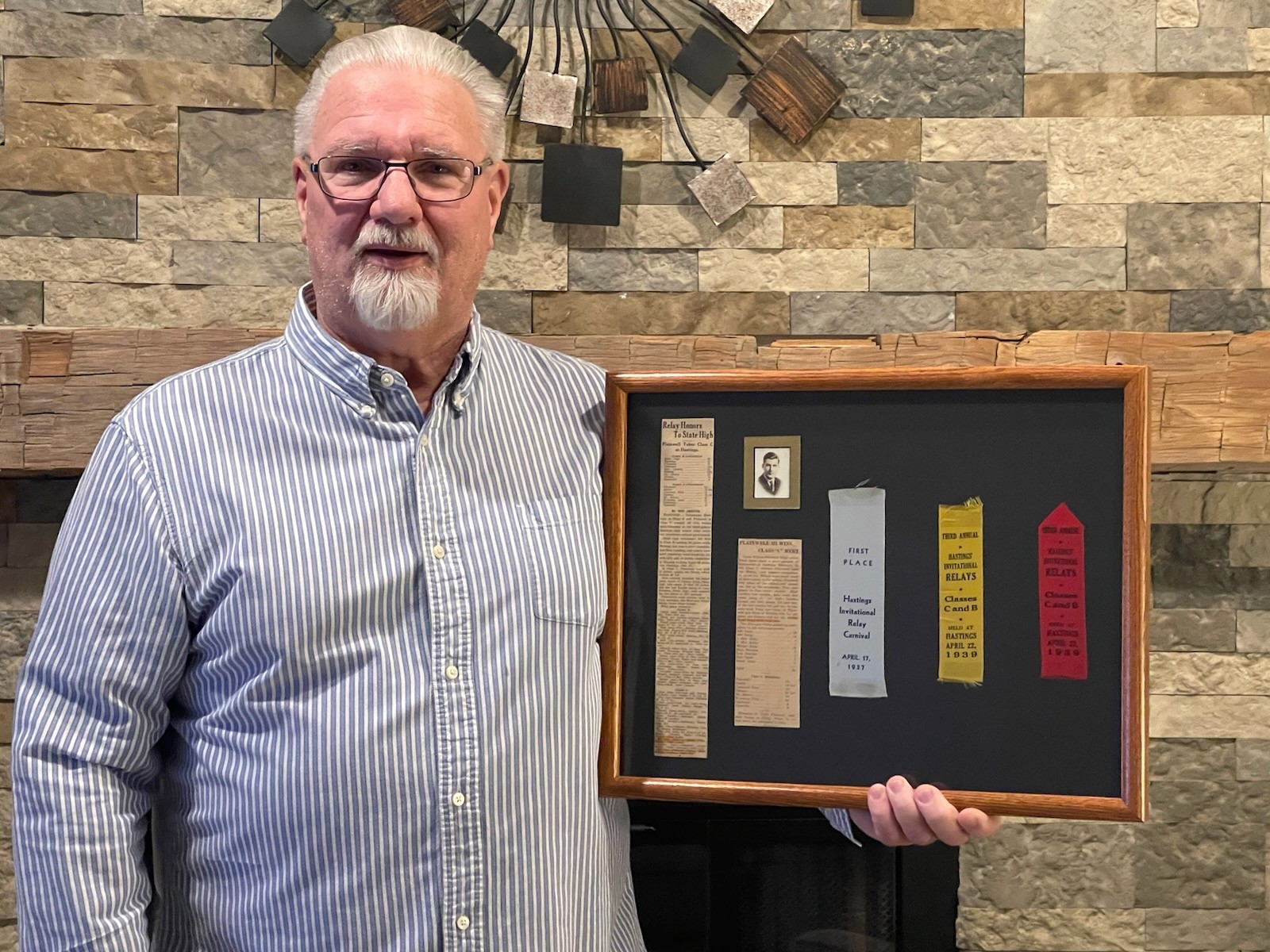 If you quiz many of the fleet of volunteers who've worked the relays over the years, each has a different memory from the meet. While Hoke describes the brotherhood and Branch the outstanding competition, others remember weather and the time a thunderstorm wiped out the line markings on the cinder track, or waking up to find three inches of snow that caused a rare cancellation of the meet. Others recall the shock of moving from the cinder to all-weather track or using the meet as an early measuring stick of what it would take to qualify for the state meet. The real old-timers remember the meet disappearing for three years during World War II.
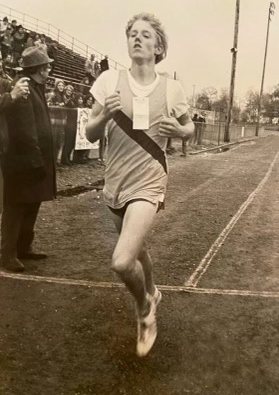
Hastings native and Western Michigan grad Tom Duits was the state’s second collegian to break the four-minute mile when he ran a 3:59.2 at a meet in Philadelphia in 1978. Duits, who ran in three Hastings Relays, was in line to join the U.S. Olympic team in 1980 before the United States pulled out of the games due to tension with Russia.
Duits has his own memories of the meet and the competition he faced there.
"I remember sunshine and being excited to be competing again. There were all these athletes swarming around; it was an awesome display of talent," he said. "It was always one of the best meets we'd be in. You could pretty much see the level of runners who would be at state, which made it a big deal. It was always early, but you could tell where you stood. It was great exposure."
Hastings track star Wayne Oom competed in four Hastings Relays from 1984-87. One of his sharpest memories was the difference between running on a raw cinder track versus the far more comfortable all-weather surface.
"Those cinders would grind into your skin," said Oom, part of the Hastings school record in the two-mile relay. "But I think it helped us because when we'd go to other tracks, it seemed we would run faster. I remember how competitive it was, especially in the distances. There were some great runners."
While participants have their unique memories, so do coaches. Former Saxons coach Paul Fulmer remembers 2008 when his team finished first on the boys side of the meet while his wife, Grand Haven coach Katie Kowalczyk-Fulmer, saw her girls team win the championship.
 "I knew we were one of the favorites to win because we were usually near the top of our conference and Regional," he said. "But then Katie's team was pretty good, and it was cool for them to win too."
Fulmer, who coached Hastings from 1978-81 and then 1985-2010, said at least part of the meet's popularity was derived from a unique way of scoring. Instead of individuals earning points solo, participants worked in pairs. For instance, two athletes would combine their shot put or long jump scores. New events such as the 1,500 relay and sprint medley were added.
"We had a tradition of being the state's oldest meet, and that was a big deal," Fulmer said. "And we ran a good relay; that attracted teams too. We took a lot of pride in that.
"And we'd get quite a lot of people to come to the meet. We'd set up until like 9 or 10 p.m., and then we'd have a party with all the coaches on Friday night."
While the meet has stretched 87 years, Branch said early participants and current runners have one thing in common: a drive to win. Branch ran in an era when the popularity of high school track was in its infancy. Today some of the best all-around athletes at a school are involved in the track program. The relays span the nearly nine decades in between.
"The quality of teams has gotten better and better," said Branch, the 1947 Lower Peninsula Class B Finals champ in the 220. "And this has made for a better meet. We would get guys who played football or baseball kind of drift into track, and that made the sport better. I think people began to appreciate track because we'd get teams from all over.
"We went from not really knowing what we were doing to track being a good sport. Even then, I'm not sure we appreciated what we had. We really liked the Hastings Relays and always wanted to do well there. It became popular and quite an honor to do well. Those are the kind of things I remember."
PHOTOS (Top) Racers run at the Hastings Relays, with several more awaiting their turns to compete at the longtime meet. (2) The author wrote on the 50th anniversary of the Relays for the Hastings Banner nearly 40 years ago. (3) Past athlete, coach and athletic director Steve Hoke shows some of the Relays awards from the 1930s. (4) Tom Duits was one of the state’s biggest track stars of the 1970s and ran in three Hastings Relays. (Top photo by Dan Goggins, Hoke photo provided by Steve Hoke and Duits photos provided by Tom Duits.)
Hamlin Breaks Escanaba's 48-Year-Old High Jump Record, Climbing List of State's Best
By
Adam Hinch
Special for MHSAA.com
May 7, 2026
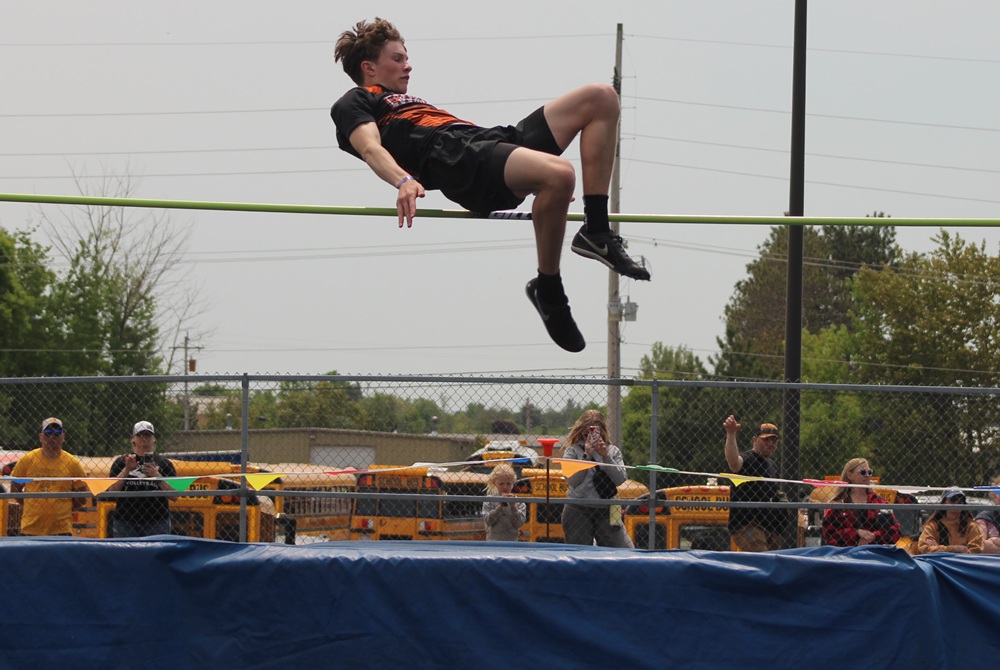
ESCANABA — Over the last three seasons, Escanaba sophomore Andrew Hamlin has shown big gains annually in the high jump – and this year he has broken Escanaba High School’s record not once but twice, with plenty of opportunities remaining to better his best performance.
 Hamlin took his first jumps in seventh grade but did not actively start competing until his eighth-grade year at Holy Name School in Escanaba.
“I remember the meet in Bark River,” Hamlin said. “I used to go off my right side with my left leg and then switched halfway through the season and ended up breaking the record.”
Hamlin broke Holy Name’s school record at the Escanaba Junior High Invitational with a jump of 5-foot-7 on May 14, 2024.
He also came in 11th at the Upper Peninsula Division 3 Finals that spring with a jump of 5-4 as one of only two eighth graders to compete in the Division 3 boys high jump that day.
“I knew Andrew since he was in fourth grade,” Holy Name athletic director Tony Derkos said. “He is a great kid, and track really gives him a chance to be his own athlete.”
Hamlin switched to Escanaba High School as a freshman and had a jump of 6-foot at the Division 1 Regional in Escanaba last spring. He then came through with a jump of 6-2 at the UP Finals in Kingsford where he was finished second as one of only two freshmen to place among the top 10.
“I really enjoy the competitiveness of the sport,” Hamlin said. “It definitely helps to fuel you as an athlete to improve every time out.”
Hamlin also has a personal coach, Hugo Munoz, who was a member of the Peru national team and competed in the 1996 and 2000 Summer Olympics.
Hamlin has competed in two high jump camps, one in Wisconsin and most recently one in New Prague, Minn.
 Now a sophomore, he broke the high jump record for Escanaba High School with a jump of 6-6 on April 21at the Delta County Invite in Gladstone. The previous record was set in 1978 by Keenan Failing.
“It meant a lot to get the record,” Hamlin said. “It was one of the goals for the season coming in, and I was just kind of surprised that it happened this early in the season.”
That record lasted for 10 days until the Escanaba Invitational on May 1, when Hamlin completed a jump of 6-7. That height ranks eighth statewide this season and first among Upper Peninsula jumpers.
“I have to adjust my goals for the season,” Hamlin said. “I never thought I would hit this high of a height this early in the season, so now I’m just trying to stay consistent and improve my height when I can.”
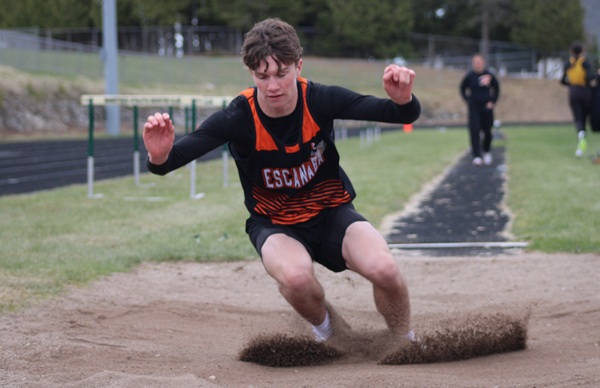
Hamlin will be taking part in the Nike Nationals this summer as well as some other high jump events. He also competes for Escanaba in the long jump, 400 meters and 1,600 relay, and plays football and basketball for his school.
“He’s everything you want in an athlete,” Eskymos track coach Scott Dykema said. “He is a good competitor and is always working on his game and what he can do to improve every time he goes out.”
Hamlin has overcome various injuries but works to get back in action as soon as he can.
“He never lets injuries keep him down,” Derkos said. “He is a tough kid and battles through injuries, and that is the sign of a natural competitor – which is what he is.”
Hamlin has aspirations of taking the high jump to the collegiate level and said he also enjoys distance running. He competes in 5K races and said he would enjoy running a marathon at some point.
“I think it would be fun to run a marathon,” Hamlin said. “That would come after college as there is so much time and training that goes into preparing for a marathon, but definitely something I would have interest in down the road.”
Hamlin has at least four track meets left this season as Escanaba will compete in Negaunee on May 8, at the Division 1 Regional at Manistique on May 13, and at Gladstone and Gaylord as well before finishing at the UP Finals on May 30 in Kingsford.
PHOTOS (Top) Escanaba’s Andrew Hamlin soars over the high jump bar during a meet. (Middle) Hamlin completes a turn in the long jump pit. (Photos by Adam Hinch.)