


Norris Center Offers Track Athletes 'Perfect' Early-Season Indoor Opportunity
By
John Vrancic
Special for MHSAA.com
April 13, 2022
SAULT STE. MARIE — Weather conditions in early April can sometimes be frightful in the Upper Peninsula.
 On a day with snow showers falling outside, eight schools took advantage of an opportunity to compete in Friday’s indoor track & field meet at Lake Superior State University’s Norris Center.
“The first meet of the season is very important to me,” said Alpena senior Madi Szymanski, who plans to run cross country and track at Northern Michigan University. “This gives me a starting base and a better idea of where I’m at. I prefer to run outdoors, but I’m very grateful to be indoors today. Conditions are always perfect inside.”
Szymanski was a triple-winner in the LSSU Large School Yooper Invitational, taking the 800-meter run in 2 minutes, 28.26 seconds, the 1,600 (5:27.83) and helping the Wildcats take the 1,600 relay (4:44.39).
“I’ve been doing indoor meets during the winter,” she said. “I go to Saginaw Valley a lot and have been to Central Michigan and Eastern Michigan, but this is my favorite 200-meter track. I always look forward to coming here. It’s real exciting and my adrenalin is very high. It’s always great to do well in the first races.”
This marked the first of just three indoor meets in the U.P. this season. Many U.P. schools were scheduled to compete in the Michigan Tech Keweenaw Classic on Tuesday in Houghton with another indoor event taking place April 21 at LSSU.
Both Alpena teams were crowned champions, and the two Manistique teams placed fourth.
Manistique junior Grant Mason won the boys 400 in a personal-best 56.88 seconds, and the girls opened with a victory in the 3,200 relay (11:34.36).
“I expected it to be a little harder on a 200 track, but ended up with my best time,” said Mason. “I had a pretty good start. It’s real important to get this meet in. It’s a lot warmer in here. Early-season meets aren’t very easy to find up here. We had some good competition up here today. The downstate schools are ahead of us because they get an opportunity to see some real good competition.”
The Emeralds finished three seconds ahead of the field in the girls 3,200 relay.
“We’re pretty happy with our time,” said sophomore Emma Jones, who led off that relay. “We still have snow on our track. We’ve been working on our handoffs inside which is not the same, especially on a 200-meter track. It feels like you’re going faster. It’s pretty important for us to get this meet in because we haven’t been outside. This is the first time many of us have been in our events this year. It was good to see different competition today. This is definitely pushing us to our new potential.”
Junior Kelsey Muth, who took the baton from Jones, had similar thoughts.
“It was an awesome feeling to win it,” she said. “We went into it not knowing what to expect. That was a real good starting point for us. Emma and I had a real good handoff, but overall we were a little shaky. Our athletic director (Nate Zaremba) has been scheduling meets (we) need to reach the next level. We’re excited about going downstate for the first time. We’re hoping for nice weather down there.”
Jones placed second in the 400 (1:10.14) and Muth was fourth (1:11.64) for the Emeralds, who resume in Friday’s Ram Scram at Harbor Springs.
“I think today was a good first showing,” said Emeralds’ coach Amy Nixon. “In the first meet of the year, you never know what to expect and we had some girls step up. Some of the new girls stepped into events which others couldn’t. We’re proud of them for being willing to do that. Now we know what the girls are capable of doing. It’s fun to compete again.”
The Manistique boys secured fourth place by taking third in the 1,600 relay (4:03.25).
“Overall, the meet went well,” said Emeralds boys coach Cody Kangas. “Some guys did some real good things, and Grant did a great job in the 400.”
 John Vrancic has covered high school sports in the Upper Peninsula since joining the Escanaba Daily Press staff in 1985. He is known most prominently across the peninsula for his extensive coverage of cross country and track & field that frequently appears in newspapers from the Wisconsin border to Lake Huron. He received the James Trethewey Award for Distinguished Service in 2015 from the Upper Peninsula Sportswriters and Sportscasters Association.
PHOTO Athletes took advantage of the opportunity to compete indoors at Friday’s Yooper Invitational at Lake Superior State University. (Photo by Robert Roos/Sault Ste. Marie Evening News.)
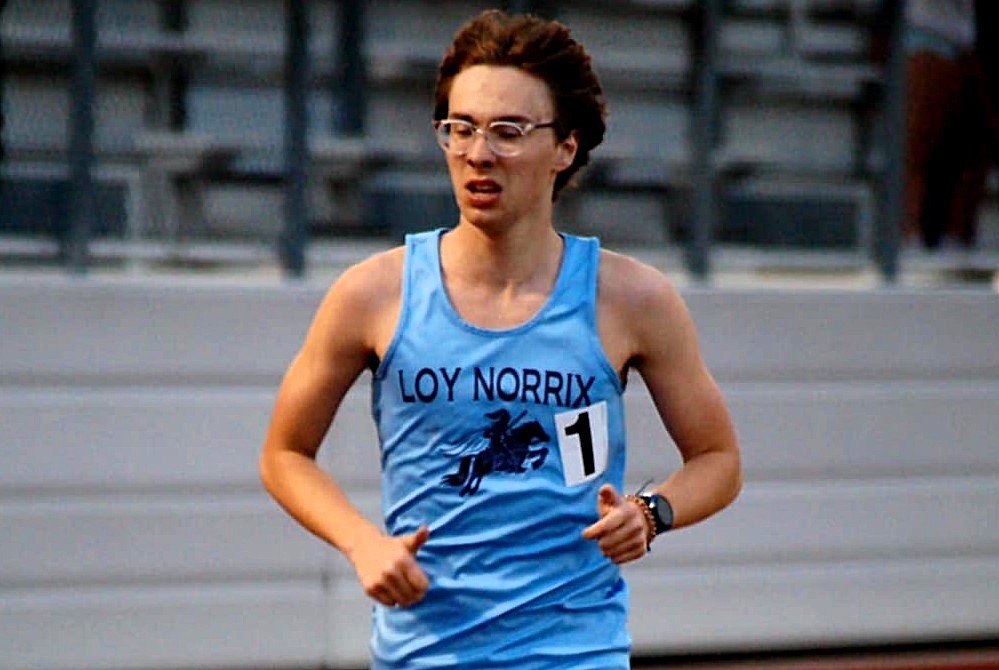
Performance of the Week: Kalamazoo Loy Norrix's Jackson Lam
May 1, 2025
 Jackson Lam ♦ Kalamazoo Loy Norrix
Junior ♦ Track & Field
Running on his home track Friday during the annual Don Lukens Invitational, Lam broke Loy Norrix's 57-year-old record in the 1,600 with a winning time of 4:13.32. The historic performance came at the first Lukens meet since the legendary coach's death last Sept. 15, and Lam finished nearly 15 ahead of the field. He also ran on the winning 3,200 relay.
The school record was Lam's second, as he was also part of the Norrix all-time best 3,200 relay finish as a freshman. The 1,600 time Friday bested that of Gary Harris from 1968, which was the oldest on Loy Norrix's record board, and Lam's time ranks as the fifth-fastest in the state this season regardless of division. He reached the MHSAA Finals as part of the 3,200 relay in 2023 and running the 1,600 a year ago, and he finished 12th at the Lower Peninsula Division 1 Cross Country Finals this past fall.
@mhsaasports 🏃POW: Jackson Lam #loynorrix #running #record #breaker #1600m #57years #track&field #part1 #highschoolsports #tiktalk #interview #performanceoftheweek #mistudentaid #fyp #MHSAA ♬ original sound - MHSAA
@mhsaasports 🏃POW: Jackson Lam #twix #chocolatemilk #grantfisher #hobbskessler #dog #skullemoji #laughingcrying #michigan #part2 #performanceoftheweek #mistudentaid #fyp #MHSAA ♬ Monkeys Spinning Monkeys - Kevin MacLeod & Kevin The Monkey
Follow the MHSAA on TikTok.
MHSAA.com's "Performance of the Week" features are powered by MI Student Aid, a division within the Department of Lifelong Education, Advancement, and Potential (MiLEAP). MI Student Aid encourages students to pursue postsecondary education by providing access to student financial resources and information. MI Student Aid administers the state’s 529 college savings programs (MET/MESP), as well as scholarship and grant programs that help make college Accessible, Affordable and Attainable for you. Connect with MI Student Aid at www.michigan.gov/mistudentaid and find more information on Facebook and Twitter @mistudentaid.
Previous 2024-25 honorees
April 25: Isabelle Horvath, Bangor - Report
April 18: Presley Jones, Sterling Heights Stevenson soccer - Report
April 11: Olivia Jasniewicz, Troy soccer - Report
March 27: Katie Spicer, Fowler basketball - Report
March 21: Moses & Markus Blackwell; Warren Lincoln basketball - Report
March 13: Keyshawn Summerville, Lansing Sexton basketball - Report
March 6: Maggie Buurma, Fowlerville wrestling - Report
Feb. 28: Maren Studt, Pontiac Notre Dame Prep skiing - Report
Feb. 21: Olive Krueger, Marquette swimming - Report
Feb. 14: Hunter Lemmon, Fraser swimming - Report
Feb. 7: Aubrey Hillard, Rochester competitive cheer - Report
Jan. 31: Wyatt Spalo, Reed City wrestling - Report
Jan. 24: Olivia Flynn, Harbor Springs basketball - Report
Jan. 17: Levi Rozema, Holland Christian swimming - Report
Jan. 10: McRecco McFadden, Burton Bentley basketball - Report
Dec. 18: Nash Leonard, Bay City Western hockey - Report
Dec. 11: Blake Cosby, Dundee wrestling - Report
Dec. 4: Keaton Hendricks, Zeeland West football - Report
Nov. 29: Kate Simon, East Grand Rapids swimming - Report
Nov. 22: Ella Kokaly, Essexville Garber volleyball - Report
Nov. 15: Caroline Bryan, Grosse Pointe South swimming - Report
Nov. 8: Kaylie Livingston, Whitmore Lake cross country - Report
Oct. 25: Oliver Caldwell, Grand Rapids West Catholic tennis - Report
Oct. 18: Alex Graham, Detroit Cass Tech football - Report
Oct. 11: Victoria Garces, Midland Dow cross country - Report
Oct. 4: Asher Clark, Bay City John Glenn soccer - Report
Sept. 26: Campbell Flynn, Farmington Hills Mercy volleyball - Report
Sept. 19: TJ Hansen, Freeland cross country - Report
Sept. 12: Jordan Peters, Grayling soccer - Report
Sept. 6: Gabe Litzner, Sault Ste. Marie cross country - Report
Aug. 30: Grace Slocum, Traverse City St. Francis golf - Report
(Action photo by Graig Stacy. Headshot by RunMichigan.com.)