

Olivet Girls Continue Reign as Peters Closes Championship-Filled Career
By
Todd VanSickle
Special for MHSAA.com
May 30, 2026
KENT CITY – After winning its first Finals championship in girls track & field a year ago by just five points, Olivet extended its title reign with another close finish Saturday at Kent City.
The Eagles scored 82 points at the Lower Peninsula Division 3 championship meet to outpace Lansing Catholic (76), with Pewamo-Westphalia (61.5) third.
“I am an alumni of the school, so to come back and do this is, is awesome,” Olivet head coach Brian Lincoln said. “We knew going in that it is was going to be a battle with Lansing Catholic. Our girls stepped up, like they have all season and for the past four seasons.”
Olivet senior Emily Peters claimed her fourth 300-meter hurdles title in 44 seconds. She qualified for this meet in seven events.
“It is pretty crazy,” said Peters said, who plans to run track for Northwood University next season. “Going into my freshman year, I knew I was pretty fast, but I never expected to have this kind of success.
“This is a perfect ending. It is the culmination of all my hard work. I am so grateful for this.”
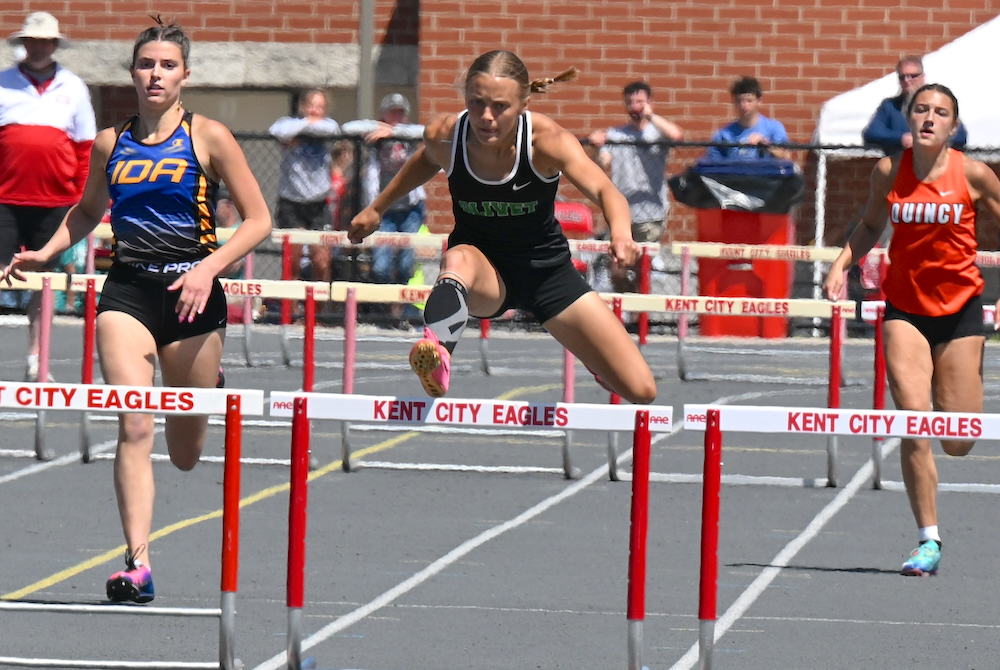
Peters also took second in the 100-meter hurdles with a personal best of 14.83 seconds as the Eagles had success in several events.
Celina Sinclair won the 200 meters with a personal best of 24.91 seconds after finishing second in the prelims. The Eagles’ 400 relay team of Bailey Powell, Lola Miars, Peters and Sinclair took first place (49.51) over Kingsley (49.53) and Traverse City St. Francis (49.77). Olivet’s 800 relay team (Peters, Sinclair, Miars and Kendall Eggerstedt) also found the top spot on the podium (1:44.67).
Pewamo-Westphalia won the 3,200 relay (9:40.94) with Julia Paxton, Katherine Schafer, Adelyn Thelen and Calista George. Lansing Catholic was second and Saugatuck finished third.
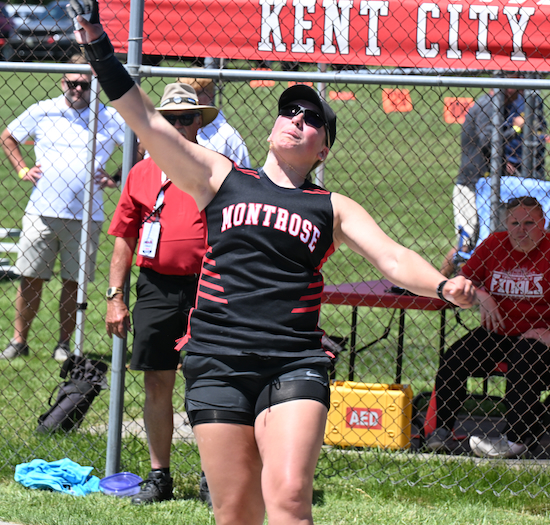 Montrose’s Addyson Stiverson won the shot put with an all-Finals record of 55 feet, 6½ inches. The previous record (50-9½) was set in 2021 by Bryon’s Sarah Marvin.
Second place went to Pewamo-Westphalia’s Jenna Spitzley with a toss of 38-1¾. “If you would have asked me a week ago, I didn’t think I would have been in the 38 range,” Spitzley said.
The Pirates senior also won the discus with a throw of 136-7. She credited her family for her success.
“I had my brother there,” Spitzley said. “He has been coaching me a lot and helping me.”
She will attend Hillsdale College in the fall and plans to throw the shot put, discus and the hammer at the collegiate level.
Olivia Beaudrie, of Monroe St. Mary Catholic Central, won the high jump with a leap of 5-4. Julia Sergeant, of Houghton Lake, took first place in the pole vault clearing 11 feet after finishing sixth in the event last spring.
“I am really happy with my progress this year,” Sergeant said.
Despite being the top seed, she was a little nervous coming into meet.
“There were a few girls I was a little intimidated by,” Sergeant said. “There were two girls I have never seen vault before, but I knew what I was capable of and I did it.”
Novella DeGraff, of Saugatuck, had a personal best of 10-9 in the pole vault to finish second. She also finished third in the long jump with a personal best of 17-2. Smantha Hopkins, of Harrison, was first with a leap of 17-4¾.
Both of DeGraff’s marks in the field events set school records. It was the second year DeGraff had competed at the Finals, although she missed last season’s meet due to a torn knee ligament. She also ran a personal best in the 100-meter hurdles for third place (14.83).
“Today has been pretty chaotic,” DeGraff said. “I planned to try my best, but I didn’t expect I would do as good as I am. My mentality was to have a good time.”
Lansing Catholic’s Grace Wonch (4:58.84) and Josie Bishop (4:58.89) took first and second, respectively, with personal bests in the 1,600 meters. Bishop won the 800 meters (2:16.07), while Wonch took the bronze. Wonch also claimed the 3,200 meters (10:53.12) and Tiya Feldpausch, of Olivet, was second. (10:58.84).
The reigning 100 hurdles champion Julia Hughes repeated with a run of 14.55 seconds. She took third in the 300 hurdles.
Erie Mason senior Giuliana Nastale repeated as the 100 champion in 12.11 seconds. Sinclair, of Olivet, was second. Ella Clause, of Clinton, ran a personal best (57.99) to claim the 400. Centreville's Diannah Schwartz finished first in the 100, 200, 400 and shot put adaptive events.
PHOTOS (Top) Olivet's Emily Peters, center, clears a hurdle on the way to a runner-up finish in the 100 hurdles race Saturday. (Middle) Montrose's Addyson Stiverson launches the shot; she set the all-Finals record in the event. (Click for more from Mary Wilson and John Willoughby/RunMichigan.com.)
Inspiration Fuels Windemuller's Pursuit
By
Tom Markowski
Special for Second Half
June 3, 2017
ZEELAND – It hasn’t been easy at Holland Christian this school year. Certainly not as easy as Kayla Windemuller made it look on the track Saturday.
Windemuller pulled off a rare triple as the junior defended her titles in the 1,600 and 3,200-meter runs and ran anchor on the winning 3,200 relay (9:09.41) at the Lower Peninsula Division 2 Track & Field Finals at Zeeland.
Five people associated with Holland Christian schools died this school year. One was a 13-year-old girl and two were teachers, and it’s something Windemuller and everyone associated with the schools can’t forget.
“It’s tough at the school,” Windemuller said. “In some meets during the season it’s tough to run. When I run in those I think of them. They inspire me. I run for them.”
Windemuller is an inspiration to any young runner, distance or otherwise. She set a personal record in the mile (4:52.60) and, although she came up short of her goal in the 3,200 run (10:49.90), it was a day to savor.
“I was concerned about the heat, but it didn’t affect me too much,” she said. “It’s amazing to defend my title(s). I really like (running) the two mile. I’m more of a distance girl.
‘My goal was to get under 10:40. At the start I felt pretty good. That’s OK. I ran a PR in the mile. It is a long day, but it’s nice to have the meet spaced out. We run the relay in the morning, and then the races get slower as the day goes on. The day, overall, was awesome. I’m not happy with the times. The three state titles are sweet.”
Team title No. 2
Lansing Waverly competed well but luck also played a part in its second consecutive title.
Waverly had no individual winners, but did place first in two relays (400 and 800) to win with 47 points. Zeeland East was second with 46, and Holland Christian was third with 34.
Here’s how some of the drama played out.
Due to injuries Waverly coach Rex Wilkes, Jr., had to shuffle his lineup on the relays. The Warriors had the fastest time in the division in the 1,600 relay entering the Finals, but Wilkes made the decision not to compete in the event while attempting to save his top runners for other races.
It worked, but just barely.
“I knew we could score around 50 (points),” he said. “I just didn’t know what the other teams would do. We got some extra points in the shot. We got 10 there. And then I was told that Priscilla (Trainor) had to finish third or higher in the 200 for us to win.”
Trainor finished third. That’s not all. Suenomi Norinh of Zeeland East finished tied for first in the 100 hurdles with times measured out to hundredths of a second; to break the tie, it was determined she finished second by two thousandths of a second.
“Sometimes it’s good to be great,” Wilkes said. “Sometimes it’s good to be lucky.”
Norinh, a junior, did take first in the high jump (5-foot-8) and was second in the long jump.
Double winner
Liz Pyles of Cadillac placed third in both the discus and shot put last season as a junior, and she took that experience to place first in the shot with a put of 45 feet, 4 inches, a personal best, and won the discus with a throw of 146-3.
“I’m so happy,” she said. “I had three new PRs today (in the shot put). I’m so pleased.
“Last year was something to build upon. I worked with my coach. I worked in the weight room. I went to a bunch of camps. I’m real serious about this.”
Pyles signed with Grand Valley State University and expects to compete in both events. She qualified for the MHSAA Finals in the shot put all four seasons and the discus three times. Even so, she doesn’t have a favorite.
“It depends on the season,” she said.
Catching up quickly
Zoe Eby of Carleton Airport is a notorious slow starter. And when you’re competing in the 100 dash, that usually doesn’t bode well.
Eby got off to a poor start again but managed to come back to win the race with a time of 12.11.
“The last 30 meters was really close,” she said. “When I got off to that start I thought I would (finish) in the middle of the pack. I honestly don’t know how I did it.”
Eby, a junior, also defended her title in the 200. As a freshman she won the 400. She doesn’t compete in that event anymore.
“It’s not my niche,” she said.
Switching gears
Jakarri Alven of Grand Rapids Catholic Central wasn’t at her best Saturday. She said she had to pull out of the 200 because she was feeling ill.
Nevertheless, she won the 400 (56.48), a race she also won last year as a freshman, and she ran anchor on the winning 1,600 relay.
“I’m better at the longer distances,” she said. “But I like the (200). I got off to a good start today (in the 400). It’s the longer distances that I can work through better. I guess I’m better at it.”
Waiting pays off
Waiting for the other competitors to complete their jumps in the long jump was getting to Taylor Dziatczak of Macomb Lutheran North. Dziatczak had used up her tries and stood in first place with a jump of 17 feet, 11½ inches.
“It was a nail-biter,” she said. “A couple of girls who were close had a couple more jumps left. The girl from Zeeland East (Norinh) had three more left. I had to go to some deep breathing to stay calm.”
Dziatczak, who placed second last year, did hold on for first.
The long jump isn’t her best event, and it’s really not second as far as favorites. The javelin is tops with her. Dziatczak is a two-time AAU All-American in the javelin and has signed with Ashland University in Ohio to compete in the heptathlon. That’s seven events, in case you’re wondering. She placed in the javelin as a sophomore nationally in her age group and was third this year. Dziatczak, who is 17 years old, pointed out she moved up to the 18-and-under age group this year.
She just started competing in the heptathlon two years ago.
Her second favorite event is the 200 dash. The other events are the 100 hurdles, 800 run, high jump and shot put.
“I ran. I jumped. I figured why not do all of the others?” she said.
Why not indeed.
Record vaulter
Spring Lake senior Gabriella LeRoux set the only meet record in Lower Peninsula Division 2 for this season, pole vaulting 12 feet, 6 inches to break Kristen Hixson's mark of 12-4 set in 2010 while competing for Remus Chippewa Hills.
LeRoux's best this season heading into the meet was 12-0. A junior, she also won the pole vault championship in 2016 and was second in 2015 to her older sister Allie.
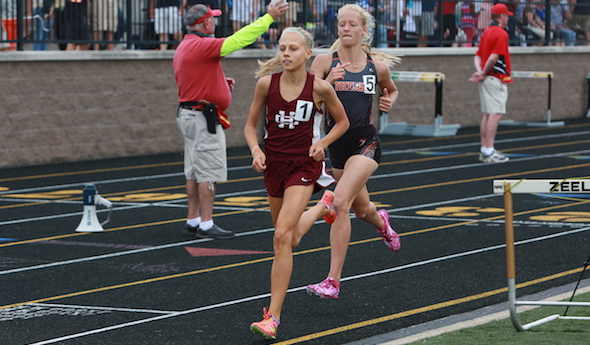
PHOTO: Holland Christian's Kayla Windemuller stays a pace ahead of Tecumseh's Christina Sawyer during one of their two races against each other Saturday. (Photo by Janina Pollatz/RunMichigan.com.)