

Owner of State's All-Time Farthest Shot Put Aiming for National Record, Olympics
By
Paul Costanzo
Special for MHSAA.com
March 25, 2026
From the first time Montrose's Addyson Stiverson picked up the shot put at a sixth-grade track & field practice, it was clear there was something there.
 Even if she wasn’t quite clear on the name.
“I ran at the first couple practices, and was like, this wasn’t for me,” she said. “They said, ‘You’re strong, try the heavy ball thing.’ I honestly never threw it like a baseball. It wasn’t impeccable, but I kind of knew the basics. I definitely had some sore elbows and shoulders.”
Five years later, Stiverson sits atop the record books as she’s thrown that heavy ball thing farther than any female in Michigan high school history.
Her personal best of 53 feet, 7½ inches, which she threw Dec. 13 at an indoor meet at Grand Valley State University, is nearly two feet farther than the previous record of 51-11 held by Byron great Sarah Marvin, according to MichTrack.org, which tracks records from all meets. (The MHSAA record book is for Finals meets only.)
And as she enters her junior outdoor season having already won the shot put twice and discus once at the Lower Peninsula Division 3 Track & Field Finals, Stiverson’s goals go well beyond the state’s borders.
“(Competing in the Olympics) is the goal,” Stiverson said. “Throwing in 2028 would be nice, but I think a good goal is to be a good contender in (2032). Even going to trials in 2028 and getting close to making the team would be a big win for me.”
It’s a huge goal, but not at all outlandish for Stiverson, who is already fielding scholarship offers from between 20 and 30 major Division I programs and is part of the Nike Elite Team, which includes 40 of the country’s top high school track & field athletes.
She also trains with Dane Miller at Throws University in Reading, Pa. Miller has trained two national champions and 12 World Team members.
“When he texted me like a month or two after we went out there and he was like, ‘I want to coach you,’ I was like, holy crap. I was kind of fan-girling for a moment,” Stiverson said. “He’s like one of the only reasons I throw as far as I do. When he first started coaching me, he was like, you’re not doing this anymore, we’re doing this. He cut out all the bad stuff.”
Stiverson’s 53-7½ would rank seventh all-time on the National Federation of State High School Associations list. The listed record there is 57-1¼, by Alyssa Wilson of New Jersey. But Wilson threw 58-1 during the summer after her senior year, and that’s the record Stiverson is chasing.
 Plus a little more.
“She always has that goal in the back of her mind of breaking that 58-1,” said Adam Stiverson, Addyson’s father and Montrose’s girls track coach. “She kind of has a little future goal that no one really talks about it: Could a high school female thrower ever hit 60 feet?
“She wants to compete in college no matter what, and she wants to get better. There’s always room for improvement. If she can fix some things, get a little bigger, a little stronger, 60 feet could be possible. But let’s get 55 feet out of the way, 56 feet out of the way, 57 feet out of the way. If we can get to 57, then we can talk about that 60, because then we’d know that 58-1 is coming.”
While chasing down national goals, Stiverson has been dominating locally.
She’s never been beaten in the shot put during the high school season, and she’s never finished lower than third in the discus, despite it being much less of a focus for her, as she doesn’t want it to affect her form in the shot.
“I’m not going to lie, I don’t touch a disc that much,” Stiverson said. “I give it maybe 75-25, maybe 70-30 during the season. I feel like if I give it too much attention, it could mess up my shot.”
While throwing is her main focus now, Stiverson did play varsity basketball as a freshman and sophomore at Montrose. She also played football all the way through freshman year.
At 5-foot-9, her all-around athletic ability and explosiveness are a great base for her throwing ability, and while she hasn’t shown it off in a while, she can run, too.
On the day she set the Montrose school record for the shot put as a freshman, she also won the 100 meters at a Mid-Michigan Activities Conference quad meet.
“That was for team points,” Stiverson said with a laugh. “Our coach said, ‘One of the girls didn’t show up, we need you to run.’ And I had my spikes with me, so I did.”
Stiverson was the Division 3 Finals champion in the shot put both of the past two years, and won the discus in 2025 as well. She was runner-up in the discus as a freshman.
There are still two full seasons to go, but she’s on pace to become the first female thrower in the Lower Peninsula to win four Finals titles in the shot put.
“I think that was my biggest goal when I came into high school; I wanted to be a four-time shot put state champ,” she said. “When it does happen, that would be one of the coolest things. That was a dream.”
 Paul Costanzo served as a sportswriter at The Port Huron Times Herald from 2006-15, including three years as lead sportswriter, and prior to that as sports editor at the Hillsdale Daily News from 2005-06. He can be reached at [email protected] with story ideas for Genesee, Lapeer, St. Clair, Sanilac, Huron, Tuscola, Saginaw, Bay, Arenac, Midland and Gladwin counties.
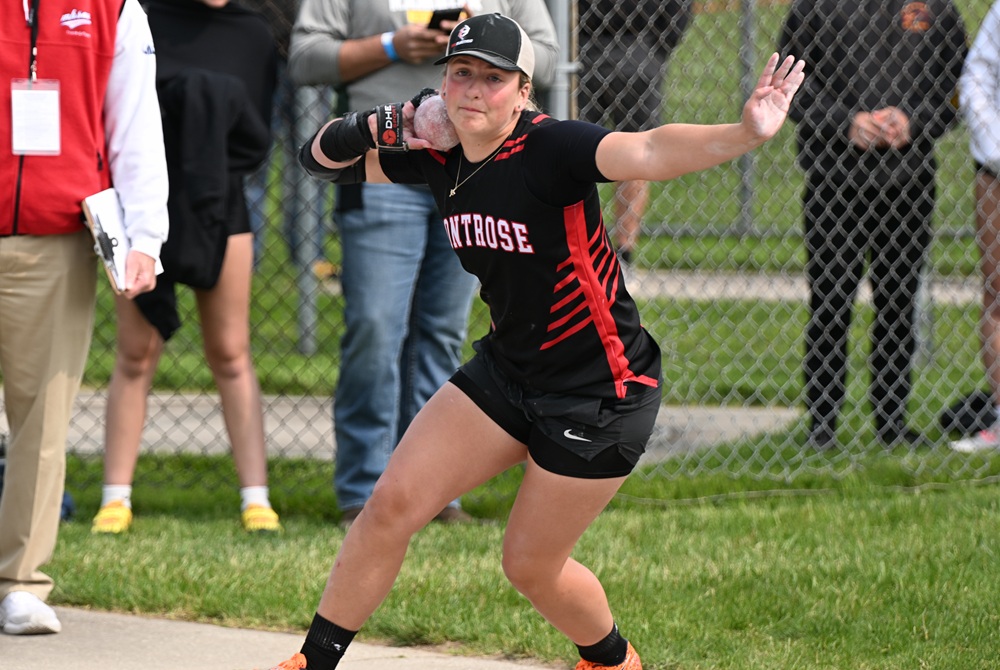
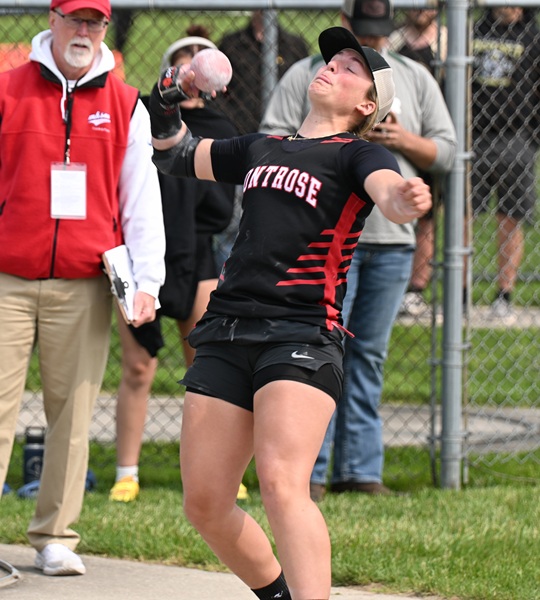
PHOTOS Montrose's Addyson Stiverson competes in the shot put at last season’s LPD3 Finals. (Photos by Mary Wilson/RunMichigan.com.)
Memorable Debut Ignites Massey's Inspiring Impact on Adaptive Athletics
By
Scott Hassinger
Special for MHSAA.com
May 7, 2025
STURGIS – Very few high school track & field athletes have an opportunity to finish their freshman seasons the way Sturgis' Vivian Massey did last spring.
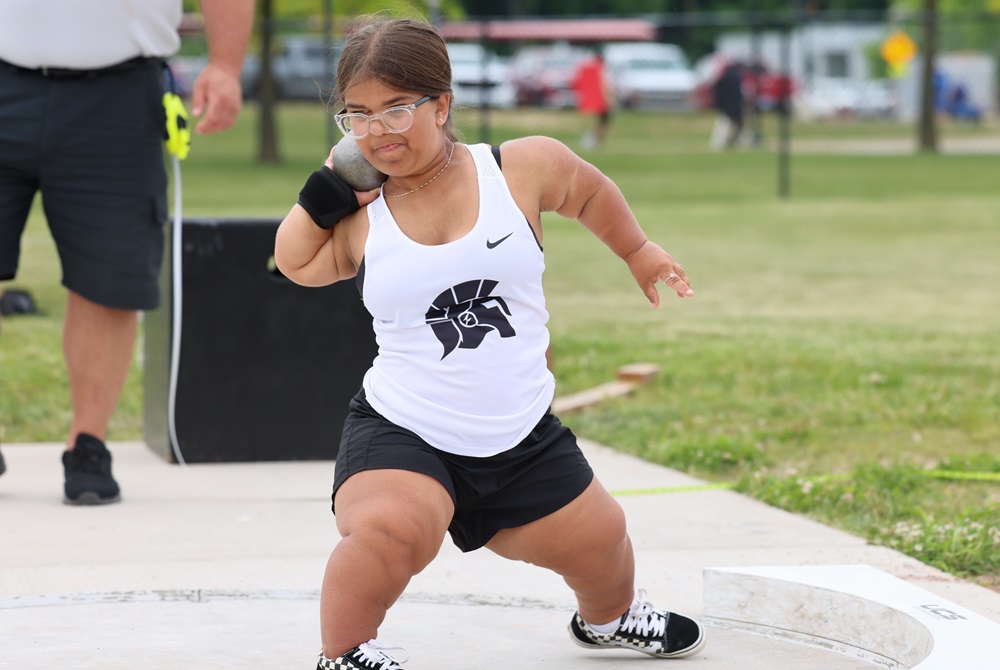
 Massey, now a sophomore, won the adaptive shot put championship last spring at the Lower Peninsula Division 1 Finals at East Kentwood. She took first with a personal-best and Finals-record throw of 12 foot, 7 inches, using a 4-kilogram (8.82-pound) ball).
"Getting a state record throw is really cool, but being able to show others that something like that is possible for an adaptive athlete is even better," Massey said.
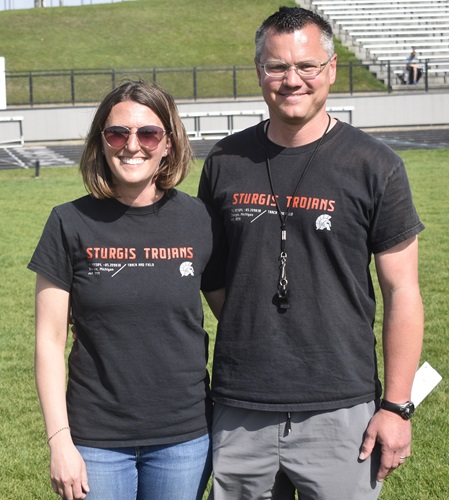
Sturgis has been one of the pioneer programs in the state as participation by adaptive athletes increases in the sport. The Trojans are led by the husband and wife duo of JB and Lesley Starkey; JB serves as Sturgis' head boys coach, while Lesley guides the girls team.
Former Sturgis athlete Jillian Romanyk, a 2023 graduate, won LP Division 2 Finals titles her senior year in the shot put (13-7) and 100-meter dash (30.53) competing in a wheelchair.
Massey has the condition achondroplasia, a genetic disorder that causes the most common form of dwarfism. It affects the growth plates in bones, resulting in abnormal bone growth and shortened limbs.
"I used to play soccer up until I was in fifth or sixth grade. But by then everyone became taller and faster than me, so I just stopped. I thought I was done competing in sports then,” said Massey, who hopes to one day study forensic psychology in college. “It just feels really good to still be able to compete. Our track family here at Sturgis is really close, and we are all there for each other. Eventually I'd like to try throwing the discus as well. I'd like to throw in college, but who knows if that will happen or not."
Vivian grew up around track & field. Her older sister Hannah, a 2020 Sturgis graduate, and brother Alex (2024) were both throwers for the Trojans.
"When I was in eighth grade I started throwing with them during the indoor season and continued with it into high school. It just seemed like a good fit for me," Vivian explained.
 There were a few adjustments Massey had to make when she began competing in outdoor track her freshman year, but having her older brother in the Sturgis program with her was an immense help.
"The experience of competing wasn't that new to me when I reached high school, but the outdoor season took a little getting used to. Having my brother and a few of his friends right there to help me was very helpful," she said.
Massey excelled and qualified for the Finals as a freshman after winning her Regional competition.
"It was a very cool experience and a lot of fun qualifying for and winning state. It's still kind of a shock to me when I pause a minute and think about what I accomplished that day. I never expected to win state," Massey said.
She is looking forward to another strong finish this season.
"I really want to get first at Regionals and qualify for state again and hopefully keep improving my performance," Massey said. "The biggest thing I'm working on right now is to not get so nervous and inside my own head. I like to listen to music to help keep me calm before I throw. It helps me focus and block out everything else that's going on around me."
Lesley Starkey, a Title I elementary teacher at Congress School in Sturgis, feels Massey's involvement will have a far-reaching effect on the track & field program and with others long after she graduates.
"Just from a general athlete and seeing what Vivian does is amazing. What she doesn't realize is how impactful she's going to be down the road,” Starkey said. “I have a student at Congress with only one arm. She could be one of our next adaptive athletes, and I'd love to have her come out for our team. So helping other athletes see that they have an opportunity to compete in the adaptive category like Vivian does is huge in the long term. Just by her work ethic and coming out here and competing when it can sometimes be intimidating, is a big contribution to our program and others around the state during her four years here and beyond as well."
Massey’s participation has inspired opposing athletes as well.
"JB and I were at a meet last season in Quincy. Vivian wasn't competing, but Athens had a blind athlete and their coaches weren't even aware that the adaptive category existed at the state level. We spoke with them and told them to make sure she went on to compete at the Regional and the state level,” Starkey said.
“Right now there are four events that adaptive athletes can compete in. They are the 100-meter, 200-meter and 400-meter dashes, and the shot put. The girl from Athens was able to do that and she became a multi-state champion in Division 4."
Massey’s personal-best in the shot put during the indoor season is 15 feet, 3 inches, using a 2 kilogram (4.41 pound) ball.
 JB Starkey, a physical education teacher at Sturgis High School, credits her commitment to a weight training program for helping her increase her strength and consistency this season.
"I learn lessons in the weight room every day. I make mistakes with things that Vivian can't do. I'm the one that has to make adjustments so we are making adaptions with her weight training, shot put throwing and even our physical education classes to service her the best that we can,” he said. “She's very flexible and understanding of our mistakes. We're learning over time and getting much better about it.”
Massey had to overcome several physical challenges before she was able to throw effectively.
"So with achondroplasia, I have little or no cartilage in my joints. For example, I can write an essay but it would take more time for me than it would other kids because I'd have to take breaks and let my wrists rest,” Massey said. “I wear a wrist strap in the shot put that helps stabilize my wrist when I'm throwing. I also use J-Hooks to help with my grip when weightlifting in doing reps with the bar. I'm strong enough to hold and do the motion, but my hands can't hold onto the weight.”
Kelly Massey, Vivian's mother, stated that her daughter's condition has never deterred her from accomplishing daily tasks or continuing her athletic career.
"Vivian has to figure out a different way to do everything she does in life, like reaching the kitchen cabinets. Everything is a struggle, but she just makes it happen,” Kelly Massey said. “She started in soccer and we thought her sports career was over, but the Starkeys have done a great job keeping her involved and giving her all the opportunities they possibly can. They truly love this sport, and they will do whatever it takes to get kids participating.”
Alex Massey remembers how Vivian became involved in throwing as an eighth grader.
"During the offseason, a small group of us throwers would come up to the school and throw, and Vivian started coming up there with us. She fell in love with it, and the Starkeys have been with her all the way. Being able to work with her some I think helped keep her motivated," Alex Massey said.
"It was pretty emotional to see Vivian up there throwing at the state meet. She holds herself to a very high standard, and it’s just amazing to see the door that she's opened for other athletes."
 Scott Hassinger is a contributing sportswriter for Leader Publications and previously served as the sports editor for the Three Rivers Commercial-News from 1994-2022. He can be reached at [email protected] with story ideas for Berrien, Cass, St. Joseph and Branch counties.
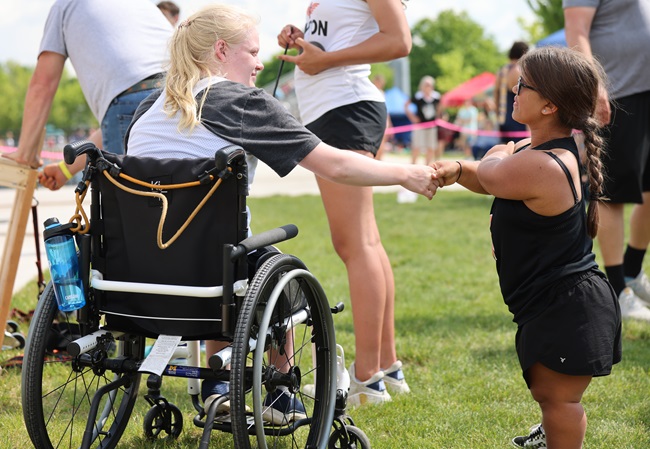
PHOTOS (Top) Vivian Massey competes in the adaptive shot put during last season’s Lower Peninsula Division 1 Finals. (Middle) Sturgis High School track & field coaches Leslie and JB Starkey stand for a photo during a Trojans' practice last week. (Below) Massey, right, receives congratulations from Fenton’s Molly Katic, left in wheelchair, following last year’s Finals shot put competition at East Kentwood. (Finals photos provided by JB Starkey. Coaches photo by Scott Hassinger.)