

Preview: Jokela's Final Lap Leading Way, but Many More Stars Also Ready to Shine
By
Geoff Kimmerly
MHSAA.com senior editor
May 29, 2025
Spectators and competitors will get one more opportunity to watch Lake Linden-Hubbell 10-time champion Emily Jokela at Saturday’s Upper Peninsula Girls track & Field Finals – but also should keep an eye on several more standouts at Kingsford High School, including a few just getting started on potentially magnificent careers.
Jokela will seek to add to her career collection and also lead her team to a third-straight championship in Division 3. But champions from a combined 19 individual events in 2024 will be back this weekend, plus a group of freshman sprinters who are sure to make noise as we head into the second half of this decade.
All three divisions will be hosted by Kingsford High School, with preliminaries leading off the day at 9 a.m. local (Central) time. Tickets cost $11 and are available digitally only via GoFan.
MHSAA.tv will live-stream the meets beginning at 9 a.m. (CDT)/10 a.m. (EDT), viewable with subscription. Check out the Girls Track & Field page for meet information and lists of all qualifiers. Those described as "seeded" below have received those seeds based on Regional performances or early qualification during the regular season.
Following is a glance at team contenders and individuals to watch in all three divisions:
Division 1
Team forecast: Sault Ste. Marie last spring became the third school in three seasons to win the Division 1 title, following Marquette in 2023 and Negaunee in 2022. Marquette and Negaunee won the two Division 1 Regionals earlier this month, but Gladstone – third last season – could make a push to become a fourth different champion in four seasons with favorites across several running events and potential field-event points especially in pole vault.
Ella Bracket, Gladstone freshman: Along with senior teammate Lauren Sundquist, Bracket gives Gladstone potential dominance in sprints with the top seed times in the 200 (26.89) and 400 (1:02.08) and running with Sundquist as part of the top-seeded 400 (52.56) and 800 (1:52.96) relays.
Ella Fure, Marquette junior: Last season’s champion in the 1,600 and runner-up in the 3,200 is top-seeded in the 3,200 (11:57.24), third in the 1,600 (5:33.35) and will again run the 800 after finishing seventh in that race last spring.
Maija Maki-Warne, Marquette senior: She could finish her career in a big way after running on two third-place relays at last year’s Finals. Maki-Warne is seeded first in the 1,600 (5:25.82) and 800 (2:27.69) and second in the 3,200 (11:59.25), and will run on the top-seeded 1,600 relay (4:18.06).
Tessa Rautiola, Houghton junior: The reigning 3,200 champion also finished second in the 1,600 and ran on the winning 3,200 relay last season. She’s seeded fourth in both the 3,200 (12:48.67) and 1,600 (5:35.47), seventh in the 800 and will run on the top-seeded 3,200 relay (10:52.72).
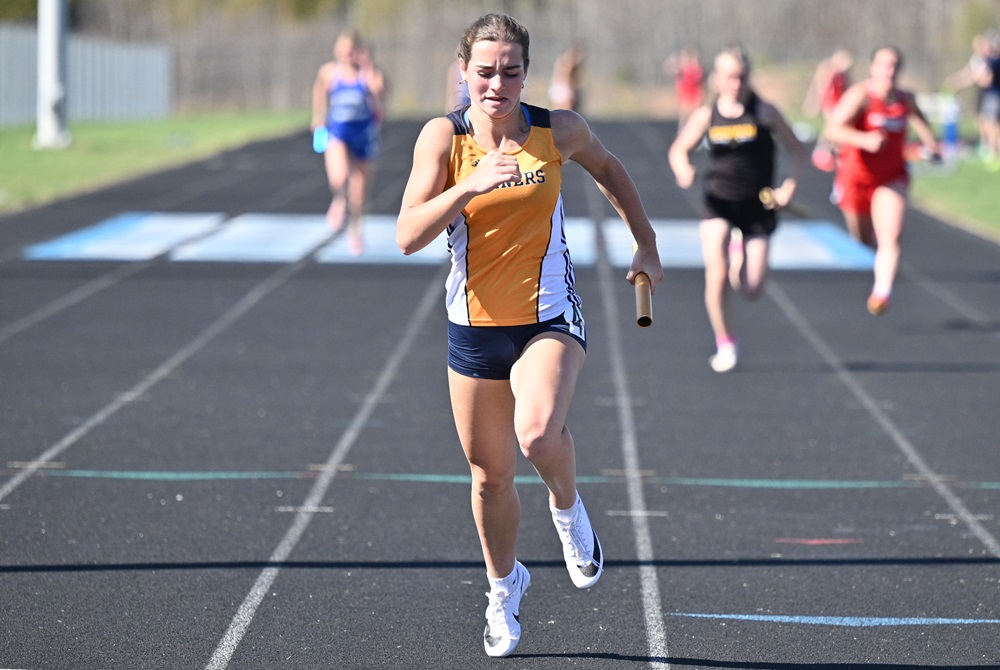
Sadie Rogers, Negaunee sophomore: She made her Finals debut last season with a championship in the 100 hurdles and runner-up finish in the 300, and she’s seeded first in both the 100 hurdles (16.62) and 300 hurdles (48.13), fourth in the 200 (27.68) and will run on the third-seeded 400 relay.
Keira Waterman, Negaunee sophomore: She’s also coming back off a championship debut after winning the 400, 800, finishing second in the 200 and fourth in the 100 in 2024. She’s seeded second in the 400 (1:02.52), sixth in the 800, will long jump and run on the 1,600 relay this weekend.
Division 2
Team forecast: Bark River-Harris has won the last three Division 2 championships, but the Broncos finished only third at their Regional behind champion Pickford and runner-up Munising. Pickford ranks third all-time with 14 U.P. Finals titles but is seeking its first since 2007. West Iron County won the Division 2 title in 2021 and finished runner-up in both 2022 and 2024, and should be in the mix again after edging Ironwood to win the other Regional in this division two weeks ago.
Lauren Adams, Norway junior: She’s seeded first in the 100 (13.97), 200 (29.02) and 400 (1:05.85) and will run on the third-seeded 400 relay. She finished fourth in the 100 and 200 and third in the 400 in Division 3 as a sophomore.
Mira Johnson, Bark River-Harris sophomore: She won the pole vault and ran on two championship relays to cap an impressive freshman season, and she’s back as the top seed in the pole vault (7-6) and running on the 1,600 relay.
Talya Schreiber, Pickford junior: The reigning champion in the 1,600 and 3,200 and runner-up in the 800 could double her career haul. She’s seeded first in the 1,600 (5:33.10) and 3,200 (11:48.82), third in then 800 (2:36.22) and will run on the top-seeded 3,200 relay (11:16.56).
Bristol Shamion, West Iron County freshman: The Shamion family has dominated U.P. track this decade, and Bristol will join junior sister Lacey Shamion among the team’s likely scorers Saturday. Bristol enters her first Finals seeded first in the high jump (5-0) and 300 hurdles (51.64) and second in the 100 hurdles (18.05) and 200 (29.12).
Emma Wardon, Ironwood junior: The reigning shot put champ and fifth-place finisher in discus is seeded first in shot put (33-11) and second in discus (89-3½) this time.
Division 3
Team forecast: Lake Linden-Hubbell has won the last two championships, sharing with Stephenson in 2023 and winning outright last season. Both were among Regional champions earlier this month, along with Rapid River and Newberry – with Newberry coming off last year’s runner-up Finals finish and potentially possessing the running firepower to pull away for a first Finals title since 2015.
Destiny Bleau, Big Bay de Noc freshman: She won the 200, finished second in the 100 and third in the high jump as an eighth grader, and returns as the top seed in the 200 (26.49), sixth in the 100 and seventh in the high jump.
Faith Cappaert, Stephenson junior: The reigning champion in the 800 also finished third in the 1,600, fifth in the 400 and ran on a runner-up relay last year. She’s back as the fifth seed in all three open races and running on the second-seeded 3,200 relay.
Ava Fischer, Crystal Falls Forest Park junior: She was another big scorer last season winning the 100 hurdles, finishing second in the 300 hurdles, fifth in the pole vault and running on a runner-up relay. She’s seeded second in the 100 hurdles (16.92) and also will compete in the pole vault, 300 and 1,600 relay.
Kiera Isaacson, Dollar Bay junior: Last season’s high jump champion is top-seeded (5-3) in that event and will again run two relays.
Emily Jokela, Lake Linden-Hubbell senior: She’s finishing up a legendary career as one of seven athletes to win four individual events at a Finals, which she did in 2023 before adding titles in the 100, 400 and 300 hurdles last season and a runner-up finish in the 200. She’s seeded first in the 100 hurdles (16.56), second in the 300 hurdles (49.22) and 100 dash (13.05), and fourth in the 400.
Mariska Laurila, Carney-Nadeau senior: She’s won the discus the last two seasons, added a shot put title last year and also finished third in the long jump. She’ll compete in all three again, with the top seed in the discus (105-11) and third seed in the shot put (31-10).
Samantha Taylor, Newberry junior: She’s the reigning champion in the 1,600 and as part of the 3,200 relay, and top-seeded this weekend in the 1,600 (5:14.06) and 3,200 (11:21.07) while potentially running on the top-seeded 1,600 (4:28.60) and 3,200 (10:51.53) relays.
PHOTO Negaunee's Sadie Rogers carries the baton across the finish line to give her team a win in the 800 relay at the Marquette County Meet earlier this month. (Photo by Cara Kamps.)
Ironwood Savors Home-Track Advantage in LaBlonde Memorial Invitational Sweep
By
John Vrancic
Special for MHSAA.com
May 15, 2025
IRONWOOD — Most high school tracks have at least six lanes and are 400 meters.
 But there’s an exception to every rule.
That’s the case at Ironwood, where the Red Devils run on a 350-meter, five-lane asphalt surface.
“That’s something we’ve addressed,” Ironwood coach Cecilia Aho said “We’re probably the last ones who have a track this small, although the distances are the same. When we do mile repeats the kids don’t like it, but it’s better than not having a track. We make it work. Some of the smaller schools don’t have a track.”
Both Ironwood teams retained their titles Saturday afternoon at the Jim LaBlonde Memorial Invitational at Longyear Field, with the boys scoring 74 points to stay ahead of Hurley, Wis., at 57, and the Ironwood girls collecting 104 points to pull away from the field.
“The kids come here and have fun,” Aho said. “We have a nice group of kids who are working real hard.”
Ironwood junior Talon Hughes, who had a hand in four meet records, said the smaller track provides some challenges.
“It’s a pretty unique track,” he added. “We have different lanes and it’s hard to switch lanes. It can be intimidating for visiting teams. It’s sometimes hard for them to adapt, although we get used to it through practice. The biggest adjustment for us on 400-meter tracks is they have longer straightaways.”
Hughes won the 100-meter dash in 11.74 seconds and also took first in the 200 (24.42), 110 hurdles (16.84) and helped the Red Devils take the 800 relay (1:40.37).
“It’s a great feeling to win at home,” he said. “Many of your friends are here to cheer you on. We’re looking forward to our last few meets.”
The different exchange zones appeared to affect the Bessemer girls 800 relay the most. After a fast start, the Speedgirls struggled with all three handoffs, dropping them to third place (2:06.05), fewer than two seconds behind the winning team from Ironwood.
“I think it has a mental block on you,” Bessemer sophomore Sarah Hoffenberg said. “It really depends on the person. In my opinion, I think it helps if you don’t think about it. It’s really a learning experience.”
Hoffenberg later helped the Speedgirls bounce back with a victory in the 400 relay (1:01.38).
Ironwood senior Aubrey Smith, who will be attending classes at University of Michigan this fall, said it’s like having a homecourt advantage.
“It’s a little confusing,” she added. “It’s a little less than 4½ laps for a mile. It’s hard to tell where everyone is.”
Smith dominated the distances, taking the 800 (2:38.84), 1,600 (5:59.53) and 3,200 (11:58.87).
The Red Devils also ran in Wednesday’s Upper Peninsula Division 2 Regional at West Iron County, the boys team winning and the girls finishing runner-up to the host Wykons. Ironwood travels to Lake Linden-Hubbell for the Copper Mountain Conference meet Monday before ending the season at the Upper Peninsula Finals on May 31 at Kingsford.
“Our seniors are looking forward to their last couple meets,” Aho said. “I’m going to miss them. Our school is 100 years old. We started celebrating our centennial last July. We’re in the process of finishing up our celebration.”
 John Vrancic has covered high school sports in the Upper Peninsula since joining the Escanaba Daily Press staff in 1985. He is known most prominently across the peninsula for his extensive coverage of cross country and track & field that frequently appears in newspapers from the Wisconsin border to Lake Huron. He received the James Trethewey Award for Distinguished Service in 2015 from the Upper Peninsula Sportswriters and Sportscasters Association.
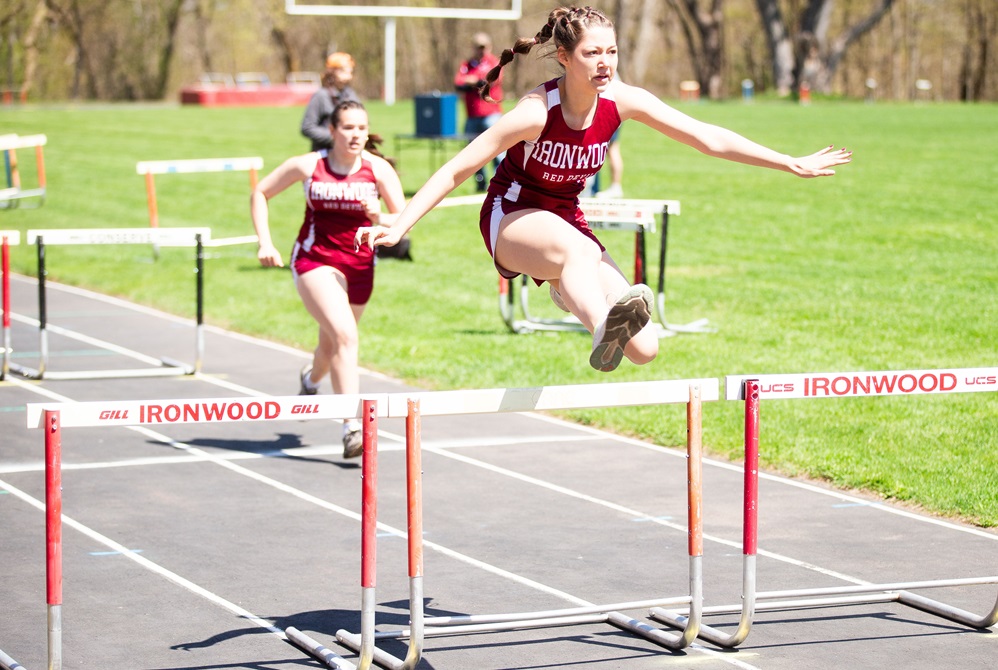
PHOTO Skyla Ballew clears a hurdle during a race at Ironwood High School. (Photo by Jason Juno/Ironwood Daily Globe.)