

Tales of the Tape: Track & Field Finals
June 3, 2014
By Geoff Kimmerly
Second Half editor
Broadcasts of all seven MHSAA Track and Field Finals from Saturday are now available free of charge on MHSAA.TV.
Also, check out below the highlight reel including some of the most notable performances, including the following:
- Lindsay Rudden of Marquette becoming the first girl to break the 5-minute mark in the 1,600-meter run at the Upper Peninsula Finals.
- Great duals in the 200-meter dash between Sekayi Bracey of East Kentwood and Anna Jefferson of Oak Park in LP Division 1, and Joshuwa Holloman of Auburn Hills Avondale and Danny Bauder of Zeeland West and Josie Yesmunt of DeWitt and Taylor Manson of Lansing Waverly, both in LP Division 2.
- Final lap kicks by Grant Fisher of Grand Blanc to win the 3,200-meter run and Karrigan Smith of St. Johns score a record-setting win in the 1,600.
- Record-setting performances by Nolen Bright-Mitchell of Concord, Michelle Davis of Reading and Angie Ritter of Frankenmuth in the sprints and hurdles.
- A photo finish win for Munising’s Andy Cooper in the 110-meter hurdles, one of his four victories on the day in UP Division 3.
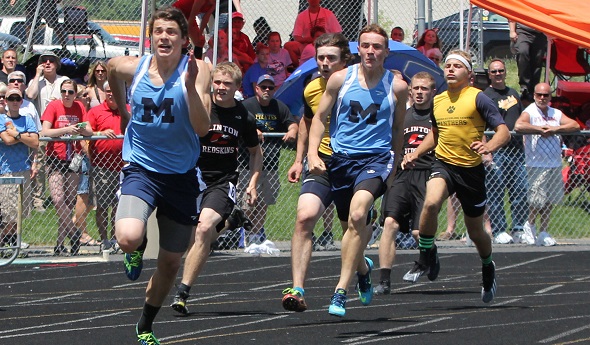
PHOTO: Sanford Meridian relay runners complete a handoff during Saturday's Lower Peninsula Division 3 Finals at Comstock Park. (Click to see more from RunMichigan.com.)
Performance of the Week: East Kentwood's De-Mani Roberts
May 28, 2026
 De-Mani Roberts ♦ East Kentwood
Sophomore ♦ Track
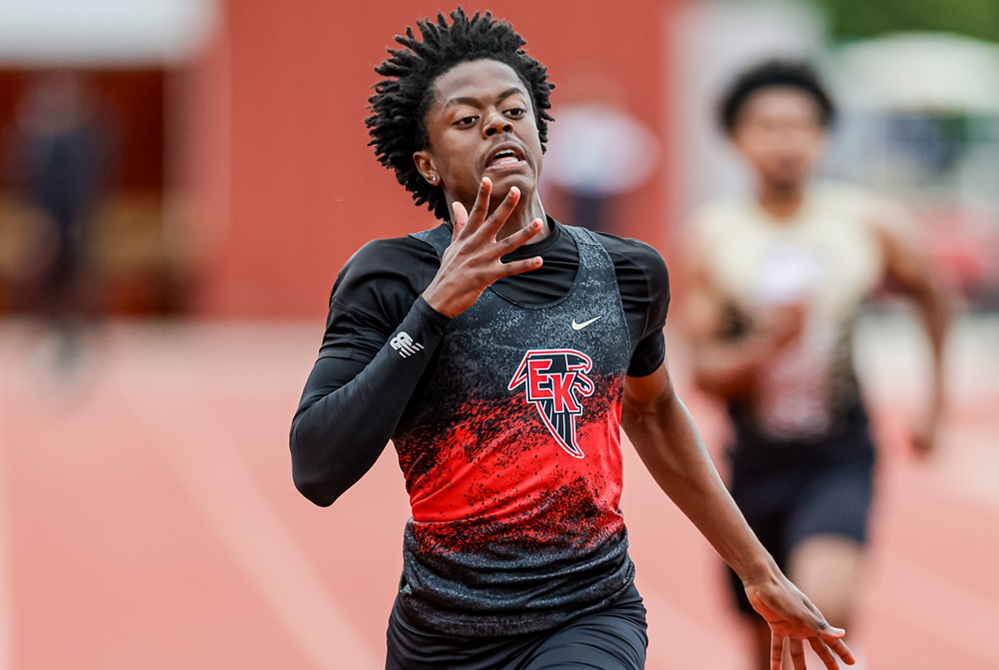
Roberts has made impressive strides in the second season of high school outdoor track, cutting nearly a half-second off his top 200-meter time from a year ago and more than a second off his freshman-year best in the 400 in helping East Kentwood become a favorite to win the team championship at Saturday's Lower Peninsula Division 1 Finals. Roberts won the 200 in a personal-best 21.26 seconds and ran on the winning 800 relay (1:26.83) as the Falcons won the Michigan Interscholastic Track Coaches Association (MITCA) Division 1 team championship last weekend.
That 200 time and his top 400 time of 47.55 seconds are both the fastest in the state in those respective races this spring, all divisions included. Roberts is undefeated in both races, a notable jump even as he finished 14th in the 200 and ran on three top-12 relays at last year's MHSAA Finals. That top 200 time also trails the current LPD1 Finals record by only 25 hundredths of a second, and he could make a run at Finals records in both individual races with half his high school career remaining. Roberts also has run cross country for East Kentwood the last two seasons.
@mhsaasports 🏃POW: De-Mani Roberts #eastkentwood #track #highschoolsports #performanceoftheweek #MHSAA ♬ Bright and fun upbeat pops, Kids, Animals, Pets, Fun, Cute, Happy, Playful, Upbeat(1465232) - SAKUMAMATATA
@mhsaasports 🏃POW: De-Mani Roberts #funfacts #tiktalk #performanceoftheweek #highschoolsports #MHSAA ♬ Girly and cute synth pop - SAKUMAMATATA
Follow the MHSAA on TikTok.
MHSAA.com's "Performance of the Week" features are powered by MI Student Aid, a division within the Department of Lifelong Education, Advancement, and Potential (MiLEAP). MI Student Aid encourages students to pursue postsecondary education by providing access to student financial resources and information. MI Student Aid administers the state’s 529 college savings programs (MET/MESP), as well as scholarship and grant programs that help make college Accessible, Affordable and Attainable for you. Connect with MI Student Aid at www.michigan.gov/mistudentaid and find more information on Facebook and X @mistudentaid.
Previous 2025-26 honorees
May 22: Taleon Guess, Temperance Bedford golf - Report
May 15: Zacchaeus Brocks, Detroit Catholic Central track - Report
May 7: Savanah Thompson, Howard City Tri County soccer - Report
April 30: Eliza Schwass, Ludington track - Report
April 23: Emily Postema, Ravenna softball - Report
April 16: Katie Berkshire, Gaylord track - Report
March 26: Kayla Hairston, Goodrich basketball - Report
March 19: Liam Smith, Otsego swimming - Report
March 12: Jack Sayen, Houghton hockey - Report
March 5: Devin Patrick, St. Clair Shores Lake Shore - Report
Feb. 26: Madison Nieuwenhuis, Plainwell wrestling - Report
Feb. 20: Sophie Ramey, Allen Park competitive cheer - Report
Feb. 13: Cam Ryans, Grand Rapids Northview basketball - Report
Feb. 6: Melanie Kolnitys, Midland Dow basketball - Report
Jan. 29: Stella Musialowski, Huron Valley United gymnastics - Report
Jan. 22: Baylor Perkins, Grand Blanc swimming - Report
Jan. 15: Delaney Vanier, Flint Kearsley bowling - Report
Jan. 8: Stevie Hall, Detroit Cass Tech basketball - Report
Dec. 18: Ethan Martha, Ishpeming Westwood basketball - Report
Dec. 11: Louis Smith, Three Rivers wrestling - Report
Dec. 4: Traverse Moore, DeWitt football - Report
Nov. 28: Elizabeth Eichbrecht, West Bloomfield swimming - Report
Nov. 20: Brady Kieff, Blanchard Montabella football - Report
Nov. 13: Ella Laupp, Battle Creek Harper Creek swimming - Report
Nov. 7: Hunter Eaton, Charlevoix cross country - Report
Oct. 31: Stephen Gollapalli, Lansing Christian tennis - Report
Oct. 23: Talya Schreiber, Pickford cross country - Report
Oct. 16: Avery Manning, Dexter golf - Report
Oct. 9: Brady Van Laecke, Hudsonville football - Report
Oct. 2: Sarah Giroux, Flat Rock volleyball - Report
Sept. 25: Sam Schumacher, Portage Central tennis - Report
Sept. 18: Kaylee Mitzel, Saline field hockey - Report
Sept. 11: Natasza Dudek, Ann Arbor Pioneer cross country - Report
Sept. 4: Kate Posey, Big Rapids golf - Report
PHOTO East Kentwood's De-Mani Roberts runs to a win in the 200 meters at the MITCA Division 1 championship meet. (Photo by Miles Postema.)