

Track Gaining Speed Toward Future with Electronic Starting Devices
By
Steve Vedder
Special for MHSAA.com
May 23, 2023
Aubrey Greenfield thinks it might be the perfect time to reevaluate 130 years of tradition.
For a number of reasons, from technical to personal, the Oxford senior sprinter believes it makes sense for the crack of a starting pistol to be eliminated from high school track meets.
Because track meets would benefit in various ways from lowering costs to easier setup at meets to the human factor of competitors not having to flinch at the crack of a pistol shot, Greenfield believes the sport has a chance to embrace new technology – electronic starting devices (ESD).
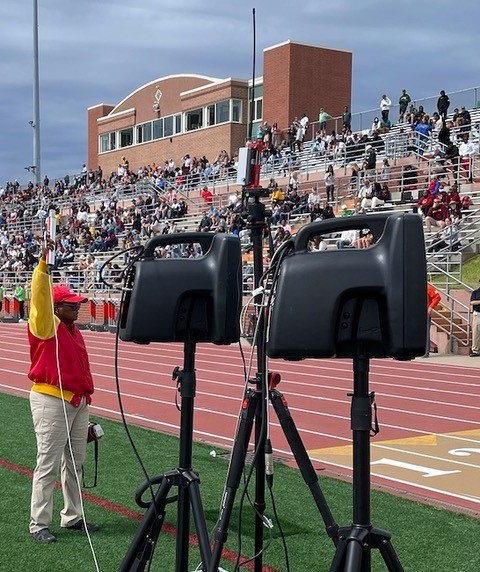
In essence, an ESD replaces the starting pistol with a light flash, tone sound or both to begin a race.
"High school sports should put the athlete first," Greenfield said. "We should promote sports, and eliminating starting pistols promotes health in terms of PTSD or trauma for athletes and spectators and that would be good. I would like to think people would say that's a good idea."
In fact, Greenfield would go as far as to say if there was not an implementation of electronic starting devices, many of her teammates would have considered giving up the sport.
"If it's something that helps us compete safely, we're all for it," she said.
Greenfield's opinion apparently is spreading. Michigan High School Athletic Association senior assistant director Cody Inglis said the use of ESD makes it both affordable for meet starters and sensible for athletes and fans to rethink the use of starting pistols. While the MHSAA is not mandating electronic starting devices, it does promote the use of what Inglis calls "emerging technology." He notes that ESD are becoming the norm for organizations such as USA Track & Field, the NCAA and an increasing number of high schools.
 "I think we have to embrace new technology, and we think this will be something that takes hold," Inglis said.
A key part of embracing ESD is the human element. The tragic Oxford High School shooting Nov. 30, 2021, that took the lives of four students while injuring seven others should not be relived even for a fleeting instance at a high school sporting event. Oxford athletic director Tony DeMare said the school began using ESD at every meet, including the MHSAA Lower Peninsula Division 1 Finals last June. He said that decision was embraced by virtually all schools Oxford encountered.
"We were very convinced that the alternative (of ESD) would promote a healthy attitude," DeMare said. "We were overwhelmed with the positive response. If a school was on the fence about it or might not be for it, I think we've started to see the tide turn in favor of people willing to listen and learn about electronic starting devices."
Inglis said the MHSAA is acutely aware of what the crack of a starting pistol can mean to athletes and fans.
"It's unimaginable what Oxford went through, and this is a small way we can help," he said. "We look at a (starting pistol) and think, ‘Could we do something else?’ It's a way of helping to solve a problem."
Over the last several years, the MHSAA has embraced finding an alternative to starting pistols. Inglis noted the discussion started with the cost and diminishing availability of 32-caliber ammunition that meet starters use. A box of ammunition, if it can be found, is around $75 a box.
In addition to cost, there is potential damage from excessive exposure to 150-plus decibels of sound generated by the traditional 32-caliber blanks. Medical studies show damage to ears caused by decibel levels above 120 dB.
The tragedy at Oxford accelerated the conversation.
Inglis said the cost of ESD can be likened to a school sinking money into artificial surfaces at football fields. Yes, there is a great cost at first, but over time money is ultimately saved. An ESD system itself ranges between $200 and $500. Speakers also may need to be purchased, but with ESD starting events like the 800 and 1,600-meter relays positioned near the outside lanes 8, 7, 6 and 5 would result in improved hearing by athletes at the start of a race.
There is one challenge with ESD that track administrators are working to overcome – lighting conditions that lessen the ability to see the ESD’s LED light or strobe when the button is pressed by a starter to begin a race. But that vision difficulty resulting from clear blue skies and backgrounds of setting suns can be substantially improved by incorporating a black background with an ESD – something as simple as a starter holding up black cardboard behind the lighting mechanism at the start of an event.
Inglis said when all factors are considered, the use of ESD makes sense.
 "With the climate we live in nowadays, no lookalike guns is good," he said. "We're not mandating this. But people are saying this is affordable."
While switching to ESD would break 130 years of tradition, the timing could be a step forward, said Jeff Hollobaugh, co-author of the book "The Fleet Feet of Spring: Michigan's High School State Championships in Track & Field." He said while no definitive answer is possible, it's likely starting pistols were used at the inaugural state meet at the Jackson Fairgounds in 1895. The meet, which included events like tossing a 16-pound shot put, bike races and a 100-meter sprint, was sponsored by the Michigan Interscholastic Athletic Association (a predecessor to the MHSAA) and comprised mostly of the state's larger schools.
Hollobaugh's sentiments echo what many involved in today's high school track & field believe in terms of making a transition from starting pistols to electronic starting devices.
"It's a change, not necessarily good or bad, just different," he said. "It's not a drastic change, but it will take some getting used to. But it is the future. In the end, we'll all be fine."
DeMare believes the future of high school track will definitely include ESD.
"Our desire is that the practicality and sensibility of this will overcome the alternative," he said. "I think we'll see the automation and electronics taking hold of certain elements in track, and people will embrace it."
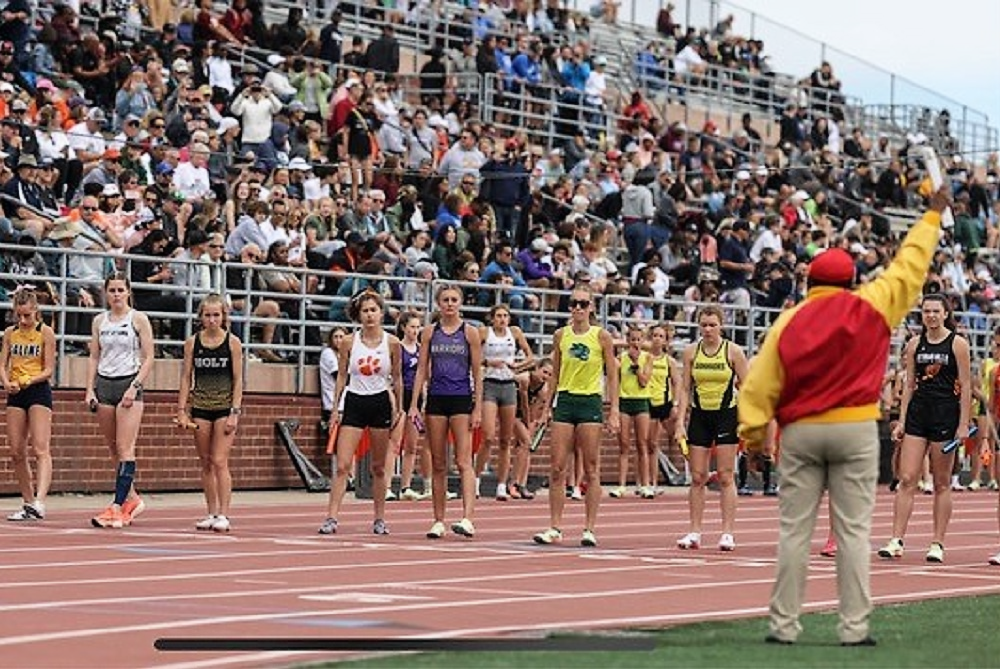
PHOTOS (Top) Runners watch official Bertha Smiley as they prepare to begin a race during last season's Lower Peninsula Division 1 Finals at Rockford. (Middle) An electronic starting device provided by VS Athletics was used to start those races. (Below) Smiley sets to begin an event. (Photos provided by David Kuderka/VS Athletics.)
TC Central's Zielinski Eying Finals Records, U-M Stardom, Olympic Aspirations
By
Tom Spencer
Special for MHSAA.com
May 29, 2026
Lorelai Zielinski may be on the verge of winning her second-straight MHSAA Finals championships in both the discus and shot put as she prepares to compete at Saturday’s Lower Peninsula Division 1 Track & Field Finals in Rockford.
 And, while being named a champion again would be an honor for the Traverse City Central junior star, she’s quick to put it in perspective.
“One thing that I always tell myself, the point of track & field is not to win — it’s all that hard work that you have done to build up to that point, and winning is just part of it all,” the University of Michigan commit said. “It's just the effect of everything that you do, and it definitely is a great accomplishment because it’s ‘states’ and some people's biggest meet of the year. Having state champion next to your name, especially more than once, and more than one event, is amazing.”
Zielinski won last year’s titles as a sophomore with throws of 46 feet, 11¾ inches in the shot put and 155-1 in the discus. She has dominated the competition so much the last couple years that local media often report her success as a winning “by a long way again.”
Her personal records, both set this spring, are 52-6 in the shot put and 168-5 in the discus. Both would set MHSAA Finals records for all divisions if she replicates them Saturday.
To Paul Anderson, Central’s head coach, Zielinski is in a category all by herself. Anderson has been around high school track in New Mexico and Michigan for 30 years. He’s coached a couple of nationally recognized names over the years, but noted Zielinski really stands out.
At Central, Anderson also coached recent Stanford graduate Julia Flynn, who made national headlines when she became the first prep girl during the 2020 season to run a 5K faster than 17 minutes. In New Mexico at Los Alamos High School, Anderson coached Chase Jackson (then Chase Ealey), currently a dominant global force in track & field. Jackson made history as the first American woman to win a shot put world title, claiming outdoor gold in 2022 and 2023.
“Lorelai is a thrower, a strong woman, and is just a great person,” Anderson said. “She is probably one of the highest-rated high school athletes that I've ever coached. It’s not just her consistency, but dominance.”
During Zielinski’s early days in the sport she was coached by her mother, Amanda. Lorelai competed in shot put as a sixth grader for Traverse City East Middle School.
Zielinski, who remains the sixth, seventh and eighth-grade record-holder at East, started exploring throwing discus the summer after seventh grade.
“Lorelai started learning about and following the sport very early, but not obsessively,” Anderson said. “She loves it — but it's not owning her — it doesn't mean that’s who she is. It’s like, ‘This is what I do, and I'm not going to be like anybody else.’ Everybody talks about what a good person she is and then being an athlete — then being a thrower — gives a nice dimension.”
Zielinski has high hopes for success in college sports and quite possibly, and most likely, as onlookers say, for the national team someday.
She has her eyes on the throwing qualifying standards for the 2028 U.S. Olympic Trials, and she realizes 2032 might be a more obtainable goal. She’s planning to focus on shot put and discus while exploring the javelin, hammer and weight throws while competing for the Wolverines and pursuing studies in physical therapy or audiology.
 But for now, she is celebrating having an impact on young female athletes. She recalls her younger sports days looking up to basketball and track athletes, including current teammates.
“Obviously, track is about performing and all that, but I wanted to be able to be a role model for these younger girls,” said Zielinski, who also plays basketball for the Trojans. “I wanted to be able to inspire younger girls. It's definitely a great feeling that other people look to me for inspiration.”
Zielinski is a recognized figure around middle school and elementary track meets as she volunteers to help with events including shot put. She’s enjoyed watching anecdotal evidence of growth in the sport’s numbers and talent as well as in the presence of high school coaches helping out middle school throwers in particular.
As further evidence of Zielinski’s impact, earlier this week Traverse City kids swept the shot put podium at the MHSAA Middle School Regional in Cadillac. West’s Anna Hornacek, the school’s sixth, seventh and eighth-grade record-holder, took first with a 40-2 throw. East’s Delaney Neveau, a sixth grader, was second at 33-5, and West’s Eilley Dwyer, the second-leading sixth and seventh-grade thrower all-time, was third at 32-11.
Zielinski and Anderson are thrilled to have field events coach Chad Norton guiding her success. Zielinski especially appreciates Norton’s constant reminders that “practice doesn’t make perfection – practice makes progress.”
Norton’s been especially helpful with the mental aspects of throwing, something with which Zielinski admits she has often struggled.
“One thing Coach Doug always tells me is to breathe and have fun,” she said. “Getting in my head or setting my standards too high, I won't be having fun, and the point of it is to have fun.”
Anderson, now in his 10th year at the helm of the Trojans’ track program, is quick to point out the pride Norton has in Zielinski’s success. Anderson also points to the development of freshman thrower Nora Jensen, who already has found success under Zielinski’s mentorship.
“Doug avoids the spotlight and he’s very much honed into knowing what he had with Lorelai and his responsibility,” Anderson said. “I love Chad as a coach, because not only does he work with Lorelai, but then he takes as much time, or more, with the new shot putters. It's a great community that he has going there.”
Zielinski, who is hoping to have Norton train with her over the summer and next winter, has her freshman year MHSAA Finals in the back of her mind as she prepares for this year’s meet.
She finished second in both shot put and discus two years ago to then senior Abigail Russell of Allen Park. But she’s since exceeded Russell’s distances as she looks to become a teammate to Russell at Michigan.
Zielinski bettered Russell’s distances, in fact, at this year’s Regional Meet in Mount Pleasant. The Trojan stellar throw topped the 50-foot mark in the shot put and exceeded 161 feet in the discus.
Expect Zielinski to be wearing her trademark different-colored shoes again at the Finals. She’s worn two colors since entering high school, and this time she’ll be sporting a new pair of yellow and orange Nikes. She introduced them this week at the Traverse City Record-Eagle Honor Roll Meet.
Zielinski must replace the shoes during the season because she wears out the bottom of her right one.
“So I buy two pair of shoes for that reason, as well as my freshman year when I started doing it I felt a little bit superstitious. So I always have different-colored shoes as a tradition,” Zielinski said. “I also write different affirmations on each of my shoes such as ‘Have fun,’ ‘Breathe,’ ‘Control,’ and ‘Be the one thing in life you can control.’”
 Tom Spencer is a longtime MHSAA-registered basketball and soccer official, and former softball and baseball official, and he also has coached in the northern Lower Peninsula area. He previously has written for the Saginaw News, Bay County Sports Page and Midland Daily News. He can be reached at [email protected] with story ideas for Manistee, Wexford, Missaukee, Roscommon, Ogemaw, Iosco, Alcona, Oscoda, Crawford, Kalkaska, Grand Traverse, Benzie, Leelanau, Antrim, Otsego, Montmorency, Alpena, Presque Isle, Cheboygan, Charlevoix and Emmet counties.
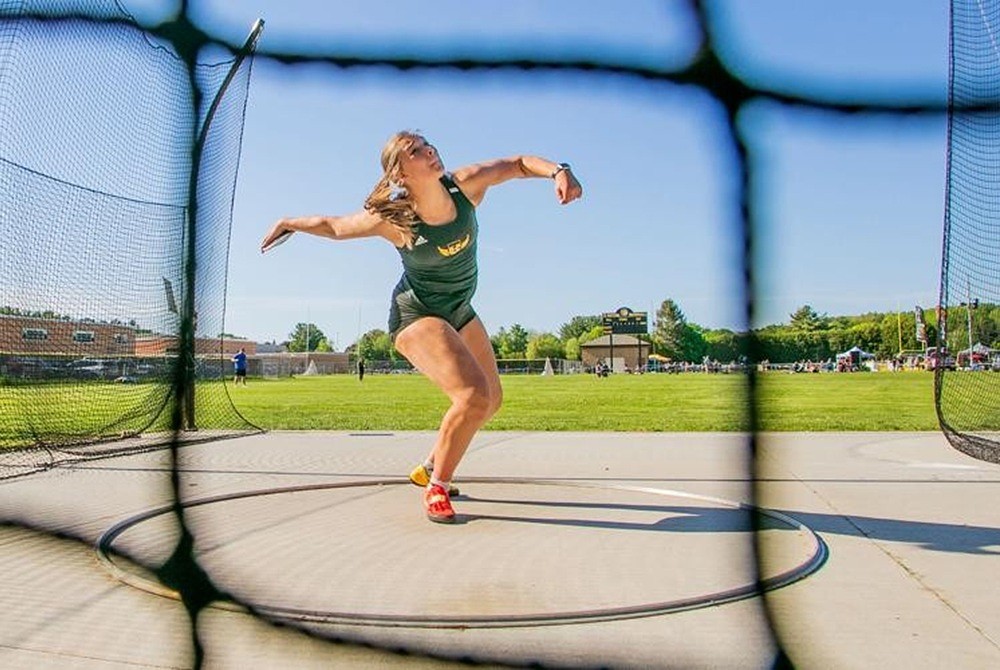
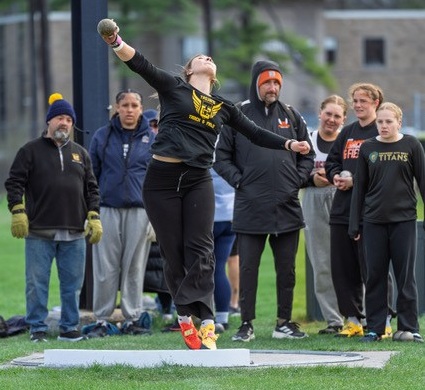
PHOTOS (Top) Traverse City Central’s Loralei Zielinski winds up during a discus throw. (Middle) Zielinski launches the shot while a gathered crowd watches. (Top photo by Jan Michael Stump/Traverse City Record-Eagle. Middle photo by TC Rick Sports Photography.)