

Track Gaining Speed Toward Future with Electronic Starting Devices
By
Steve Vedder
Special for MHSAA.com
May 23, 2023
Aubrey Greenfield thinks it might be the perfect time to reevaluate 130 years of tradition.
For a number of reasons, from technical to personal, the Oxford senior sprinter believes it makes sense for the crack of a starting pistol to be eliminated from high school track meets.
Because track meets would benefit in various ways from lowering costs to easier setup at meets to the human factor of competitors not having to flinch at the crack of a pistol shot, Greenfield believes the sport has a chance to embrace new technology – electronic starting devices (ESD).
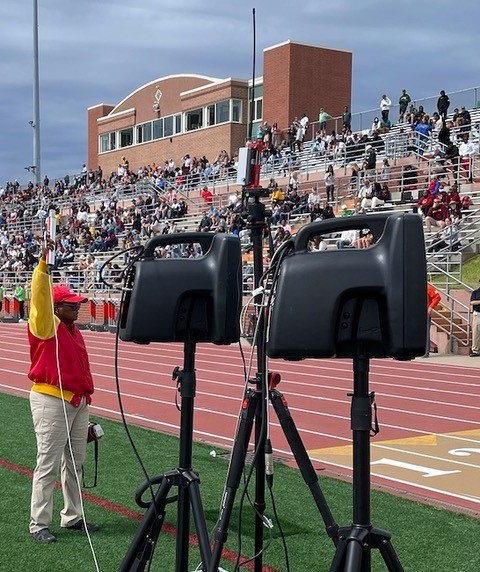
In essence, an ESD replaces the starting pistol with a light flash, tone sound or both to begin a race.
"High school sports should put the athlete first," Greenfield said. "We should promote sports, and eliminating starting pistols promotes health in terms of PTSD or trauma for athletes and spectators and that would be good. I would like to think people would say that's a good idea."
In fact, Greenfield would go as far as to say if there was not an implementation of electronic starting devices, many of her teammates would have considered giving up the sport.
"If it's something that helps us compete safely, we're all for it," she said.
Greenfield's opinion apparently is spreading. Michigan High School Athletic Association senior assistant director Cody Inglis said the use of ESD makes it both affordable for meet starters and sensible for athletes and fans to rethink the use of starting pistols. While the MHSAA is not mandating electronic starting devices, it does promote the use of what Inglis calls "emerging technology." He notes that ESD are becoming the norm for organizations such as USA Track & Field, the NCAA and an increasing number of high schools.
 "I think we have to embrace new technology, and we think this will be something that takes hold," Inglis said.
A key part of embracing ESD is the human element. The tragic Oxford High School shooting Nov. 30, 2021, that took the lives of four students while injuring seven others should not be relived even for a fleeting instance at a high school sporting event. Oxford athletic director Tony DeMare said the school began using ESD at every meet, including the MHSAA Lower Peninsula Division 1 Finals last June. He said that decision was embraced by virtually all schools Oxford encountered.
"We were very convinced that the alternative (of ESD) would promote a healthy attitude," DeMare said. "We were overwhelmed with the positive response. If a school was on the fence about it or might not be for it, I think we've started to see the tide turn in favor of people willing to listen and learn about electronic starting devices."
Inglis said the MHSAA is acutely aware of what the crack of a starting pistol can mean to athletes and fans.
"It's unimaginable what Oxford went through, and this is a small way we can help," he said. "We look at a (starting pistol) and think, ‘Could we do something else?’ It's a way of helping to solve a problem."
Over the last several years, the MHSAA has embraced finding an alternative to starting pistols. Inglis noted the discussion started with the cost and diminishing availability of 32-caliber ammunition that meet starters use. A box of ammunition, if it can be found, is around $75 a box.
In addition to cost, there is potential damage from excessive exposure to 150-plus decibels of sound generated by the traditional 32-caliber blanks. Medical studies show damage to ears caused by decibel levels above 120 dB.
The tragedy at Oxford accelerated the conversation.
Inglis said the cost of ESD can be likened to a school sinking money into artificial surfaces at football fields. Yes, there is a great cost at first, but over time money is ultimately saved. An ESD system itself ranges between $200 and $500. Speakers also may need to be purchased, but with ESD starting events like the 800 and 1,600-meter relays positioned near the outside lanes 8, 7, 6 and 5 would result in improved hearing by athletes at the start of a race.
There is one challenge with ESD that track administrators are working to overcome – lighting conditions that lessen the ability to see the ESD’s LED light or strobe when the button is pressed by a starter to begin a race. But that vision difficulty resulting from clear blue skies and backgrounds of setting suns can be substantially improved by incorporating a black background with an ESD – something as simple as a starter holding up black cardboard behind the lighting mechanism at the start of an event.
Inglis said when all factors are considered, the use of ESD makes sense.
 "With the climate we live in nowadays, no lookalike guns is good," he said. "We're not mandating this. But people are saying this is affordable."
While switching to ESD would break 130 years of tradition, the timing could be a step forward, said Jeff Hollobaugh, co-author of the book "The Fleet Feet of Spring: Michigan's High School State Championships in Track & Field." He said while no definitive answer is possible, it's likely starting pistols were used at the inaugural state meet at the Jackson Fairgounds in 1895. The meet, which included events like tossing a 16-pound shot put, bike races and a 100-meter sprint, was sponsored by the Michigan Interscholastic Athletic Association (a predecessor to the MHSAA) and comprised mostly of the state's larger schools.
Hollobaugh's sentiments echo what many involved in today's high school track & field believe in terms of making a transition from starting pistols to electronic starting devices.
"It's a change, not necessarily good or bad, just different," he said. "It's not a drastic change, but it will take some getting used to. But it is the future. In the end, we'll all be fine."
DeMare believes the future of high school track will definitely include ESD.
"Our desire is that the practicality and sensibility of this will overcome the alternative," he said. "I think we'll see the automation and electronics taking hold of certain elements in track, and people will embrace it."
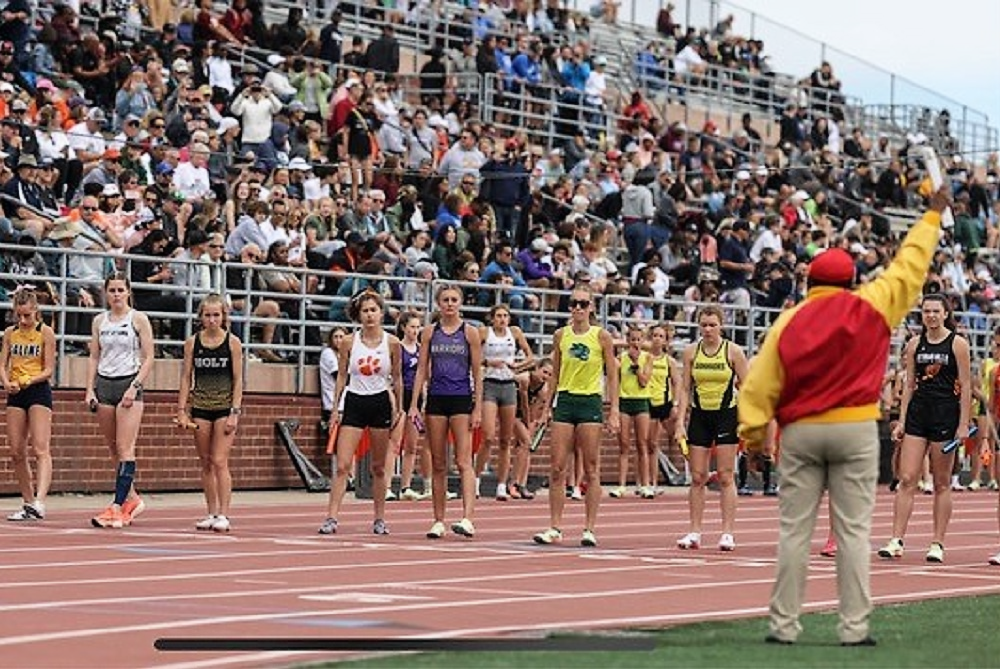
PHOTOS (Top) Runners watch official Bertha Smiley as they prepare to begin a race during last season's Lower Peninsula Division 1 Finals at Rockford. (Middle) An electronic starting device provided by VS Athletics was used to start those races. (Below) Smiley sets to begin an event. (Photos provided by David Kuderka/VS Athletics.)
Preview: Contenders Lining Up to Slow Down UP Boys Reigning Champions
By
Geoff Kimmerly
MHSAA.com senior editor
May 28, 2026
This decade has seen only six schools win an MHSAA Upper Peninsula Finals team championship in boys track & field – out of 15 opportunities – and all three meets this weekend feature returning winners seeking to stretch current title streaks already measuring multiple seasons.
But there are several more contenders in position to play stopper as they seek to begin their own championship eras.
All three divisions will be hosted by Kingsford High School, with preliminaries leading off the day at 9 a.m. local (Central) time. Tickets cost $11 and are available digitally only via GoFan.
MHSAA.tv will live-stream the meets beginning at 9 a.m. (CDT)/10 a.m. (EDT), viewable with subscription. Check out the Boys Track & Field page for meet information and lists of all qualifiers.
Those described as "seeded" below have received those seeds based on Regional performances or early qualification during the regular season. (Although not noted for most, several individuals below also will run on contending relays.)
Following is a glance at team contenders and individuals to watch in all three divisions:
Division 1
Team forecast: A sixth-straight championship Saturday would tie Marquette with the Gladstone teams from 2004-09 for the second-longest championship streak in Upper Peninsula history. But the Sentinels’ depth will have to shine through as last year’s Finals runner-up Sault Ste. Marie edged Marquette by a point at their Regional, and Kingsford and Houghton have several potential scorers as well.
Lucas Ballard, Marquette junior: The reigning champion in the 800 is seeded first in that race (2:02.82), second in the 1,600 (4:42.00) and third in the 3,200 (10:08.60).
Gabe Litzner, Sault Ste. Marie senior: He’ll graduate among the top distance runners in Upper Peninsula history. He’s won the 3,200 the last two seasons – setting the meet record at 9:31.20 a year ago – and is seeded first in that race (10:00.18) and the 1,600 (4:41.31).
Jacob Norman, Marquette senior: He’s seeded first in the 110 hurdles (15:82) after winning that race last spring.
Michael Solena, Houghton junior: He finished second in the discus a year ago but could have a much bigger day this time seeded first in that throw (144-2) and shot put (50-3¾) as well.
Gaige Sorenson, Kingsford junior: He finished second in the long jump last spring and also has multiple scoring opportunities, seeded first in long jump (20-8), running the 100 and also on two top-three seeded relays.
Division 2
Team forecast: Pickford has won three straight Division 2 championships and held of Munising by 31 points in 2024 and 50 a year ago to build the streak. Pickford has entries all over this meet again and three top-seeded relays. Rudyard is another team to watch with several potential scorers.
John Anderson, Pickford senior: The high jump champion the last two seasons is seeded first in that event (6-4) and the long jump (19-5) and second in the 110 (15.95) and 300 (45.32) hurdles.
Gunner Bennin, Pickford senior: He’s won the 400 the last two seasons and also the 200 as a sophomore, and could finish his high school career by doubling that count seeded first in the 100 (11.60), 200 (23.25) and 400 (52.61).
Talon Hughes, Ironwood senior: After winning the 100 and 200 a year ago, he’s seeded second in the 100 (11.63), third in the 200 (24.09) and also third in the 110 hurdles (16.83).
Steven Kirschner, Rudyard senior: He’s looking to move up a spot or more after finishing second in the 3,200 and third in both the 800 and 1,600 last season, and is seeded first in the 800 (2:08.51) and 3,200 (11:01.68) and third in the 1,600 (5:04.77).
Gionni McDonough, Bark River Harris junior: He won the 110 hurdles last year and is seeded to repeat (15.59) and win the 300 as well (44.64) while also competing in the 100 dash and long jump.
Division 3
Team forecast: Newberry also has built a winning streak with two straight championships, and a third is possible especially thanks to strong relays. But Rapid River dominated its Regional and should be in the hunt, and Stephenson and Lake Linden-Hubbell have qualifiers all over the lineup as well. LL-H is the returning team runner-up.
Lukas Axford, Lake Linden-Hubbell junior: After winning the 300 hurdles last season, Axford is seeded third in the 400 (56.11) and also set to run the 800.
Connor Kemppainen, L’Anse junior: The reigning 110 hurdles champion is seeded first in that race (16.87) and third in the 300 hurdles (44.07).
Brady Leblanc, Brimley junior: He’s seeded first in the 300 hurdles (43.20) and second in the 110 (16.93) after finishing fourth in the latter last season.
Ethan Snyder, Cedarville/DeTour junior: After finishing second in the 800 and 1,600 and third in the 3,200 last season, he’s seeded first in all three races in 2:06.67, 4:45.36 and 10:41.43, respectively.
Will Spranger, Eben Junction Superior Central senior: Last season’s Finals highlight was a third place in the 400, but he returns as the top seed in the 100 (11.61) and 200 (23.62) and also slated to run the 300 hurdles.
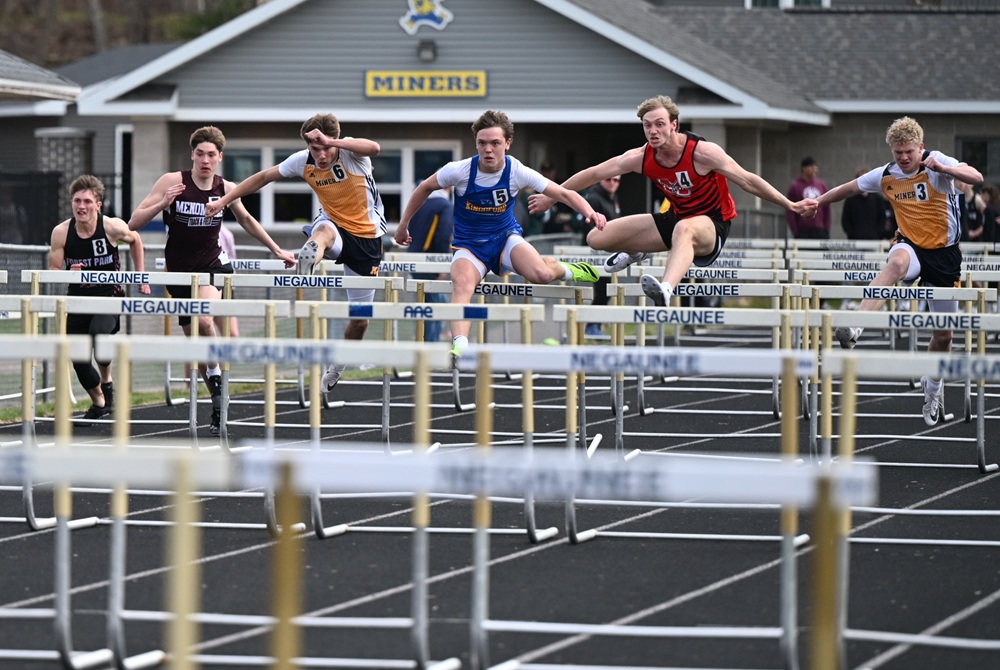
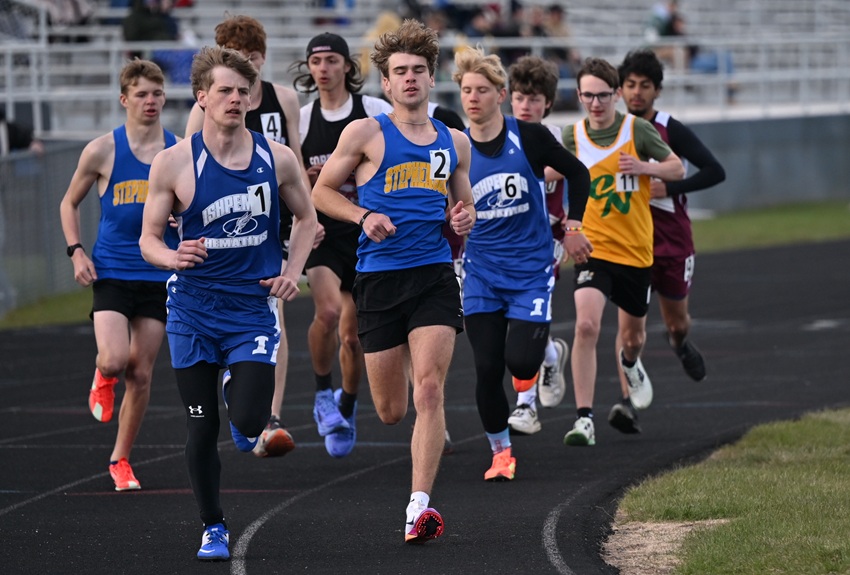
PHOTOS (Top) Negaunee's Cole Prusi (6), Kingsford's Sid Olson (5), Marquette's Jacob Norman (4), and Negaunee's Cole Pekrul (3) race the 110 hurdles May 8 at the Lions Invitational in Negaunee. (Middle) Ishpeming's Kemper Gearhart (1) leads the beginning of the 1,600 with Stephenson's Canon Kuntze (2) getting into position to follow during the UPD3 Regional on May 18 at Ishpeming. (Photos by Cara Kamps.)