

West Marching to Finals Hoping to Build on 4th-Straight Regional, League Titles
By
Tom Spencer
Special for MHSAA.com
May 23, 2025
Reese Smith is hoping the third time is the charm.
 Not that any of the previous efforts by the Traverse City West junior could possibly be considered failures.
And if her third-straight appearance at the Lower Peninsula Division 1 Track & Field Finals next weekend at East Kentwood High School doesn’t result in a championship, it will be filled with love — for her teammates and everything else the Titans accomplished this year.
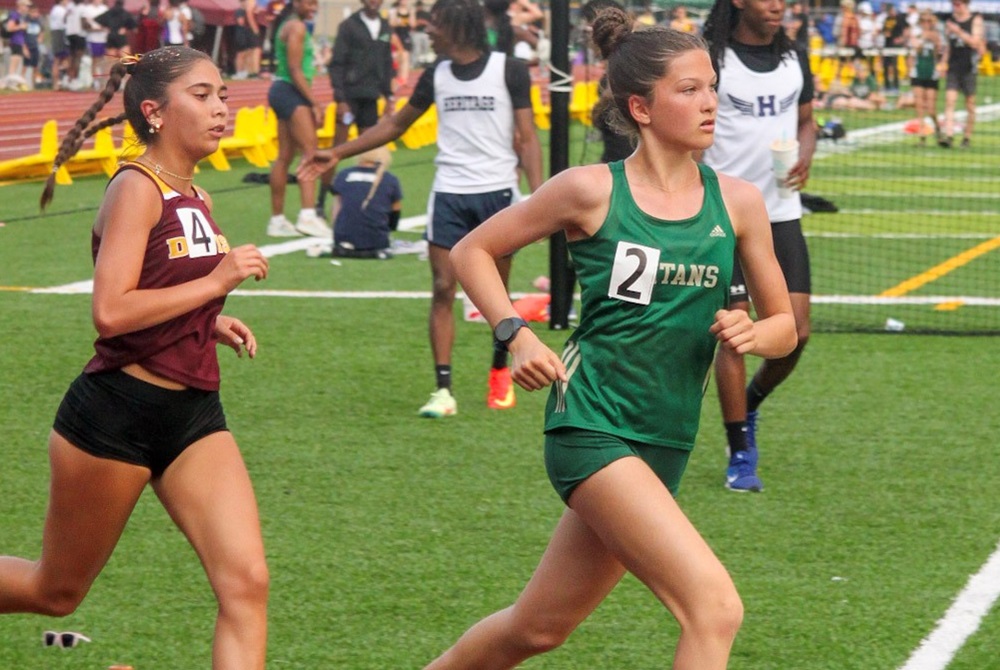
West, coming off a fourth-straight Regional championship and a fourth-straight Big North Conference title, have high hopes of capturing the 3,200 relay at East Kentwood. The Titans also have their eyes on the 1,600 relay. Smith anchors both.
“I really love the team and the bonds I’ve made with the girls on my team, especially the relays teams,” Smith said. “I feel like we’ve gotten really close, and that makes a difference when you are racing together and working together to get what you want to accomplish.”
West has qualified for 3,200 relay Final all four of Smith’s seasons, finishing 15th two years ago and third last season. Alyssa Fouchey, a senior, also ran on those first three qualifiers. Junior Bailey Wenzlick is back for her second straight, and the team’s fourth is sophomore Tessa Mascari, who will be experiencing her first 3,200 Final as well after narrowly qualifying for the 1,600-meter as a freshman last year.
Mascari also qualified this year for the open 1,600 and 3,200-meter races.
“I love this team, and I am very honored to be running a 4x8,” Mascari said. “We have a really strong team, and we’re definitely all trying to place.”
Smith will also be running the 800 with hopes of bettering her fifth-place finish from a year ago. The Titans also finished 15th in 2024 in the 1,600 relay with Smith, Wenzlick and Fouchey competing. Emily Kelsey is the fourth member of that relay this season.
“We’re pretty competitive in the 4x800, so we’re really trying to place in it,” Smith said. “And, the 800 I really want to place also and the 4x4 we’re not as competitive in, but I am still going to do all my effort in all of them.”
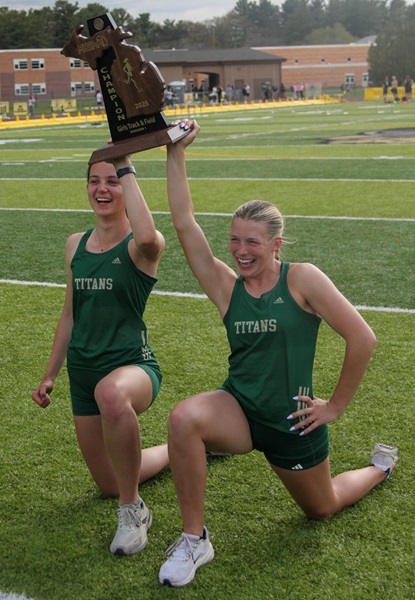 West also qualified sophomore Audrina Redmond in the pole vault and Olivia Kandow in the 100 hurdles. And senior high jumper Madeline Bildeaux is back for her second Finals appearance; she placed seventh last year.
“I am a lot less nervous than last year because I have been there before,” Bildeaux said. “I am going to try to represent myself the best that I can. How ever it goes is just how it was meant to be.”
Bildeaux also looks at the Finals as a bonus to the final chapter of her high school career. The all-state volleyball player is committed to continue playing that sport for Navy this fall.
She is one of six seniors on the West track team. All six were coached in middle school by Libby Shutler, who took over the Titans’ varsity this spring. Shutler ran the middle school program for six years, joined by Daryl Stallworth, who took over the West varsity boys team this season.
Shutler was thrilled to see West continue its conference and Regional championship strings as she transitioned to the varsity, succeeding retired coach Diane Goss.
“I am the first-year coach who was handed a very talented group of young ladies,” Shutler said. “It’s kind of like 54 daughters I have.”
West won both the Regional and conference titles on the track of cross-town rival Traverse City Central. Capturing individual conference championships were Kelsey (200, 26.35; and 400, 59.91); Smith (800, 2:16); Bildeaux (high jump, 5-2) and Redmond (pole vault, 10-0).
Bildeaux against reached 5-2 in the high jump to claim the Titans’ lone individual Regional title. Smith finished second in the 800, and Mascari was second in both the 1,600 and 3,200. Both are looking forward to the challenge of participating in three events against the best competition in Michigan.
“It’s pretty hard especially doing the first and last event,” said Smith, who will run the exact same events she did at the 2024 Finals. “You have to watch what you’re eating all day, make sure you’re getting enough rest in between the events, warming up in enough time and spacing everything out.”
Mascari is glad the 3,200 relay is her first event. She’ll finish with the open 3,200, a distance she hadn’t tried before this season. But the 1,600 field intrigues her the most.
“I have a pretty good heat to compete against,” Mascari said of that event. “If I stay at the top of my heat, I hope to break five (minutes) in the mile. I am really excited to have some good people to compete against.”
 Tom Spencer is a longtime MHSAA-registered basketball and soccer official, and former softball and baseball official, and he also has coached in the northern Lower Peninsula area. He previously has written for the Saginaw News, Bay County Sports Page and Midland Daily News. He can be reached at [email protected] with story ideas for Manistee, Wexford, Missaukee, Roscommon, Ogemaw, Iosco, Alcona, Oscoda, Crawford, Kalkaska, Grand Traverse, Benzie, Leelanau, Antrim, Otsego, Montmorency, Alpena, Presque Isle, Cheboygan, Charlevoix and Emmet counties.
PHOTOS (Top) Traverse City West’s Tessa Macari (2) carries the baton for the 3,200 relay. (Middle) Madeline Bildeaux, left, and Keira Murphy hold up their Regional team trophy as coach Libby Shutler takes their photo. (Photos by Grace McSparron.)
Ironwood Savors Home-Track Advantage in LaBlonde Memorial Invitational Sweep
By
John Vrancic
Special for MHSAA.com
May 15, 2025
IRONWOOD — Most high school tracks have at least six lanes and are 400 meters.
 But there’s an exception to every rule.
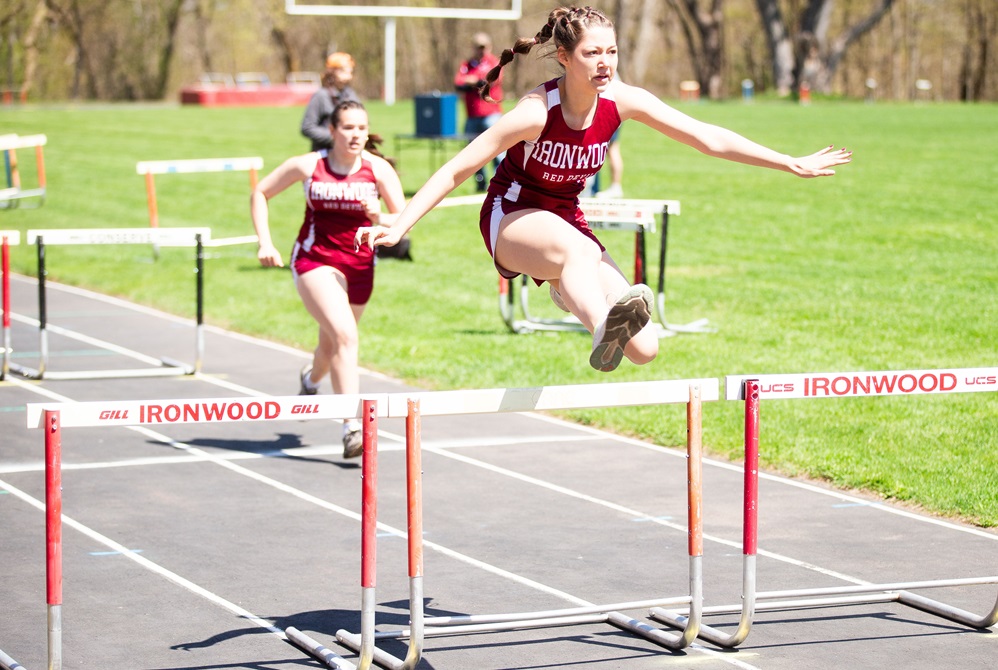
That’s the case at Ironwood, where the Red Devils run on a 350-meter, five-lane asphalt surface.
“That’s something we’ve addressed,” Ironwood coach Cecilia Aho said “We’re probably the last ones who have a track this small, although the distances are the same. When we do mile repeats the kids don’t like it, but it’s better than not having a track. We make it work. Some of the smaller schools don’t have a track.”
Both Ironwood teams retained their titles Saturday afternoon at the Jim LaBlonde Memorial Invitational at Longyear Field, with the boys scoring 74 points to stay ahead of Hurley, Wis., at 57, and the Ironwood girls collecting 104 points to pull away from the field.
“The kids come here and have fun,” Aho said. “We have a nice group of kids who are working real hard.”
Ironwood junior Talon Hughes, who had a hand in four meet records, said the smaller track provides some challenges.
“It’s a pretty unique track,” he added. “We have different lanes and it’s hard to switch lanes. It can be intimidating for visiting teams. It’s sometimes hard for them to adapt, although we get used to it through practice. The biggest adjustment for us on 400-meter tracks is they have longer straightaways.”
Hughes won the 100-meter dash in 11.74 seconds and also took first in the 200 (24.42), 110 hurdles (16.84) and helped the Red Devils take the 800 relay (1:40.37).
“It’s a great feeling to win at home,” he said. “Many of your friends are here to cheer you on. We’re looking forward to our last few meets.”
The different exchange zones appeared to affect the Bessemer girls 800 relay the most. After a fast start, the Speedgirls struggled with all three handoffs, dropping them to third place (2:06.05), fewer than two seconds behind the winning team from Ironwood.
“I think it has a mental block on you,” Bessemer sophomore Sarah Hoffenberg said. “It really depends on the person. In my opinion, I think it helps if you don’t think about it. It’s really a learning experience.”
Hoffenberg later helped the Speedgirls bounce back with a victory in the 400 relay (1:01.38).
Ironwood senior Aubrey Smith, who will be attending classes at University of Michigan this fall, said it’s like having a homecourt advantage.
“It’s a little confusing,” she added. “It’s a little less than 4½ laps for a mile. It’s hard to tell where everyone is.”
Smith dominated the distances, taking the 800 (2:38.84), 1,600 (5:59.53) and 3,200 (11:58.87).
The Red Devils also ran in Wednesday’s Upper Peninsula Division 2 Regional at West Iron County, the boys team winning and the girls finishing runner-up to the host Wykons. Ironwood travels to Lake Linden-Hubbell for the Copper Mountain Conference meet Monday before ending the season at the Upper Peninsula Finals on May 31 at Kingsford.
“Our seniors are looking forward to their last couple meets,” Aho said. “I’m going to miss them. Our school is 100 years old. We started celebrating our centennial last July. We’re in the process of finishing up our celebration.”
 John Vrancic has covered high school sports in the Upper Peninsula since joining the Escanaba Daily Press staff in 1985. He is known most prominently across the peninsula for his extensive coverage of cross country and track & field that frequently appears in newspapers from the Wisconsin border to Lake Huron. He received the James Trethewey Award for Distinguished Service in 2015 from the Upper Peninsula Sportswriters and Sportscasters Association.
PHOTO Skyla Ballew clears a hurdle during a race at Ironwood High School. (Photo by Jason Juno/Ironwood Daily Globe.)