

Be the Referee: Volleyball Double & Lift
By
Paige Winne
MHSAA Director of Brand Management
October 3, 2023
Be The Referee is a series of short messages designed to help educate people on the rules of different sports, to help them better understand the art of officiating, and to recruit officials.
Below is this week's segment – Volleyball Double & Lift - Listen
You’re sitting at a volleyball match and hear parents in the stands yell “Double!” or “Lift!”
What do those terms mean, and why are they yelling them?
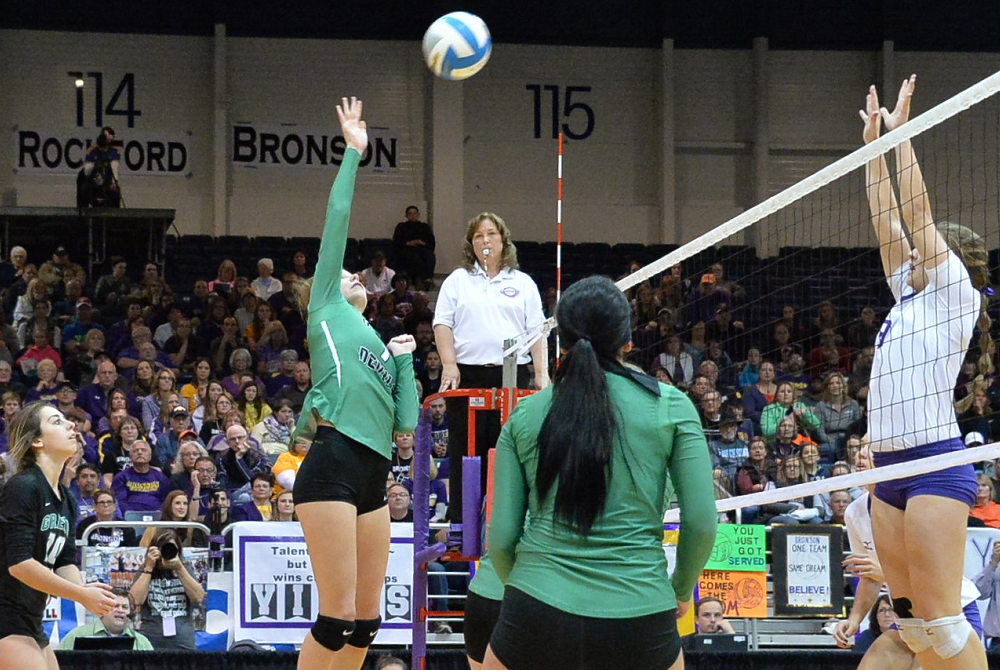
Double refers to double contact. That’s when a player hits the ball twice in a row or if the ball touches two parts of the player’s body in succession. If a setter hits the ball with one hand then the other – even if immediate, it’s a double. She needs to set with both hands at the same time.
A lift is when the player, typically a setter, has prolonged contact with the ball that results in throwing or re-directing the ball back into play. The ball doesn’t rebound off the player's fingers or hands, but is directed by the player.
The official on the stand at the net is in the best position to notice these fouls.
Previous Editions
Sept. 26: Registration Process - Listen
Sept. 20: Animal Interference - Listen
Sept. 13: Feet Rule on Soccer Throw-In - Listen
Sept. 6: Volleyball Jewelry - Listen
Aug. 30: Football Rules Similarities - Listen
Aug. 23: Football Rules Differences - Listen
(PHOTO by Gary Shook.)
Lowell Follows Lone Senior to Inaugural MHSAA Boys Volleyball Championship
By
Jeff Bleiler
Special for MHSAA.com
June 6, 2026
BATTLE CREEK — Drew Davidson left Kellogg Arena on Saturday with the first Division 2 Finals championship trophy awarded by the MHSAA for boys volleyball – and also with a pocket full of timeouts.
Davidson’s Lowell boys volleyball team defeated Grand Rapids South Christian in the best-of-5 final, 3-1. Despite an up-and-down, back-and-forth match with Lowell prevailing 25-23, 25-20, 23-25 and 25-18, Davidson called no timeouts during the Final.
“I like seeing them get flustered and see how they respond,” Davidson said. “You saw in the third game where we responded poorly and couldn’t side out, and then what happened in the fourth game? We responded and came back out and finished the job off.
“For a young team, it’s not always going to be perfect, but to see how they respond to getting flustered, I like to see that.”
Saturday’s historic championship marked a culmination of more than two years’ work since the May 2024 announcement of the boys volleyball tournament joining the MHSAA postseason schedule.
That fact was not lost on Davidson nor his younger brother Max, the lone senior on a team that had collected three consecutive state volleyball championships (awarded previously by the coaches association) entering Saturday’s Finals.
“It’s the first and the fourth for us,” Drew Davidson said. “It’s Max’s senior year so he’s won every year, so that’s kind of a cool way to send him out. With it being an MHSAA sport now, it’s just makes it even better to bring the first one home and have that on the record books.”
Max Davidson led a team of 11 total — including six freshmen — and turns the setting reins over to freshman Issac Kissinger.
“I don’t have to worry about the program after I leave,” Max Davidson said. “I know Issac can take over. He’s definitely better than when I was a freshman, so I can’t imagine how good he’s going to be as a senior. And all the other freshmen who came in and filled really big roles, they did a really good job.”
They needed to in order to defeat a talented and senior-laden South Christian team for the third time this season. The Sailors had a lead in every set and the first set knotted at 23-23 before Lowell won the last two points.
 The second set was back and forth as well, with neither team holding a lead larger than two points until consecutive aces by Lowell junior Lincoln Pollema put the Red Arrows up 19-16. South Christian tied it at 19-19 before Lowell scored six of the next seven points, including the set-winning kill by Kissinger.
The third set featured just about everything from both sides — with South Christian jumping out to a 17-11 lead, a Brock Hoekwater one-armed dig finding the floor on the other side the final point of four straight.
Drew Davidson did not call timeout, and his team responded on Pollema’s serve, scoring eight in a row for a 19-17 lead. With the score tied 23-23, seniors Jack Borisch and Carson Joldersma each had kills to close the set for South Christian.
“We’ve played Lowell three times, but we stood in it with them today, and I thought we played an incredible match,” South Christian coach Mya Udell said. “I just can’t be more proud of the guys, how they worked together and how they’ve come together. They’ve been a huge support for each other, and it’s just been great to be a part of.
“We took a set off Lowell, and they’re an incredible team.”
Lowell jumped out to a 19-11 lead in the fourth set before a South Christian timeout ignited a six-point run that included three straight Joldersma kills — but did not result in a Lowell timeout.
Instead, the Red Arrows took serve on a kill by Kissinger, got two Jaeger Smith kills and with freshman Teylon Compton serving, closed it out with a Kissinger kill and block kill by junior Josh Wolfers.
“That was a crazy game. South Christian brought it,” Drew Davidson said. “They played really well, so that was fun to come against and have to overcome. The boys did eventually.”
The Sailors lose seven seniors from this year’s runner-up squad that finished 28-14-2, and Udell said the group leaves behind a lasting legacy.
“I think for them, their legacy is they can always be known for that first season, making it to a state championship and having a great record,” she said. “But they’re also great men. They love the Lord, they care about others and they’re going to do great in the real world.”
Lowell, which finished the season 27-6, likely will not be a stranger to the MHSAA Finals. Of the 11 players on the roster, four are juniors and six are freshmen — with six additional freshmen on the way.
“We’ve been playing four, five, six freshmen, so it’s super exciting to see those guys grow,” Drew Davidson said. “The opportunity they get to play with the older kids and then what that’ll do for next year, that’s exciting.”
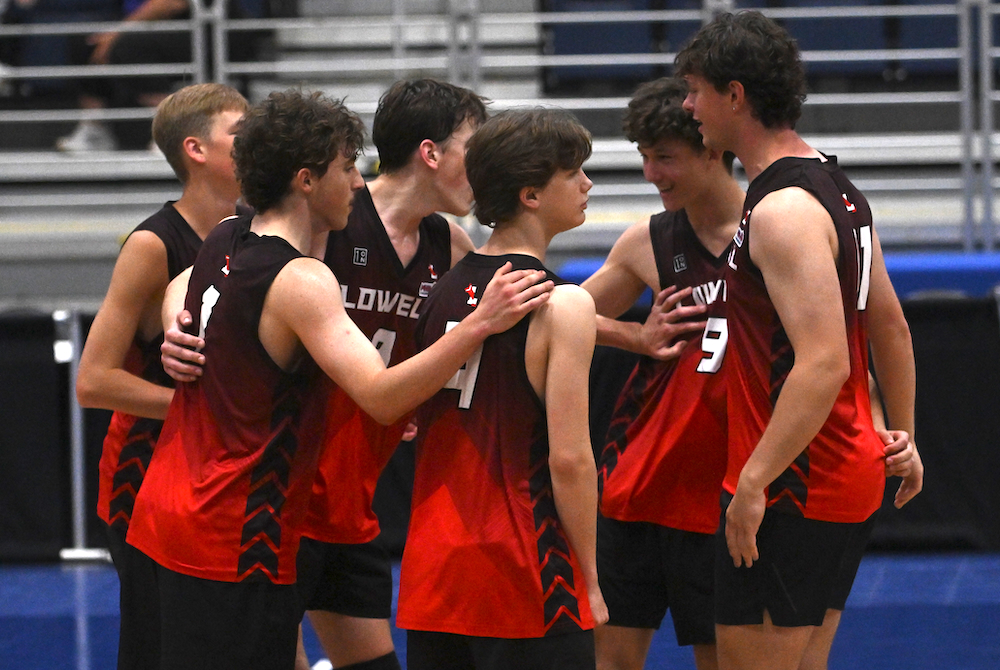
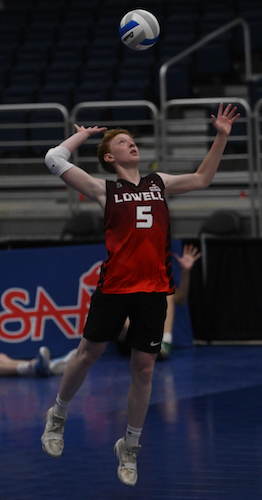
PHOTOS (Top) Lowell players huddle on the court during their Division 2 championship win Saturday at Kellogg Arena. (Middle) The Red Arrows’ Will Selent elevates during a serve.