

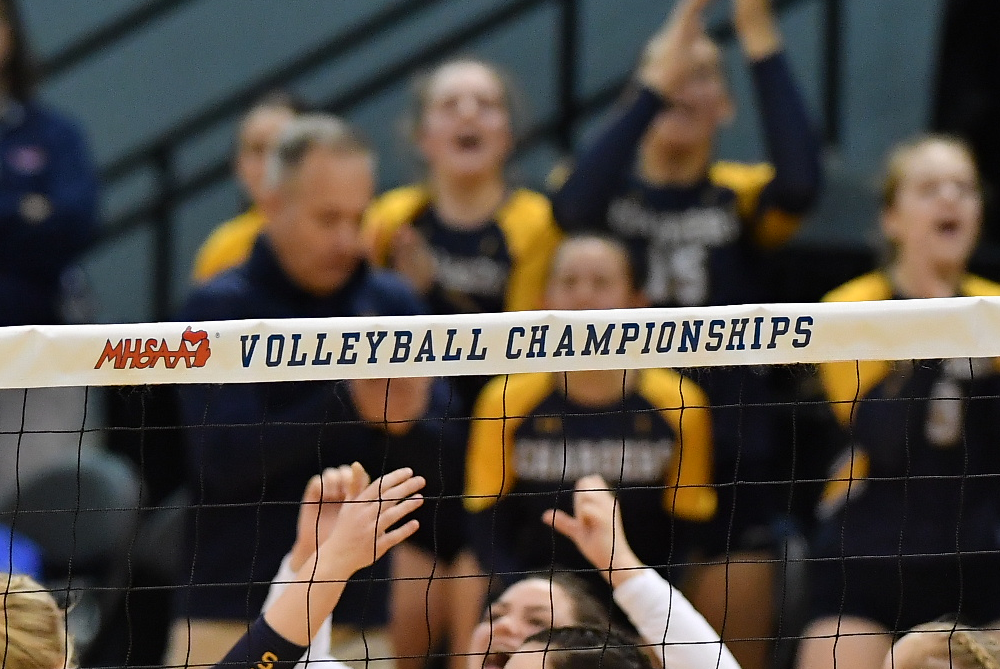
Be the Referee: Volleyball Jewelry
By
Paige Winne
MHSAA Marketing & Social Media Coordinator
September 6, 2023
Be The Referee is a series of short messages designed to help educate people on the rules of different sports, to help them better understand the art of officiating, and to recruit officials.
Below is this week's segment – Volleyball Jewelry - Listen
There’s a new rule in volleyball regarding the wearing of jewelry.
Previously, participants were not allowed to wear stud or post-like jewelry, such as earrings, even if they were covered by tape.
But now, stud or post-like jewelry, worn above the chin, is allowed. Stud earrings are now allowed to be worn during play – and do not need to be covered by tape.
Hoop-style jewelry, such as hoop earrings, are still not allowed, even if covered by tape. If a player is wearing hoop earrings, the coach will be issued an administrative yellow card for the first offense and a red card for a second offense in that set.
Items such as a medical-alert medal or a religious medal must be taped to the body and can be visible during play.
Previous Editions
Aug. 30: Football Rules Similarities - Listen
Aug. 23: Football Rules Differences - Listen
Pioneering Competitive Cheer Official Cox to Receive MHSAA Norris Award
By
Geoff Kimmerly
MHSAA.com senior editor
April 18, 2024
A registered contest official since the Michigan High School Athletic Association introduced competitive cheer with the 1993-94 school year, Quincy’s Candace Cox has played one of the leading roles in building the sport that’s averaged more than 5,500 participants annually over its 31-year history.
She will be celebrated April 27 as the 2024 Vern L. Norris Leadership in Officiating Award honoree during the MHSAA’s Officials Awards & Alumni Banquet, where she and several of her competitive cheer colleagues who began as registered officials that inaugural season also will be recognized for completing their 30th years of service in 2022-23.
The Norris Award is presented annually to a veteran official who has been active in a local officials association, has mentored other officials, and has been involved in officials’ education. It is named for Vern L. Norris, who served as executive director of the MHSAA from 1978-86 and was well-respected by officials on the state and national levels. He initiated the officials banquet in 1980, and this year’s will be the first in-person celebration since 2019. Cox will be honored along with high school game officials with 20, 30, 40, 45 and 50 years of service.
Competitive cheer is unique to Michigan. While several states have spirit or cheer as a sport, the MHSAA format – which includes teams showcasing a variety of skills over three rounds and encourages full teams to participate by scoring higher when more athletes are on the floor – was created in part to provide more opportunities for cheerleaders to compete. Cox brought her knowledge and experience in sideline cheer into the initial development of the competitive format.
She officiated a Regional competition during that first season of competitive cheer in 1993-94, and the following season she began in a string of officiating at the last 30 MHSAA Finals, including in Division 1 this past winter. Cox also is in her 11th year as executive director of the Michigan Cheer Judges Association, the statewide leadership and training organization for the sport, and in that role she has trained thousands of officials – the MCJA instructs about 175 annually.
She will be the first competitive cheer official to be recognized with the Norris Award.
“At the very beginning, we didn't know what (competitive cheer) was going to involve, and there was a lot of work put in, a lot of committees, sharing a lot of information from sideline because Michigan is so unique to cheer,” Cox said. “At the very beginning, I never believed we would advance as much as we have. But I really feel we're a leader in the competitive cheer community.
“My favorite thing is helping educate and be involved, and I do it for the kids. I want them to have a positive experience, and I want them to learn, and I also want to educate other officials so they realize what an important sport this is … another sport for girls to compete in.”
Cox cheered while a student at Coldwater High School and became the sideline cheer coach after she returned from college. It was during that time she was approached by Marilyn Bowker, another of the founding trailblazers in the sport, and from then on Cox became a growing presence as competitive cheer continued to develop and thrive.
She has served on the MHSAA’s Competitive Cheer Committee and Judges Selection Committee, and is an MHSAA registered assigner in the sport. Cox was named MCJA Official of the Year in 1999 and Michigan’s top official in cheer by the National Federation of State High School Associations (NFHS) in 2000.
“She’s been a pioneer since Day 1 in competitive cheer and is considered literally one of the fundamental pillars who have grown and promoted the sport over the years,” MHSAA Executive Director Mark Uyl said. “Candy is a very worthy Norris Award winner.”
Cox is the clinic manager at the Branch-Hillsdale-St. Joseph Community Health Agency and provides expertise from her professional field as part of the MHSAA’s Sports Medicine Advisory Committee. A 1973 Coldwater High School graduate, she earned an associate’s degree in medical administration from Barton Bryman School in Phoenix in 1979 and is certified as an HIV counselor by the State of Michigan, and BLS (basic life support), CPR/AED and first aid instructor by the American Heart Association.
She has served her community of Girard Township in several roles, including currently as township supervisor after previously holding office as trustee and contributing on multiple boards and commissions. She’s also served as Branch County jury board chairperson and was named Branch County Citizen of the Year in 2011 by the Coldwater Area Chamber of Commerce.
Cox is a member of the Coldwater Early Bird Exchange Club and has served as president of the Bronson Polish Festival. She is active in service projects for St. Charles Borromeo Parish and judged CPR for local, district and regional Future Health Professionals (HOSA) competitions.
Previous recipients of the Norris Award
1992 – Ted Wilson, East Detroit
1993 – Fred Briggs, Burton
1994 – Joe Brodie, Flat Rock
1995 – Jim Massar, Flint
1996 – Jim Lamoreaux, St. Ignace
1997 – Ken Myllyla, Escanaba
1998 – Blake Hagman, Kalamazoo
1999 – Richard Kalahar, Jackson
2000 – Barb Beckett, Traverse City; Karl Newingham, Bay City
2001 – Herb Lipschultz, Kalamazoo
2002 – Robert Scholie, Hancock
2003 – Ron Nagy, Hazel Par
2004 – Carl Van Heck, Grand Rapids
2005 – Bruce Moss, Alma
2006 – Jeanne Skinner, Grand Rapids
2007 – Terry Wakeley, Grayling
2008 – Will Lynch, Honor
2009 – James Danhoff, Richland
2010 – John Juday Sr., Petoskey
2011 – Robert Williams, Redford
2012 – Lyle Berry, Rockford
2013 – Tom Minter, Okemos
2014 – Hugh R. Jewell, West Bloomfield
2015 – Sam Davis, Lansing
2016 – Linda Hoover, Marshall
2017 – Michael Gentry, Shelby Township
2018 – Jill Baker-Cooley, Big Rapids
2019 – David Buck, St. Joseph
2020 – Hugh Matson, Saginaw
2021 – Lewis Clingman, Grand Rapids
2022 – Pat Hayes, Birmingham
2023 – Chuck D. Walters, Jackson
High school game officials with 20, 30, 40, 45 and 50 years of service also will be honored at the Officials Awards & Alumni Banquet on April 27. Twenty-four officials with 50 or more years of service will be honored, along with 36 officials with 45 years and 51 officials with 40 years of service. A 30-year award will be presented to 110 officials, and 176 officials with 20 years of experience will be honored.
Tickets for the banquet are available to the public and priced at $25. They will not be sold at the door. Tickets can be ordered by calling the MHSAA office at (517) 332-5046 or by registering online at this link (officials must be logged into the website to register). Deadline to register is April 19.
***
MICHIGAN HIGH SCHOOL ATHLETIC ASSOCIATION
20, 30, 40, 45 & 50-YEAR OFFICIALS
The officials on this list are receiving their 20, 30, 40, 45 and 50-year service awards.
20-YEAR OFFICIALS
Allegan - Joseph Munn
Allen Park - James Murdoch
Ann Arbor - Shawna Lorch
Bad Axe - Gary Krause
Bannister - Clyde English
Baraga - Scott Koski
Battle Creek - Lonzo Warren
Bay City - Jason Ruple
Bay City - David Szczypka
Belleville - Michael McCormick
Big Rapids - Marty Shaffer
Blissfield - Steven Babbitt
Bloomfield Twp. - Richard Dylewski Jr.
Bloomfield Village - Maynard Timm
Bridgman - Shane Peters
Brimley - George Jones
Bronson - Brian Case
Bronson - Kevin Gardner
Brownstown Twp. - Charles Monette Jr.
Cadillac - Demetrio Rojas-Cruz
Chassell - Robert Fay
Chassell - Shana Ruotsala
Chesterfield - Paul McBride
Clarkston - Jamie Rykse
Clarksville - Michael Burgess
Clinton Township - Mark Carney
Clinton Township - Brad Thomas
Clinton Township - Keith Justice Sr.
Commerce Township - Robert Foss
Constantine - Jerry Burgess
Cottrellville - Grant Harris
Dearborn Heights - Abasi Sanders
Detroit - Delonda Little
Detroit - Kevin Cleveland
Detroit - Cozette Ealy
Detroit - Cedric Green
Detroit - William Pugh
DeWitt - Mark Kellogg
Dewitt - Adam Miller
Dorr - Dan Heasley
East Lansing - Eric McGaugh
Estero - Michael Jager
Fenton - Paula McAllister
Flint - Rozier Looney
Frankenmuth - Matthew Krause
Freeland - Nick Horn
Fremont - Kevin Holmberg
Gaylord - Michael Switalski
Gobles - Randy Hood
Grand Blanc - Josh Dean
Grand Blanc - Anthony Klinck
Grand Blanc - David Clement
Grand Haven - Chris Romero
Grand Ledge - Brian Gorman
Grand Rapids - Marc Davis
Grand Rapids - Timothy Gildner
Grand Rapids - Lloyd Kilgore Sr.
Grand Rapids - Fritz Owen
Grand Rapids - Debra Rambow
Grand Rapids - James Stokes
Grand Rapids - Michael Underwood
Grand Rapids - Randy Wilson
Grandville - Kelli Polinskey
Grosse Ile - Michael Szczechowski
Grosse Pointe Woods - Douglas Bohannon
Harbor Beach - Jill Fuller
Harrison Township - Kimberly Broski
Haslett - Casey Kern
Haslett - Scott Bradley
Hastings - Fred Koning
Highland - Jason Zimmerman
Holland - Jayson Dibble
Holt - Andrew Hoard
Honor - Matt Olson
Horton - Jerry Waddington
Houghton - Gregg Richards
Howell - Anthony Vella
Howell - Nathan Thompson
Hudsonville - Roberto Ortega-Ramos
Ionia - April Holman
Ironwood - Guy Trier
Jackson - Tracy Boyers
Jackson - Troy Fairbanks
Jackson - Daniel Garrison
Jackson - Jim Miller
Jackson - Bernard Nabozny
Jackson - Douglas Richardson
Jenison - Alfred Kennedy
Kalamazoo - Jill Lansky
Kentwood - Andrew Terrien
Kentwood - Rus Tien
Lansing - Oscar Castaneda
Lansing - Steve Crowley
Lansing - Terry Harris
Lansing - Arthur Lilly
Lansing - Keith Rhodabeck
Lansing - Cameron Rodgers
Lathrup Village - Gerald Jones
Livonia - Scott Racer
Macomb - Terry Prince
Macomb - Don Kalpin
Manistique - Joseph Crowder
Manistique - Howard Parmentier
Marlette - Chris Storm
Marquette - John Schultz
Marshall - James Dyer
Marshall - Eric Earl
Marysville - John Schweihofer
Mason - Ammahad Wnaikau
Memphis - Steven Gray
Merrill - Malena Marr
Michigan City - Larry Jordan III
Middleville - Darrin Oliver
Midland - Thomas Coatoam
Midland - Alan Huntress
Midland - Douglas Jones
Milan - Jill Hargrove
Milan - Michael St. John
Milford - Jeffrey Garvin
Milford - Larry Walters
Mount Pleasant - Jeff Siler
Muskegon - Robert Koekkoek
Niles - Glenn Kimmerly
Niles - Cory Gowen
Northville - Doug Doyle
Ortonville - Laurel Kobe
Perrysburg, Ohio - Gregg Becker
Pickford - Marc Andrzejak
Pontiac - Wanda Clayton
Port Austin - Andrew Preston
Portage - Phillip Baker
Portage - Jeff Kirkman
Portage - Mike Lauraine
Portage - Michael Northuis
Reed City - Aaron Keup
Riverview - Gregory Drewno
Rochester - Avoki Omekanda
Rochester Hills - Michael Timko
Rochester Hills - Terry Zangkas
Royal Oak - Linda Mariani
Saginaw - Richard Moody
Saginaw - Charles Smith
Schoolcraft - Nathan DeMaso
Schoolcraft - Reid Jones
South Haven - Ken Dietz
South Lyon - Elisabeth Tyzo-DePaulis
St. Clair Shores - Chad Kelly
Sterling Heights - Robert Hornik
Sterling Heights - Patrick Radaj
Sterling Heights - Erik Schneider
Sterling Heights - Ernest Sciullo
Sterling Heights - Terry Sheen
Stevensville - Thomas Rivette
Stevensville - Douglas Wegscheid
Swartz Creek - Andrew Palovich
Tecumseh - Eryn Stamper
Temperance - Mike Faunce
Temperance - Larry Nocella Jr.
Traverse City - Jeffrey Brunner
Traverse City - Jason Meriwether
Traverse City - Thomas Spencer
Trenton - Brian Hill
Trenton - Kevin McMillion
Troy - Glenn Craze
Troy - Patrick Grady
Twin Lake - Mike Vanderstelt
Utica - Edward Kotulski
Wallace - Terry Unti
Walled Lake - Terry Prickett
Warren - Arthur Lynn
Wayland - Joseph Kramer
West Bloomfield - Ilya Beltser
West Branch - Howard Hanft
White Lake - Gregory Waun
Williamston - Kelli Hart
Wixom - Cuba Gregory III
30-Year Officials
Allen - Kent Sanborn
Allen Park - Mark Klein
Alpena - Robert Centala Jr.
Alto - Bene Benedict
Bad Axe - Brent Wehner
Baroda - Chris Falak
Battle Creek - John Crumb
Bay City - Stephen Linton
Bay City - Scott Packard
Bay City - Joseph Pietryga
Bessemer - James Trcka
Brooklyn - Gregg Wonderly
Caledonia - Stacy Smith
Center Line - Scott Manteuffel
Charlotte - Val Nelson
Chelsea - Eric VanHevel
Chesterfield - Anthony Mancina
Clinton Township - Barbara Laird
Clinton Township - Scott Walendowski
Comstock Park - Kathy Felty
Davison - James Edgar
Dearborn - Gloria Joseph
Dearborn Heights - Rick Ballnik
Detroit - Joyce Smith
Dowagiac - Scott Stewart
East Lansing - Brent Sorg
Eaton Rapids - Wesley Collins
Essexville - Mark Gentle
Farmington Hills - Robert Dobson Jr.
Fenton - Paul White
Flat Rock - Janis Stahr
Flint - Richard Higgins
Flint - John Yelle
Flushing - Jeffrey Straley
Freeland - Terry Schmidt
Grand Blanc - Thomas Le Blanc
Grand Blanc - Leonard Sparks Sr.
Grand Rapids - Jacquie DeJonge
Grand Rapids - Jeff Green
Greenville - Darcia Kelley
Grosse Pointe - Ryan Murphy
Grosse Pointe Park - George Markley
Grosse Pointe Woods - Renee Dicristofaro
Hazel Park - Benny Holzman
Hickory Corners - Dean Bostwick
Holt - John Massey
Imlay City - John Forti
Jacksonville Beach, Fla. - Bernadette Koenig
Kalamazoo - Julie Jones
Kalamazoo - Mark Kampen
Kingsley - David Lemmien
Lansing - Dee Hammond
Lansing - Robert Mccullem
Livonia - Steve Timm
Manchester - James Connors
Marinette - Neil Motto
Mason - Daniel Carmichael
Mason - Kathy Showers
Mattawan - John Visser
McMillan - Anthony Immel
Midland - Katherine Duso
Monroe - Carolyn Peters
Montague - Stanley Bush
Muskegon - Jacklyn Burr
Muskegon - Chris Calkins
Muskegon - Dennis Danicek
Muskegon - Randall Peters
North Muskegon - Tony Kartes
Ontonagon - Andrew Borseth
Ottawa Lake - Douglas Sanders
Paw Paw - Karla Koviak
Perry - Thomas Montpas
Petoskey - Mark Holland
Pierson - Joseph Williams
Pleasant Lake - Marty Shean
Plymouth - Richard Schmidt
Plymouth - Michael Rossman
Quincy - Candace Cox
Rapid River - Mike Pilon
Rochester - Janette Luttenberger
Rochester Hills - Katherine DiMeglio
Romeo - Mary Milke
Rossford, Ohio - Steven Agler
Saginaw - Thomas Nichols
Saline - Todd Schultz
Shelby - Todd Fox
Shelby Township - Sheila Brownlee
Shelby Township - Kristi Dean
South Lyon - Michael Kiselis
Sparta - Ryan Huber
St. Clair Shores - Gary Kowalewski
St. Joseph - Terry Myers
St. Joseph - Dave Waaso
Standish - Kimberly Belchak
Stanton - Jason Petersen
Sterling Heights - George Braund
Sterling Heights - John Moceri
Traverse City - Allen Hebden
Utica - Sean Barel
Waldron - Michael Granger
Walled Lake - Donald Magee
Warren - Joseph DiBucci
Washington - Gloria Berger
Wayne - Robert Allen II
West Bloomfield - Cynthia Tyzo
Williamston - David Sweeney
Wolverine - David Ashenfelter
Wyandotte - David Shalda
Wyoming - Stephen Hendrickson
Yale - Perry Sutherland
40-Year Officials
Adrian - Doris Goodlock
Allen Park - James Sombati
Battle Creek - Corby O'Leary
Bay City - Tony Biskup
Buchanan - Ronald Bartz
Cedar Springs - Dan Rypma
Charlevoix - Daniel Ulrich
Clark Lake - Ralph Piepkow Jr.
Clinton Township - Patrick Crandall
Crystal Falls - Lyle Smithson Jr.
Detroit - John Leidlein Jr.
Detroit - Richard Shalhoub
Eastpointe - Wayne Rockensuess
Fort Gratiot - Jeff Klausing
Garden City - Eric Hebestreit
Grosse Ile - Steven Vecchioni
Hancock - Brian Rimpela
Holland - Brent Hoitenga
Hudsonville - Gerald Kuiper
Jackson - Thomas Morrissey
Jackson - Joseph Page
Jonesville - Kirk Snyder
Kentwood - William Meade
Lake Orion - James Weidman
Lansing - Daniel Kitchel
Lapeer - Gary Oyster
Lapeer - Scott Strickler
Macomb Township - William Gerbe
Mayville - Gary Libka
Midland - Bradley Crampton
Newaygo - Clinton Abbott
Ray - David Hines
Reed City - David Erler
Republic - Paul Price
Rockford - Carl Knoop
Rogers City - Karl Grambau
Roseville - Mario Soresi
Saginaw - Michael Mayers
Saginaw - Richard Welzein
Saginaw - Dennis Wildey
Sand Creek - Jack Sager
Sault Ste Marie - Dale Cryderman
St. Clair Shores - Gerald Garcia
St. Joseph - Bruce Molineaux
Swartz Creek - James Loria
Temperance - Michael Bitz
Traverse City - Barbara Beckett
Walled Lake - Nicholas Lesnau
Waters - Rick Sehl
Wolverine - Aimee Davis
Ypsilanti - Jerry Kelley
45-Year Officials
Alpena - Scott MacKenzie
Berkley - Charles Tyrrell
Boyne City - Peter Moss
Bronson - Randy Houtz
Brown City - Curt Lowe
Buchanan - Larry Monsma
Burton - Thomas Rau Sr.
Cheboygan - Peter Stempky
Conklin - Gary Meerman
East Lansing - Bruce Heeder
Flint - Joseph Johnson Sr.
Flushing - David Cowden
Fowler - Dean Schrauben
Frankfort - Peter Olson
Grand Rapids - Todd VandenAkker
Haslett - Heidi Doherty
Holland - Craig Kuipers
Houghton - Roy Britz
Iron Mountain - Robert Barkle
Jenison - James Kerbel
Lake Isabella - James Novar
Linden - John Cross
Madison Heights - Joseph Marcinkowski
Muskegon Heights - Johnny Robinson
Oxford - Donald Maskill Jr.
Plymouth - Charles Hempel
Portage - Richard Bird
Portage - Robert Burch
Posen - Donna Couture
Prescott - Charles Wren
Roseville - Robert Iwasko Sr.
Shelby Township - Michael Gentry
South Bend, Ind. - Dale Matteson
South Lyon - Dan Riggs
Taylor - Clayton Conner
Warren - Vern Rottmann
50-Year Officials
Adrian - Gary Laskowsky
Ann Arbor - Michael Parsons
Canton - David Mattingly
Caseville - Daniel Korbutt
DeWitt - Raymond Barnes
Fenton - Hewitt Judson
Fruitport - David Fisher
Kalamazoo - David Turley
Livonia - Steven Boyak
Livonia - John Dunn
Ludington - Roger Chappel
Marlette - Jerry Sauder Sr.
Marquette - Gene Aho
Ontonagon - John Gravier
Palmetto, Fla. - Donald Bourdon
Rodney - Jeffrey Greene
Rogers City - Michael Grulke
Saginaw - Richard Havercroft
South Haven - Robert Linderman
South Lyon - Richard Gibson
Stevensville - Bruce Arter
Traverse City - Tom Post
West Bloomfield - Anthony Magni
Whitehall - Chuck Hulce
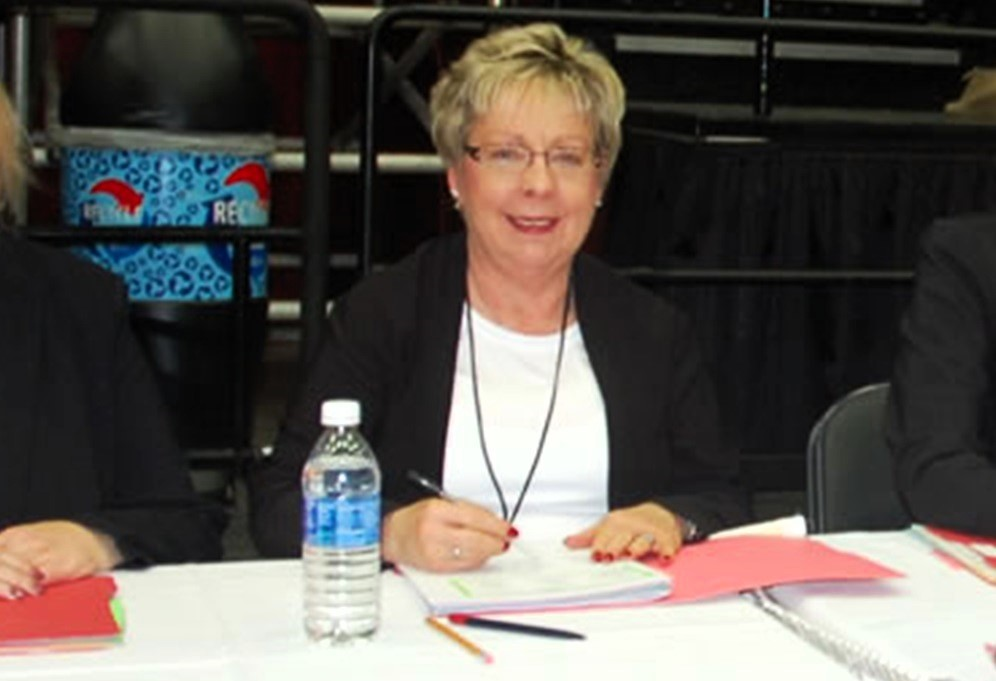
PHOTO: Candy Cox prepares to judge during the 2018 MHSAA Competitive Cheer Finals. (Photo courtesy of the Michigan Cheer Judges Association.)