

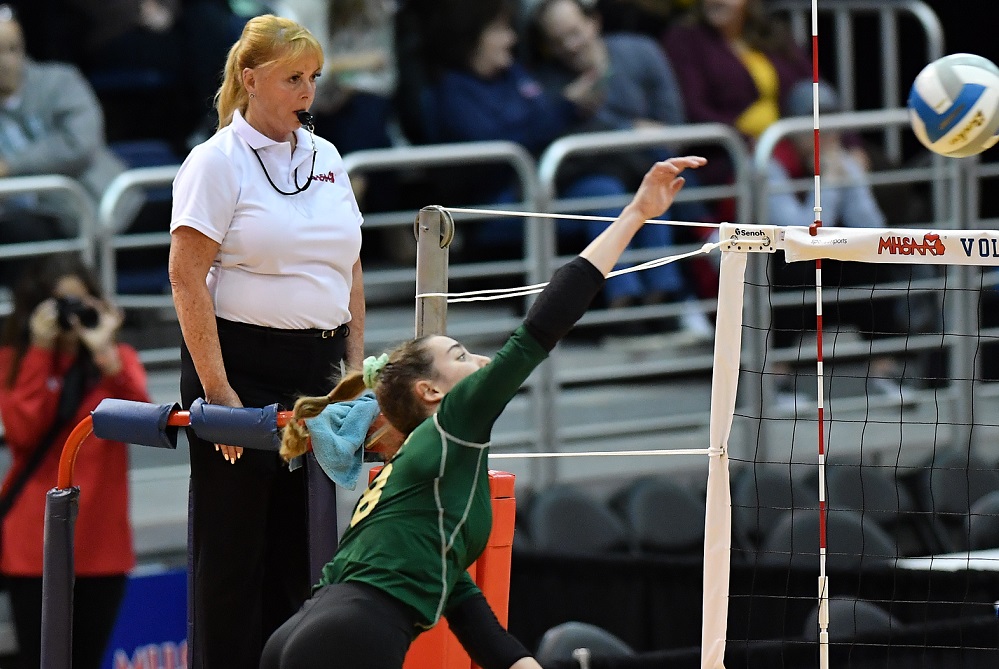
Be the Referee: Volleyball Obstruction
By
Brent Rice
MHSAA Assistant Director
September 23, 2021
Be The Referee is a series of short messages designed to help educate people on the rules of different sports, to help them better understand the art of officiating, and to recruit officials.
Below is this week's segment – Volleyball Obstruction - Listen
Ever wonder why in volleyball some balls hit into obstructions remain in play, while others are replayed, and some end the rally?
If a ball hits an obstruction over a playable area during a rally, and then is played by the same team, it has the same status as any other hit. However, that isn’t the case in all other instances.
If the ball hitting the wall or an object attached flush to the wall doesn’t actually interfere with a player’s legitimate effort to play the ball, the ball is dead and a loss of rally and point shall be awarded. If it does interfere with the playing of the ball, a replay is declared if the wall is less than six feet from the boundary.
If the ball hits a suspended backboard over the playable area, a replay will be declared as long as the referee believes the ball would have remained in play. Serves that hit any obstruction are a loss of rally and point.
Previous editions
Sept. 16: Catch or No Catch - Listen
Sept. 9: Intentional Grounding – Listen
Sept. 2: Pass Interference – Listen
Aug. 26: Protocols and Mechanics – Listen
What's My Why: Official Robert Williams
July 1, 2026
Robert Williams, Redford
Williams officiated 52 years total through his final football season in 2023, also contributing in basketball, baseball and softball during his highly-respected run. He received the MHSAA's Vern L. Norris Leadership in Officiating Award in 2011 for his contributions not only as one of the best on the field but to mentorship and education of officials, and multiple Norris winners since have recalled his support as they were beginning their own legendary careers making the call.
My dad was a coach, so there had to be some adversity in the house. So I had to become an official, but that actually helped me.
I loved officiating because of the fact that I’m with the kids, I can give back to the game, I’m right there – best seat in the house. You see the best games whenever you officiate, because the kids are there.
It’s just helping the kids out and helping the sports that you officiate.
“What’s My Why” is a weekly feature telling the stories of MHSAA-registered officials in their own words. If you’re an MHSAA official and would like to share your reason why, please submit a 15 to 45-second video, taken horizontally, to director of officials Sam Davis at [email protected].
Don't miss Officiate Michigan Day 2026, July 25 in Grand Rapids! Check out MHSAA.com/OMD to register and learn more.
What's My Why
June 24: Will Godfrey, Jackson - Watch
June 19: Jarrett Skorup, Midland - Watch
June 12: Brady Driver, Sturgis - Watch
June 8: Cindy Tyzo, West Bloomfield - Watch
June 3: Jeff Spedoske, DeWitt - Watch
June 1: Mike Carrier, Commerce Township - Watch
May 27: Stan Wright, Warren - Watch
May 26: Murray Rose, Zeeland - Watch
May 22: Mike VanLaan, Alto - Watch
May 18: Clint Abbott, Newaygo - Watch