


MHSA(Q&A): Grand Ledge Gymnastics' Duane Haring
March 15, 2012
 Duane Haring first took over the Grand Ledge gymnastics program in 2002 because his daughter Allison and her friends kept asking. He left to work as an assistant coach at Michigan State from 2005-06 -- but realized Allison and her teammates were on to something.
Haring returned to the Comets in 2006-07, and last weekend led them to a record fifth-straight MHSAA team championship. Grand Ledge senior Christine Wilson and junior Sara Peltier also won the Division 1 and 2 individual titles, respectively, making it two straight seasons Grand Ledge has swept all three competitions.
This winter's Team Final came down to Grand Ledge's last apparatus, bars, after a below-expectations performance on vault. But just as they have for a decade, Haring's Comets came through when it counted. And although Allison graduated nearly a decade ago, Duane plans to keep the winning streak rolling for years to come.
What was the conversation you had between your third and four apparatus? How would you paraphrase it?
I was sitting with the parents and I told them I was really angry because we can vault. We're a good vaulting team. I think we're the best vaulting team in the state, and we didn't do it. So I told them I just have to go for a walk, because I can't talk to them right now. I started to walk way, and I thought, “Oh yes I can.” I dragged them off the bleachers, and went out in the hallway. Trust me; they were wide awake for bars. They understood, loud and clear.
I know what they can do. All year I've been waiting for them to do bars like that.
Are all these championships different for you, or are they the same?
They're all nerve-wracking. This is supposed to be fun ... (he laughed). It's nerve-wracking.
How do you get them to come back and want to do six?
We lit a fire under them when we first did this. The community loves these guys. Most communities talk about football and basketball, and they still do. But more and more people in Grand Ledge talk about gymnastics. Almost everywhere you go, how about that gymnastics team? They're 75-0 ... that's in the paper, and people pay attention to that. They're into their gymnastics team in Grand Ledge.
Does this make you happy you came back and did this a second time?
It does. I'm glad. It's a good fit for me.
Comets Vault to Record 6th MHSAA Title
March 8, 2013
By Geoff Kimmerly
Second Half editor
CANTON – Grand Ledge’s gymnasts knew what was at stake as they warmed up for their last rotation of the MHSAA Team Final on Friday.
And they realized how much more would be lost if they didn’t rally one more time this season.
A streak of 92 straight victories over nearly six years had to weigh heavily upon their shoulders. Not that anyone at Plymouth High School could tell from the way the Comets vaulted to finish their run at a sixth-straight MHSAA title.
With Canton – runner-up the last two seasons – waiting to move up if Grand Ledge erred, seniors Lauren Clark and Sara Peltier came back from falls during warm-ups to land vaults of 9.6 and 9.525, respectively. Instead of falling back, the Comets nearly tripled their 1.375-point lead to finish with a score 149.350 and another championship.
“We knew we all had to nail vault to be able to win. We knew we all had to land on our feet,” Clark said. “We knew it was tight, but we still knew we could do it. So I think during vault warm-ups, we kept our heads together, talked calm. We knew what we had to do.”
 And the Comets have done more than any gymnastics program in MHSAA history.
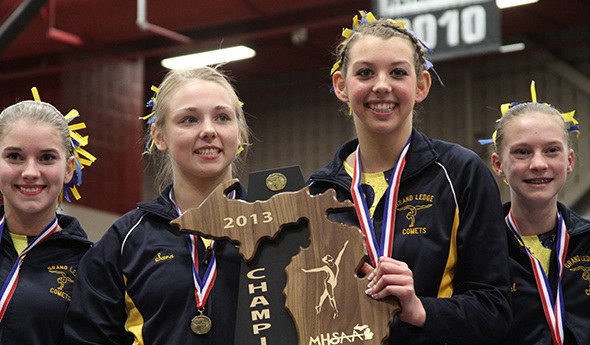
Grand Ledge became the first to win six straight titles after coming into this season tied with Ludington’s 1975-79 teams for the longest Finals win streak.
With their sixth-straight Division 1 individual champion graduated last spring, and three freshmen entering the lineup this winter, this was the season the Comets were supposed to be nervous.
Instead, they won this Final by their largest margin of the six.
“Our other ones, we had kids who came in with pretty good experience. All we did was up their values so they would score better,” Grand Ledge coach Duane Haring said. “This year we put three freshmen out there. To put freshmen out there to score well, especially against teams like Canton, Farmington, Rockford … I wasn’t sure what we were going to do. I was hoping to get 149s, but that was my goal. I wasn’t sure it was going to be possible.”
But he knew his team would be strong on floor. And he knew they could vault.
Grand Ledge finished first on all four apparatuses Friday, but by more than a point on those two – placing 1.425 better than the field on vault with a score of 37.975, and 1.375 better than the rest on floor with a score of 38.300.
Peltier – last season’s Division 2 individual champion – had the high all-around score Friday among those who competed in all four events, with a 38.250. Junior Presley Allison was right behind with a 38.000, followed by freshman Rachel Hogan at 37.250 and Clark at 35.850.
Neither senior experienced a team loss during their high school careers.
“We were really relaxed; last year we were pretty stressed,” Peltier said. “We just knew if we tried our best, everything would be fine.
“It was a great goal, and we achieved our goal, and we all feel really completed.”
In finishing runner-up for the third straight season, Canton put up a courageous effort despite falls on beam and bars.
 At the end of Jocelyn Moraw’s bars routine, coach John Cunningham leaned in close and told her he was proud of his standout sophomore – who competed with a painfully strained hamstring and a sore back.
Still, she finished with an all-around score of 36.500 to follow up junior teammate Melissa Green’s 37.100. Junior Erica Lucas posted a 35.725.
“You can’t say that they didn’t gut it out and do the best they could,” Cunningham said. “We just didn’t have a great meet. You can’t (fall) if you want to beat Grand Ledge; they’re just that good."
Canton’s season could be next, as only senior Nicole Lasecki graduates from a team that had two freshmen and two sophomores compete Friday, and had two more freshmen who didn't but regularly have broken 9.0 this season.
Grand Ledge will have a challenge ahead, with the one-two captain punch of Clark and Peltier gone.
“They can do it again if they all just stay together, do what we did this year, and keep their confidence level up and their heads held up high,” Clark said. “They’re a great group of girls, even without me and Sara. And the juniors this year will be great captains next year.”
Canton finished with a team score of 145.750, followed by Farmington’s 141.475. Junior Meredith Jonik scored 36.000 all-around and freshman Carina Wright scored 35.975 for Farmington. Freshman Morgan Korf scored a 36.650 to lead fourth-place Rockford/Sparta.
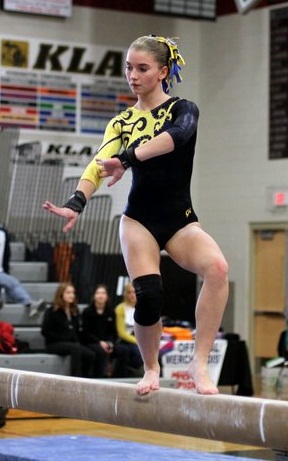
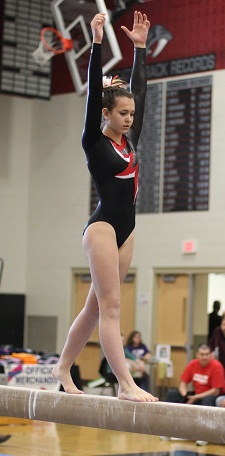
PHOTOS: Seniors Sara Peltier (left holding trophy) and Lauren Clark (right holding trophy) captained Grand Ledge's sixth-straight championship team this season. (Middle) Comets junior Presley Allison posted an all-around score of 38.000 on Friday. (Bottom) Canton freshman Maddie Toal scored a 9.475 on beam for the runner-up Chiefs. (Photos by Gregory Long. Click to see more from HighSchoolSportsScene.com.)