


MHSA(Q&A): Grand Ledge Gymnastics' Duane Haring
March 15, 2012
 Duane Haring first took over the Grand Ledge gymnastics program in 2002 because his daughter Allison and her friends kept asking. He left to work as an assistant coach at Michigan State from 2005-06 -- but realized Allison and her teammates were on to something.
Haring returned to the Comets in 2006-07, and last weekend led them to a record fifth-straight MHSAA team championship. Grand Ledge senior Christine Wilson and junior Sara Peltier also won the Division 1 and 2 individual titles, respectively, making it two straight seasons Grand Ledge has swept all three competitions.
This winter's Team Final came down to Grand Ledge's last apparatus, bars, after a below-expectations performance on vault. But just as they have for a decade, Haring's Comets came through when it counted. And although Allison graduated nearly a decade ago, Duane plans to keep the winning streak rolling for years to come.
What was the conversation you had between your third and four apparatus? How would you paraphrase it?
I was sitting with the parents and I told them I was really angry because we can vault. We're a good vaulting team. I think we're the best vaulting team in the state, and we didn't do it. So I told them I just have to go for a walk, because I can't talk to them right now. I started to walk way, and I thought, “Oh yes I can.” I dragged them off the bleachers, and went out in the hallway. Trust me; they were wide awake for bars. They understood, loud and clear.
I know what they can do. All year I've been waiting for them to do bars like that.
Are all these championships different for you, or are they the same?
They're all nerve-wracking. This is supposed to be fun ... (he laughed). It's nerve-wracking.
How do you get them to come back and want to do six?
We lit a fire under them when we first did this. The community loves these guys. Most communities talk about football and basketball, and they still do. But more and more people in Grand Ledge talk about gymnastics. Almost everywhere you go, how about that gymnastics team? They're 75-0 ... that's in the paper, and people pay attention to that. They're into their gymnastics team in Grand Ledge.
Does this make you happy you came back and did this a second time?
It does. I'm glad. It's a good fit for me.
Heartfelt Thanks for a Life Saved
By
Geoff Kimmerly
MHSAA.com senior editor
November 13, 2012
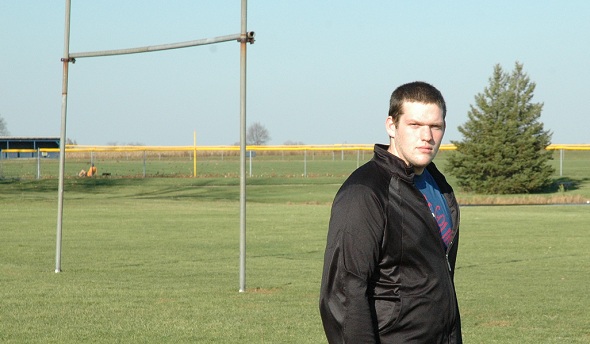
ELSIE – Like many who have played high school football, the practice field will always be more than just another piece of lawn to Ovid-Elsie’s Chris Fowler.
Over his right shoulder, beyond a few of the fields that surround his high school, sits his family’s house. To his left is the finish to the school’s cross country course his younger sister was preparing to run the day his heart stopped beating.
In this spot, on Oct. 9, the 16-year-old Fowler collapsed while he and his teammates ran 40-yard sprints. His heart, for reasons doctors could not explain, went into an irregular rhythm that caused him to go into cardiac arrest.
“It still doesn’t (make sense),” Fowler said two weeks later. “I try to forget it as much as I can. It’s not worth remembering. I don’t want to think about it.”
But the Marauders sophomore will always remember those who brought him back to life that day.
Thanks to the quick, calm response of Ovid-Elsie football coach Travis Long and his staff, and the speedy work of athletic director Sonya Latz to retrieve the school’s AED device, Fowler’s heart was shocked back to life.
Unlike too many national news stories lately of athletes who died far too soon of similar circumstances, this story ends well.
Fowler’s father Dave knows it is because every detail was carried out to perfection. Standing near the cross country finish line, he was there to watch it all.
“Truthfully,” Dave said, “I thought it was the end of my world.”
Trying to remember, trying to forget
Both father and son knew the story of Fennville’s Wes Leonard, who died from sudden cardiac arrest after making the game-winning shot in a basketball game March 3, 2011.
They hadn’t heard of the all-state football and basketball player before that day, but Dave began following the story as it became national news and spurred an effort to have AEDs in every school.
AED stands for automated external defibrillator. The device combats sudden cardiac arrest by detecting an irregular heart beat and delivering a shock that can put the heart back into correct rhythm. Ovid-Elsie High School has two. The first was purchased through the Kimberly Anne Gillary Foundation, which was started after Gillary, a student at Troy Athens, died of sudden cardiac arrest during a water polo game in 2000. The second was donated by alum and former basketball player Daryl Melvin, now a cardiologist in Lansing.
Chris remembers reading about Leonard’s death the day after and thinking there was no way it could happen again to someone like him.
Dave Fowler recounts in his head daily how it nearly did.
The image he can’t get out of his mind is that of Chris’ coaches flipping him over and starting chest compressions.
“It’s just like it was unreal. It was like a bad dream I was waiting to wake up from,” Dave said.
Chris remembers none of it.
He’s a strong student who even before this was considering becoming a doctor. He’s the middle child of three – sister Maria graduated in the spring, and Morgan is in eighth grade. Basketball is Chris’ favorite sport, and he also played soccer growing up – but frequently was carded for running over opponents.
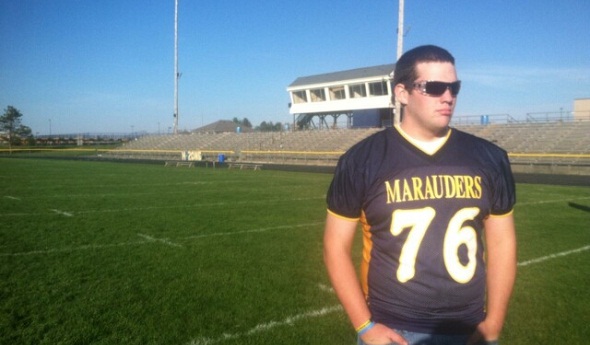 So logically, in eighth grade, he gave football a try. Two years later, at 6-foot-3 and 265 pounds, Fowler was a starting offensive tackle on the varsity.
The Marauders’ Oct. 9 practice was dedicated to defense. Fowler took a shot to the ankle and rolled it, and remembers mentioning it to quarterback Jake Helms. That was probably about 25 minutes before the team began its daily conditioning, a set of 20 short sprints run at half to three-quarters speed.
Dave watched his son run while waiting for Morgan’s race to begin. Her mom Amy was at the starting line, and their grandparents also were in attendance, part of a larger crowd because the cross country jamboree included multiple teams from all eight schools in Ovid-Elsie’s league.
And then shock. “I knew what was going on,” Dave said. “But it was denial that I was really seeing what I was seeing.”
Call to quick action
Suddenly, Chris was face down on the ground.
Only moments later, Long and assistant Brad Sutliff were flipping him over. Long, a physical education teacher at the school, began the chest compressions. Another coach blew breaths into Fowler’s lungs.
Dave, perhaps acting on instinct as much as anything, yelled for anyone to find his wife. He took off toward Latz, who also had made her way to the cross country finish area, yelling for her to get the AED.
Word of Fowler's dire situation quickly made its way through the crowd. The Bullock Creek cross country team, surely among many others, began to pray. And Dave will never forget watching Chris’ teammates, standing a short way off, yell at him, “Don’t give up! Keep fighting!”
Latz, in the school’s Mule utility vehicle, raced to the trainer’s room, grabbed the AED and raced back. A parent from another school who is a nurse asked if she could help and took the AED to the coaches, who connected it to Fowler.
The AED gives the user explicit instructions on how to operate it, including where to attach connections and when to step away as to avoid also receiving a shock.
Sutliff was holding Fowler’s head and didn't want to set it down. But he had to – the shock was so strong it lifted Fowler’s body off the ground.
The jolt also reset his heart.
The next thing Fowler remembers, he was in the ambulance on the way to Sparrow Hospital in Lansing, vomiting. And he couldn't see. He flashed his hand in front of his face, trying to find it. It was then that he found out his heart had stopped.
After a night at Sparrow, Fowler was taken to the University of Michigan’s C.S. Mott Hospital, where he spent five days. Fowler went through the battery of tests. No problems were found. The family doesn't have a history of heart trouble. Doctors said there were no blockages.
“They said basically that it’s a miracle. There are no side effects, none whatsoever,” Dave Fowler said. “No heart damage, no organ damage. The neurologist said his brain function is perfect; there’s nothing wrong with it. And they all say that stems from the quick reaction from the coaches. … The doctor said he’s never seen chest compressions done that well.”
Ovid-Elsie has a disaster plan in place for situations like these, but had never had to put it into play for a life-threatening situation as long as Latz has been part of the athletic staff – dating back to her first year coaching in 1989.
It went off without a hitch. The whole process of starting compressions, retrieving and hooking up the AED and restarting Fowler’s heart took maybe a bit more than five minutes.
“The coaching staff is amazing, how smooth and calm everybody kept just to do their jobs. I’m just amazed,” Latz added. “I shouldn't say ‘amazed.’ Because I trust that they are very good. I’m just proud of the way they handled everything.”
She added that Ovid-Elsie’s National Honors Society has asked about raising funds to purchase an AED for a school that doesn't have one.
Many thanks to give
Fowler wears two bracelets he received while at U-M. One reads “Hearts working together,” and the other “And the beat goes on.” He was considering becoming a neurologist some day, but now cardiology seems pretty cool.
 Fowler’s friends don’t ask much about that day. They know he’s trying to block it out of his memory. But others do ask the “ridiculous questions. Like, you know, what did it feel like to be dead?”
His response: “I just say I wasn't getting oxygen to my brain, so I don’t remember anything.”
The questions don’t make him angry. It’s easy to figure out quickly that Fowler is the type to let such things just roll off.
When Fowler does hear his story re-told, he feels like it’s about someone else.
But he’s a smart guy, and he’s heard enough doctor talk to understand what’s going on.
The biggest bummer is he can’t play basketball. His career in contact spots is over. That leaves golf, and he might take it up eventually. This winter, he’s going to be on the bench with his varsity teammates and he’ll help with the freshmen team and perhaps Morgan’s eighth-grade team too.
He still sounds like a football player. “It’s a lame scar,” he said of the small cut under the front of his left shoulder. Embedded in a “pocket” under his skin on the left side of his chest is an implantable cardioverter defibrillator – or ICD – meant to automatically shock his heart back into rhythm if it falls out of beat again.
Fowler came back for a football practice before the Marauders season ended, and also for the parents’ night game. He’ll still be part of that program next year too. “The joke around town is I’ll be the offensive coordinator,” Fowler said.
Dave still asks himself the what-ifs of that day. He looks at his family differently. Too many times during the day he pictures those chest compressions. It’s hard for him to leave home, and he doesn't sleep well. And he’s pretty sure Chris is getting tired of his parents peeking into his room at night to make sure all is well.
Perhaps. But Fowler also has never been one to take anything for granted – although that’s another part of what makes this situation tough. He’s always one to show gratitude, but he can’t remember right now all the people he’d like to thank. He’s just doing his best.
“I can’t remember. There are so many people. I saw some people at the football game, and I just walked up and said thank you,” Fowler said. “Because they were there, praying for me or whatever.
“I’m very fortunate. It’s unbelievable.”
Click to see more from the Wes Leonard Heart Team or the Kimberly Anne Gillary Foundation.
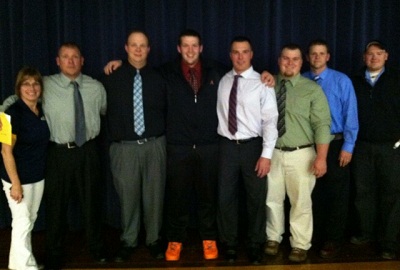
NOTE: Chris Fowler's parents Dave and Amy would like to give special thanks to those pictured with their son (in suit and orange shoes) above: athletic director Soni Latz and football coaches Brad Sutliff, Eric Jones, Jeremy Palus, Cody Staley, Travis Long and Dustin Thiel.
PHOTOS: (Top) Chris Fowler stands in the place on Ovid-Elsie's practice field where coaches worked to restart his heart on Oct. 9. (Middle) Fowler, in his game jersey, stands on Ovid-Elsie's football field. (Bottom two photos courtesy of the Fowler family.)