


Be the Referee: Tripping in Ice Hockey
January 10, 2019
This week, MHSAA officials coordinator Sam Davis explains another of the most misunderstood rules in high school sports – this one concerning tripping in hockey.
Be The Referee is a series of short messages designed to help educate people on the rules of different sports, to help them better understand the art of officiating, and to recruit officials.
Below is this week's segment – Tripping in Hockey - Listen
Today, we’re in our series of the most misunderstood rules in high schools sports, and we’re going to talk about tripping in ice hockey.
In high school hockey, a player intentionally leaving his or her feet and knocking an opponent down is tripping – even if the puck hits the player leaving his or her feet.
This is different than the professional interpretation and frustrates amateur officials at all levels. A player can dive and legally knock the puck off the opponent’s stick, but if on the follow-through cuts down the opponent – it’s a trip. A dangerous play, pure and simple.
Past editions
January 3: Sliding in Basketball - Listen
December 27: Stalling in Wrestling - Listen
December 20: Basketball: You Make the Call - Listen
December 13: Basketball Uniform Safety - Listen
December 6: Coaching Box Expansion - Listen
November 29: Video Review, Part 2 - Listen
November 22: Video Review, Part 1 - Listen
November 15: You Make the Call - Sleeper Play - Listen
November 8: 7-Person Football Crews - Listen
November 1: Overtime Differences - Listen
October 25: Trickery & Communication - Listen
October 18: Punts & Missed Field Goals - Listen
October 11: What Officials Don't Do - Listen
October 4: Always 1st-and-Goal - Listen
September 27: Unique Kickoff Option - Listen
September 20: Uncatchable Pass - Listen
September 13: Soccer Rules Change - Listen
September 6: You Make the Call: Face Guarding - Listen
August 30: 40-Second Play Clock - Listen
August 23: Football Rules Changes - Listen
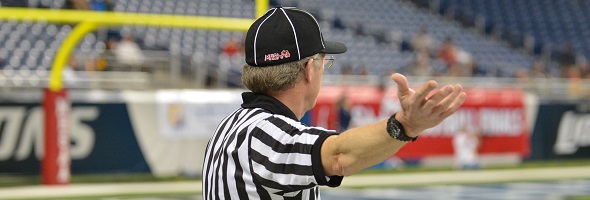
Be the Referee: Covering Knees
September 8, 2016
This week, MHSAA assistant director Mark Uyl explains the increased focus on making sure knee padding is worn correctly in football.
Be The Referee is a series of short messages designed to help educate people on the rules of different sports, to help them better understand the art of officiating, and to recruit officials.
Below is this week's segment – Equipment Covering the Knees - Listen
Everything in the game of football, from a rules-making perspective, starts and ends with an increased focus on player safety.
One big point of emphasis for the 2016 season centers on equipment being worn properly by all players. Too often we see college and pro players, especially those at the skill positions, wearing football pants that come nowhere close to covering the knee area.
With a continued focus on all high school players to lower the target zone when hitting an opponent to keep the head out of football, kids must wear pants with knee pads which completely cover the knee area to avoid those types of injuries.
Past editions
Sept. 1: Play Clock Experiment - Listen
Aug. 25: Clipping in the Free Blocking Zone - Listen