

Brighton 'Connects' For Repeat Run
April 12, 2018
By Geoff Kimmerly
Second Half editor
In the moment, Brighton’s run last month to its latest Division 1 ice hockey championship felt a lot like the successful title chases in 2012, 2013 and 2017.
 But now that the most recent victory has had some time to marinate, there’s no question – what the Bulldogs accomplished to close this winter was just a little different.
One team generally isn’t a measuring stick for the rest. But most aren’t the Detroit Catholic Central hockey program. The Shamrocks entered the Division 1 Semifinals on March 9 at USA Hockey Arena perfect against in-state competition this winter and riding a six-game shutout streak that began with an 8-0 win over eventual Division 2 champion Hartland. DCC had won 10 of the last 18 Division 1 titles and finished runner-up in 2017 to Brighton, the last Michigan high school team to topple the Shamrocks.
DCC wasn’t expected to have trouble this time – many of its scores against other top Michigan teams this season were jaw dropping. And Brighton, although the reigning champion, had lost twice to Hartland this winter, and the Eagles clearly had their troubles with the Shamrocks.
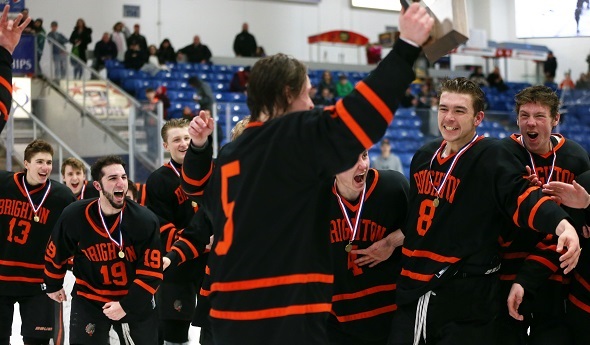
Yet the Bulldogs believed, and they pulled it off – avenging an earlier 3-0 loss and stunning the top-ranked Shamrocks 2-1 in a Semifinal. Emotionally running toward empty, the MHSAA/Applebee’s March “Team of the Month” then came back the next day and defeated Saginaw Heritage 5-2 to repeat as Division 1 champion.
“Catholic Central always has been the team. Just look at what they’ve accomplished,” Brighton coach Paul Moggach said. “That’s the bar. You can get over it once in a while. But we’re starting to feel like we are at that level … that maybe we can be that team. The belief in yourself maybe has arrived, that we’re good enough to do this on a regular basis.”
Brighton, which entered the postseason ranked No. 3 in Division 1, finished 25-6-1 this winter. Its lone losses were to DCC on Dec. 16, twice to league rival Hartland, and once apiece to Northville, Livonia Stevenson and Cleveland St. Ignatius.
The Bulldogs are used to facing Orchard Lake St. Mary’s and then DCC during the Division 1 tournament – they previously beat DCC in the 2013 and 2017 championship games and finished runners-up to the Shamrocks in 2014 and 2016. This time, Brighton beat No. 2 St. Mary’s 3-1 in a Regional Final and got DCC one game earlier than usual.
Boasting 10 seniors – including four who had goals or assists in the 2017 Final – Brighton took on the underdog “mask,” as Moggach put it, but despite the expected nerves also had “an incredible level of confidence in ourselves and to give to each other.”
Seniors Adam Conquest and Mathew Kahra scored Brighton’s goals in the Semifinal, both on power plays, and Kahra scored again in the championship game. Sophomore Will Jentz had two goals in the Final, and junior Evan MacDonald and freshman Nate Przysiecki both added one. Junior goalie Harrison Fleming had a combined 44 saves on 47 shots over the weekend.
With time to reflect the last few weeks, Moggach has begun to notice a few things about this run that maybe didn’t pop out entirely at the time – like Brighton’s incredible 17-2 record in road or neutral-site games. He also is able to look back fondly on the “connection” among members of this team – something built on the ice, sure, and during trips like the one to the Upper Peninsula featured on Second Half in January. But he found it created most during off-ice strength and conditioning workouts where a culture of togetherness was emphasized and formed – and that surely paid off in last month’s repeat rise.
“That’s the difference maker,” said Moggach, who has led the program 23 seasons. “I’ve been around the game a long time. I think early in my coaching career, and in most coaching careers, you’re figuring out how to get the Xs and Os done, figuring out power plays and penalty kills and things. And then, how to beat teams (that are more) talented.
“But how to bring it together, it’s a maturation of ideas. … The last couple of years, we’ve really built to a point; we put the work in, we enjoy each other, we complement each other, and I think that brings connections. Then we do things like the trip to the U.P. – we’re not celebrating ourselves, but each other. You start giving more to each other, it comes back in spades, and we’re realizing that as a group and as a program.”
Past Teams of the Month, 2017-18
February: Marquette girls and boys skiing - Report
January: Sterling Heights Stevenson competitive cheer - Report
December: Cadillac boys bowling - Report
November: Ottawa Lake Whiteford football - Report
October: Beaverton volleyball - Report
September: Shepherd girls golf - Report
PHOTO: Brighton co-captain Sam Brennan (5) presents the championship trophy to his teammates after last month’s Division 1 Final at USA Hockey Arena.
Port Huron Unified Providing Opportunity
By
Paul Costanzo
Special for MHSAA.com
December 4, 2019
Growing up in Yale, Trevor Sugars never thought about playing high school hockey. He bounced around Sanilac, St. Clair and Lapeer counties finding house leagues to stay involved in the sport he loved, as Yale didn’t have a team.
But a year ago, thanks to an expansion of the Port Huron Unified cooperative team, a new option arose, and Sugars has taken full advantage.
“This is great for Yale because we get to come out and have a hockey team, and younger kids can get into the sport of hockey,” said Sugars, a junior defenseman. “They’re able to go further without having to pay all the money for AAA.”
Three players from Yale and six players from St. Clair join the 11 from Port Huron in donning the Big Reds jersey this season. It’s the fourth that Port Huron has collaborated with East China School District – St. Clair and Marine City – and the second it has collaborated with Yale. The collaboration has given players from those schools an opportunity they wouldn’t otherwise have, while saving the Port Huron program.
“I went to a coaching clinic before the season started, and we actually had a roundtable about unified hockey programs,” Port Huron coach Ben Pionk said. “It was kind of interesting, because we all had one common theme. Most of us were all there for survival. That’s why we’re unified. A lot of the teams were in the same boat. Some of the other unified programs, they have like seven schools and you’re getting two kids from each school just to make a team. Honestly, it was all for survival, and that was solely ours. It wasn’t to build a superpower team; it was to make sure we had a team we could even put on the ice.”
Pionk has been at Port Huron for two decades, most of which spent coaching a team solely from his school. But numbers began to dwindle not long ago, threatening the future of the program.
“I can’t remember what year it was, but we had tryouts and I had eight kids standing here,” Pionk said. “I went to our former athletic director and talked to him and said, ‘What do you want us to do here? You really can’t put a program on the ice.’ We actually started the season that way and then we picked up a few more; I think we ended up with 12 that year. We got through the year, and kind of the next year was the same way. You go back four or five years and people weren’t working a lot, so what are you going to do? Are you going to play hockey or pay your bills?”
Not only was it hard to be competitive with so few players, but Pionk was worried about the safety of his players, who were forced to take longer shifts. He said he knew there were players in St. Clair – a school that had a program through the 2012-13 season – so Port Huron became a unified team for the 2016-17 season.
It didn’t happen overnight, but the team has now nearly doubled in size.
 “Even after the first year or so of being unified with St. Clair, we still weren’t getting really good numbers,” Pionk said. “We just found that a lot of the older kids down there had been with their teams, and at this point they were established where they were and didn’t want to leave to come play high school hockey. They would love to have played high school hockey but didn’t want to leave at that point. Through Port Huron Minor Hockey’s help, they knew there were a couple kids in Yale who had kind of aged out and weren’t going to have anywhere to play, so we kind of approached their school about it and next thing you know, we had Yale as well. Now, a few years into it everybody knows we’re unified and the kids are coming out. We have 17 skaters and three goalies this year.”
The six players from St. Clair this season make up the biggest group Port Huron Unified has brought in from another school besides Port Huron High. While they may have grown up expecting to one day be Saints, they’re grateful for the opportunity they now have.
“The high school experience is so much fun,” said Duncan McLeod, a junior defenseman from St. Clair. “It’s just fun to play for something – something big.”
While players from out of town are excited about a newer opportunity, those within the program are excited to see their team growing again.
“My freshman year, my sophomore year, we were really struggling on numbers,” Port Huron junior Kevin Schott said. “It was tough having to double shift a lot and pretty much play wherever Coach needed you to play. This year I was really excited to hear that we had a lot of kids coming from St. Clair and Yale – some better skating kids that I knew had played travel. So, I was really super excited to see that we were going to have a full and deep team this year.”
With all the new faces and multiple schools combining to create one team, not a lot of the players had played with one another prior to high school. That hasn’t been an issue, though.
“We all came together real quick, because we all know how to play hockey – we've all been playing hockey for at least four years,” Sugars said. “We all know our positions, got together and figured it out.”
This year’s team has already enjoyed as much success as any of its unified predecessors. The Big Reds opened the season with a pair of wins, eclipsing last year’s win total (one).
“We’re trying to be at least .500 this year,” Sugars said. “I wanted to be the best Yale high school team, but we already did that.”
A flu bug hit the team right before Thanksgiving, which didn’t help during a busy week. But even sitting at 2-3, there’s optimism about the season and the future, as without a senior on the roster, there’s a possibility everyone could come back next year.
“It’s looking positive for the year,” McLeod said. “We have a good team going.”
 Paul Costanzo served as a sportswriter at The Port Huron Times Herald from 2006-15, including three years as lead sportswriter, and prior to that as sports editor at the Hillsdale Daily News from 2005-06. He can be reached at [email protected] with story ideas for Genesee, Lapeer, St. Clair, Sanilac, Huron, Tuscola, Saginaw, Bay, Arenac, Midland and Gladwin counties.
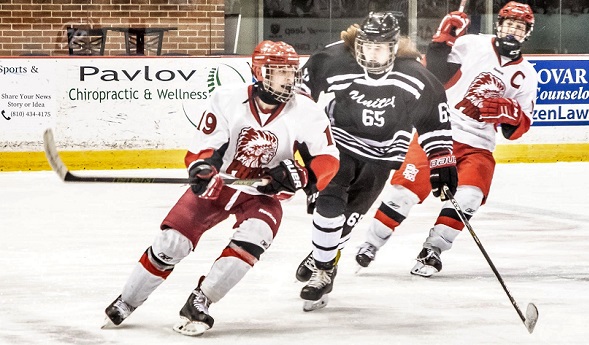
PHOTOS: (Top) Port Huron Unified’s Noah Gunderson (19) is among Port Huron High School students who help make up the program again this winter. (Middle) Duncan McLeod, a St. Clair student, controls the puck. (Photos by Jeremiah May.)