

DCC Follows New Leader to 3rd Straight D1 Win
March 12, 2016
By Bill Khan
Special for Second Half
PLYMOUTH — The biggest challenge to Detroit Catholic Central's hockey dominance has come from within.
For the third straight season, the Shamrocks took the ice this winter while trying to adapt to the demands of a new head coach.
No worries. Because, for the third straight season, the Shamrocks are the MHSAA Division 1 champions.
Top-ranked Catholic Central controlled the game from start to finish to beat second-ranked Brighton, 3-0, on Saturday at USA Hockey Arena in a championship matchup featuring the two teams that have won 13 of the 17 Division 1 crowns.
Catholic Central (24-7) has won 10 of those titles under the guidance of five head coaches. Brandon Kaleniecki helped begin that run as a senior with the Shamrocks in 2000 and kept it going as a first-year head coach this season. He followed in the footsteps of Doug Itami, coach of the 2013-14 team, and Danny Veri, coach of the 2014-15 squad.
"There are some differences, but a lot of similarities," senior forward Brian Kearns said of the three coaches for whom he's played. "They're all preaching the same stuff. They all preach to play as hard as you can. You've got to play for the two Cs on your chest. They were all different, but they were all great in their own way and they all added a piece to the puzzle to go win three. It was huge for us. Coach Kal was the perfect coach to finish it all off."
Kaleniecki credited the leadership of Kearns and fellow captain Nick Macari for making his job easier as he took over one of Michigan's iconic hockey programs.
"They were without a doubt my best ally in terms of coming in this year," said Kaleniecki, an all-state forward for the Shamrocks in 1999-2000. "These are two guys who have been around the program. They've had three different coaches. They could've made things real challenging for me. Instead, they made it absolutely phenomenal. Anything I needed, I could tell them and it was done. The reason we're here is because of guys like this. We can point them in the right direction, but they're the guys driving it."
Having a background in the Catholic Central program helped each of the three coaches gain credibility with the players. Itami was an assistant coach, while Veri coached the junior varsity team.
"It's a good thing knowing our coaches have been in our shoes before," Macari said. "They have that experience. They know what they're talking about. We know we can listen to them, because they're telling us the right things to do."
The championship was the 13th for Catholic Central, moving the Shamrocks within one of Trenton for second-most in MHSAA history. Bloomfield Hills Cranbrook Kingswood holds the record with 17.
It was the 10th time out of those 13 championship victories that the Shamrocks won by at least three goals. They outshot Brighton, 29-15.
"They were just all over us," Brighton junior Jake Crespi said. "Positionally, they were great. Every time we would touch the puck, there were two guys on us."
Crespi gave Brighton (22-9) its best chance to grab some momentum when he was awarded a penalty shot with 11:44 left in the first period. Crespi, who shared Brighton's goal-scoring lead with 20, was slashed from behind on a shorthanded breakaway. He tried to get the puck between the pads of Alec Calvaruso on the penalty shot, but the senior goaltender closed off the opening to make the save.
 "I was going to go five-hole on the breakaway, also," Crespi said. "I had my mind set when I was going out there; I should've buried it. I think it could've been a different game if I could've put that one away for the boys. Maybe we'd have some momentum going."
The game remained scoreless until Glynn Robitaille pounced on a loose puck near the crease and scored at 7:56 of the second period. Macari set up the goal by rushing down the left side and putting a shot on the net.
"Coach Kaleniecki always tells me I need to drive the net more often and I need to shoot more often," Macari said. "I kind of listened to what he said; I drove to the net and it worked. It ended up on my player's stick, and he got it in the net."
On a similar rush, Macari made it 2-0 as he buried a shot into the upper-right corner of the net from the left circle with 2:38 left in the second period.
"Same thing," Macari said. "Drive wide and shoot the puck is what he's been telling me to do. I did it and, once again, it worked."
With the shots 23-10 in the Shamrocks' favor after two periods and having been shut out in the teams' regular-season meeting, the Bulldogs faced the daunting task of scoring at least twice in the third.
Catholic Central didn't allow Brighton an opening, making it a 3-0 game on Cody Borke's goal with 15:16 left in the third period.
"We knew we could come back, but that kind of hurt when they got that third one," Brighton defenseman Nick Foran said. "We didn't stop battling, but it didn't exactly boost our confidence."
Brighton was trying to beat a sixth straight ranked opponent in the playoffs. The Bulldogs beat No. 13 Jackson, No. 8 Howell, No. 4 Orchard Lake St. Mary's, No. 11 East Kentwood and No. 6 Grandville before coming up short against the No. 1 Shamrocks.
The Bulldogs didn't score a goal and had only 25 shots on goal in two matchups with Catholic Central this season. The Shamrocks won 3-0 with three third-period goals on Nov. 21.
"Playing six games in two weeks is emotionally and physically draining," Brighton coach Paul Moggach said. "I think it does have an impact mentally and physically when you go to that third period down. It's a lot easier to find your legs if you're in a position to win it; we just never were. After that first period, we tried to find a way, but we weren't finding the opportunities to make a game of it. You've got to give credit to C.C. They played a great game. They beat us twice. We haven't scored a goal and they scored six."
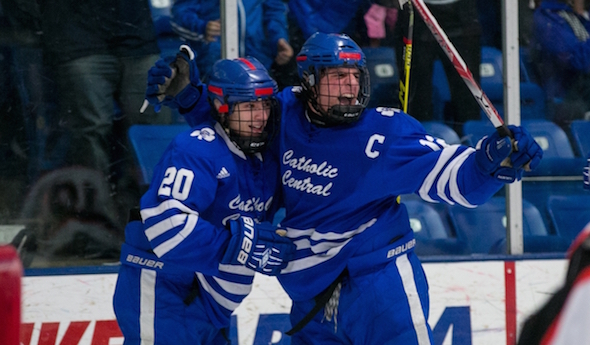
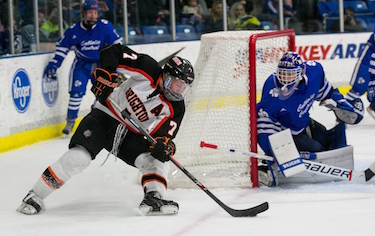
PHOTOS: (Top) Glynn Robitaille (20) and Nick Macari celebrate during Saturday’s Division 1 Final. (Middle) Brighton’s Joey Clifford (7) works to create a shot while DCC goalie Alec Calvaruso blocks the side of the crease. (Click for more from Andrew Knapik.)
#TBT: 2002 Ends with Lights-Out Finals
July 12, 2019
By Rob Kaminski
MHSAA benchmarks editor
The Flint IMA had been to the MHSAA Ice Hockey Finals what Joe Louis Arena was to the Detroit Red Wings since it began hosting high school championships in the state in 1977.
For parts of four decades, the facility set the scene for many memorable moments on ice for scholastic skaters.
So it would have been fitting as the curtain was closing on an era March 9, 2002, if there’d been an overtime championship game or two to commemorate the last MHSAA Finals at the building.
In 2003, the MHSAA Semifinals and Finals would move to Compuware Arena in Plymouth – now USA Hockey Arena – where the event has been played ever since.
There would be no overtimes during the IMA’s swan song, but the arena wasn’t about to let go without a fight. Following the morning’s Division 2 Final, won by Grosse Pointe North over local qualifier Davison, things got strange.
As if by divine intervention, a significant power outage hit the Flint area between the first and second periods of the Division 3 Final, necessitating a return to the building for an encore performance that Monday.
Following is an account from then-MHSAA Assistant Director Randy Allen, administrator of the sport at that time.
 “East Grand Rapids and (Dearborn) Divine Child were between the first and second periods when the power went out at what must’ve been around three in the afternoon. Some of the house lights went on, but there was no huge generator. The power company told us it could be quite a while before the power came back, so the decision was made pretty quickly to come back Monday. (Editor’s Note: MHSAA regulations at that time prohibited Sunday competition, thus play would resume Monday)
“Finishing the game in progress Monday was really a no-brainer, but now there were a couple of immediate challenges. First, how were we going to let people know, and second, what was going to happen to the (Detroit) Catholic Central-Marquette Division 1 game coming up later in the day?
“Well, knowing what I knew about the TV business (Allen’s background in Wisconsin included sportscasting), I grabbed one of the television reporters there, probably from Grand Rapids, and asked him to come down to the ice with me. It was totally dark; I figured once he put his camera lights on, it would get the attention of the crowd, which it did. So there’s about 2 or 3 thousand people in the arena – in the dark – and I’m standing in front of a light from a TV camera, and at the top of my voice I explain the situation and let them know we’re coming back Monday.
“Anyone wanting to come back, admission was free of charge, and we’d trust they were at the game. If they wanted a refund, they could mail their ticket stub to MHSAA and we'd send a refund. We obviously couldn’t use the box office without power. I don’t recall more than a couple dozen refund requests coming to our office later.
“Now the real challenge is the Division 1 game. Marquette very, very much wanted to go home and come back a week later. They’d been on the road all week (Marquette won a Quarterfinal in Traverse City that Wednesday). Jack (Roberts, former MHSAA executive director) was there, and he and Marquette’s AD (Scott Koski) and their superintendent debated a bit. In the end, the regulations of the day were upheld, and the game would be Monday.
“As it turned out, someone in the Marquette entourage had a contact in the Detroit Pistons front office, so the team was entertained in a suite at The Palace of Auburn Hills on Sunday night, so that was quite a happy ending from their standpoint.
“Many of the Marquette people were either in the arena or at a single hotel or two in the area, so alerting them to the change was not difficult.
“But then we started to think, ‘What about the Detroit CC people who would be driving up for their game later? Remember, social media was not as prevalent as it is today, or even the dependence on the internet.
“So, Saturday night, I sat there at the entrance to the IMA with my car running and lights on to inform the CC fans and anyone else who pulled up that the game had changed ... ‘Power’s out; game’s on Monday.’ They'd say thanks, and out they'd go. No one really got angry; there wasn’t anything anyone could do. I sat there an hour and a half with a steady stream, and shortly after the scheduled game time I called it a night.”
And, the IMA called it the end of an era, but not before hanging on for one more night, when Divine Child and Detroit CC would raise the last trophies in that building ... under the lights.
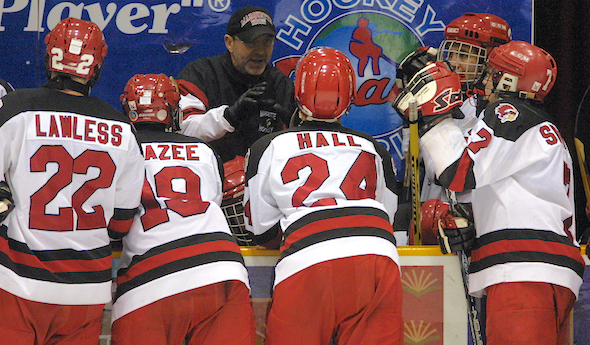
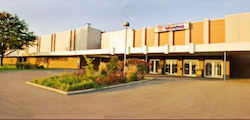
PHOTOS: (Top) Marquette was among teams that needed to stick around Flint two more days to play in the 2002 MHSAA Ice Hockey Finals. (Middle) Flint’s IMA arena.