

Dedication Pays Off With Hartland Title
March 10, 2018
Second Half reports
PLYMOUTH — Josh Albring and Jake Behnke didn’t have to keep playing hockey for Hartland High School.
They were certainly good enough to go back to AAA travel programs, but they never bought into the notion that going that route is the only way to move on in the sport.
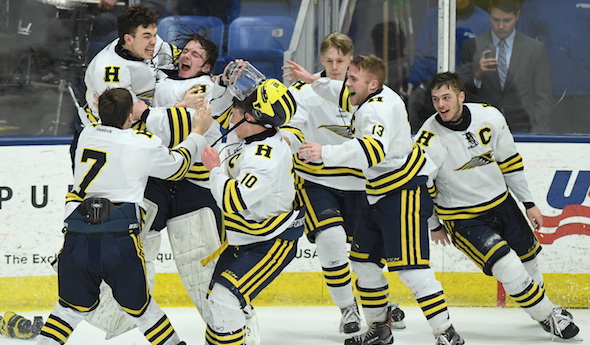
The reward for their loyalty to Hartland came Saturday when the senior centers led the Eagles to their first MHSAA championship after the program had come close each of the past six seasons.
Behnke scored two goals and Albring one in Hartland’s 4-2 victory over 14-time MHSAA champion Trenton in the Division 2 title game at USA Hockey Arena.
Behnke finished with five goals in Hartland’s two games this weekend at USA Hockey Arena, while Albring had a goal and four assists over the Semifinal and Final.
Albring was the first Hartland player to break free from the pile of players in the championship celebration. He headed for the team bench to exchange hugs with the coaching staff.
“I came here my sophomore year,” Albring said. “I had zero confidence in my game and where I was at. All the coaches on the bench I went and hugged today, they’re the only reason we’re here today and they’re the reason I’ll probably play hockey next year. They changed my love for the game, made it so much more fun, so much more enjoyable and easier to learn, too. Everything goes to them. They’re by far the best coaches I’ve ever had.”
It’s hard to believe a player like Albring lacked confidence, considering he made all-state as a sophomore and junior and likely will make it this season after scoring 10 goals and tallying 42 assists.
“He was the same size as a sophomore,” Hartland coach Rick Gadwa said. “He’s a big boy that’s got some puck skills and can play the hard part of the game. Josh didn’t get worse because he scored less goals this year. That guy decided that, as a player, if I’m going to play at the next level, I’m going to have to change my role. He leads our team in blocked shots; he probably leads the state in blocked shots. He doesn’t lose board battles. He’s going to be a guy who somebody is going to be lucky to have next year.”
Behnke, a second-team all-state pick last season, emerged as one of the top players in Michigan this winter. He finished with 35 goals and 21 assists.
 “Jacob Behnke has proved, as well as some other guys, you can play high school hockey and still develop,” Gadwa said. “Jacob Behnke will play junior hockey. He, in my opinion, was the best player in the tournament thus far and will probably finish that way. He’s dominant. To watch where he was his sophomore year, he was always good, to watching him become elite is really a special thing to see. He worked his butt off every offseason and he got better every day from the first day he stepped on the ice.”
Trenton reached its 21st MHSAA championship game by defeating three teams ranked among the top six over five playoff games. The third-ranked Eagles proved to be too much, jumping out to a 4-0 lead after two periods and holding off a late charge by No. 5 Trenton.
“I don’t think anyone gave us much of a shot at the beginning of the year,” Trenton coach Chad Clements said. “To get here, I know all the guys wanted to win, but I was proud of their efforts. They proved a lot of people wrong this year. A couple bad mistakes by us early on, but they never quit battling. I wish it would’ve ended differently.”
Behnke scored the only goal of the first period with 6:58 left when he took a pass from Joey Larson and put a shot up high while falling to the ice.
The biggest period in Hartland hockey history was the second. The Eagles took control of the game by scoring three times in a 7:17 span.
Albring scored with 9:31 left in the period, Behnke scored with Hartland two men short with 3:11 left and Larson made it 4-0 with 2:14 to go.
Nolan Szczepaniak and Brandon Clark had power-play goals to get Trenton within two with 2:05 left in the third period, but the Trojans couldn’t get another puck past Hartland goalie Brett Tome. Tome finished with 27 saves.
“It was hard to battle back,” Clements said. “It just kept getting harder and harder, but they stuck with it. The third period we came out and their goalie played exceptionally well. We just couldn’t get enough past him.”
Trenton allowed only three goals over five playoff games before the Final. Hartland outscored six playoff rivals by a combined 48-4.
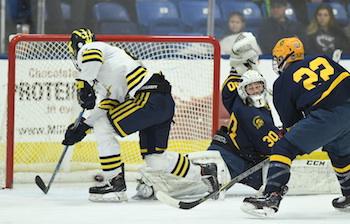
PHOTOS: (Top) Hartland players celebrate their first MHSAA championship Saturday at USA Hockey Arena. (Middle) The Eagles push a goal past Trenton into the back of the net.
Be the Referee: Hockey Rules Chart
February 6, 2020
This week, MHSAA assistant director Brent Rice addresses some of the rules differences between high school and college hockey.
Be The Referee is a series of short messages designed to help educate people on the rules of different sports, to help them better understand the art of officiating, and to recruit officials.
Below is this week's segment - Hockey Rules Chart - Listen
Today we’d like to take a look at some of the differences between high school and college hockey.
• During pregame, the high school coach must meet with officials to verify that all players are properly equipped. There is no such rule in college hockey.
• Hand passes are permitted in the defensive zone in high school hockey, but not in college hockey.
• Goalies may play the puck with a high stick in college hockey, but not in high school hockey.
• A puck directed into the goal with a skate may be allowed in college hockey, but not in high school hockey.
Knowing the rules differences can help you better enjoy watching this sport. You can find the complete chart of rules differences on the Ice Hockey page of the MHSAA Website.
Past editions
Jan. 30: Cheer Safety - Listen
Jan. 23: Goaltending - Listen
Jan. 16: Wrestling Tie-Breaker - Listen
Jan. 9: Pregame Meeting - Listen
Dec. 19: Alternating Possession - Listen
Dec. 12: Ratings - Listen
Dec. 5: Video Review Success - Listen
Nov. 28: More Injury Time - Listen
Nov. 21: Football Review - Listen
Nov. 14: Sideline Safety - Listen
Nov. 7: Officials Playlist - Listen
Oct. 31: Most Important Line - Listen
Oct. 24: Automatic 1st Downs - Listen
Oct. 17: Catch Momentum - Listen
Oct. 10: Golf Rules Changes - Listen
Oct. 3: No Tackle Box - Listen
Sept. 26: You Make the Overtime Call - Listen
Sept. 19: Swimming Finishing Touch - Listen
Sept. 12: Curbing Gamesmanship By Substitution - Listen
Sept. 5: Football Safety Rules Changes - Listen
Aug. 29: 40-Second Play Clock - Listen