

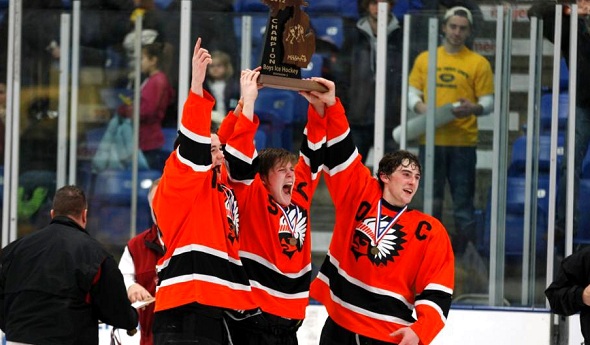
Division 2: This time, it's Brother Rice
March 10, 2012
PLYMOUTH – Mackenzie MacEachern and Thomas Ebbing have known each other since they were 2 or 3. They’ve played hockey on the same teams for five years.
And there was no way they were going to end their final high school game together for Bloomfield Hills Brother Rice with another Division 2 Final loss.
Saturday’s 4-1 championship game win over Grosse Pointe South at Compuware Arena landed the Warriors their first MHSAA title since 2005. And it took root exactly one year ago, when Brother Rice fell to Wyandotte Roosevelt in the Division 2 Final by the same score.
“We weren’t about to face that again this year,” Ebbing said. “So we came out strong, and we won. And that’s all that matters.”
Ranked No. 1 entering the postseason, Brother Rice finished 25-4-1. Two of those wins came over Wyandotte Roosevelt. And all four of those losses came to opponents from the Michigan Interscholastic Hockey League, without question the most competitive in the state featuring many of the top-ranked teams in all three MHSAA divisions – and four of eight Division 1 and 2 Semifinalists this weekend.
The Warriors finished MIHL runner-up to Division 1 Detroit Catholic Central and along the way picked up the patience, puck possession skills and defensive tenacity that paid off through a six-game tournament run during which they outscored opponents 36-5.
“There weren’t a lot of guys in that locker room who remembered last year, but there were five,” said Brother Rice coach Lou Schmidt, Jr., referring in part to captains Ebbing, MacEachern and senior Chris Wilberding. “They said it wasn’t going to happen again.”
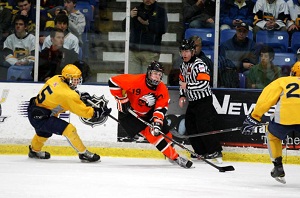 Senior Eric Dibble got Brother Rice on the board 1 minute, 50 seconds in off a pass from junior T.J. Petzold. But Grosse Pointe South (22-6-1) evened the score with a power play goal by junior Jake Cordon with 26 seconds remaining in the first period.
“To have an ever score after the first period was great," Grosse Pointe South coach James Bufalino said. "But we wouldn’t say there was any five minutes where we outplayed them tonight. We lost to a great team."
The Warriors outshot Grosse Pointe South 16-2 in the second period, with junior Russell Cicerone and MacEachern both scoring. Cicerone added another goal with 15 seconds to play.
Total, Brother Rice outshot Grosse Pointe South 38-17. Blue Devils senior Christopher Schebil had 34 saves, including 27 over the first two periods.
"We played a lot of great teams like Trenton and (Grosse Pointe) North," Schebil said. "It seemed like every single one of (Rice's players) was fast, like every single one of them had a fast shot, so it was tough. The shots were coming from everywhere."
MacEachern, a senior who has committed to join Michigan State after a year or two of juniors, finished arguably the best offensive run in the state this season with 42 goals and 48 assists. Ebbing, a junior, added 27 goals and 40 assists.
“We’ve always told the guys, we just want you to continue doing what you’re doing, but do it at a faster level, a higher level,” Schmidt said. “Every practice this year, that’s what we did. We continued working on foot speed, continued working on individual skills so that they were passing the puck into the offensive zone instead of just getting rid of it. In that regard, they got better every game as the season progressed, and we’ve never lost our focus.”
Click for the Division 2 Final box score.
PHOTOS courtesy of Hockey Weekly.
(Top) Brother Rice captains Mackenzie MacEachern (left), Chris Wilberding (center) and Thomas Ebbing hoist the championship trophy after Saturday's win.
(Middle) MacEachern (19) splits Grosse Pointe South defenders Saturday. He scored his 42nd goal of the season in the Final.
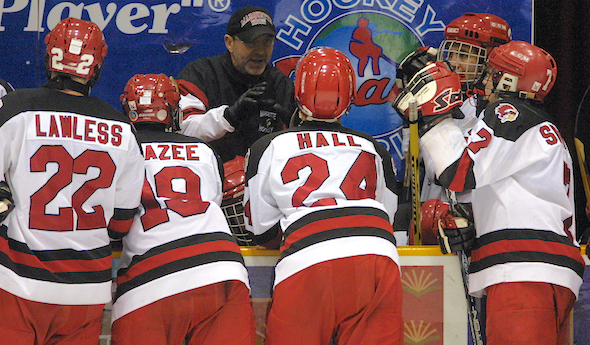
#TBT: 2002 Ends with Lights-Out Finals
July 12, 2019
By Rob Kaminski
MHSAA benchmarks editor
The Flint IMA had been to the MHSAA Ice Hockey Finals what Joe Louis Arena was to the Detroit Red Wings since it began hosting high school championships in the state in 1977.
For parts of four decades, the facility set the scene for many memorable moments on ice for scholastic skaters.
So it would have been fitting as the curtain was closing on an era March 9, 2002, if there’d been an overtime championship game or two to commemorate the last MHSAA Finals at the building.
In 2003, the MHSAA Semifinals and Finals would move to Compuware Arena in Plymouth – now USA Hockey Arena – where the event has been played ever since.
There would be no overtimes during the IMA’s swan song, but the arena wasn’t about to let go without a fight. Following the morning’s Division 2 Final, won by Grosse Pointe North over local qualifier Davison, things got strange.
As if by divine intervention, a significant power outage hit the Flint area between the first and second periods of the Division 3 Final, necessitating a return to the building for an encore performance that Monday.
Following is an account from then-MHSAA Assistant Director Randy Allen, administrator of the sport at that time.
 “East Grand Rapids and (Dearborn) Divine Child were between the first and second periods when the power went out at what must’ve been around three in the afternoon. Some of the house lights went on, but there was no huge generator. The power company told us it could be quite a while before the power came back, so the decision was made pretty quickly to come back Monday. (Editor’s Note: MHSAA regulations at that time prohibited Sunday competition, thus play would resume Monday)
“Finishing the game in progress Monday was really a no-brainer, but now there were a couple of immediate challenges. First, how were we going to let people know, and second, what was going to happen to the (Detroit) Catholic Central-Marquette Division 1 game coming up later in the day?
“Well, knowing what I knew about the TV business (Allen’s background in Wisconsin included sportscasting), I grabbed one of the television reporters there, probably from Grand Rapids, and asked him to come down to the ice with me. It was totally dark; I figured once he put his camera lights on, it would get the attention of the crowd, which it did. So there’s about 2 or 3 thousand people in the arena – in the dark – and I’m standing in front of a light from a TV camera, and at the top of my voice I explain the situation and let them know we’re coming back Monday.
“Anyone wanting to come back, admission was free of charge, and we’d trust they were at the game. If they wanted a refund, they could mail their ticket stub to MHSAA and we'd send a refund. We obviously couldn’t use the box office without power. I don’t recall more than a couple dozen refund requests coming to our office later.
“Now the real challenge is the Division 1 game. Marquette very, very much wanted to go home and come back a week later. They’d been on the road all week (Marquette won a Quarterfinal in Traverse City that Wednesday). Jack (Roberts, former MHSAA executive director) was there, and he and Marquette’s AD (Scott Koski) and their superintendent debated a bit. In the end, the regulations of the day were upheld, and the game would be Monday.
“As it turned out, someone in the Marquette entourage had a contact in the Detroit Pistons front office, so the team was entertained in a suite at The Palace of Auburn Hills on Sunday night, so that was quite a happy ending from their standpoint.
“Many of the Marquette people were either in the arena or at a single hotel or two in the area, so alerting them to the change was not difficult.
“But then we started to think, ‘What about the Detroit CC people who would be driving up for their game later? Remember, social media was not as prevalent as it is today, or even the dependence on the internet.
“So, Saturday night, I sat there at the entrance to the IMA with my car running and lights on to inform the CC fans and anyone else who pulled up that the game had changed ... ‘Power’s out; game’s on Monday.’ They'd say thanks, and out they'd go. No one really got angry; there wasn’t anything anyone could do. I sat there an hour and a half with a steady stream, and shortly after the scheduled game time I called it a night.”
And, the IMA called it the end of an era, but not before hanging on for one more night, when Divine Child and Detroit CC would raise the last trophies in that building ... under the lights.
PHOTOS: (Top) Marquette was among teams that needed to stick around Flint two more days to play in the 2002 MHSAA Ice Hockey Finals. (Middle) Flint’s IMA arena.