

Garofalo: On-Ice Teacher and Recruiter
By
Rob Kaminski
MHSAA benchmarks editor
December 28, 2012
Something caught his eye as Allen Park’s Jim Garofalo circled the Olympic hockey rink in Salt Lake City to familiarize himself with the surroundings prior to the start of play at the 2002 Games.
“When the dimensions of a rink are laid out, everything is measured from the exact center of the ice outward,” Garofalo explains. “Usually there’s a washer or something small under the surface at center ice. All measurements are taken from there.
“Well, in Salt Lake City that year, a Canadian company was hired to prepare the sheets of ice, and they used a Loonie (common term for a Canadian $1 coin) to mark center ice. That year, the Canadians beat the United States in the gold medal game and won the Olympics on U.S. soil. I later visited the Hockey Hall of Fame in Toronto, and that Loonie is there.”
As Garofalo was getting acquainted with Canadian currency, an invitation in his mailbox back home went unanswered. At the time, MHSAA Tournament invitations were still sent by mail, so Garofalo was unaware the Association was awaiting his RSVP to accept his first Finals assignment.
“I was in Salt Lake City and had no idea. Now, of course, everything is online and by email, but that just shows how rapidly technology has progressed in the last 10 years,” Garofalo said. “So, (fellow official) Dan DiCristofaro calls and says something like, ‘Hey, do you want your state final?’ It was pretty funny; the running joke afterward was that you’ve gotta work the Olympics to get a shot at the state finals.”
Of course, that’s not the case. And, if Garofalo had it his way, all hockey officials who worked hard, persevered, paid their dues and set that as a goal would get a shot at the MHSAA Finals.
A 25-year registered MHSAA official who at one time juggled rules books for eight different hockey leagues and has worked four World Championships in addition to the Olympics, Garofalo now works only high school hockey.
“From a selfish standpoint, I suppose, I like a season that has a definite start and end to it,” says the New Boston Middle School social studies teacher, whose resume’ at one point looked like an endless Scrabble hand that included abbreviations for USA, USA Junior, Ontario, East Coast, International, International Independent and Central Collegiate hockey leagues in addition to the MHSAA.
“Being a teacher, there’s so much about the high school game that fits into education,” said Garofalo, now in his 10th year with the New Boston Huron District. “There’s so much to learn, and to help people learn at this level, from a playing and officiating standpoint.
“The people who officiate high school hockey are dedicated to improving, and as a veteran there’s an opportunity to help them learn and advance,” he says. “And, the coaches deserve kudos too. They are usually more professional and ask questions more properly than at other amateur levels. The reason is a direct result of them being accountable. They’ve got to answer to their principal or athletic director. Who are the junior and community league coaches accountable to? No one.”
 And, there’s another allure to the school game compared to which other levels pale.
“The atmosphere of high school hockey is better than any other amateur level,” Garofalo says. “You go do a game at Trenton, and there’s a band. How many hockey games do you go to where there’s a band? Detroit Catholic Central and Birmingham Brother Rice have their cheering sections. It’s just a great atmosphere.”
It’s a scene that would surely help maintain the roster of younger, driven hockey officials. The trick is getting them there, according to Garofalo, one of the MHSAA’s biggest proponents for advancement and recruitment of officials.
Part of the issue is the oversaturation of games that fill Mite, Midget and other amateur schedules. Those who simply want a paycheck are never at a loss for work as long as they know how to skate.
“Hockey is unique because high school hockey is in progress at the same time as USA Hockey. An official can get twice the pay at a Bantam/Midget doubleheader than they can for one high school game,” Garofalo said. “The trouble is, who is instructing them? Who’s helping them to develop?”
To that end, Garofalo, DiCristofaro and the rest of the Northeast Hockey Referees Association established a $500 college scholarship. The recipient must be a high school hockey player who is officiating games in USA Hockey. Once they graduate from high school, many join the Association to work high school hockey.
Garofalo also offers other recruiting initiatives. In the Michigan Interscholastic Hockey League most schools play JV/Varsity doubleheaders, where the officials often let a linesman work a game at referee, while the experienced referee observes.
“At events like the Trenton Showcase, if we divide the fees differently we could get more officials involved,” he suggests. “We can do four-person crews to get our good young people some varsity experience as linesmen, and move some of our experienced linesmen to referee on the same crew with some of the top referees.”
It’s the kind of continual teaching that perpetuates the quality of officiating, and it takes time. The goal is to have the officials ready to perform when they hit the ice.
“If I put you out there to referee or pull lines, I set you up to succeed,” Garofalo says. “If I put people in too soon, I’ve set them up to fail, which leads to them leaving the game, and I haven’t done my job.”
The expectations and production of teacher and student must mesh for the system to work as intended. It requires patience as officials strive to climb the ladder, a bit of a lost art in today’s society.
“The culture of newer officials today is different. It’s a culture of immediate gratification,” says Garofalo. “Very few want to hang around eight to 10 years as a linesman before they referee, or move up. There are some very good officials who leave each year, because they haven’t become a referee, or haven’t got a tournament assignment.”
At the MHSAA Finals, Garofalo and DiCristofaro assist Jim Gagleard and the Livonia Ice Hockey Officials in heading up the off-ice officials. The inclusion and experience of such officials serves as a motivational tool which leads to improvement and retention. He also believes a four-person system in the MHSAA tournament would not only afford more qualified officials an opportunity for postseason assignments, but also provide better ice coverage as the sport’s speed has increased dramatically.
Not everyone can reach the summit, no matter the level. Even Garofalo himself, who once entertained dreams of skating in the NHL.
“The NHL looked at me a bit, but when I was at that age, it seemed all of the other linesmen were in their prime,” he said. “It is what it is.”
But, for a guy who began officiating at age 15 just to help pay for his hockey equipment, things have turned out quite well. In addition to the 2002 Olympics, Garofalo worked the Women’s World Championships in 1990, and the Men’s Worlds in Switzerland (1998), Norway (1999) and Germany (2001), working the Gold Medal game in 1998 and 1999. He’s been a fixture at the MHSAA tournament during the last dozen years.
“My wife, Mary Beth, says, ‘Wherever you go, you know someone.’ I owe that to officiating; the places I’ve gone and the people I’ve met,” Garofalo said. “It’s taken me all over the country instructing, and even overseas for some assignments. I can’t help but know people. It’s a people business.”
It might seem odd for Garofalo to even utter those words, describing the people-person this once shy kid has become. That’s one of the many rewards officiating delivers which is more valuable than any top-level assignment or game fee.
“I was quiet when I was younger. Well, when a coach is going crazy and yelling, you’ve got to speak for yourself. You learn conflict resolution,” Garofalo says, continuing as if he wrote the book on it. “‘Coach, get off the bench, quit screaming, and I’ll explain what I saw and why I called it the way I did. Then , if you have a question, I’ll answer it.’ You learn to communicate with people who don’t always agree with you.”
Then, there are the memories. Memories won’t buy a thing, but they go a long way in making 25 years on the ice, thousands of miles on the road, and countless hours away from home worth a million bucks.
“I worked 25 years for the IHL and AHL, and two years ago at the end of the regular season I was doing a Grand Rapids Griffins game. During the game, I told Brad May, ‘I’m done,’” Garofalo recalls, confiding in the gritty enforcer and one-time Stanley Cup champion who had more than 1,000 NHL games under his pads.
“At the end of the game, every guy and coach skated to me and shook my hand. Then Brad May says, ‘I heard you once worked the Olympics. It was an honor to be on the ice with you,’” Garofalo reveals, shaking his head. “Brad May said that to me.”
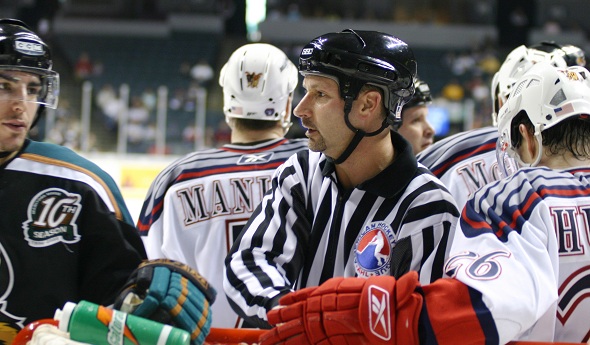
PHOTO: Jim Garofalo (center) officiate an NHL game. The Allen Park resident also has worked the Olympics.
NOTE: This is the sixth installment in the series "Making – and Answering – the Call" detailing the careers and service of MHSAA officials. Click the links below to view the others.
DCC Follows New Leader to 3rd Straight D1 Win
March 12, 2016
By Bill Khan
Special for Second Half
PLYMOUTH — The biggest challenge to Detroit Catholic Central's hockey dominance has come from within.
For the third straight season, the Shamrocks took the ice this winter while trying to adapt to the demands of a new head coach.
No worries. Because, for the third straight season, the Shamrocks are the MHSAA Division 1 champions.
Top-ranked Catholic Central controlled the game from start to finish to beat second-ranked Brighton, 3-0, on Saturday at USA Hockey Arena in a championship matchup featuring the two teams that have won 13 of the 17 Division 1 crowns.
Catholic Central (24-7) has won 10 of those titles under the guidance of five head coaches. Brandon Kaleniecki helped begin that run as a senior with the Shamrocks in 2000 and kept it going as a first-year head coach this season. He followed in the footsteps of Doug Itami, coach of the 2013-14 team, and Danny Veri, coach of the 2014-15 squad.
"There are some differences, but a lot of similarities," senior forward Brian Kearns said of the three coaches for whom he's played. "They're all preaching the same stuff. They all preach to play as hard as you can. You've got to play for the two Cs on your chest. They were all different, but they were all great in their own way and they all added a piece to the puzzle to go win three. It was huge for us. Coach Kal was the perfect coach to finish it all off."
Kaleniecki credited the leadership of Kearns and fellow captain Nick Macari for making his job easier as he took over one of Michigan's iconic hockey programs.
"They were without a doubt my best ally in terms of coming in this year," said Kaleniecki, an all-state forward for the Shamrocks in 1999-2000. "These are two guys who have been around the program. They've had three different coaches. They could've made things real challenging for me. Instead, they made it absolutely phenomenal. Anything I needed, I could tell them and it was done. The reason we're here is because of guys like this. We can point them in the right direction, but they're the guys driving it."
Having a background in the Catholic Central program helped each of the three coaches gain credibility with the players. Itami was an assistant coach, while Veri coached the junior varsity team.
"It's a good thing knowing our coaches have been in our shoes before," Macari said. "They have that experience. They know what they're talking about. We know we can listen to them, because they're telling us the right things to do."
The championship was the 13th for Catholic Central, moving the Shamrocks within one of Trenton for second-most in MHSAA history. Bloomfield Hills Cranbrook Kingswood holds the record with 17.
It was the 10th time out of those 13 championship victories that the Shamrocks won by at least three goals. They outshot Brighton, 29-15.
"They were just all over us," Brighton junior Jake Crespi said. "Positionally, they were great. Every time we would touch the puck, there were two guys on us."
Crespi gave Brighton (22-9) its best chance to grab some momentum when he was awarded a penalty shot with 11:44 left in the first period. Crespi, who shared Brighton's goal-scoring lead with 20, was slashed from behind on a shorthanded breakaway. He tried to get the puck between the pads of Alec Calvaruso on the penalty shot, but the senior goaltender closed off the opening to make the save.
 "I was going to go five-hole on the breakaway, also," Crespi said. "I had my mind set when I was going out there; I should've buried it. I think it could've been a different game if I could've put that one away for the boys. Maybe we'd have some momentum going."
The game remained scoreless until Glynn Robitaille pounced on a loose puck near the crease and scored at 7:56 of the second period. Macari set up the goal by rushing down the left side and putting a shot on the net.
"Coach Kaleniecki always tells me I need to drive the net more often and I need to shoot more often," Macari said. "I kind of listened to what he said; I drove to the net and it worked. It ended up on my player's stick, and he got it in the net."
On a similar rush, Macari made it 2-0 as he buried a shot into the upper-right corner of the net from the left circle with 2:38 left in the second period.
"Same thing," Macari said. "Drive wide and shoot the puck is what he's been telling me to do. I did it and, once again, it worked."
With the shots 23-10 in the Shamrocks' favor after two periods and having been shut out in the teams' regular-season meeting, the Bulldogs faced the daunting task of scoring at least twice in the third.
Catholic Central didn't allow Brighton an opening, making it a 3-0 game on Cody Borke's goal with 15:16 left in the third period.
"We knew we could come back, but that kind of hurt when they got that third one," Brighton defenseman Nick Foran said. "We didn't stop battling, but it didn't exactly boost our confidence."
Brighton was trying to beat a sixth straight ranked opponent in the playoffs. The Bulldogs beat No. 13 Jackson, No. 8 Howell, No. 4 Orchard Lake St. Mary's, No. 11 East Kentwood and No. 6 Grandville before coming up short against the No. 1 Shamrocks.
The Bulldogs didn't score a goal and had only 25 shots on goal in two matchups with Catholic Central this season. The Shamrocks won 3-0 with three third-period goals on Nov. 21.
"Playing six games in two weeks is emotionally and physically draining," Brighton coach Paul Moggach said. "I think it does have an impact mentally and physically when you go to that third period down. It's a lot easier to find your legs if you're in a position to win it; we just never were. After that first period, we tried to find a way, but we weren't finding the opportunities to make a game of it. You've got to give credit to C.C. They played a great game. They beat us twice. We haven't scored a goal and they scored six."
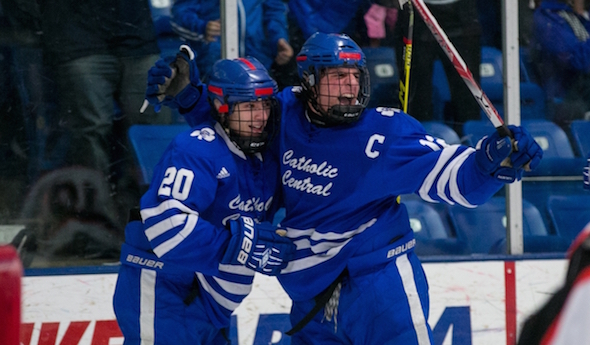
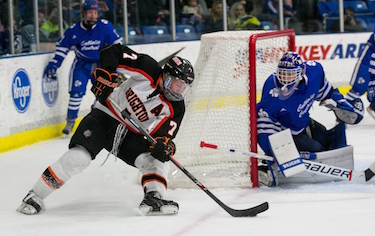
PHOTOS: (Top) Glynn Robitaille (20) and Nick Macari celebrate during Saturday’s Division 1 Final. (Middle) Brighton’s Joey Clifford (7) works to create a shot while DCC goalie Alec Calvaruso blocks the side of the crease. (Click for more from Andrew Knapik.)