

Garofalo: On-Ice Teacher and Recruiter
By
Rob Kaminski
MHSAA benchmarks editor
December 28, 2012
Something caught his eye as Allen Park’s Jim Garofalo circled the Olympic hockey rink in Salt Lake City to familiarize himself with the surroundings prior to the start of play at the 2002 Games.
“When the dimensions of a rink are laid out, everything is measured from the exact center of the ice outward,” Garofalo explains. “Usually there’s a washer or something small under the surface at center ice. All measurements are taken from there.
“Well, in Salt Lake City that year, a Canadian company was hired to prepare the sheets of ice, and they used a Loonie (common term for a Canadian $1 coin) to mark center ice. That year, the Canadians beat the United States in the gold medal game and won the Olympics on U.S. soil. I later visited the Hockey Hall of Fame in Toronto, and that Loonie is there.”
As Garofalo was getting acquainted with Canadian currency, an invitation in his mailbox back home went unanswered. At the time, MHSAA Tournament invitations were still sent by mail, so Garofalo was unaware the Association was awaiting his RSVP to accept his first Finals assignment.
“I was in Salt Lake City and had no idea. Now, of course, everything is online and by email, but that just shows how rapidly technology has progressed in the last 10 years,” Garofalo said. “So, (fellow official) Dan DiCristofaro calls and says something like, ‘Hey, do you want your state final?’ It was pretty funny; the running joke afterward was that you’ve gotta work the Olympics to get a shot at the state finals.”
Of course, that’s not the case. And, if Garofalo had it his way, all hockey officials who worked hard, persevered, paid their dues and set that as a goal would get a shot at the MHSAA Finals.
A 25-year registered MHSAA official who at one time juggled rules books for eight different hockey leagues and has worked four World Championships in addition to the Olympics, Garofalo now works only high school hockey.
“From a selfish standpoint, I suppose, I like a season that has a definite start and end to it,” says the New Boston Middle School social studies teacher, whose resume’ at one point looked like an endless Scrabble hand that included abbreviations for USA, USA Junior, Ontario, East Coast, International, International Independent and Central Collegiate hockey leagues in addition to the MHSAA.
“Being a teacher, there’s so much about the high school game that fits into education,” said Garofalo, now in his 10th year with the New Boston Huron District. “There’s so much to learn, and to help people learn at this level, from a playing and officiating standpoint.
“The people who officiate high school hockey are dedicated to improving, and as a veteran there’s an opportunity to help them learn and advance,” he says. “And, the coaches deserve kudos too. They are usually more professional and ask questions more properly than at other amateur levels. The reason is a direct result of them being accountable. They’ve got to answer to their principal or athletic director. Who are the junior and community league coaches accountable to? No one.”
And, there’s another allure to the school game compared to which other levels pale.
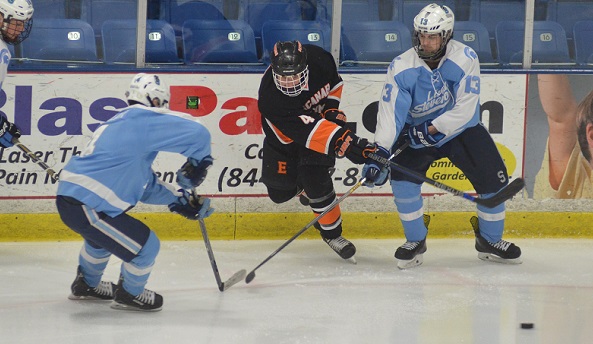
“The atmosphere of high school hockey is better than any other amateur level,” Garofalo says. “You go do a game at Trenton, and there’s a band. How many hockey games do you go to where there’s a band? Detroit Catholic Central and Birmingham Brother Rice have their cheering sections. It’s just a great atmosphere.”
It’s a scene that would surely help maintain the roster of younger, driven hockey officials. The trick is getting them there, according to Garofalo, one of the MHSAA’s biggest proponents for advancement and recruitment of officials.
Part of the issue is the oversaturation of games that fill Mite, Midget and other amateur schedules. Those who simply want a paycheck are never at a loss for work as long as they know how to skate.
“Hockey is unique because high school hockey is in progress at the same time as USA Hockey. An official can get twice the pay at a Bantam/Midget doubleheader than they can for one high school game,” Garofalo said. “The trouble is, who is instructing them? Who’s helping them to develop?”
To that end, Garofalo, DiCristofaro and the rest of the Northeast Hockey Referees Association established a $500 college scholarship. The recipient must be a high school hockey player who is officiating games in USA Hockey. Once they graduate from high school, many join the Association to work high school hockey.
Garofalo also offers other recruiting initiatives. In the Michigan Interscholastic Hockey League most schools play JV/Varsity doubleheaders, where the officials often let a linesman work a game at referee, while the experienced referee observes.
“At events like the Trenton Showcase, if we divide the fees differently we could get more officials involved,” he suggests. “We can do four-person crews to get our good young people some varsity experience as linesmen, and move some of our experienced linesmen to referee on the same crew with some of the top referees.”
It’s the kind of continual teaching that perpetuates the quality of officiating, and it takes time. The goal is to have the officials ready to perform when they hit the ice.
“If I put you out there to referee or pull lines, I set you up to succeed,” Garofalo says. “If I put people in too soon, I’ve set them up to fail, which leads to them leaving the game, and I haven’t done my job.”
The expectations and production of teacher and student must mesh for the system to work as intended. It requires patience as officials strive to climb the ladder, a bit of a lost art in today’s society.
“The culture of newer officials today is different. It’s a culture of immediate gratification,” says Garofalo. “Very few want to hang around eight to 10 years as a linesman before they referee, or move up. There are some very good officials who leave each year, because they haven’t become a referee, or haven’t got a tournament assignment.”
At the MHSAA Finals, Garofalo and DiCristofaro assist Jim Gagleard and the Livonia Ice Hockey Officials in heading up the off-ice officials. The inclusion and experience of such officials serves as a motivational tool which leads to improvement and retention. He also believes a four-person system in the MHSAA tournament would not only afford more qualified officials an opportunity for postseason assignments, but also provide better ice coverage as the sport’s speed has increased dramatically.
Not everyone can reach the summit, no matter the level. Even Garofalo himself, who once entertained dreams of skating in the NHL.
“The NHL looked at me a bit, but when I was at that age, it seemed all of the other linesmen were in their prime,” he said. “It is what it is.”
But, for a guy who began officiating at age 15 just to help pay for his hockey equipment, things have turned out quite well. In addition to the 2002 Olympics, Garofalo worked the Women’s World Championships in 1990, and the Men’s Worlds in Switzerland (1998), Norway (1999) and Germany (2001), working the Gold Medal game in 1998 and 1999. He’s been a fixture at the MHSAA tournament during the last dozen years.
“My wife, Mary Beth, says, ‘Wherever you go, you know someone.’ I owe that to officiating; the places I’ve gone and the people I’ve met,” Garofalo said. “It’s taken me all over the country instructing, and even overseas for some assignments. I can’t help but know people. It’s a people business.”
It might seem odd for Garofalo to even utter those words, describing the people-person this once shy kid has become. That’s one of the many rewards officiating delivers which is more valuable than any top-level assignment or game fee.
“I was quiet when I was younger. Well, when a coach is going crazy and yelling, you’ve got to speak for yourself. You learn conflict resolution,” Garofalo says, continuing as if he wrote the book on it. “‘Coach, get off the bench, quit screaming, and I’ll explain what I saw and why I called it the way I did. Then , if you have a question, I’ll answer it.’ You learn to communicate with people who don’t always agree with you.”
Then, there are the memories. Memories won’t buy a thing, but they go a long way in making 25 years on the ice, thousands of miles on the road, and countless hours away from home worth a million bucks.
“I worked 25 years for the IHL and AHL, and two years ago at the end of the regular season I was doing a Grand Rapids Griffins game. During the game, I told Brad May, ‘I’m done,’” Garofalo recalls, confiding in the gritty enforcer and one-time Stanley Cup champion who had more than 1,000 NHL games under his pads.
“At the end of the game, every guy and coach skated to me and shook my hand. Then Brad May says, ‘I heard you once worked the Olympics. It was an honor to be on the ice with you,’” Garofalo reveals, shaking his head. “Brad May said that to me.”
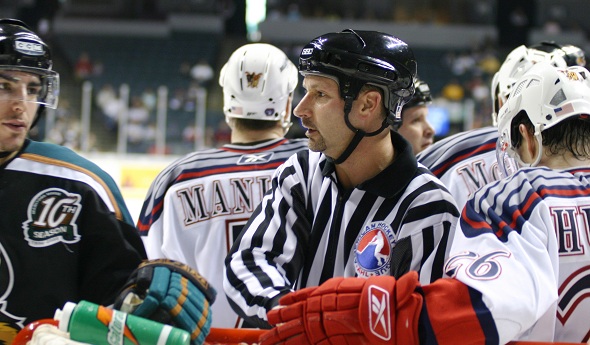
PHOTO: Jim Garofalo (center) officiate an NHL game. The Allen Park resident also has worked the Olympics.
NOTE: This is the sixth installment in the series "Making – and Answering – the Call" detailing the careers and service of MHSAA officials. Click the links below to view the others.
Taking a Healthy Approach to Sports
By
Rob Kaminski
MHSAA benchmarks editor
November 8, 2013
During election years, it’s a familiar rallying cry: “Four more years! Four more years!”
It’s become commonplace following the third quarter of football games around the country for members of the leading team to march down the gridiron with four fingers raised on one outstretched hand as teams switch ends of the field to signify, “Fourth quarter is ours; finish the job.”
The number four also is significant in education with school terms identified as freshman, sophomore, junior and senior years.
To that end, the MHSAA is imploring everyone involved in educational athletics to go back to school in 2013-14 with a four-year mission in mind: “Four Thrusts for Four Years.”
The goal is to attain and maintain advanced degrees in sports safety, positioning Michigan schools in the center of best practices for ensuring the health of our product and students, today and beyond.
“Just a brief look around all levels of today’s athletic landscape reveals heightened awareness of health and safety issues,” said MHSAA Executive Director Jack Roberts. “Interscholastic sports as a whole – and particularly school sports in Michigan – has long led the charge to employ the safest contest rules and provide the healthiest environments for our games and participants.
“But, to put it in athletic terms, we can’t sit on the lead,” Roberts added. “We can, and must, improve our games in order to guarantee their existence for future generations. That is our goal, our thrust in the coming years.”
Following are the focal points for this four-year plan:
- Implement heat and humidity management policies at all schools for all sports.
- Require more initial and ongoing sports safety training for more coaches.
- Revise practice policies generally, but especially for early in the fall season.
- Modify game rules to reduce the frequency of the most dangerous play situations, and to reduce head trauma.
The directive actually kicked off last March, when the Representative Council approved a heat management policy for MHSAA tournaments and a detailed model policy for schools. While not setting requirements for member schools during the regular season, it suggests actions based on heat index – the degree of felt discomfort derived by combining temperature and humidity measurements – that are designed to minimize the risk of heat-related illness during interscholastic participation.
The policy is mandatory for all MHSAA tournaments beginning this school year, and the MHSAA plans to monitor schools’ adoption of the plan throughout the year to determine best policies moving forward.
Laminated cards containing the policy and heat index chart were printed and mailed to schools in June and continue to be disseminated at statewide meetings this fall. Two publications, Heat Ways and Safety Blitz, were published, mailed and posted to MHSAA.com, heightening awareness of healthy practice regimens, and schools have been offered discounted psychrometer prices through the MHSAA to assist in their efforts to properly monitor weather conditions.
“This action was significant; but it’s just the next step in a continuous series of actions being taken to make school sports as healthy as possible for students,” said Roberts.
The MHSAA’s proactive movements toward a safer tomorrow are taking place concurrently, rather than sequentially. While the heat and humidity plan is the most developed of the four “thrusts,” other initiatives are underway. Today’s climate prompts such action.
From the NCAA’s new “targeting fouls” to the NFL’s “crown” rule, and of course Major League Baseball’s Biogenesis/PED debacle, the headlines off the field in August centered on protecting the games rather than simply playing them. Like it or not, it’s the type of news fans need to get used to as their favorite sports audible to option plays in order to steer clear of the endangered species list.
The situation can’t be overstated. Athletics at all levels has been approaching a crossroads for years, and the time to heed the signals has come.
“Let’s make one thing abundantly clear: The people in charge of football at all levels are wise to craft rules that make the game safer, even if those rules will be controversial,” wrote Andy Staples for SI.com College Football on July 23.
The story continued: “As more information arrives about the long-term dangers of the headshots football players absorb at the high school, college and pro levels, something has to change. The next few years will be messy. The game needs saving, because if it continues as it has, it will get decimated by lawsuits and by parents of young children who decide the potential adverse effects aren't worth the risk.”
When kids stop playing, numbers at the high school level and beyond are bound to diminish as well. To trumpet the vast benefits of interscholastic football while easing parents’ minds on safety concerns, the MHSAA formed a Football Task Force in the spring of 2013. The task force is the first of several to be convened during the next four school years, and the objectives of each are to promote the sports involved as safe, low-risk, competitive athletics through the development of better practice policies and modification of playing rules.
“These task forces will be central to the overarching mission of preserving sports for years to come,” said Roberts. “We believe the MHSAA Football Task Force has set a foundation on which to build. Our discussions involving revised practice policies have reached the draft stage, and we intend to have formal proposals ready to present to the Representative Council in March 2014.”
The work of the 13-member task force – made up of football coaches and school administrators from around the state – will be reviewed by the Michigan High School Football Coaches Association, the MHSAA Football Committee and at the MHSAA League Leadership meeting for fine-tuning prior to reaching the Council.
“It is important that we provide opportunities for children to participate in interscholastic athletics and crucial that we do all we can to ensure they will be safe when they do,” said Football Task Force member Tammy Jackson, principal at East Jordan High School, who has a sports medicine background. “The MHSAA has taken an active role in promoting safety by convening the Task Force to examine current rules and consider modifications to further protect children.”
With so much publicity concerning football safety, the football group was a natural to become the first of several task forces to be assembled.
“We must educate the public on the benefits of all school sports,” said task force member Bill Chilman, superintendent of Beal City Schools. “In the case of football, it must be impressed upon people that it is statistically a very safe game when taught and played properly. The Football Task Force being proactive rather than reactive to this safety movement is key to promoting the lifelong values of football and all school sports.”
And within that public is a group which has the most vested concerns: the parents.
“There is more information available to the general public regarding sport and sport injuries, and unfortunately parents and kids all too often hear about the negative side of sport,” suggests Mike Bakker, athletic director at Fenton High School, and another member of the MHSAA Football Task Force. “It is imperative for the integrity of the sport of football to have coaches and administrators provide information about the safety of the game and the steps we take to keep kids safe. We must educate parents about the proper way to play the game and the signs to look for if problems arise.”
Without getting into the minutia of the new NCAA and NFL playing rules regarding use of the helmet, suffice it to say this will be an interesting fall during which to monitor penalties and their effects on injury numbers, particularly when it comes to concussions.
The rules changes have been reported and debated at the national level ad nauseam, and the mood seems to inexplicably tilt toward skepticism and criticism from the very group that would stage a revolt of epic proportions if football ever became extinct: the fans.
Case in point: six targeting fouls were called in 75 games during the opening weekend of college football over Labor Day Weekend (one ejection was overturned by replay), and the outcry began. Analysts and fans are afforded frame-by-frame replays which onfield officials do not have the luxury of seeing before throwing the flag.
Like it or not, the rules are in place. And, they have been implemented to protect the future of the game. The impetus now falls to the caretakers of the game – the officials – who no doubt will bear the brunt of disapproving masses in the stadiums. Yet, football is their livelihood too; both players and officials are expected to make adjustments.
At Officiate Michigan Day and the ensuing National Association of Sports Officials Summit this past July in Grand Rapids, the theme was clear: “The game has changed, and the officiating has to change with it.”
From NFL Referee Jeff Triplette to SEC Coordinator of Officials Scott Shaw to Big Ten Referee Alex Kemp and Fox Sports NFL Rules Analyst Mike Pereira – people who have been around the block – the message delivered was that the changes are necessary for the health and growth of football.
“We’re talking about taking out a specific type of play that, quite honestly, you didn’t see that much of before about 10 years ago,” Triplette said during a player safety panel at the NASO Summit. “They still played defense, there were still great hits. But somehow, these violent types of tackles began to get notoriety – whether it was all the ESPN highlights, YouTube, and maybe a combination of all of that stuff – and players started to celebrate those hits, and that became the goal.”
Not only can the game become safer; it might even become better by going retro. In recent comments on The Sports XChange, NFL analyst and former coach John Madden said, “You are always concerned how any change will impact the game. In this case, players are not going for the head shot, that big hit. They are keeping their heads up. Better tackling has become the unintended consequence. That's a good thing. Good for football. Good for kids watching. Players are tackling the way they are supposed to, with their shoulders and wrapping up. The big hit, the big replay had become so popular that tackling suffered.”
In high school, the most notable rule change involving helmets involves penalties for players who lose their helmets during a play. However, illegal helmet contact continues to be a point of emphasis and carries a minimum of a 15-yeard penalty as it has for many years. In the NCAA the mantra on helmet-to-helmet blows is, “When in doubt throw them out,” as the foul now carries with it a player ejection.
That is not the high school rule—yet—but officials at all levels need to be on the lookout. Kemp was quick to warn a roomful of prep football officials during Officiate Michigan Day, “We’ve been told to err on the side of safety, and these plays will result in ejection,” while also adding that such plays will be reviewed by replay officials. “That portion of the rule isn’t there in high school yet, but be ready for it; it’s coming, so when it happens in your games take notice and determine the severity.”
Which brings us to contest rules for safer play. During the next few years, various sport groups will be assembled to follow the MHSAA football task force’s lead in scrutinizing rules and developing proposals for revisions or additions to be submitted to the National Federation of State High School Associations. Initial football discussions receiving some traction involve changing the enforcement spot on post-interception penalties and limiting the number of yards teams can run up on free kicks. Before any submissions are made to the NFHS Football Committee, the task force will conduct research and present findings to Michigan committees.
“We can make changes ourselves – through MHSAA sport committees – for the subvarsity level, but our committees can only make recommendations to national rules committees for varsity level play,” explained Roberts. “Over the next four years, we will be asking our sport committees to give more time to the most dangerous plays in their sport – identifying what they are and proposing how to reduce that danger.”
While the football task force here at home is finalizing practice policy proposals targeted for implementation in the fall of 2014, Texas and Illinois are two states which launched restrictions with the opening of football this season. Spokespersons from both states indicate that coaches and school administrators have been pleased with the new formats.
Coaches no doubt will need to adjust practice itineraries and budget time wisely. Administrators need to remind staffs that the new era is dawning in the name of player safety, which is paramount to all parties.
“In game situations, coaches want our officials to throw the flag on late hits, low hits and other illegal contact,” Roberts said. “These are incidents that they have no control over. They do have control over practice time and teaching fundamentals; so let’s encourage safety measures that we can control, and employ those tactics to help the game prosper.”
Education will key the efforts to align coaches of all sports – and all levels – in the movement toward a healthy future. School will be in session during the next four years as the MHSAA implements effective and practical means for raising coaches’ preparedness. Three avenues are on the map:
First, the Representative Council mandated that beginning with the 2014-15 school year, all assistant and subvarsity coaches at the high school level must complete the same MHSAA rules meetings currently only required of varsity head coaches or, alternatively, one of the free online sports safety courses posted on or linked from the MHSAA Website that is designated as fulfilling this requirement.
Second, it is proposed that by 2015-16, MHSAA member high schools will be required to certify that all of their varsity head coaches have a valid CPR certification.
Third, it is proposed that by 2016-17, any person who is hired for the first time to be the varsity head coach of a high school team, to begin after July 31, 2016, must have completed either Level 1 or Level 2 of the MHSAA Coaches Advancement Program. The MHSAA is preparing to subsidize some of the course cost for every coach who completes Level 1 or 2.
Together, these changes will move Michigan from one of the states of fewest coaching requirements to a position consistent with the “best practices” for minimizing risk in school sports and providing students a healthy experience.
At stake in these four thrusts – whether for an administrator, coach, official, student-athlete, parent or fan – are the environments that offer so many lessons and the games for which we root.