

Garofalo: On-Ice Teacher and Recruiter
By
Rob Kaminski
MHSAA benchmarks editor
December 28, 2012
Something caught his eye as Allen Park’s Jim Garofalo circled the Olympic hockey rink in Salt Lake City to familiarize himself with the surroundings prior to the start of play at the 2002 Games.
“When the dimensions of a rink are laid out, everything is measured from the exact center of the ice outward,” Garofalo explains. “Usually there’s a washer or something small under the surface at center ice. All measurements are taken from there.
“Well, in Salt Lake City that year, a Canadian company was hired to prepare the sheets of ice, and they used a Loonie (common term for a Canadian $1 coin) to mark center ice. That year, the Canadians beat the United States in the gold medal game and won the Olympics on U.S. soil. I later visited the Hockey Hall of Fame in Toronto, and that Loonie is there.”
As Garofalo was getting acquainted with Canadian currency, an invitation in his mailbox back home went unanswered. At the time, MHSAA Tournament invitations were still sent by mail, so Garofalo was unaware the Association was awaiting his RSVP to accept his first Finals assignment.
“I was in Salt Lake City and had no idea. Now, of course, everything is online and by email, but that just shows how rapidly technology has progressed in the last 10 years,” Garofalo said. “So, (fellow official) Dan DiCristofaro calls and says something like, ‘Hey, do you want your state final?’ It was pretty funny; the running joke afterward was that you’ve gotta work the Olympics to get a shot at the state finals.”
Of course, that’s not the case. And, if Garofalo had it his way, all hockey officials who worked hard, persevered, paid their dues and set that as a goal would get a shot at the MHSAA Finals.
A 25-year registered MHSAA official who at one time juggled rules books for eight different hockey leagues and has worked four World Championships in addition to the Olympics, Garofalo now works only high school hockey.
“From a selfish standpoint, I suppose, I like a season that has a definite start and end to it,” says the New Boston Middle School social studies teacher, whose resume’ at one point looked like an endless Scrabble hand that included abbreviations for USA, USA Junior, Ontario, East Coast, International, International Independent and Central Collegiate hockey leagues in addition to the MHSAA.
“Being a teacher, there’s so much about the high school game that fits into education,” said Garofalo, now in his 10th year with the New Boston Huron District. “There’s so much to learn, and to help people learn at this level, from a playing and officiating standpoint.
“The people who officiate high school hockey are dedicated to improving, and as a veteran there’s an opportunity to help them learn and advance,” he says. “And, the coaches deserve kudos too. They are usually more professional and ask questions more properly than at other amateur levels. The reason is a direct result of them being accountable. They’ve got to answer to their principal or athletic director. Who are the junior and community league coaches accountable to? No one.”
 And, there’s another allure to the school game compared to which other levels pale.
“The atmosphere of high school hockey is better than any other amateur level,” Garofalo says. “You go do a game at Trenton, and there’s a band. How many hockey games do you go to where there’s a band? Detroit Catholic Central and Birmingham Brother Rice have their cheering sections. It’s just a great atmosphere.”
It’s a scene that would surely help maintain the roster of younger, driven hockey officials. The trick is getting them there, according to Garofalo, one of the MHSAA’s biggest proponents for advancement and recruitment of officials.
Part of the issue is the oversaturation of games that fill Mite, Midget and other amateur schedules. Those who simply want a paycheck are never at a loss for work as long as they know how to skate.
“Hockey is unique because high school hockey is in progress at the same time as USA Hockey. An official can get twice the pay at a Bantam/Midget doubleheader than they can for one high school game,” Garofalo said. “The trouble is, who is instructing them? Who’s helping them to develop?”
To that end, Garofalo, DiCristofaro and the rest of the Northeast Hockey Referees Association established a $500 college scholarship. The recipient must be a high school hockey player who is officiating games in USA Hockey. Once they graduate from high school, many join the Association to work high school hockey.
Garofalo also offers other recruiting initiatives. In the Michigan Interscholastic Hockey League most schools play JV/Varsity doubleheaders, where the officials often let a linesman work a game at referee, while the experienced referee observes.
“At events like the Trenton Showcase, if we divide the fees differently we could get more officials involved,” he suggests. “We can do four-person crews to get our good young people some varsity experience as linesmen, and move some of our experienced linesmen to referee on the same crew with some of the top referees.”
It’s the kind of continual teaching that perpetuates the quality of officiating, and it takes time. The goal is to have the officials ready to perform when they hit the ice.
“If I put you out there to referee or pull lines, I set you up to succeed,” Garofalo says. “If I put people in too soon, I’ve set them up to fail, which leads to them leaving the game, and I haven’t done my job.”
The expectations and production of teacher and student must mesh for the system to work as intended. It requires patience as officials strive to climb the ladder, a bit of a lost art in today’s society.
“The culture of newer officials today is different. It’s a culture of immediate gratification,” says Garofalo. “Very few want to hang around eight to 10 years as a linesman before they referee, or move up. There are some very good officials who leave each year, because they haven’t become a referee, or haven’t got a tournament assignment.”
At the MHSAA Finals, Garofalo and DiCristofaro assist Jim Gagleard and the Livonia Ice Hockey Officials in heading up the off-ice officials. The inclusion and experience of such officials serves as a motivational tool which leads to improvement and retention. He also believes a four-person system in the MHSAA tournament would not only afford more qualified officials an opportunity for postseason assignments, but also provide better ice coverage as the sport’s speed has increased dramatically.
Not everyone can reach the summit, no matter the level. Even Garofalo himself, who once entertained dreams of skating in the NHL.
“The NHL looked at me a bit, but when I was at that age, it seemed all of the other linesmen were in their prime,” he said. “It is what it is.”
But, for a guy who began officiating at age 15 just to help pay for his hockey equipment, things have turned out quite well. In addition to the 2002 Olympics, Garofalo worked the Women’s World Championships in 1990, and the Men’s Worlds in Switzerland (1998), Norway (1999) and Germany (2001), working the Gold Medal game in 1998 and 1999. He’s been a fixture at the MHSAA tournament during the last dozen years.
“My wife, Mary Beth, says, ‘Wherever you go, you know someone.’ I owe that to officiating; the places I’ve gone and the people I’ve met,” Garofalo said. “It’s taken me all over the country instructing, and even overseas for some assignments. I can’t help but know people. It’s a people business.”
It might seem odd for Garofalo to even utter those words, describing the people-person this once shy kid has become. That’s one of the many rewards officiating delivers which is more valuable than any top-level assignment or game fee.
“I was quiet when I was younger. Well, when a coach is going crazy and yelling, you’ve got to speak for yourself. You learn conflict resolution,” Garofalo says, continuing as if he wrote the book on it. “‘Coach, get off the bench, quit screaming, and I’ll explain what I saw and why I called it the way I did. Then , if you have a question, I’ll answer it.’ You learn to communicate with people who don’t always agree with you.”
Then, there are the memories. Memories won’t buy a thing, but they go a long way in making 25 years on the ice, thousands of miles on the road, and countless hours away from home worth a million bucks.
“I worked 25 years for the IHL and AHL, and two years ago at the end of the regular season I was doing a Grand Rapids Griffins game. During the game, I told Brad May, ‘I’m done,’” Garofalo recalls, confiding in the gritty enforcer and one-time Stanley Cup champion who had more than 1,000 NHL games under his pads.
“At the end of the game, every guy and coach skated to me and shook my hand. Then Brad May says, ‘I heard you once worked the Olympics. It was an honor to be on the ice with you,’” Garofalo reveals, shaking his head. “Brad May said that to me.”
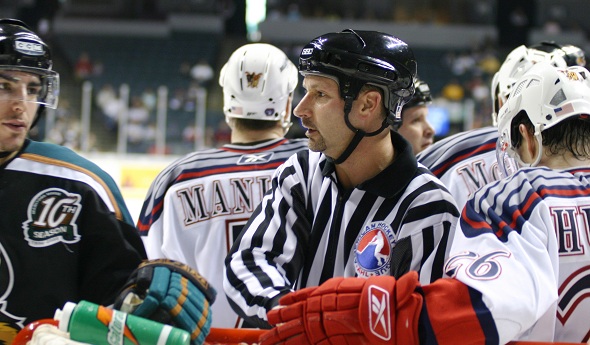
PHOTO: Jim Garofalo (center) officiate an NHL game. The Allen Park resident also has worked the Olympics.
NOTE: This is the sixth installment in the series "Making – and Answering – the Call" detailing the careers and service of MHSAA officials. Click the links below to view the others.
Be the Referee: Legacy Program
December 4, 2014
This week, MHSAA assistant director Mark Uyl dicusses the Legacy Program, which helps in the recruitment of officials from among current high school students.
"Be the Referee" is designed to help educate people on the rules of different sports, to help them better understand the art of officiating and to recruit officials. The segment can be heard on Mondays, Wednesdays and Fridays during the school year on The Drive With Jack Ebling on WVFN-AM, East Lansing.
Below is this week's segment - Legacy Program - Listen
Today we are going to talk about recruitment. Specifically the recruitment of new officials into the world of school sports.
One of the best ways for young people to get involved is through the MHSAA Legacy official program. This is open to any high school junior or senior who is interested in sports and officiating.
The Legacy official is paired with a Mentor official. That Mentor official is an established, veteran official for many years. The Legacy and Mentor official both go out and officiate together at the sub-varsity level, where that new person learns the rules, mechanics, coverages, and basically is learning the ropes of officiating from that Mentor official and getting them off on the right foot in the world of officiating.
Past editions
Nov. 26 - Sideline Management - Listen
Nov. 19 - 7-Person Mechanics - Listen
Nov. 12 - Blocking Below the Waist - Listen
Nov. 5 - Tournament Selection - Listen
Oct. 29 - Uncatchable Pass - Listen
Oct. 22 - Preparation for Officials - Listen
Oct. 15 - Automatic First Downs - Listen
Oct. 8 - Officials & Injuries - Listen
Oct. 1 - Overtime - Listen
Sept. 25 - Field Goals - Listen
Sept. 18 - Tackle Box - Listen
Sept. 11 - Pass Interference - Listen
Aug. 25 - Targeting - Listen