

Hancock Finishes Long Trip on Top of D3
March 12, 2016
By Bill Khan
Special for Second Half
PLYMOUTH — The stage was big, the lights were bright, but no bigger or brighter for Hancock freshman Alex Nordstrom than for his older teammates.
Many of Hancock's players weren't born the last time the Bulldogs skated in an MHSAA championship hockey game back in 2000.
So, competing for the Division 3 title on Saturday was a foreign experience for all of the Bulldogs, from the oldest to the youngest.
Nordstrom certainly didn't perform like a nervous freshman, following up his Semifinal overtime heroics by scoring two goals in Hancock's 4-2 victory over Grand Rapids Catholic Central before 1,154 fans at USA Hockey Arena.
Pressure? What pressure?
In Hancock's biggest games, Nordstrom produced with the poise of a veteran. He had two goals and one assist in a 5-2 Quarterfinal victory over Sault Ste. Marie, scored the overtime winner in the Semifinal against Bloomfield Hills Cranbrook Kingswood, then had another two-goal, one-assist performance in the title game.
"I kind of just focused and told my brain it's another game," Nordstrom said. "Just go out there and do what I do; just play."
In 30 games, he tallied 33 goals and 26 assists to finish second in team scoring to sophomore linemate Teddy Rendell.
"He was a key part of this puzzle," Hancock coach Dan Rouleau said of Nordstrom. "The kid was our second-leading scorer this year. He had great chemistry with a sophomore on his line. The kids were our top two scorers this year. It bodes well for the future of this team."
So, maybe Hancock won't have to wait 17 years for its next MHSAA championship. Although the Bulldogs have had a strong program for decades, their only title came in 1999 when they beat Big Rapids, 7-3, in the Class B Final. They lost to Cranbrook in the 2000 title game.
The team's goaltender, Dawson Kero, is only a sophomore. Kero made 20 saves.
The Bulldogs (24-6) won the championship not only for their own school, but for the Upper Peninsula as a whole. U.P. teams had gone 0-5 in MHSAA Finals since Marquette (Division 1) and Calumet (Division 3) won titles in 2008.
"Usually when a team from the U.P. comes down, you have the whole Upper Peninsula-backing mentality up there," Rouleau said. "It's really cool. We're a little isolated up there, but we've got some good hockey players up there, I'll tell you that."
Even bitter rivals become supporters when U.P. pride is at stake downstate.
"There might be a couple kids or parents who do not, but I think we got about 95 percent who are backing us," Rouleau said.
It looked like Hancock would run the Cougars out of the rink after one period, as the Bulldogs jumped out to a 3-0 lead and had a 17-8 advantage in shots on goal.
Jack Fenton scored at 7:17 of the first period to open the scoring, then Nordstrom made it 2-0 at 10:05.
A potential back-breaker came with 18.2 seconds left in the period when Danny Hill buried a two-on-one pass from Nordstrom for a shorthanded goal to make it 3-0.
"Obviously, in any hockey game you want to get out to the quick start," Rouleau said. "That was our game plan for here today. To get a three-goal lead was huge, because it turned out to be the difference."
 But the Cougars weren't at or near the top of the rankings all season because they're pushovers. They got on the board at 8:41 of the second period when a shot by Ethan Tellier made it under the crossbar. Catholic Central cut the lead to 3-2 on Chase Madden's power-play goal at 12:24 of the second.
Despite being outshot 30-16 through two periods, the Cougars were back in the game.
"Obviously, a disappointing start for us," Catholic Central coach Mike Slobodnik said. "We got overwhelmed. A lot of credit goes to them. They just really came out and pressed. We didn't have the start we wanted, being down 3-0. We came in between the first and second period and talked about how we've got to be better than that. We didn't change anything. We didn't feel it was a system thing. We had to work harder. We had to be better in certain areas of the ice. In the second period, we did that. We lost to a great hockey team, too, that's for sure."
The Cougars stayed in the game throughout the third period, thanks to some stellar netminding from junior Jacob McClelland.
With Hancock trying to get a two-goal cushion, McClelland made three saves in a row while playing without a stick with just under five minutes remaining. McClelland finished with 37 saves.
"He was great," Slobodnik said. "Jacob's a great goaltender. He's a great kid. He has over a four-point GPA. He's one of those guys on our team who understands the core values of what it means to be a Catholic Central hockey player."
Hancock's biggest scare came with 7:58 left in the game when Kero made a save and ended up on his back, not appearing to know the location of the puck. After the Cougars got a whack or two trying to get the puck loose, the whistle stopped play.
The Bulldogs could breathe a little easier after Nordstrom took a pass from Rendell and scored into an empty net with 57.4 seconds remaining. Even then, some of the Hancock players weren't taking anything for granted.
"Me and Jack (Fenton) and Danny (Hill) try to pound into the younger kids' heads that we have to keep going hard, not ever giving up," Hancock senior captain Dylan Paavola said. "That's when comebacks happen. We don't want any of that, because we haven't won a state championship. We didn't want to screw this one up, I guess you could say. I could say I felt comfortable with 3.6 seconds left."
Hancock players praised their fans, many of whom got on a bus in the middle of the night to make the nine-hour trek to Plymouth for the championship game.
"It's nice to bring back a state championship for all these fans," Nordstrom said. "They drove down today at 3 in the morning to come watch us. It's nice to bring back a state championship for them."
A Go Fund Me page to help pay for Hancock's trip to Plymouth raised $6,620 from 99 donors in two days.
"It's awesome to see the support of the whole community," Fenton said. "Not just the school, but you see people from all over the country supporting us, alumni coming together and supporting us in our run to achieve this goal, the one goal everyone has to get this state championship."
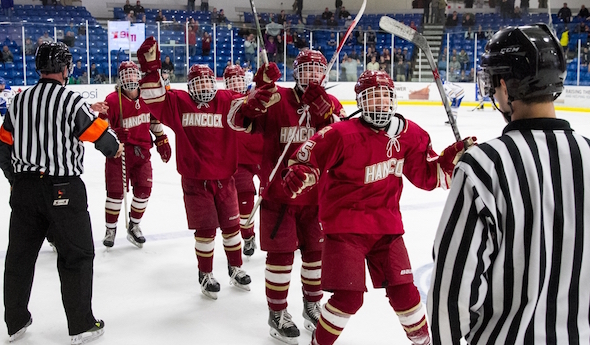
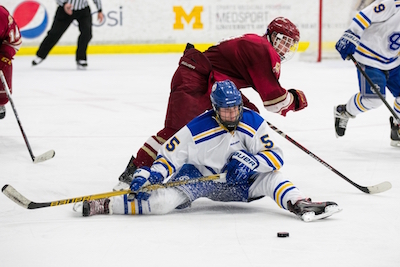
PHOTOS: (Top) Hancock players begin to celebrate during Saturday’s Division 3 championship victory. (Middle) Grand Rapids Catholic Central’s Andrew Holland (5) works to keep control of the puck in front of a Hancock pursuer. (Click for more from Andrew Knapik.)
'Team 43' Delivers 1st Livonia Title
March 9, 2013
By Bill Khan
Special to Second Half
PLYMOUTH — Livonia is one of the great hockey communities in Michigan, but had never been home to an MHSAA Finals champion.
Until now.
Livonia Stevenson brought a championship to the birthplace of former NHL star Mike Modano, beating Hartland 5-4 in the Division 2 title game Saturday at Compuware Arena.
Prior to this weekend, Livonia's three hockey-playing schools had combined for only eight regional championships during the 39-year history of the MHSAA tournament and just one semifinal appearance (Stevenson in 1987). It doesn't help that the Livonia schools often encounter some of the state's perennial powerhouses early in the postseason. Stevenson has been eliminated 10 times by Detroit Catholic Central and five times by Trenton in regional play.
"I couldn't be happier for the Stevenson administration, the alumni and the whole Livonia community," fifth-year Stevenson coach David Mitchell said. "We're in the 43rd year of high school hockey in Livonia.
We're the 43rd team in Stevenson history. This is the first chance a Livonia school has had to play in a state final. To get it done, this is not just for Stevenson, but for all of Livonia high school hockey. We've had some great teams and some great kids go through our program. To do it is very special. Hopefully, the whole community can enjoy this."
To win its first championship, Stevenson denied Hartland the same opportunity. The Eagles had won 11 regional titles before this season, reaching the semifinals only twice until playing in their first final on Saturday.
Hartland coach Rick Gadwa praised captains Nick Pleshakov, Justin Bailey and Ned O'Boyle for laying the foundation for Hartland's first march to the championship game.
"These three guys changed Hartland hockey," Gadwa said. "It was their leadership on and off the ice. We put Hartland on the map. That's something that hopefully stays."
Junior Dominic Lutz was the star in Stevenson's historic season, scoring 42 goals with 32 assists in 31 games to easily lead the Spartans in scoring. It was fitting that the 6-foot, 185-pound forward scored the team's biggest goals in the championship game, popping in two in a 2:37 span of the second period to turn a 2-1 deficit into a 3-2 advantage. Stevenson never surrendered the lead.
"We've been preaching Team 43," Lutz said. "It's just great to see it all come together in the end. We've got it. It's unbelievable. We're like a family. This is the closest team I've ever played on."
 Stevenson senior Travis Harvey, who scored two goals and had two assists in the semifinal on Friday, opened the scoring off a faceoff win at 4:55 of the first period. Hartland junior Austin Flores tied it off a
feed from Chris McRae at 6:26 of the first.
Despite being outplayed in the first period, Hartland found itself on top by a 2-1 count when McRae scored just 54 seconds into the second period.
The pace picked up considerably after that, as the teams combined for five goals during an 8:18 span. Stevenson took the lead for good on two goals by Lutz at 4:30 and 7:07 and Harvey's second goal of the game at
9:10.
O'Boyle brought Hartland within 4-3 at the 9:56 mark, only to have Stevenson regain a two-goal advantage at 12:48 on a goal by Ray Chartier.
"We would rather not play that way," Mitchell said. "We'd rather play a little more defensive and shut things down. These guys, when they see opportunities, they tend to go. We saw a few opportunities and
took some. Give Hartland credit. We were starting to look for goals and they caught us and they turned around and buried some of their own. They played an outstanding game."
"It was just go, go, go," O'Boyle said. "It was incredible emotionally."
Hartland didn't take long to trim the lead once the puck dropped in the third period, making it a 5-4 game on a goal by McRae at the 14-second mark.
The Eagles had eight more shots on net the rest of the game, but couldn't get another puck past Stevenson goalie Connor Humitz. Hartland called timeout with 2:21 left and pulled goalie Nick Wineka in the final minute, but couldn't generate a shot in that time against an aggressive Stevenson forecheck.
"We just want to keep it deep in their zone as much as we can," Lutz said. "Just gain the red line, get it deep and forecheck. We didn't want anything in our zone. We wanted everything down there, just keep
all the pressure off Connor. It seemed like it worked out."
Stevenson finished with a 23-7-1 record, while Hartland ended 19-9-2.
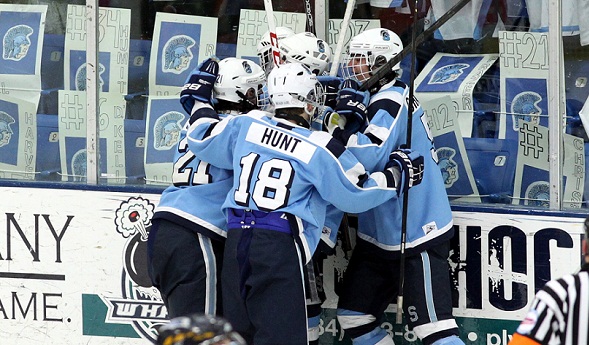
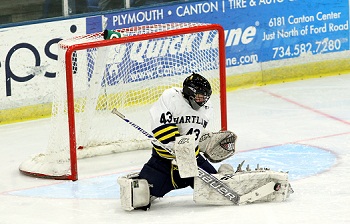
PHOTOS: (Top) Livonia Stevenson players celebrate a goal during Saturday's Division 2 Final in front of their fan section at Compuware Arena. (Middle) Hartland goaltender Nick Wineka makes one of his 35 saves Saturday. (Photos by Hockey Weekly Action Photos.)