

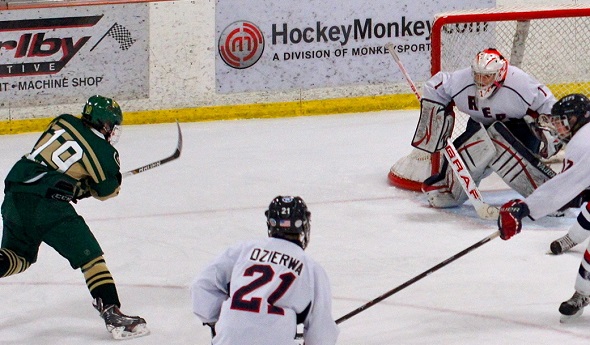
'Miracle' Comeback, Memorable Finish
February 27, 2014
By Geoff Kimmerly
Second Half editor
At some point, Jay Jones is sure, he and his friends from Traverse City West will reminisce about playing in the second-longest hockey game in MHSAA history.
Erik Anton always will remember sending the shot into the top corner of the net that made the score 2-1 in favor of his team and ended the seven-overtime marathon against Jones and the Traverse City Bay Reps – but there’s no way Anton will be the one bringing it up.
No need. His goal as midnight approached Monday immediately became legendary in the Traverse City area – complete with a captivating back story as well.
Anton’s shot ended the game after 103 minutes and 33 seconds – or 4:33 into the seventh overtime.
A little more than year ago, Anton couldn’t skate, or for that matter walk – he was hospitalized in Grand Rapids, paralyzed from the rib cage down because of a viral infection.
And among his visitors was Jones, a friend since childhood and the Bay Reps goalie Monday who stopped 48 shots before Anton potted the game winner.
“I don’t think it’s something where I’ll be like, ‘Remember that?’ But obviously it will be in our memories,” Anton said. “We were trying for such a long time. (For them) it was such a heart-breaking experience.
“(But) I might tease him about it a little bit.”
Anton and Traverse City West live on, having also beaten Manistee on Wednesday to advance to Saturday’s Division 1 Regional Final against Grand Rapids West Catholic. A trophy-earning win that night surely would add to an incredibly memorable week.
But it already has been an unforgettable year for the Titans junior wing, even as his most “miraculous” feat came against a friend who has been among those rooting him on these last many months.
Suddenly sidelined
Anton has played hockey since he was 3, and he has six goals and eight assists this winter. It’s his number one sport – although he also plays tennis and lacrosse.
Needless to say, he’s always been an active guy.
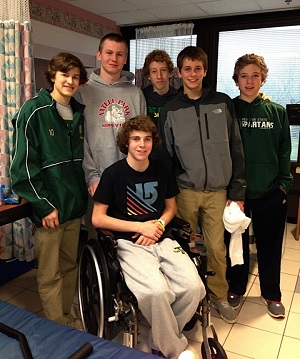 Until December 2012. Anton contracted transverse myelitis, an infection affecting the spiral cord caused in this case by a virus. His immune system, mistaking that part of his nervous system for the virus, attacked – causing the paralysis that sent him on a trip to Helen DeVos Children’s Hospital in Grand Rapids.
“How I describe it, I was lying down and somebody just put 1,000 pounds on top of my legs,” Anton said. “You try to move your legs and you can’t.
“(The doctor) would take a pen and touch the bottom of my foot, and it felt like they were taking a lighter to the bottom of my foot.”
His doctor gave him a 33 percent chance of recovering fully. Anton was expected to stay in Grand Rapids at the Mary Free Bed rehabilitation hospital for three months.
That first weekend away from home, Anton was visited by teammates and friends, including Jones. Their travel teams growing up had included about half of the current West team, a few who now play at Traverse City Central and a handful more now on the Bay Reps.
“I was shocked to see him like that,” Jones said, “not being able to move a whole lot.”
Friendly support
Jones, a sophomore, attends St. Francis High School. The Bay Reps are a hockey co-op team comprised of students from seven schools. He and Anton never went to the same one, but their families are friends and they became hockey teammates on the travel circuit when they were 8 or 9.
They also started lacrosse together, played tennis together, golfed and more recently snowboarded together.
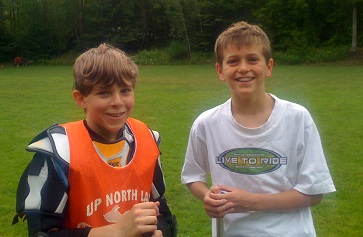 Jones first heard of what had befallen his friend in the lockerroom after a practice. Stunned to say the least, Jones didn’t say much for the first day or two before he and their friends made the trip to Grand Rapids.
By Jones’ description, Anton is a funny guy, definitely an extrovert. They together were the talkers on their travel teams growing up. Jones found his friend wasn’t much different in this unusual setting, just a little quieter. “He actually got up and we wheeled him around the hospital area,” Jones said. “We were laughing and making jokes like normal.”
“I just remember being in high spirits,” Anton added. “I always love seeing my friends, and having my friends come down and visit me, just being able to be with them again, especially when I was just laying in the hospital ...”
Anton said he knew from the start that he wouldn’t settle for a three-month hospital stay and surely not for paralysis for life if he could help it. He showed enough improvement to go home after just two weeks. And by the end of the spring lacrosse season, he felt back at full strength.
“It is pretty amazing. Once he got back, everyone pretty much treated him like normal,” Jones said. “He was back to his old self.”
Memorable moment
Anton could feel Jones’ stick jabbing at his skates whenever he came close to the net Monday. Anton laughed to himself at the little unspoken competition between the two.
He felt strong going into the third overtime, but by the fourth his legs were feeling heavy. By the seventh overtime his shifts had shortened substantially as players dug for any energy they could muster.
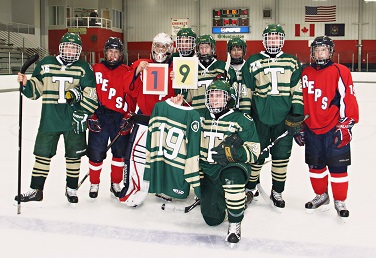 Meanwhile, Jones would smack his stick at the goal posts between periods, swing it at the net – “pretty much trying to stay awake at that point,” he said.
As the overtimes piled up, Jones also began to consider the significance of being part of such a game. It would be talked about for a long time. Everyone would know it was hard-fought. Win or lose, both teams would feel a sense of accomplishment. But if his team lost, he’d be absolutely crushed.
Both he and Anton saw a similar build-up to Anton’s deciding shot. Anton had been on the ice for about 15 seconds. His team was regrouping in the neutral zone when teammate Caleb Breithaupt ended up with a loose puck and pushed it ahead to forward Nick Schultz at the blue line.
Anton took a pass at the top of a circle in front of the Bay Reps’ net. Jones saw him line up the shot. A defenseman skated between them, but remained just off to a side. Anton fired at the high left corner of the net. Jones never saw the puck go by.
It was the Bay Reps’ fifth overtime loss this season. Jones took a knee staring at the ice in front of him. His teammates skated over and provided some support, but the moment was “surreal” – for a moment, Jones said, the ice was completely silent. And then he looked into the corner and saw number 19, Anton, celebrating. He smiled, just a little.
Traverse City West had lost to the Reps in overtime, 5-4, in a 2013 Pre-Regional opener, and then again earlier this season. Those details provide additional layers to an extraordinary experience players on both sides will tell about in the years to come.
It’s what Anton has learned to relish while recovering from his unfortunate circumstance, even if he’ll let others start this conversation the next time he’s hanging with Jones and his other Bay Reps pals.
“I definitely don’t take anything for granted anymore. I always put all my effort into sports, but after going through that, I really try to enjoy it, make the most of it when I can,” Anton said. “I always had a competitive edge, and I still do. Now I definitely try to enjoy it while I’m out there, enjoy the experience.”
Click to read more about Anton’s initial recovery from the Traverse City Record-Eagle.
PHOTOS: (Top) Traverse City West’s Erik Anton (19) unloads a shot at Bay Reps goalie Jay Jones that Jones stops Monday. (Middle top) Anton, seated, is visited by friends including Jones (gray jacket) during his hospital stay. (Middle below) Anton, left, and Jones take a brief moment from lacrosse during their younger days. (Below) Members of the West and Bay Reps hockey teams hold up Anton’s jersey after a game he could not play in last season. (Photos courtesy of Madelaine Jones.)
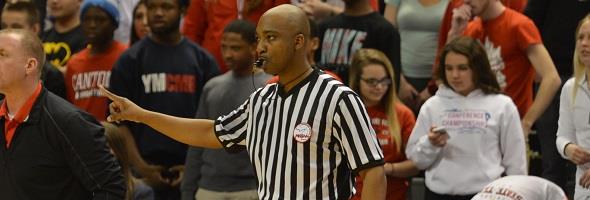
Be the Referee: Hockey Rules Chart
February 6, 2020
This week, MHSAA assistant director Brent Rice addresses some of the rules differences between high school and college hockey.
Be The Referee is a series of short messages designed to help educate people on the rules of different sports, to help them better understand the art of officiating, and to recruit officials.
Below is this week's segment - Hockey Rules Chart - Listen
Today we’d like to take a look at some of the differences between high school and college hockey.
• During pregame, the high school coach must meet with officials to verify that all players are properly equipped. There is no such rule in college hockey.
• Hand passes are permitted in the defensive zone in high school hockey, but not in college hockey.
• Goalies may play the puck with a high stick in college hockey, but not in high school hockey.
• A puck directed into the goal with a skate may be allowed in college hockey, but not in high school hockey.
Knowing the rules differences can help you better enjoy watching this sport. You can find the complete chart of rules differences on the Ice Hockey page of the MHSAA Website.
Past editions
Jan. 30: Cheer Safety - Listen
Jan. 23: Goaltending - Listen
Jan. 16: Wrestling Tie-Breaker - Listen
Jan. 9: Pregame Meeting - Listen
Dec. 19: Alternating Possession - Listen
Dec. 12: Ratings - Listen
Dec. 5: Video Review Success - Listen
Nov. 28: More Injury Time - Listen
Nov. 21: Football Review - Listen
Nov. 14: Sideline Safety - Listen
Nov. 7: Officials Playlist - Listen
Oct. 31: Most Important Line - Listen
Oct. 24: Automatic 1st Downs - Listen
Oct. 17: Catch Momentum - Listen
Oct. 10: Golf Rules Changes - Listen
Oct. 3: No Tackle Box - Listen
Sept. 26: You Make the Overtime Call - Listen
Sept. 19: Swimming Finishing Touch - Listen
Sept. 12: Curbing Gamesmanship By Substitution - Listen
Sept. 5: Football Safety Rules Changes - Listen
Aug. 29: 40-Second Play Clock - Listen