

Performance: Bay Reps' Jake Stevenson
February 15, 2019
 Jake Stevenson
Traverse City St. Francis senior – Hockey
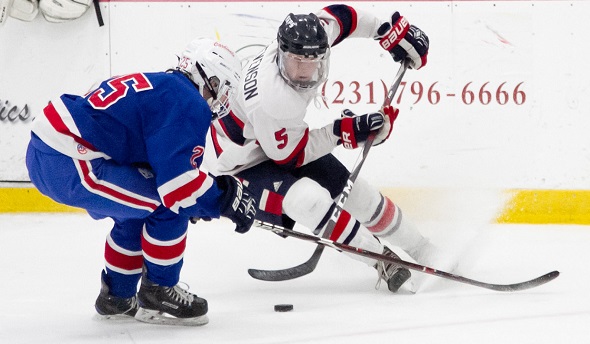
Stevenson had three goals including two straight during the third period to send Saturday’s game against Petoskey to overtime, as his Traverse City Bay Reps co-op team went on to win 5-4 and clinch the Northern Michigan Hockey League championship. Stevenson, in his fourth season in the program, is the team’s leading scorer and has scored five goals over his last three games in earning the Michigan Army National Guard “Performance of the Week.”
The Bay Reps are made up of players from Stevenson’s St. Francis High School as well as Bear Lake, Elk Rapids, Kalkaska and Kingsley. They’ve won nine of their last 10 games to move to 17-5 and earn the No. 11 ranking in Division 1. The hat trick was Stevenson’s second this season, and after Thursday’s win over Manistee he has 22 goals and 20 assists in 22 games this winter. Petoskey led Saturday’s game 2-0 before Stevenson scored his first goal, and he added his second on a power play and his third from just outside the circle.
 Stevenson is playing this season for his third high school head coach; his dad Mark was the coach Jake’s freshman year, followed by Ryan Fedorinchik the last two and now former assistant – and NHL defenseman – Mike Matteucci. Jake Stevenson also played soccer at St. Francis and golf earlier in high school, and he’s hoping to continue playing hockey at the junior level and then collegiately after graduating this spring. He carries a 3.0 GPA and eventually would like to study drone piloting.
Coach Mike Matteucci said: “This will be Jake's fourth year playing high school hockey, and each year his game has improved. Jake has always wanted to move on to the next level after high school, so the last couple of years he has really taken ownership in his game. As a coach, it is a pleasure to come to the rink every day and have players like Jake who are coachable and who make others around them better. This year more than others, Jake has embraced the ‘team’ game, which as increased our statistical output as well as helped us win more games. What separates Jake from others is his tenacity. He is a very competitive person who is hard to play against. He is definitely an impact player on our team!”
Performance Point: “It's senior year and you don't want to go down without a fight. All the boys started the pick it up in the third period, and we all brought it together,” Stevenson said of his team’s comeback against Petoskey. “We just weren’t connecting our passes. Everyone was getting too nervous with the puck, not really calm. We weren't really playing our game. I think just being one of the leaders on the team, you need to show that even when we're down, it’s no excuse to stop playing. Someone had to step up and take control a little bit.”
Together as a team: “It's fun just knowing there's all these guys (from Bay Reps’ schools) out there, and being able to play with them and meet them and become new friends. I think when we're at the rink we make the most of it, every time we're there from the second we walk in to the second we leave. Usually no one just leaves right after practice – we kinda hang out for a little bit and talk, and catch up and mess around see how everyone's day is going. We hang out every now and then in the summer times. We do some summer hockey together. ... We try to stay close.”
 Valuable input: “We've brought in Mike Matteucci as our head coach and Kyle Jean, Mikey Wittersheim and of course Coach (Eric) Videan. I think all the coaching staff has helped a lot, helped bring everyone together. They've taken different looks at kids and helping them out. Coach Jean has helped me out tremendously on offense, just helping me realize when to shoot the puck, when to make the pass, how to make the plays. Coach Matteucci has been helping me a lot in the defensive zone, and so has Coach Videan. And Mikey's our goalie coach, and he's been helping me out with tips on where to shoot.”
Dad knows: “It was great having him as a coach because he played in the high-level juniors and he knows a lot about the game, and he’s coached a lot of kids so that helped a lot. Every now and then he still gives me advice from what he sees and tries to help me out still.”
Game on: “Everybody in my family has played hockey, even my mom did; she played on a girls club team when she was younger. (I have) three sisters and three brothers … I'm the second youngest. We used to build a rink in our back yard, and so we'd all go out there and play, and we got a little competitive because obviously we all want to be the best from the family. But it's fun. I'd say I'm the best, but ... my brother thinks he is. I don't know about that.”
- Geoff Kimmerly, Second Half editor
Every week during the 2018-19 school year, Second Half and the Michigan Army National Guard recognizes a “Performance of the Week" from among the MHSAA's 750 member high schools.
The Michigan Army National Guard provides trained and ready forces in support of the National Military Strategy, and responds as needed to state, local, and regional emergencies to ensure peace, order, and public safety. The Guard adds value to our communities through continuous interaction. National Guard soldiers are part of the local community. Guardsmen typically train one weekend per month and two weeks in the summer. This training maintains readiness when needed, be it either to defend our nation's freedom or protect lives and property of Michigan citizens during a local natural disaster.
Past 2018-19 honorees
February 7: Molly Davis, Midland Dow basketball - Read
January 31: Chris DeRocher, Alpena basketball - Read
January 24: Imari Blond, Flint Kearsley bowling - Read
January 17: William Dunn, Quincy basketball - Read
November 29: Dequan Finn, Detroit Martin Luther King football - Read
November 22: Paige Briggs, Lake Orion volleyball - Read
November 15: Hunter Nowak, Morrice football - Read
November 8: Jon Dougherty, Detroit Country Day soccer - Read
November 1: Jordan Stump, Camden-Frontier volleyball - Read
October 25: Danielle Staskowski, Pontiac Notre Dame Prep golf - Read
October 18: Adam Bruce, Gladstone cross country - Read
October 11: Ericka VanderLende, Rockford cross country - Read
October 4: Kobe Clark, Schoolcraft football - Read
September 27: Jonathan Kliewer, Grand Rapids Forest Hills Northern soccer - Read
September 20: Kiera Lasky, Bronson volleyball - Read
September 13: Judy Rector, Hanover-Horton cross country - Read
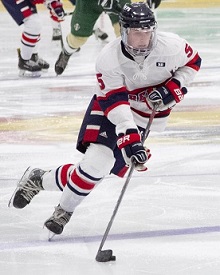
PHOTOS: (Top) The Bay Reps' Jake Stevenson (5) battles for the puck during a November game against Big Rapids. (Middle) Stevenson brings the puck forward against Monroe St. Mary Catholic Central. (Photos courtesy of the Traverse City Bay Reps hockey program.)
Finals Preview: The Puck Starts Here
March 6, 2013
By Geoff Kimmerly
Second Half editor
Two things are sure to occur at this weekend's MHSAA Ice Hockey Finals.
At least one Division 2 finalist will play in a title game for the first time. And no matter which wins Saturday, that team will take leave Plymouth's Compuware Arena with its first MHSAA Finals championship trophy.
None of this weekend's Division 2 Semifinalists have won the biggest prize, adding another layer of intrigue to a tournament that traditionally draws contenders from all corners of the state.
Divisions 1 and 3, meanwhile, feature two of the most successful programs in MHSAA history. Although both missed Finals weekend in 2012, Detroit Catholic Central is back in Division 1 going for its 11th title, and Bloomfield Hills Cranbrook-Kingswood is back in Division 3 going for its 16th championship.
The pairings are as follows:
Division 2 Semifinals - Thursday
Port Huron Northern (15-13-1) vs. Hartland (18-8-2), 5 p.m.
Saginaw Heritage (24-5) vs. Livonia Stevenson (21-7-1), 7:30 p.m.
Division 3 Semifinals - Friday
Bloomfield Hills Cranbrook-Kingswood (26-2-1) vs. Riverview (20-7-1), noon
Sault Ste. Marie (21-8) vs. Flint Powers Catholic (22-5-1), 2:30 p.m.
Division 1 Semifinals - Friday
East Kentwood (15-12-2) vs. Detroit Catholic Central (21-7), 6 p.m.
Brighton (26-2-1) vs. Detroit U-D Jesuit (19-8-2), 8:30 p.m.
FINALS - Saturday
Division 2 – 10 a.m.
Division 3 – 2 p.m.
Division 1 – 6 p.m.
All Semifinals and Finals will be streamed live on MHSAA.tv, with live audio available on MHSAANetwork.com. The Finals also will appear later this month on Comcast channel 900. Division 1 will be broadcast at noon March 18, 9:30 p.m. March 19 and 10:30 a.m. March 20; Division 2 at 8 a.m. March 16 and 6 p.m. March 17, and Divsion 3 at 3 p.m. March 16, 9 a.m. March 17, 7 p.m. March 19 and 8 a.m. March 20.
Click for a full schedule of this weekend's games plus full results as they come in. Players statistics below are through the Regional round and were submitted by participating schools. And check back on Second Half this Saturday night for coverage from all three Finals.
Division 1
BRIGHTON
Record/rank: 26-2-1, No. 3
Championship history: Two MHSAA titles (most recently 2012).
Coach: Paul Moggach, 18th season (328-112-37)
League finish: First in Kensington Lakes Activities Association (Central and overall)
Best wins: 5-1 over No. 5 Plymouth, 4-3 over Division 3 No. 2 Houghton,4-1 over Division 3 No. 3 Calumet, 6-0 over Division 3 No. 5 Grosse Pointe Woods University Liggett, 6-2 and 8-1 over Division 2 No. 8 Novi, 5-3 over Division 2 No. 6 Livonia Churchill, 6-1 over Division 2 No. 9 Hartland, 4-2 over Division 3 No. 8 Farmington.
Players to watch: Michael Yuhasz, senior right wing (34 goals, 26 assists); Danny Bosio, junior left wing (26 goals, 27 assists); Jimmy Milletics, sophomore goaltender (1.60 GAA, 0.91 save %, eight shutouts).
Outlook: Brighton rode a sturdy defense to last season’s championship, and is strong stopping the puck again with Milletics providing quite an obstacle in net. The Bulldogs had given up one or no goals in eight straight games before allowing three to Bay City Central in the Quarterfinal. This team can score too, with seven who have netted at least 10 goals this season and 13 with at least 10 assists. Another result that could become important depending on how Friday shakes out – Brighton closed the regular season with an 8-0 win over East Kentwood, a Semifinalist on the other side of the bracket.
DETROIT CATHOLIC CENTRAL
Record/rank: 21-7, No. 1
Championship history: 10 MHSAA titles (most recently 2010), three runner-up finishes.
Coach: Todd Johnson, 13th season (277-58-23)
League finish: Second in Michigan Interscholastic Hockey League North
Best wins: 5-0 and 3-0 over No. 6 Grosse Pointe North, 6-1 and 3-1 over No. 4 Orchard Lake St. Mary’s, 2-1 over No. 7 Detroit U-D Jesuit, 3-1 and 3-1 (Regional) over No. 2 Birmingham Brother Rice, 5-1 over No. 5 Plymouth (Quarterfinal), 4-1 and 5-1 over Division 2 No. 5 Port Huron Northern, 8-0 and 5-1 over Division 2 No. 3 Trenton, 5-2 over Division 2 No. 6 Livonia Churchill, 4-2 over Division 3 No. 1 Bloomfield Hills Cranbrook-Kingswood, 6-0 over Division 3 No. 7 Dearborn Divine Child, 8-0 over Division 3 No. 5 University Liggett.
Players to watch: Michael Babcock, senior center (14 goals, 22 assists); Carson Gatt, junior defenseman (three goals, 17 assists), Charlie Green, senior right wing (16 goals, 18 assists).
Outlook: It’s fair to say DCC played the state’s toughest schedule this winter. On top of the 16 wins over ranked opponents, the Shamrocks’ losses came twice to Cranbrook-Kingswood, once to Brother Rice, once to Division 2 No. 1 Livonia Stevenson, twice to Indiana power Culver Academy and once to Canada’s Hill Academy. Babcock and Green made the all-state first team and Gatt made the second team in 2012.
DETROIT U-D JESUIT
Record/rank: 19-8-2, No. 7
Championship history: Has not appeared in an MHSAA Final.
Coach: Rick Bennetts, 18th season (215-217-32)
League finish: Second in MIHL South.
Best wins: 5-2 over No. 6 Grosse Pointe North (Regional), 5-2 over Division 2 No. 1 Livonia Stevenson, 4-3 and 5-4 over Division 2 No. 3 Trenton, 5-4 over Division 2 No. 5 Port Huron Northern, 4-0 over Division 2 No. 7 Grosse Pointe South, 5-2 over Division 3 No. 3 Calumet, 5-1 over Division 3 No. 4 Sault Ste. Marie.
Players to watch: Tommy Apap, junior right wing (14 goals, 23 assists); Craig Pefley, senior center (26 goals, 32 assists); Pete McMahon, senior left wing (14 goals, 19 assists).
Outlook: Jesuit fell just one point shy of winning its league title, and then beat MIHL South champion Grosse Pointe North during the Regional. Five of the Cubs’ losses came to ranked Division 1 teams, with two more against Division 3 teams that will play for that title this weekend. Pefley and Apap both made the all-state second team in 2012.
EAST KENTWOOD
Record/rank: 15-12-2, unranked
Championship history: One MHSAA title (1993), three runner-up finishes.
Coach: Shawn Jensen, first season (15-12-2)
League finish: Third in O-K Red
Best wins: 3-2 over Division 2 No. 10 Grand Haven, 4-1 over Rockford, 6-5 (OT) over Muskegon Reeths-Puffer (Quarterfinal).
Players to watch: Tyler Layle, senior defenseman (eight goals, 11 assists); Trent Bravata, senior center (20 goals, 18 assists), Austin Adams, senior left wing (10 goals, 13 assists).
Outlook: East Kentwood is back at the Semifinals for the third straight season and this time under first-year coach Jensen, an all-state defenseman for the Falcons in 1997 and later an assistant coach for the team. East Kentwood advanced in part with overtime wins in the Regional final and Quarterfinal. Layle made the all-state second team last season and Bravata earned an honorable mention.
Division 2
HARTLAND
Record/rank: 18-8-2, No. 9
Championship history: Has not appeared in an MHSAA Final.
Coach: Rick Gadwa, second season (33-18-4)
League finish: First in Kensington Lakes Activities Association Lakes Conference
Best wins: 2-1 over No. 8 Novi, 7-4 and 5-4 over Howell, 7-2 over Walled Lake Central.
Players to watch: Nick Pleshakov, senior defenseman; Brett Bandyk, senior forward; Chris McRae, junior forward. (Statistics not submitted.)
Outlook: Hartland has won its Regional both times under Gadwa, and this season took the next step. Although the games ended in losses, the Eagles saw some of the state’s best competition this winter including Division 1 top-five teams Brighton and Plymouth and Division 3 No. 5 Grosse Pointe Woods University Liggett. Pleshakov made the all-state second team as a junior.
LIVONIA STEVENSON
Record/rank: 21-7-1, No. 1
Championship history: Has not appeared in an MHSAA Final.
Coach: David Mitchell, fifth season (89-33-11)
League finish: Second in KLAA Kensington Central
Best wins: 9-2, 7-3 and 3-1 (Regional final) over No. 6 Livonia Churchill, 6-1 over No. 7 Grosse Pointe South, 6-1 over No. 8 Novi, 1-0 over Division 1 No. 1 Detroit Catholic Central, 4-0 over Division 1 No. 9 Macomb Dakota, 7-6 over Division 3 No. 5 Grosse Pointe Woods University Liggett.
Players to watch: Dominic Lutz, junior left wing (39 goals, 31 assists); Tyler Irvine, junior right wing (15 goals, 29 assists); Devin Kelly, junior center (14 goals, 35 assists).
Outlook: Stevenson survived a scare in the Quarterfinal before beating Ann Arbor Pioneer 3-2 in double overtime, but has won big against some of the best teams from all three divisions. Senior defenseman Trent Harvey has added 14 goals and 14 assists this season in front of senior goaltender Connor Humitz, who has five shutouts.
PORT HURON NORTHERN
Record/rank: 15-13-1, No. 5
Championship history: Division 1 runner-up in 2001.
Coach: Daryel McCarrel, 21st season (373-213-47)
League finish: Fifth in Michigan Interscholastic Hockey League North
Best wins: 5-2 over No. 3 Trenton, 4-3 over No. 7 Grosse Pointe South (Quarterfinal), 6-1 over Division 3 No. 6 Flint Powers Catholic
Players to watch: Bryce VanHorn, junior left wing (18 goals, 25 assists); Tyler Hughes, senior defenseman (four goals, 12 assists); Matt Fernandez, senior goaltender (2.78 GAA, four shutouts).
Outlook: The Huskies’ MIHL league finish again is deceptive, as it shares the league with Division 1 No. 1 Detroit Catholic Central, No. 2 Birmingham Brother Rice and No. 4 Orchard Lake St. Mary’s, and Division 3 No. 1 Bloomfield Hills Cranbrook-Kingswood. After facing that group, Northern no doubt is ready for anything this weekend. VanHorn earned an all-state honorable mention last season and is one of five Huskies with at least 10 goals and one of eight with at least 10 assists. Fernandez made the all-state second team last season and Hughes made the first team.
SAGINAW HERITAGE
Record/rank: 24-5, unranked
Championship history: Has not appeared in an MHSAA Final.
Coach: JJ Bamberger, fourth season (66-37)
League finish: Second in Saginaw Valley Association
Best wins: 4-3 over Howell, 4-1 and 3-2 (Regional) over Midland, 4-1 over No. 10 Grand Haven (Quarterfinal).
Players to watch: Tyler Angers, junior center (27 goals, 27 assists); Sami Abdelaziz, senior left wing (25 goals, 22 assists); Jacob Tweedle, senior center (13 goals, 12 assists).
Outlook: The Hawks are Regional champs for the second time in four seasons and after down finishes of 7-16-2 and 12-12 the last two winters. Heritage was ranked most of this season and peaked at No. 5, and is riding a 10-game winning streak. Junior goalie Kevin Cressey also has been outstanding, with a 2.40 goals-against average and .916 save percentage.
Division 3
BLOOMFIELD HILLS CRANBROOK-KINGSWOOD
Record/rank: 26-2-1, No. 1
Championship history: 15 MHSAA titles (most recently 2010), two runner-up finishes.
Coach: Andy Weidenbach, 20th season (387-145-34)
League finish: First in MIHL North.
Best wins: 5-2 and 5-1 over Division 1 No. 1 Detroit Catholic Central, 2-0 and 5-2 over Division 1 No. 4 Orchard Lake St. Mary’s, 9-3 over Division 1 No. 2 Birmingham Brother Rice, 7-4 over Division 1 No. 5 Plymouth, 3-2 and 4-3 over Division No. 6 Grosse Pointe North, 5-3 over Division 1 No. 7 Detroit U-D Jesuit., 7-0 over Division 2 No. 1 Livonia Stevenson.
Players to watch: Christopher Brown, junior center (21 goals, 24 assists); Alex Alger, junior right wing (29 goals, 24 assists); Austin Alger, junior center (20 goals, 27 assists); Michael Romund, senior left wing (20 goals, 27 assists).
Outlook: Cranbrook-Kingswood likely would be considered the favorite to win any of the three divisions this weekend, despite playing among the smallest schools. The Cranes beat six of the top 10 in Division 1 this season, and 18 of 23 games played against in-state opponents were against ranked teams. They didn't give up a goal in the postseason until beating No. 5 University Liggett 7-2 in the Quarterfinal. Brown made the all-state first team last season, and Alex Alger made the second team.
FLINT POWERS CATHOLIC
Record/rank: 22-5-1, No. 6
Championship history: Seven MHSAA runner-up finishes (most recently 2010).
Coach: Travis Perry, seventh season (144-41-11)
League finish: First in Saginaw Valley Association.
Best wins: 5-1 over Division 1 No. 7 Detroit U-D Jesuit, 2-1 over Division 2 No. 10 Grand Haven, 2-0 over Saginaw Heritage, 2-1 (2 OT) over East Grand Rapids (Quarterfinal).
Players to watch: Garrett Gormley, junior right wing (21 goals, 15 assists); Casey Korhonen, senior goaltender (1.27 GAA, 0.93 save %); Mike Forman, sophomore center (12 goals, 16 assists).
Outlook: Powers has won six straight Regional championships and is back in the Semifinals for the first time since 2010. Its defense has been staggering. The Chargers have given up one or zero goals in 16 games this season, and Korhonen has nine of the team’s 10 shutouts. He and Gormley both earned all-state honorable mentions last season.
RIVERVIEW
Record/rank: 20-7-1, No. 10
Championship history: Has not appeared in an MHSAA Final.
Coach: Al Taurence, third season (38-39-1)
League finish: Huron League, finish unavailable.
Best wins: 4-3 and 4-3 (Regional) over Monroe St. Mary Catholic Central, 5-3 over Chelsea (Quarterfinal).
Players to watch: Brian Bachnak, senior left wing (52 goals, 42 assists); Timothy Lyons, senior center (21 goals, 46 assists); Alex Testy, senior right wing (16 goals, 18 assists).
Outlook: Bachnak made the all-state second team last season and has put up incredible numbers in leading Riverview to the Finals after it finished 4-20 only two seasons ago. He’s one of a number of veterans, with 11 seniors among team’s 21 players. The Quarterfinal win over Chelsea avenged a 4-2 loss midway through the season.
SAULT STE. MARIE
Record/rank: 21-8, No. 4
Championship history: Two MHSAA titles (most recently 1989), five runner-up finishes.
Coach: John Ferroni, second season (33-19-2)
League finish: Does not compete in a league.
Best wins: 8-2 over No. 9 Hancock, 6-3 and 4-1 (Quarterfinal) over No. 2 Houghton, 1-0 over No. 7 Dearborn Divine Child, 5-2 over No. 5 University Liggett, 2-1 over Division 2 No. 5 Port Huron Northern, 5-4 over Division 2 No. 7 Grosse Pointe South
Players to watch: William Gauthier, junior center (17 goals, 18 assists), Blake Mastaw, junior left wing (15 goals, 22 assists); Eric Hillock, senior left wing (21 goals, 14 assists); Chase Gamelin, junior right wing (15 goals, 20 assists).
Outlook: Sault Ste. Marie has done exceptionally well against a tough slate after finished 12-11-2 in 2011-12. Four of its losses are to ranked Division 1 or 2 teams – including 5-4 in overtime to Division 1 No. 2 Birmingham Brother Rice. While there is obvious scoring punch, the defense has been impressive as well – the Blue Devils didn't allow a goal in the playoffs until Houghton got one Wednesday. Senior defenseman C.J. Wilkins earned an all-state honorable mention as a forward last season.
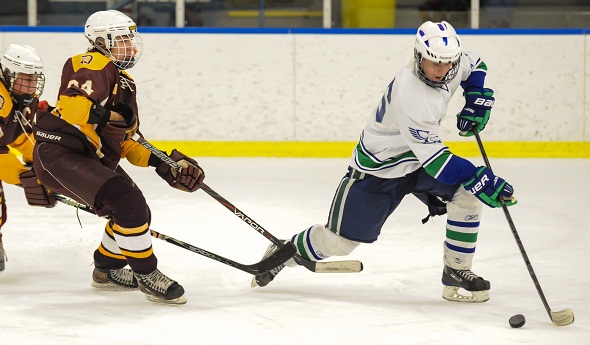
PHOTO: Saginaw Heritage (right) will attempt to advance to its first MHSAA championship game by defeating top-ranked Livonia Churchill in one of today's Division 2 Semifinals. (Click to see more at HighSchoolSportsScene.com.)