

St. Mary's Avenges Regular-Season Sweep to Claim 1st Finals Title Since 2008
March 8, 2025
PLYMOUTH — Orchard Lake St. Mary’s never really went away.
Yes, it had been 17 years since the Eagles won their last MHSAA hockey championship, but they’ve always been a factor.
Whether it was running into Division 1 powers Brighton and Detroit Catholic Central when St. Mary’s played in the biggest-school division in the MHSAA Tournament, losing in overtime twice in Regional Finals or getting shut out in two championship game appearances, and even forfeiting due to COVID policies in 2021, the Eaglets had some great teams come up just short in the postseason.
A program that won three MHSAA Finals in four seasons from 2005-08 finally put it all together again for five tournament games, winning the Division 3 championship with a 3-0 victory over 2024 champion Bloomfield Hills Cranbrook Kingswood on Saturday at USA Hockey Arena.
Winning MHSAA championships is apparently more difficult than St. Mary’s made it look way back when.
 “It’s hard,” said Brian Klanow, who has won 404 games as St. Mary’s coach over 26 seasons. “You’ve got to go through Regionals, and you certainly have to be on your game. Our team is playing its best hockey of the season right now.”
The last time St. Mary’s won a Finals championship was in a game that has now taken on mythical proportions. The Eaglets and Marquette played eight overtimes in the 2008 Division 1 Final tied 1-1 before the game was called and co-champions were declared out of concern for player safety.
So, why was this team the one to end the streak? Certainly, the Eaglets were loaded with talent, as they are most years. But they also had intangibles working in their favor.
“The difference between this year and previous years was we were close this year,” junior co-captain Charlie Roberts said. “Most of these guys have played with each other before. It played a big role. We were like a family out there. You can’t beat that.”
St. Mary’s senior goalie Will Keane has been trying for three seasons to bring a championship back to a school with a strong hockey tradition. He stopped all 26 shots he faced to backstop the victory.
“It’s unbelievable,” Keane said. “I’ve spent now three years here. My first one was a struggle; we didn’t even win a Regional. The guys who were in that room knew it was pretty tough. Last year, we came in and thought we had the team to do it. You don’t get a bounce. You have to get lucky. I don’t think we did last year, but we came back out and knew this year we had the team and we knew we could break that streak. That’s exactly what we did. The result’s unreal, nothing better.”
Keane split the goaltending duties nearly 50/50 throughout the regular season, partially because he missed time in late December with an injury. But St. Mary’s rode him for all five playoff games and he delivered, allowing only four goals for a 0.80 goals-against-average and .968 save percentage.
 “Both of our goaltenders have done a great job this year,” Klanow said. “Mason Shea stepped in when Will was injured. They typically would split. It’s probably close to 50/50, 60/40, but I think it’s important to pick a guy and we needed to ride him.”
Cranbrook Kingswood swept the two-game season series with St. Mary’s, winning 4-3 and 6-2. But the Eaglets locked it down defensively this time and did something they were unable to do in the previous meetings — get an early lead.
Emmett Pilch scored 5 minutes and 20 seconds into the game. St. Mary’s nursed that one-goal lead for more than 27 minutes until Matthew Mourad gave the Eaglets a 2-0 lead with 1:14 left in the second.
Jacob Fedor scored into an empty net from a faceoff circle in St. Mary’s end with 2:53 remaining to seal the victory and deprive the Cranes of back-to-back titles.
“The leadership was unbelievable this year,” Cranbrook coach John LaFontaine said. “These guys came together really quick. They always wanted to do the extra things to be a team. We didn’t have individuals, we had a bunch of guys who were battling together. They will keep these memories for the rest of their life.”
Senior forward Nick Timko concurred.
“The bond I made with all these guys, it’s going to be life-long,” he said. “It stinks to end it this way, but I’ll forever be thankful for these years I’ve had with them.”
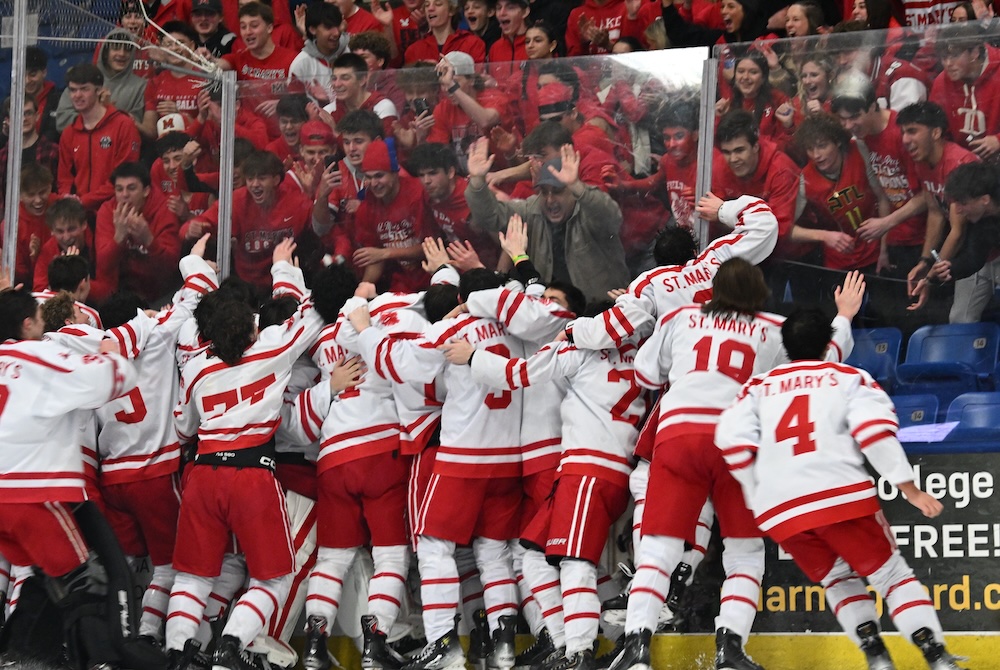
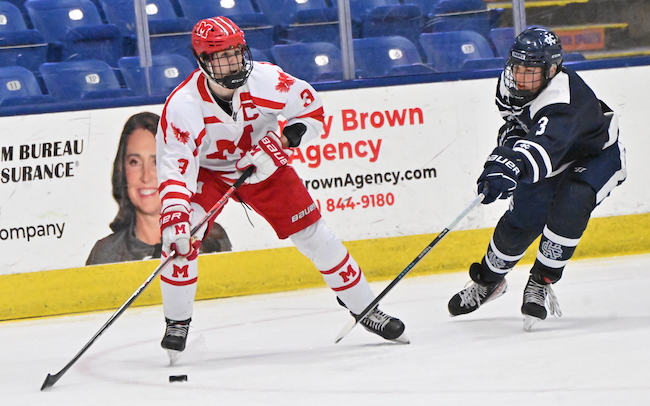
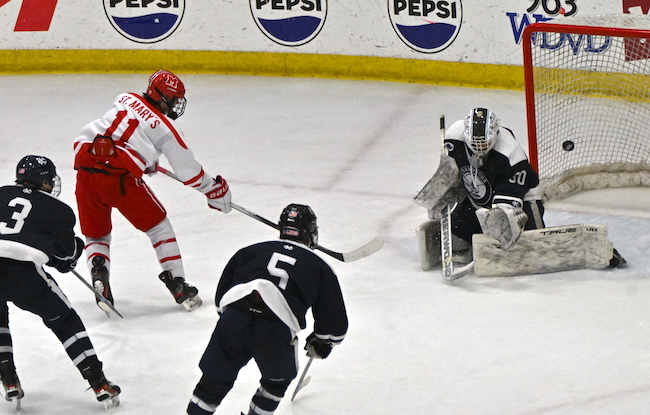
PHOTOS (Top) Orchard Lake St. Mary’s players celebrate their championship win Saturday with the student section and USA Hockey Arena. (Middle) St. Mary’s Charlie Roberts considers his next move with Cranbrook’s David Schmitt defending. (Below) The Eaglets’ Matthew Mourad (11) sends a shot into the net during the second period.
#TBT: 2002 Ends with Lights-Out Finals
July 12, 2019
By Rob Kaminski
MHSAA benchmarks editor
The Flint IMA had been to the MHSAA Ice Hockey Finals what Joe Louis Arena was to the Detroit Red Wings since it began hosting high school championships in the state in 1977.
For parts of four decades, the facility set the scene for many memorable moments on ice for scholastic skaters.
So it would have been fitting as the curtain was closing on an era March 9, 2002, if there’d been an overtime championship game or two to commemorate the last MHSAA Finals at the building.
In 2003, the MHSAA Semifinals and Finals would move to Compuware Arena in Plymouth – now USA Hockey Arena – where the event has been played ever since.
There would be no overtimes during the IMA’s swan song, but the arena wasn’t about to let go without a fight. Following the morning’s Division 2 Final, won by Grosse Pointe North over local qualifier Davison, things got strange.
As if by divine intervention, a significant power outage hit the Flint area between the first and second periods of the Division 3 Final, necessitating a return to the building for an encore performance that Monday.
Following is an account from then-MHSAA Assistant Director Randy Allen, administrator of the sport at that time.
 “East Grand Rapids and (Dearborn) Divine Child were between the first and second periods when the power went out at what must’ve been around three in the afternoon. Some of the house lights went on, but there was no huge generator. The power company told us it could be quite a while before the power came back, so the decision was made pretty quickly to come back Monday. (Editor’s Note: MHSAA regulations at that time prohibited Sunday competition, thus play would resume Monday)
“Finishing the game in progress Monday was really a no-brainer, but now there were a couple of immediate challenges. First, how were we going to let people know, and second, what was going to happen to the (Detroit) Catholic Central-Marquette Division 1 game coming up later in the day?
“Well, knowing what I knew about the TV business (Allen’s background in Wisconsin included sportscasting), I grabbed one of the television reporters there, probably from Grand Rapids, and asked him to come down to the ice with me. It was totally dark; I figured once he put his camera lights on, it would get the attention of the crowd, which it did. So there’s about 2 or 3 thousand people in the arena – in the dark – and I’m standing in front of a light from a TV camera, and at the top of my voice I explain the situation and let them know we’re coming back Monday.
“Anyone wanting to come back, admission was free of charge, and we’d trust they were at the game. If they wanted a refund, they could mail their ticket stub to MHSAA and we'd send a refund. We obviously couldn’t use the box office without power. I don’t recall more than a couple dozen refund requests coming to our office later.
“Now the real challenge is the Division 1 game. Marquette very, very much wanted to go home and come back a week later. They’d been on the road all week (Marquette won a Quarterfinal in Traverse City that Wednesday). Jack (Roberts, former MHSAA executive director) was there, and he and Marquette’s AD (Scott Koski) and their superintendent debated a bit. In the end, the regulations of the day were upheld, and the game would be Monday.
“As it turned out, someone in the Marquette entourage had a contact in the Detroit Pistons front office, so the team was entertained in a suite at The Palace of Auburn Hills on Sunday night, so that was quite a happy ending from their standpoint.
“Many of the Marquette people were either in the arena or at a single hotel or two in the area, so alerting them to the change was not difficult.
“But then we started to think, ‘What about the Detroit CC people who would be driving up for their game later? Remember, social media was not as prevalent as it is today, or even the dependence on the internet.
“So, Saturday night, I sat there at the entrance to the IMA with my car running and lights on to inform the CC fans and anyone else who pulled up that the game had changed ... ‘Power’s out; game’s on Monday.’ They'd say thanks, and out they'd go. No one really got angry; there wasn’t anything anyone could do. I sat there an hour and a half with a steady stream, and shortly after the scheduled game time I called it a night.”
And, the IMA called it the end of an era, but not before hanging on for one more night, when Divine Child and Detroit CC would raise the last trophies in that building ... under the lights.
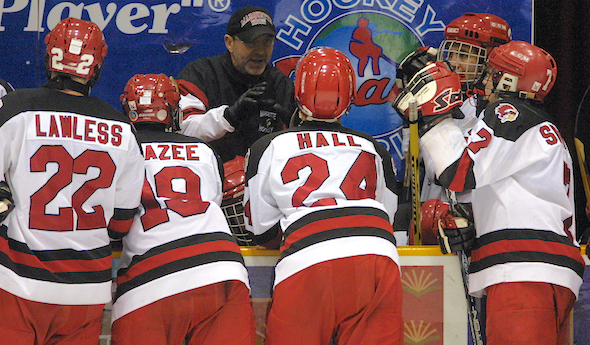
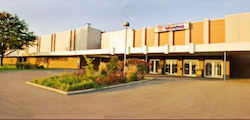
PHOTOS: (Top) Marquette was among teams that needed to stick around Flint two more days to play in the 2002 MHSAA Ice Hockey Finals. (Middle) Flint’s IMA arena.