

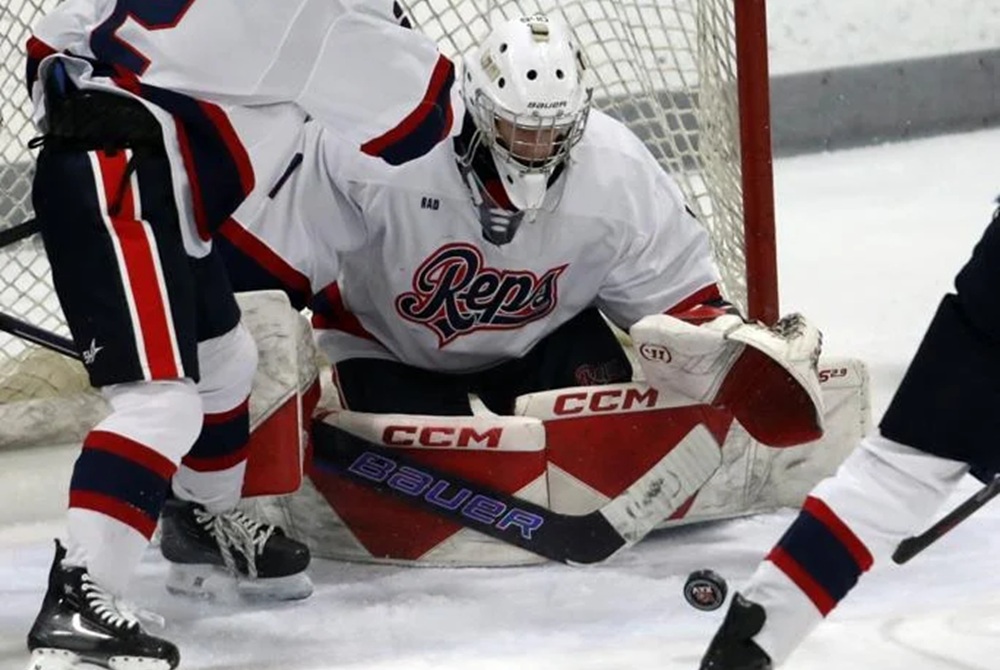
'TBF' Backstopping Bay Reps' Title Hopes as Exciting Future Takes Shape
By
Tom Spencer
Special for MHSAA.com
February 27, 2026
Tyler Boynton-Fischer knows his high school ice hockey career could end any day now.
 He also knows, or at least hopes, his playing days are far from over. Many, including his coaches, believe he’ll play at the next level and just maybe in the National Hockey League.
Boynton-Fisher is the record-setting goalie for the Bay Area Reps, a hockey co-op hosted by Traverse City St. Francis that includes athletes from Charlevoix, Elk Rapids, Kalkaska, Kingsley, Lake Leelanau St. Mary, Mancelona and Suttons Bay. He’s a senior at Traverse City St. Francis, and he finds himself in a familiar position.
The Reps are in the Quarterfinal for the second time over three years with Boynton-Fisher as their starting goalie. They advanced to the Regional Finals last season with Boynton-Fischer in net and his older brother Thomas, a senior then, and Grant Lucius leading an explosive attack.
Regardless of what happens when they take on Freeland on Saturday in Gaylord, the 6-foot-2 and growing goalie should play on. He’s been dreaming of playing in the NHL as far back as he can remember – and maybe longer.
“If I can, playing in the NHL would be really cool,” Fisher-Boynton said. “I am just excited to see what I can do and see what level I can play at.”
The dream could have begun as an infant when he was literally placed in the Stanley Cup as it visited Traverse City in 2008. From a photo, it almost looks like he was dreaming about making a kick save.
And while scientists continue to debate exactly when children start dreaming, Boynton-Fisher’s started in or before he was in first grade. His first-grade teacher, Kim Tumey, and his mother, Alysia Boynton-Fischer, recall having a follow-up discussion on a lesson at Willow Hill Elementary School in Traverse City.
Fisher-Boynton declared to his entire classroom he was going to play in the National Hockey League. Tumey, now retired, said the declaration was in response to how the students thought they could make money when they’re older. Tumey recalled further questioning Boynton-Fisher, and he said his mom would provide financially for him if he didn’t.
Boynton-Fisher is already making arrangements to play juniors – competitive amateur level for players aged 16–21 (but primarily 18–19) designed to develop skills for college and or professional hockey. His older brother Thomas went on to play for the juniors team in Saskatchewan after setting the Reps’ single-season assists record at 38 and finishing his high school career high on the Reps’ all-time career assists and scoring lists.
 Their cousin, Dyson Drake, is playing juniors right now in the Manitoba Junior Hockey League. Drake is the son Dallas Drake, a member of the 2008 Stanley Cup-winning Detroit Red Wings. Fisher-Boynton often gets ice time with his uncle and cousin.
The former Red Wing was the first to hoist the cup on the ice, and he brought it to his Traverse City residence late that summer. He believes Boynton-Fischer has what it takes to play at the next level. The family and doctors believe the senior is still growing, giving him even more puck stopping capabilities.
“Tyler’s very athletic, and he's had a great high school career,” Dallas Drake said. “I know he wants to move on. I'm looking forward to see what he does.”
Drake is quick to point out Boynton-Fisher and his entire family has had to overcome challenges to get to today.
“We had a big loss in the family with his dad passing away,” Drake acknowledged. “He's gone through a lot in the last four or five years, and he's obviously adjusted very well, and he's a great kid. He works hard.”
Boynton-Fisher’s father Toby died unexpectedly before he started high school, causing him to step away from hockey briefly. He returned to the game with his brother knowing their father would want it that way.
“Everything was perfect – I was playing hockey, having so much fun. … We were in the summertime, and then he passed away,” Boynton-Fisher recalled. “It’s pretty traumatic when you realize you're not going to have a dad.”
Keeping the brothers playing hockey, and his sister Izzy in travel volleyball, has been a priority and a challenge for his mother.
“My number one goal after Toby passed away was to make sure that the trajectory of the kids’ sports wouldn’t change – Toby would hate that more than anything,” Alysia Fisher-Boynton said. “I could have never done that without all the help and love we received from all of our sports families.”
The loss led to Boynton-Fisher’s life motto.
“Through some rough things you can still have fun and live life to the fullest,” he explained. “(Dad) was a good guy, always was having fun joking around. If he wanted us to be happy, why would we just grieve him all the time when you can laugh instead of crying?”
Boynton-Fisher – who earned Division 3 all-state honorable mention last season – is known as “TBF” by many. He’s taken the nickname in honor of his father’s initials. Toby was the owner and operator of the Traverse City Golf Center. He also was known for his sense of humor.
Today, TBF’s coaches describe him as a pretty loose, easy-going kid loved by his teammates. They are quick to add he has prototypical goalie build features – long arms and legs – with incredible hand-eye coordination.
Competitiveness is his major strength, along with his demeanor and character. His coaches believe he’s the best Division 3 goalie in Michigan. Continuing the Reps’ run will bring Boynton-Fisher much deserved recognition, they say.
“His best quality is just his competitiveness, and he's very athletic too,” pointed out Reps coach Mike Matteucci, who also played in the NHL and was on the 1994 NCAA national champion Lake Superior State hockey team. “He loves the heat of the moment. He's just a very fiery, competitive person who wants to win.”
 Matteucci grew up in the same area of British Columba as Drake and played against Drake as well. He too believes TBF can play professional hockey someday.
“It takes being in a situation where everybody's doing well and you get noticed,” he said. “He's durable, and I think he does have a good opportunity to continue to play with the attitude that he has and not getting too rattled in that spot.”
Fisher-Boynton leads Division 3 goalies in most stat categories. He’s top in goals-against average at 1.22, save percentage at .929, and shoutouts with six. He’s the Reps career shutout record-holder and the winningest goalie in the co-op’s history.
He’d like to add a Finals championship too.
TBF is a captain, rare for a goalie in Reps history. He owns the program record for most wins for a career, now at 38, the career shutout record of 12 and the single-season shutout records of five.
Really, the only program record he doesn’t own is for wins in a season. He had 16 his sophomore year, which is second all-time.
Boynton-Fischer and his older brother Thomas were both selected as Rookie of the Year by the Reps’ coaching staff after their respective first years in the program, and their names are stacked on the plaque.
Longtime assistant coach and former Reps head coach Ryan Fedorinchik recalls vividly the first time TBF was exposed to high school hockey. His new teammates, led by Thomas, gave him a quick orientation during a summertime skate.
They pretty much scored at will that day, but never again. It didn’t take long for Fedorinchik to believe the Reps had a top-notch goalie.
“I didn't know to what level Tyler's competitive nature was, and once the season started, it became immediately apparent that he was not only incredibly athletic, but extremely competitive,” Fedorinchik said. Fast forward to the end of the season and we go to the final four, and Tyler had a great year.”
Matteucci is hoping the Reps continue to improve with their record-setting goalie. Marquette, Houghton, Grosse Pointe Woods University Liggett, East Grand Rapids, Orchard Lake St. Mary’s and Dearborn Divine Child are the other Division 3 quarterfinalists.
“As a coaching staff we like to talk about improvement and putting us in a situation where at the end of the year we've improved, and we have a chance,” Matteucci asserted. “If we're playing like we can, we have an opportunity for sure.”
The Reps are 15-12-1 on the season, coming off a 3-1 win over Petoskey in the Regional Final. Colton Davidson, Thatcher Beaudoin and Madden Pateman all scored against Petoskey. Picking up two assists was Chase Kent, while Luke Schulte, Jake Ingersoll and Nolan Ziecina each had one helper.
Boynton-Fisher stopped 22 shots in the Regional Final.
 Tom Spencer is a longtime MHSAA-registered basketball and soccer official, and former softball and baseball official, and he also has coached in the northern Lower Peninsula area. He previously has written for the Saginaw News, Bay County Sports Page and Midland Daily News. He can be reached at [email protected] with story ideas for Manistee, Wexford, Missaukee, Roscommon, Ogemaw, Iosco, Alcona, Oscoda, Crawford, Kalkaska, Grand Traverse, Benzie, Leelanau, Antrim, Otsego, Montmorency, Alpena, Presque Isle, Cheboygan, Charlevoix and Emmet counties.
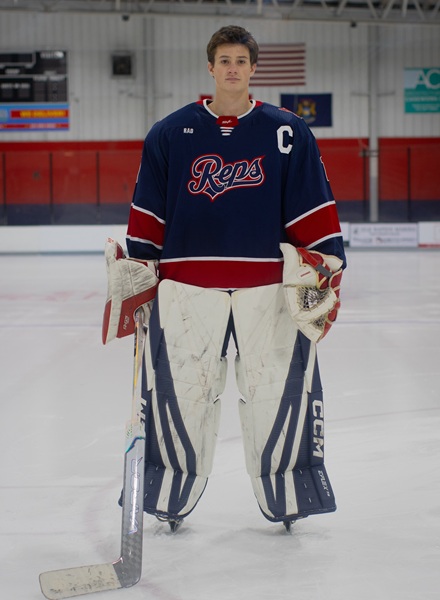
PHOTOS (Top) Traverse Bay Reps goalie Tyler Boynton-Fischer guards his team’s net during a game this season. (Middle) Boynton-Fischer “kick-saves” in the Stanley Cup in 2008. (Below) Boynton-Fischer stands tall for the Reps, who have advanced to a Saturday Quarterfinal. (Action shot courtesy of the Traverse City Record-Eagle. Other photos are courtesy of the Boynton-Fischer family.)
Port Huron Unified Providing Opportunity
By
Paul Costanzo
Special for MHSAA.com
December 4, 2019
Growing up in Yale, Trevor Sugars never thought about playing high school hockey. He bounced around Sanilac, St. Clair and Lapeer counties finding house leagues to stay involved in the sport he loved, as Yale didn’t have a team.
But a year ago, thanks to an expansion of the Port Huron Unified cooperative team, a new option arose, and Sugars has taken full advantage.
“This is great for Yale because we get to come out and have a hockey team, and younger kids can get into the sport of hockey,” said Sugars, a junior defenseman. “They’re able to go further without having to pay all the money for AAA.”
Three players from Yale and six players from St. Clair join the 11 from Port Huron in donning the Big Reds jersey this season. It’s the fourth that Port Huron has collaborated with East China School District – St. Clair and Marine City – and the second it has collaborated with Yale. The collaboration has given players from those schools an opportunity they wouldn’t otherwise have, while saving the Port Huron program.
“I went to a coaching clinic before the season started, and we actually had a roundtable about unified hockey programs,” Port Huron coach Ben Pionk said. “It was kind of interesting, because we all had one common theme. Most of us were all there for survival. That’s why we’re unified. A lot of the teams were in the same boat. Some of the other unified programs, they have like seven schools and you’re getting two kids from each school just to make a team. Honestly, it was all for survival, and that was solely ours. It wasn’t to build a superpower team; it was to make sure we had a team we could even put on the ice.”
Pionk has been at Port Huron for two decades, most of which spent coaching a team solely from his school. But numbers began to dwindle not long ago, threatening the future of the program.
“I can’t remember what year it was, but we had tryouts and I had eight kids standing here,” Pionk said. “I went to our former athletic director and talked to him and said, ‘What do you want us to do here? You really can’t put a program on the ice.’ We actually started the season that way and then we picked up a few more; I think we ended up with 12 that year. We got through the year, and kind of the next year was the same way. You go back four or five years and people weren’t working a lot, so what are you going to do? Are you going to play hockey or pay your bills?”
Not only was it hard to be competitive with so few players, but Pionk was worried about the safety of his players, who were forced to take longer shifts. He said he knew there were players in St. Clair – a school that had a program through the 2012-13 season – so Port Huron became a unified team for the 2016-17 season.
It didn’t happen overnight, but the team has now nearly doubled in size.
 “Even after the first year or so of being unified with St. Clair, we still weren’t getting really good numbers,” Pionk said. “We just found that a lot of the older kids down there had been with their teams, and at this point they were established where they were and didn’t want to leave to come play high school hockey. They would love to have played high school hockey but didn’t want to leave at that point. Through Port Huron Minor Hockey’s help, they knew there were a couple kids in Yale who had kind of aged out and weren’t going to have anywhere to play, so we kind of approached their school about it and next thing you know, we had Yale as well. Now, a few years into it everybody knows we’re unified and the kids are coming out. We have 17 skaters and three goalies this year.”
The six players from St. Clair this season make up the biggest group Port Huron Unified has brought in from another school besides Port Huron High. While they may have grown up expecting to one day be Saints, they’re grateful for the opportunity they now have.
“The high school experience is so much fun,” said Duncan McLeod, a junior defenseman from St. Clair. “It’s just fun to play for something – something big.”
While players from out of town are excited about a newer opportunity, those within the program are excited to see their team growing again.
“My freshman year, my sophomore year, we were really struggling on numbers,” Port Huron junior Kevin Schott said. “It was tough having to double shift a lot and pretty much play wherever Coach needed you to play. This year I was really excited to hear that we had a lot of kids coming from St. Clair and Yale – some better skating kids that I knew had played travel. So, I was really super excited to see that we were going to have a full and deep team this year.”
With all the new faces and multiple schools combining to create one team, not a lot of the players had played with one another prior to high school. That hasn’t been an issue, though.
“We all came together real quick, because we all know how to play hockey – we've all been playing hockey for at least four years,” Sugars said. “We all know our positions, got together and figured it out.”
This year’s team has already enjoyed as much success as any of its unified predecessors. The Big Reds opened the season with a pair of wins, eclipsing last year’s win total (one).
“We’re trying to be at least .500 this year,” Sugars said. “I wanted to be the best Yale high school team, but we already did that.”
A flu bug hit the team right before Thanksgiving, which didn’t help during a busy week. But even sitting at 2-3, there’s optimism about the season and the future, as without a senior on the roster, there’s a possibility everyone could come back next year.
“It’s looking positive for the year,” McLeod said. “We have a good team going.”
 Paul Costanzo served as a sportswriter at The Port Huron Times Herald from 2006-15, including three years as lead sportswriter, and prior to that as sports editor at the Hillsdale Daily News from 2005-06. He can be reached at [email protected] with story ideas for Genesee, Lapeer, St. Clair, Sanilac, Huron, Tuscola, Saginaw, Bay, Arenac, Midland and Gladwin counties.
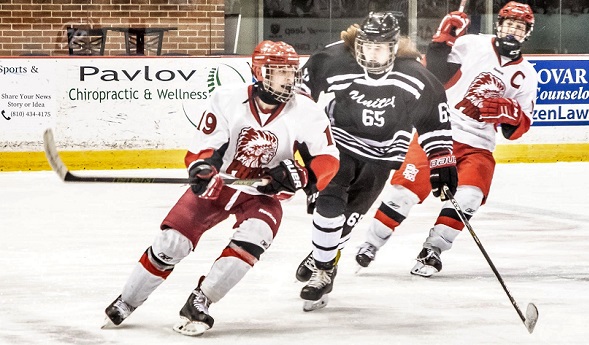
PHOTOS: (Top) Port Huron Unified’s Noah Gunderson (19) is among Port Huron High School students who help make up the program again this winter. (Middle) Duncan McLeod, a St. Clair student, controls the puck. (Photos by Jeremiah May.)