

#TBT: 2002 Ends with Lights-Out Finals

July 12, 2019

By Rob Kaminski
MHSAA benchmarks editor

The Flint IMA had been to the MHSAA Ice Hockey Finals what Joe Louis Arena was to the Detroit Red Wings since it began hosting high school championships in the state in 1977.

For parts of four decades, the facility set the scene for many memorable moments on ice for scholastic skaters.

So it would have been fitting as the curtain was closing on an era March 9, 2002, if there’d been an overtime championship game or two to commemorate the last MHSAA Finals at the building.

In 2003, the MHSAA Semifinals and Finals would move to Compuware Arena in Plymouth – now USA Hockey Arena – where the event has been played ever since.

There would be no overtimes during the IMA’s swan song, but the arena wasn’t about to let go without a fight. Following the morning’s Division 2 Final, won by Grosse Pointe North over local qualifier Davison, things got strange.

As if by divine intervention, a significant power outage hit the Flint area between the first and second periods of the Division 3 Final, necessitating a return to the building for an encore performance that Monday.

Following is an account from then-MHSAA Assistant Director Randy Allen, administrator of the sport at that time.
“East Grand Rapids and (Dearborn) Divine Child were between the first and second periods when the power went out at what must’ve been around three in the afternoon. Some of the house lights went on, but there was no huge generator. The power company told us it could be quite a while before the power came back, so the decision was made pretty quickly to come back Monday. (Editor’s Note: MHSAA regulations at that time prohibited Sunday competition, thus play would resume Monday)

“Finishing the game in progress Monday was really a no-brainer, but now there were a couple of immediate challenges. First, how were we going to let people know, and second, what was going to happen to the (Detroit) Catholic Central-Marquette Division 1 game coming up later in the day?

“Well, knowing what I knew about the TV business (Allen’s background in Wisconsin included sportscasting), I grabbed one of the television reporters there, probably from Grand Rapids, and asked him to come down to the ice with me. It was totally dark; I figured once he put his camera lights on, it would get the attention of the crowd, which it did. So there’s about 2 or 3 thousand people in the arena – in the dark – and I’m standing in front of a light from a TV camera, and at the top of my voice I explain the situation and let them know we’re coming back Monday.

“Anyone wanting to come back, admission was free of charge, and we’d trust they were at the game. If they wanted a refund, they could mail their ticket stub to MHSAA and we'd send a refund. We obviously couldn’t use the box office without power. I don’t recall more than a couple dozen refund requests coming to our office later.

“Now the real challenge is the Division 1 game. Marquette very, very much wanted to go home and come back a week later. They’d been on the road all week (Marquette won a Quarterfinal in Traverse City that Wednesday). Jack (Roberts, former MHSAA executive director) was there, and he and Marquette’s AD (Scott Koski) and their superintendent debated a bit. In the end, the regulations of the day were upheld, and the game would be Monday.

“As it turned out, someone in the Marquette entourage had a contact in the Detroit Pistons front office, so the team was entertained in a suite at The Palace of Auburn Hills on Sunday night, so that was quite a happy ending from their standpoint.

“Many of the Marquette people were either in the arena or at a single hotel or two in the area, so alerting them to the change was not difficult.

“But then we started to think, ‘What about the Detroit CC people who would be driving up for their game later? Remember, social media was not as prevalent as it is today, or even the dependence on the internet.

“So, Saturday night, I sat there at the entrance to the IMA with my car running and lights on to inform the CC fans and anyone else who pulled up that the game had changed ... ‘Power’s out; game’s on Monday.’ They'd say thanks, and out they'd go. No one really got angry; there wasn’t anything anyone could do. I sat there an hour and a half with a steady stream, and shortly after the scheduled game time I called it a night.”

And, the IMA called it the end of an era, but not before hanging on for one more night, when Divine Child and Detroit CC would raise the last trophies in that building ... under the lights.

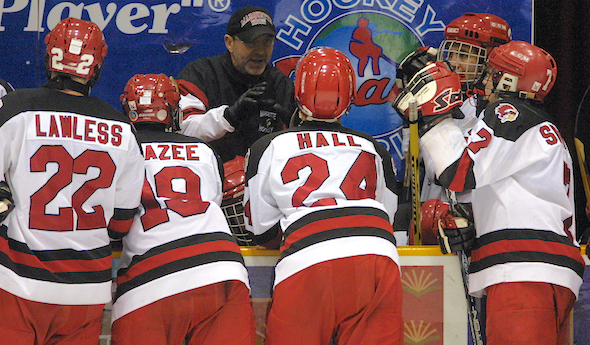
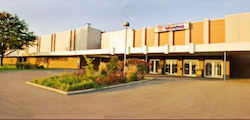
PHOTOS: (Top) Marquette was among teams that needed to stick around Flint two more days to play in the 2002 MHSAA Ice Hockey Finals. (Middle) Flint’s IMA arena.

Multi-Sport Coach Kalleward Molds Multi-School Eagles Into Formidable Foe

By Pam Shebest
Special for MHSAA.com

January 21, 2025

KALAMAZOO – When it comes to hockey, JD Kalleward has a different challenge than many high school coaches.

Southwest CorridorHis Kalamazoo Eagles team is a cooperative of six schools: Richland Gull Lake, Parchment, Vicksburg, Plainwell, Kalamazoo Christian and Paw Paw.

That is not a problem for Kalleward, who has more than 30 years of coaching experience to help meld his players into a family.

“In the locker room we sit by our linemates,” Gull Lake senior forward Carter Dominowski said. “My line is one from Vicksburg, one from Gull Lake. 

“It’s all team bonding, hanging out, having fun. We have team dinners every Tuesday (at The Nest at Wings Event Center, where the Eagles practice).”

Kalleward went from Eagles assistant coach to head coach when Matt Kruzich stepped down after last season. The team has rebounded from a 1-3 start this winter to reach 8-7 with eight games remaining before the start of the MHSAA Tournament. 

“JD was the perfect replacement for many reasons: his meticulous preparation, practice planning, management skills,” Kruzich said. “But most of all, I’ve seen the positive impact that he has had on 100 percent of young men and hockey players specifically.”

Gull Lake is the sponsoring school and providing nine of the 23 players.

“It’s a challenge.” Kalleward said of bringing the players together. “You work together, do exercises for bonding in preseason, and you make certain they’re playing for each other.”

The veteran coach has almost 1,000 high school hockey games under his skates. Add the 170 games coaching lacrosse, and he has eclipsed that milestone total.

Coaching across multiple net games

Kalleward started his coaching career with Art Missias in KOHA youth hockey, then moved to Portage Northern when Missias took that head coaching job in 1986. He took over the Northern coaching reins five years later when Missias retired.

Kalleward expanded his coaching experience, becoming Northern’s assistant boys lacrosse coach for three years until being named head coach in 2016.

Comparing hockey and lacrosse, Kalleward said the field sport is a bit harder to coach because of numbers.

Kalleward and his Portage Northern lacrosse team receive the Matt Thrasher trophy in 2019 from then-Portage Central athletic director Joe Wallace (speaking into microphone).“Both are chess games, and both are very fluid,” he said. “Lacrosse has 10 (players) instead of six, but it’s also easier to hide some of your weaker kids in lacrosse.”

Kalleward has had more success in lacrosse, making the MHSAA Division 2 Quarterfinals three of the last five years and winning the Southwest Michigan Athletic Conference three times.

Kalleward said he enjoys coaching both sports, and there are some common elements – especially defensively.

“In hockey, you have to keep your head on a swivel, be aware of your surroundings the entire time,” he said. “Same in lacrosse. Always one more pass you’re looking to make.”

When it comes to drills, especially in hockey, the coach readily admits to “stealing” them from other programs to instruct his players.

“That’s how you learn,” he said, naming drills after former coaching friends. “(Portage Central’s) Jim Murray drills. (Kalamazoo Wings) Mark Reeds drills, (Western Michigan University’s) Bill Wilkinson drills, (K-Wings) Ken Hitchcock drills, (Fox Motors AAA U16) Travis Richards drills.”

Learning more than hockey

Kalleward coaches life skills as well as hockey techniques, assistant coach Ken Rogers said.

“These kids aren’t going to be NHL players after high school, so it’s trying to develop some responsibility, some accountability, what’s it like to be on your own,” Rogers said. “We’ve got a lot of seniors, and they’re going to be away from home next year. 

Eagles assistant coach Ken Rogers. “For most of them, that’s a big step in their lives. What we try to do along with hockey is instill those life lessons. Being part of a hockey team, you’re going to have to face those challenges when you get a job, become a good employee.”

Kalleward, who is on the ice with the team every day but Sunday, said that with tournaments the Eagles play 25 games a season plus MHSAA playoffs.

“I enjoy coaching,” he said. “We’re not here for you to try to be the next Sidney Crosby, that next pro. We’re here to have a good experience in high school, be competitive, have fun.

“I’m very big about life lessons. I’m very old school: manners, how we behave in public, address each other.”

Gull Lake senior defenseman Evan Kares appreciates that leadership.

“He has taught me to make smart decisions,” Kares said. “He’s developed the way I think about hockey and the way I play. He’s really introduced the physical aspect for me. I’m still not there yet, but I’m working on it.”

Forward Hank Livingston, another Gull Lake senior, added, “He’s always pushing the team to be the best players and best young men we can be. He’s always trying to help everyone.”

Kalleward, standing, coaches his Eagles hockey team.Other Gull Lake players are Owen Anderson, Joey Blondia, Henry Ludmer, Ryan Rocco, Henry Worgess and Jacob Worgess. Players from Vicksburg are Aidyn Garza, Blaine Herson, Cody Klesko and Grant Stopher, while the two from Paw Paw are Colton Gronau and Caleb Ranger. 

Kalamazoo Christian players are Isaac Riggs, Matthew Rohrer, Ryan Rohrer and Ari Wilkinson. The lone Comstock player is Brody Woolsey. Ryan Baranoski, and Carter Monette are from Plainwell and Kayden Hailey is from Parchment.

One of the downsides to coaching hockey is how player numbers are dwindling, Kalleward said.

The South Central Michigan Hockey League is down to six teams and four besides the Eagles are co-ops: the Capital City Capitals (Lansing), Eastside Stars (East Lansing), Kalamazoo United, and Portage. Mattawan is the only team that is not made up of players from multiple schools.

“That’s the sad thing about hockey,” Kalleward said. “It’s hard to grow the sport with the expense. I like to joke that (renting the ice) costs $6 a minute.”

Pam ShebestPam Shebest served as a sportswriter at the Kalamazoo Gazette from 1985-2009 after 11 years part-time with the Gazette while teaching French and English at White Pigeon High School. She can be reached at [email protected] with story ideas for Calhoun, Kalamazoo and Van Buren counties.

PHOTOS (Top) Kalamazoo Eagles coach JD Kalleward talks strategy with Gull Lake seniors (from left) Hank Livingston, Evan Kares and Carter Dominowski. (2) Kalleward and his Portage Northern lacrosse team receive the Matt Thrasher trophy in 2019 from then-Portage Central athletic director Joe Wallace (speaking into microphone). (3) Eagles assistant coach Ken Rogers. (4) Kalleward, standing, coaches his Eagles hockey team. (Top photo and headshot by Pam Shebest. Lacrosse and hockey game photos courtesy of JD Kalleward.)