

'Team 43' Delivers 1st Livonia Title
March 9, 2013
By Bill Khan
Special to Second Half
PLYMOUTH — Livonia is one of the great hockey communities in Michigan, but had never been home to an MHSAA Finals champion.
Until now.
Livonia Stevenson brought a championship to the birthplace of former NHL star Mike Modano, beating Hartland 5-4 in the Division 2 title game Saturday at Compuware Arena.
Prior to this weekend, Livonia's three hockey-playing schools had combined for only eight regional championships during the 39-year history of the MHSAA tournament and just one semifinal appearance (Stevenson in 1987). It doesn't help that the Livonia schools often encounter some of the state's perennial powerhouses early in the postseason. Stevenson has been eliminated 10 times by Detroit Catholic Central and five times by Trenton in regional play.
"I couldn't be happier for the Stevenson administration, the alumni and the whole Livonia community," fifth-year Stevenson coach David Mitchell said. "We're in the 43rd year of high school hockey in Livonia.
We're the 43rd team in Stevenson history. This is the first chance a Livonia school has had to play in a state final. To get it done, this is not just for Stevenson, but for all of Livonia high school hockey. We've had some great teams and some great kids go through our program. To do it is very special. Hopefully, the whole community can enjoy this."
To win its first championship, Stevenson denied Hartland the same opportunity. The Eagles had won 11 regional titles before this season, reaching the semifinals only twice until playing in their first final on Saturday.
Hartland coach Rick Gadwa praised captains Nick Pleshakov, Justin Bailey and Ned O'Boyle for laying the foundation for Hartland's first march to the championship game.
"These three guys changed Hartland hockey," Gadwa said. "It was their leadership on and off the ice. We put Hartland on the map. That's something that hopefully stays."
Junior Dominic Lutz was the star in Stevenson's historic season, scoring 42 goals with 32 assists in 31 games to easily lead the Spartans in scoring. It was fitting that the 6-foot, 185-pound forward scored the team's biggest goals in the championship game, popping in two in a 2:37 span of the second period to turn a 2-1 deficit into a 3-2 advantage. Stevenson never surrendered the lead.
"We've been preaching Team 43," Lutz said. "It's just great to see it all come together in the end. We've got it. It's unbelievable. We're like a family. This is the closest team I've ever played on."
 Stevenson senior Travis Harvey, who scored two goals and had two assists in the semifinal on Friday, opened the scoring off a faceoff win at 4:55 of the first period. Hartland junior Austin Flores tied it off a
feed from Chris McRae at 6:26 of the first.
Despite being outplayed in the first period, Hartland found itself on top by a 2-1 count when McRae scored just 54 seconds into the second period.
The pace picked up considerably after that, as the teams combined for five goals during an 8:18 span. Stevenson took the lead for good on two goals by Lutz at 4:30 and 7:07 and Harvey's second goal of the game at
9:10.
O'Boyle brought Hartland within 4-3 at the 9:56 mark, only to have Stevenson regain a two-goal advantage at 12:48 on a goal by Ray Chartier.
"We would rather not play that way," Mitchell said. "We'd rather play a little more defensive and shut things down. These guys, when they see opportunities, they tend to go. We saw a few opportunities and
took some. Give Hartland credit. We were starting to look for goals and they caught us and they turned around and buried some of their own. They played an outstanding game."
"It was just go, go, go," O'Boyle said. "It was incredible emotionally."
Hartland didn't take long to trim the lead once the puck dropped in the third period, making it a 5-4 game on a goal by McRae at the 14-second mark.
The Eagles had eight more shots on net the rest of the game, but couldn't get another puck past Stevenson goalie Connor Humitz. Hartland called timeout with 2:21 left and pulled goalie Nick Wineka in the final minute, but couldn't generate a shot in that time against an aggressive Stevenson forecheck.
"We just want to keep it deep in their zone as much as we can," Lutz said. "Just gain the red line, get it deep and forecheck. We didn't want anything in our zone. We wanted everything down there, just keep
all the pressure off Connor. It seemed like it worked out."
Stevenson finished with a 23-7-1 record, while Hartland ended 19-9-2.
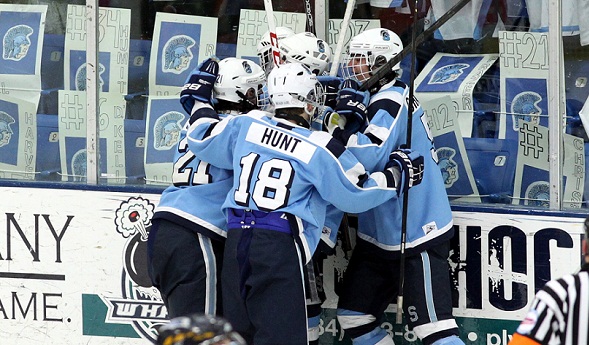
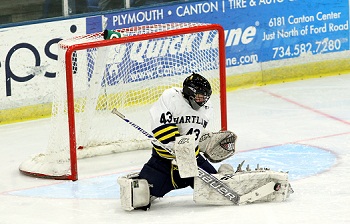
PHOTOS: (Top) Livonia Stevenson players celebrate a goal during Saturday's Division 2 Final in front of their fan section at Compuware Arena. (Middle) Hartland goaltender Nick Wineka makes one of his 35 saves Saturday. (Photos by Hockey Weekly Action Photos.)
Finals Preview: The Puck Starts Here
March 6, 2013
By Geoff Kimmerly
Second Half editor
Two things are sure to occur at this weekend's MHSAA Ice Hockey Finals.
At least one Division 2 finalist will play in a title game for the first time. And no matter which wins Saturday, that team will take leave Plymouth's Compuware Arena with its first MHSAA Finals championship trophy.
None of this weekend's Division 2 Semifinalists have won the biggest prize, adding another layer of intrigue to a tournament that traditionally draws contenders from all corners of the state.
Divisions 1 and 3, meanwhile, feature two of the most successful programs in MHSAA history. Although both missed Finals weekend in 2012, Detroit Catholic Central is back in Division 1 going for its 11th title, and Bloomfield Hills Cranbrook-Kingswood is back in Division 3 going for its 16th championship.
The pairings are as follows:
Division 2 Semifinals - Thursday
Port Huron Northern (15-13-1) vs. Hartland (18-8-2), 5 p.m.
Saginaw Heritage (24-5) vs. Livonia Stevenson (21-7-1), 7:30 p.m.
Division 3 Semifinals - Friday
Bloomfield Hills Cranbrook-Kingswood (26-2-1) vs. Riverview (20-7-1), noon
Sault Ste. Marie (21-8) vs. Flint Powers Catholic (22-5-1), 2:30 p.m.
Division 1 Semifinals - Friday
East Kentwood (15-12-2) vs. Detroit Catholic Central (21-7), 6 p.m.
Brighton (26-2-1) vs. Detroit U-D Jesuit (19-8-2), 8:30 p.m.
FINALS - Saturday
Division 2 – 10 a.m.
Division 3 – 2 p.m.
Division 1 – 6 p.m.
All Semifinals and Finals will be streamed live on MHSAA.tv, with live audio available on MHSAANetwork.com. The Finals also will appear later this month on Comcast channel 900. Division 1 will be broadcast at noon March 18, 9:30 p.m. March 19 and 10:30 a.m. March 20; Division 2 at 8 a.m. March 16 and 6 p.m. March 17, and Divsion 3 at 3 p.m. March 16, 9 a.m. March 17, 7 p.m. March 19 and 8 a.m. March 20.
Click for a full schedule of this weekend's games plus full results as they come in. Players statistics below are through the Regional round and were submitted by participating schools. And check back on Second Half this Saturday night for coverage from all three Finals.
Division 1
BRIGHTON
Record/rank: 26-2-1, No. 3
Championship history: Two MHSAA titles (most recently 2012).
Coach: Paul Moggach, 18th season (328-112-37)
League finish: First in Kensington Lakes Activities Association (Central and overall)
Best wins: 5-1 over No. 5 Plymouth, 4-3 over Division 3 No. 2 Houghton,4-1 over Division 3 No. 3 Calumet, 6-0 over Division 3 No. 5 Grosse Pointe Woods University Liggett, 6-2 and 8-1 over Division 2 No. 8 Novi, 5-3 over Division 2 No. 6 Livonia Churchill, 6-1 over Division 2 No. 9 Hartland, 4-2 over Division 3 No. 8 Farmington.
Players to watch: Michael Yuhasz, senior right wing (34 goals, 26 assists); Danny Bosio, junior left wing (26 goals, 27 assists); Jimmy Milletics, sophomore goaltender (1.60 GAA, 0.91 save %, eight shutouts).
Outlook: Brighton rode a sturdy defense to last season’s championship, and is strong stopping the puck again with Milletics providing quite an obstacle in net. The Bulldogs had given up one or no goals in eight straight games before allowing three to Bay City Central in the Quarterfinal. This team can score too, with seven who have netted at least 10 goals this season and 13 with at least 10 assists. Another result that could become important depending on how Friday shakes out – Brighton closed the regular season with an 8-0 win over East Kentwood, a Semifinalist on the other side of the bracket.
DETROIT CATHOLIC CENTRAL
Record/rank: 21-7, No. 1
Championship history: 10 MHSAA titles (most recently 2010), three runner-up finishes.
Coach: Todd Johnson, 13th season (277-58-23)
League finish: Second in Michigan Interscholastic Hockey League North
Best wins: 5-0 and 3-0 over No. 6 Grosse Pointe North, 6-1 and 3-1 over No. 4 Orchard Lake St. Mary’s, 2-1 over No. 7 Detroit U-D Jesuit, 3-1 and 3-1 (Regional) over No. 2 Birmingham Brother Rice, 5-1 over No. 5 Plymouth (Quarterfinal), 4-1 and 5-1 over Division 2 No. 5 Port Huron Northern, 8-0 and 5-1 over Division 2 No. 3 Trenton, 5-2 over Division 2 No. 6 Livonia Churchill, 4-2 over Division 3 No. 1 Bloomfield Hills Cranbrook-Kingswood, 6-0 over Division 3 No. 7 Dearborn Divine Child, 8-0 over Division 3 No. 5 University Liggett.
Players to watch: Michael Babcock, senior center (14 goals, 22 assists); Carson Gatt, junior defenseman (three goals, 17 assists), Charlie Green, senior right wing (16 goals, 18 assists).
Outlook: It’s fair to say DCC played the state’s toughest schedule this winter. On top of the 16 wins over ranked opponents, the Shamrocks’ losses came twice to Cranbrook-Kingswood, once to Brother Rice, once to Division 2 No. 1 Livonia Stevenson, twice to Indiana power Culver Academy and once to Canada’s Hill Academy. Babcock and Green made the all-state first team and Gatt made the second team in 2012.
DETROIT U-D JESUIT
Record/rank: 19-8-2, No. 7
Championship history: Has not appeared in an MHSAA Final.
Coach: Rick Bennetts, 18th season (215-217-32)
League finish: Second in MIHL South.
Best wins: 5-2 over No. 6 Grosse Pointe North (Regional), 5-2 over Division 2 No. 1 Livonia Stevenson, 4-3 and 5-4 over Division 2 No. 3 Trenton, 5-4 over Division 2 No. 5 Port Huron Northern, 4-0 over Division 2 No. 7 Grosse Pointe South, 5-2 over Division 3 No. 3 Calumet, 5-1 over Division 3 No. 4 Sault Ste. Marie.
Players to watch: Tommy Apap, junior right wing (14 goals, 23 assists); Craig Pefley, senior center (26 goals, 32 assists); Pete McMahon, senior left wing (14 goals, 19 assists).
Outlook: Jesuit fell just one point shy of winning its league title, and then beat MIHL South champion Grosse Pointe North during the Regional. Five of the Cubs’ losses came to ranked Division 1 teams, with two more against Division 3 teams that will play for that title this weekend. Pefley and Apap both made the all-state second team in 2012.
EAST KENTWOOD
Record/rank: 15-12-2, unranked
Championship history: One MHSAA title (1993), three runner-up finishes.
Coach: Shawn Jensen, first season (15-12-2)
League finish: Third in O-K Red
Best wins: 3-2 over Division 2 No. 10 Grand Haven, 4-1 over Rockford, 6-5 (OT) over Muskegon Reeths-Puffer (Quarterfinal).
Players to watch: Tyler Layle, senior defenseman (eight goals, 11 assists); Trent Bravata, senior center (20 goals, 18 assists), Austin Adams, senior left wing (10 goals, 13 assists).
Outlook: East Kentwood is back at the Semifinals for the third straight season and this time under first-year coach Jensen, an all-state defenseman for the Falcons in 1997 and later an assistant coach for the team. East Kentwood advanced in part with overtime wins in the Regional final and Quarterfinal. Layle made the all-state second team last season and Bravata earned an honorable mention.
Division 2
HARTLAND
Record/rank: 18-8-2, No. 9
Championship history: Has not appeared in an MHSAA Final.
Coach: Rick Gadwa, second season (33-18-4)
League finish: First in Kensington Lakes Activities Association Lakes Conference
Best wins: 2-1 over No. 8 Novi, 7-4 and 5-4 over Howell, 7-2 over Walled Lake Central.
Players to watch: Nick Pleshakov, senior defenseman; Brett Bandyk, senior forward; Chris McRae, junior forward. (Statistics not submitted.)
Outlook: Hartland has won its Regional both times under Gadwa, and this season took the next step. Although the games ended in losses, the Eagles saw some of the state’s best competition this winter including Division 1 top-five teams Brighton and Plymouth and Division 3 No. 5 Grosse Pointe Woods University Liggett. Pleshakov made the all-state second team as a junior.
LIVONIA STEVENSON
Record/rank: 21-7-1, No. 1
Championship history: Has not appeared in an MHSAA Final.
Coach: David Mitchell, fifth season (89-33-11)
League finish: Second in KLAA Kensington Central
Best wins: 9-2, 7-3 and 3-1 (Regional final) over No. 6 Livonia Churchill, 6-1 over No. 7 Grosse Pointe South, 6-1 over No. 8 Novi, 1-0 over Division 1 No. 1 Detroit Catholic Central, 4-0 over Division 1 No. 9 Macomb Dakota, 7-6 over Division 3 No. 5 Grosse Pointe Woods University Liggett.
Players to watch: Dominic Lutz, junior left wing (39 goals, 31 assists); Tyler Irvine, junior right wing (15 goals, 29 assists); Devin Kelly, junior center (14 goals, 35 assists).
Outlook: Stevenson survived a scare in the Quarterfinal before beating Ann Arbor Pioneer 3-2 in double overtime, but has won big against some of the best teams from all three divisions. Senior defenseman Trent Harvey has added 14 goals and 14 assists this season in front of senior goaltender Connor Humitz, who has five shutouts.
PORT HURON NORTHERN
Record/rank: 15-13-1, No. 5
Championship history: Division 1 runner-up in 2001.
Coach: Daryel McCarrel, 21st season (373-213-47)
League finish: Fifth in Michigan Interscholastic Hockey League North
Best wins: 5-2 over No. 3 Trenton, 4-3 over No. 7 Grosse Pointe South (Quarterfinal), 6-1 over Division 3 No. 6 Flint Powers Catholic
Players to watch: Bryce VanHorn, junior left wing (18 goals, 25 assists); Tyler Hughes, senior defenseman (four goals, 12 assists); Matt Fernandez, senior goaltender (2.78 GAA, four shutouts).
Outlook: The Huskies’ MIHL league finish again is deceptive, as it shares the league with Division 1 No. 1 Detroit Catholic Central, No. 2 Birmingham Brother Rice and No. 4 Orchard Lake St. Mary’s, and Division 3 No. 1 Bloomfield Hills Cranbrook-Kingswood. After facing that group, Northern no doubt is ready for anything this weekend. VanHorn earned an all-state honorable mention last season and is one of five Huskies with at least 10 goals and one of eight with at least 10 assists. Fernandez made the all-state second team last season and Hughes made the first team.
SAGINAW HERITAGE
Record/rank: 24-5, unranked
Championship history: Has not appeared in an MHSAA Final.
Coach: JJ Bamberger, fourth season (66-37)
League finish: Second in Saginaw Valley Association
Best wins: 4-3 over Howell, 4-1 and 3-2 (Regional) over Midland, 4-1 over No. 10 Grand Haven (Quarterfinal).
Players to watch: Tyler Angers, junior center (27 goals, 27 assists); Sami Abdelaziz, senior left wing (25 goals, 22 assists); Jacob Tweedle, senior center (13 goals, 12 assists).
Outlook: The Hawks are Regional champs for the second time in four seasons and after down finishes of 7-16-2 and 12-12 the last two winters. Heritage was ranked most of this season and peaked at No. 5, and is riding a 10-game winning streak. Junior goalie Kevin Cressey also has been outstanding, with a 2.40 goals-against average and .916 save percentage.
Division 3
BLOOMFIELD HILLS CRANBROOK-KINGSWOOD
Record/rank: 26-2-1, No. 1
Championship history: 15 MHSAA titles (most recently 2010), two runner-up finishes.
Coach: Andy Weidenbach, 20th season (387-145-34)
League finish: First in MIHL North.
Best wins: 5-2 and 5-1 over Division 1 No. 1 Detroit Catholic Central, 2-0 and 5-2 over Division 1 No. 4 Orchard Lake St. Mary’s, 9-3 over Division 1 No. 2 Birmingham Brother Rice, 7-4 over Division 1 No. 5 Plymouth, 3-2 and 4-3 over Division No. 6 Grosse Pointe North, 5-3 over Division 1 No. 7 Detroit U-D Jesuit., 7-0 over Division 2 No. 1 Livonia Stevenson.
Players to watch: Christopher Brown, junior center (21 goals, 24 assists); Alex Alger, junior right wing (29 goals, 24 assists); Austin Alger, junior center (20 goals, 27 assists); Michael Romund, senior left wing (20 goals, 27 assists).
Outlook: Cranbrook-Kingswood likely would be considered the favorite to win any of the three divisions this weekend, despite playing among the smallest schools. The Cranes beat six of the top 10 in Division 1 this season, and 18 of 23 games played against in-state opponents were against ranked teams. They didn't give up a goal in the postseason until beating No. 5 University Liggett 7-2 in the Quarterfinal. Brown made the all-state first team last season, and Alex Alger made the second team.
FLINT POWERS CATHOLIC
Record/rank: 22-5-1, No. 6
Championship history: Seven MHSAA runner-up finishes (most recently 2010).
Coach: Travis Perry, seventh season (144-41-11)
League finish: First in Saginaw Valley Association.
Best wins: 5-1 over Division 1 No. 7 Detroit U-D Jesuit, 2-1 over Division 2 No. 10 Grand Haven, 2-0 over Saginaw Heritage, 2-1 (2 OT) over East Grand Rapids (Quarterfinal).
Players to watch: Garrett Gormley, junior right wing (21 goals, 15 assists); Casey Korhonen, senior goaltender (1.27 GAA, 0.93 save %); Mike Forman, sophomore center (12 goals, 16 assists).
Outlook: Powers has won six straight Regional championships and is back in the Semifinals for the first time since 2010. Its defense has been staggering. The Chargers have given up one or zero goals in 16 games this season, and Korhonen has nine of the team’s 10 shutouts. He and Gormley both earned all-state honorable mentions last season.
RIVERVIEW
Record/rank: 20-7-1, No. 10
Championship history: Has not appeared in an MHSAA Final.
Coach: Al Taurence, third season (38-39-1)
League finish: Huron League, finish unavailable.
Best wins: 4-3 and 4-3 (Regional) over Monroe St. Mary Catholic Central, 5-3 over Chelsea (Quarterfinal).
Players to watch: Brian Bachnak, senior left wing (52 goals, 42 assists); Timothy Lyons, senior center (21 goals, 46 assists); Alex Testy, senior right wing (16 goals, 18 assists).
Outlook: Bachnak made the all-state second team last season and has put up incredible numbers in leading Riverview to the Finals after it finished 4-20 only two seasons ago. He’s one of a number of veterans, with 11 seniors among team’s 21 players. The Quarterfinal win over Chelsea avenged a 4-2 loss midway through the season.
SAULT STE. MARIE
Record/rank: 21-8, No. 4
Championship history: Two MHSAA titles (most recently 1989), five runner-up finishes.
Coach: John Ferroni, second season (33-19-2)
League finish: Does not compete in a league.
Best wins: 8-2 over No. 9 Hancock, 6-3 and 4-1 (Quarterfinal) over No. 2 Houghton, 1-0 over No. 7 Dearborn Divine Child, 5-2 over No. 5 University Liggett, 2-1 over Division 2 No. 5 Port Huron Northern, 5-4 over Division 2 No. 7 Grosse Pointe South
Players to watch: William Gauthier, junior center (17 goals, 18 assists), Blake Mastaw, junior left wing (15 goals, 22 assists); Eric Hillock, senior left wing (21 goals, 14 assists); Chase Gamelin, junior right wing (15 goals, 20 assists).
Outlook: Sault Ste. Marie has done exceptionally well against a tough slate after finished 12-11-2 in 2011-12. Four of its losses are to ranked Division 1 or 2 teams – including 5-4 in overtime to Division 1 No. 2 Birmingham Brother Rice. While there is obvious scoring punch, the defense has been impressive as well – the Blue Devils didn't allow a goal in the playoffs until Houghton got one Wednesday. Senior defenseman C.J. Wilkins earned an all-state honorable mention as a forward last season.
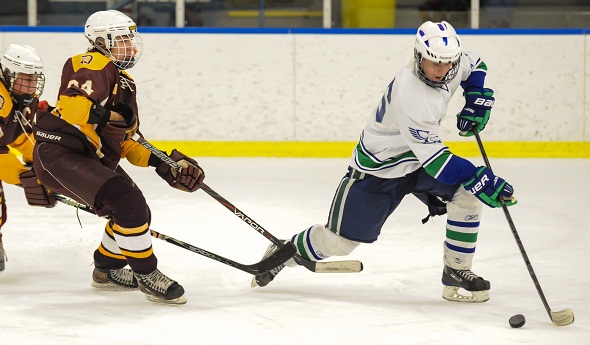
PHOTO: Saginaw Heritage (right) will attempt to advance to its first MHSAA championship game by defeating top-ranked Livonia Churchill in one of today's Division 2 Semifinals. (Click to see more at HighSchoolSportsScene.com.)