


Escanaba Finds Home as Softball Champ
June 26, 2018
By Geoff Kimmerly
Second Half editor
Relative to the other 15 softball teams playing in the MHSAA Semifinals two weekends ago at Michigan State University’s Secchia Stadium, the Escanaba contingent was far from home.

Escanaba not only advanced to play in its first MHSAA championship game since 2003, but returned home to the Upper Peninsula with its first MHSAA Finals title in the sport – and first in any sport with a unified tournament (both peninsulas together) since the football team won Class A in 1981.
The Eskymos gave up two runs total over six postseason games, shutting out Eaton Rapids 2-0 in a Semifinal and South Haven 5-0 in the Division 2 championship game to earn the honor as the final MHSAA/Applebee’s “Team of the Month” for 2017-18.
“It had been so long since we’d had a group down here, I think it was kinda nerve-wracking for them to be down on that field,” said Escanaba coach Jamie Segorski of the 2016 team, the first to return to the Semifinals since that 2003 Division 1 runner-up. “The last couple of years we’ve been fortunate enough to get down there, develop a comfort level, and we’ve come up with a nice schedule that’s convenient and comfortable and helped the girls stay with their norm.
“We expect to make it down there. Will we make it every year? Absolutely not. The competition is fierce. But in their minds, they know they can do it.”
Escanaba finished the spring 31-3, its only losses to eventual Division 3 runner-up Millington, Division 3 semifinalist Clinton and Rice Lake of Wisconsin. All three defeats were by just a run.
The Eskymos, as noted, also had advanced to the 2016 and 2017 Division 2 Semifinals, and they entered this playoffs ranked No. 3 by the state coaches association. So opening with District wins of 4-0 over Cheboygan and 11-1 over Petoskey wasn’t shocking. But a 10-0 shutout of No. 8 Muskegon Oakridge followed by a 12-0 shutout of Remus Chippewa Hills in the Regional certainly grabbed some attention.
Escanaba followed those with a 9-1 Quarterfinal win over annual power Saginaw Swan Valley, before finishing the run with two more shutouts – and a combined postseason scoring edge of 53-2.
Sophomore Gabi Salo without question is one of the best pitchers in the state. She came in in relief during the 2017 Semifinal loss to Richmond, but returned to Secchia to throw 14 shutout innings, giving up a combined seven hits and one walk with 20 strikeouts. She has added four mph to her fastball over the last year, dialing up 66 during the final inning against South Haven. For the season she finished 21-3 with a 0.40 ERA and 287 strikeouts in 156 innings pitched – and she’s already set to play at University of Wisconsin after graduation.
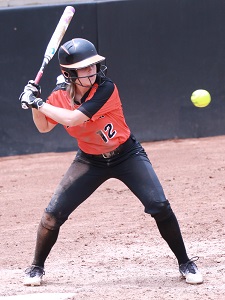 Her nearly unhittable performance was matched by plenty of hitting from her teammates. Junior rightfielder Lexi Chaillier hit .510 with eight home runs and 27 stolen bases from the leadoff spot. Senior second baseman Claire McInerney (.439, 16 SB), senior shortstop Taylor Gauthier (.400, 37 RBI) and senior third baseman Madison Griffin (.430, 6 HR, 46 RBI) filled in the next three places in the lineup, respectively. Eight starters entered the final week of the season batting at least .371, and all nine starters this season had at least one home run. Freshman Nicole Kamin batted fifth both games of Finals weekend and finished the season hitting .526 over 13 games, while going 10-0 with a 1.26 ERA from the pitching circle.
Gauthier and McInerney were three-year starters in the middle of the infield, and the rest of the team’s seniors all came up for the 2016 tournament run and had made all the trips to MSU. The team is well-traveled during the regular season as well, frequently heading downstate and into Wisconsin to find tough competition. The Eskymos find plenty at home too, as Delta County also includes Gladstone and Rapid River – ranked No. 8 in Division 3 and No. 9 in Division 4, respectively, heading into the postseason.
Football is king in Escanaba, and basketball rules the girls sports scene across the Upper Peninsula. But Eskymos softball came home as first-time-in-a-long-time champion, toppling history, clichés about the weather and any remaining misconceptions that teams traveling over the Bridge will sooner or later run into a rocky road.
“It’s fun to watch the girls develop that grit – being from the U.P., they always feel like they’re not looked at like everybody else, like they’re not as good, like how can they be good when they have snow until July,” Segorski said. “I think it really helps determine that higher sense of determination to win games.
“They’ll bask in the glory. They’ll enjoy it. And the younger girls were able to see what happened, see the fun and what we got done, and they’ll come in next year very determined.”
Past Teams of the Month, 2017-18
May: Brownstown Woohaven baseball - Report
April: Detroit Catholic Central boys lacrosse - Report
March: Brighton hockey - Report
February: Marquette girls and boys skiing - Report
January: Sterling Heights Stevenson competitive cheer - Report
December: Cadillac boys bowling - Report
November: Ottawa Lake Whiteford football - Report
October: Beaverton volleyball - Report
September: Shepherd girls golf - Report
PHOTOS: (Top) Escanaba gets ready for its turn at bat after holding South Haven to another scoreless inning during the Division 2 Final. (Middle) Lexi Chaillier lines up a pitch during the championship game.
Constantine Follows Slugger on Fast Start
By
Wes Morgan
Special for MHSAA.com
May 11, 2017
By Wes Morgan
Special for Second Half
Kim Maddox has an incredible feel for the game of softball. Growing up with significantly impaired hearing, that’s been a necessity.
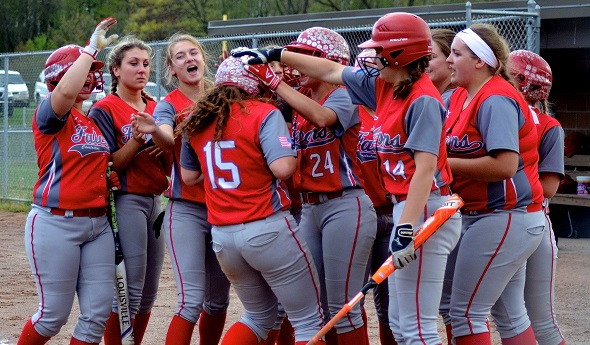
 Maddox, a junior slugger at Constantine High School who set her school’s season home run record in 2016 with 11 bombs, has already blasted 12 through 23 games this spring in playing a major role in the Falcons’ 22-1 record.
With the aid of cochlear implants she’s had since she was a small child, Maddox can hear, but she has to concentrate more than anyone else on the field. That is just one of many traits Constantine coach Marge Caid said sets her third baseman apart.
“She misses some things, but she does pay attention more than the others,” Caid said.
“I just look at the coach all the time,” Maddox said.
Precision and power are what’s obvious about Maddox, not any kind of disability.
“She is physically probably the strongest player I have ever coached. She has great bat speed, and her technique and her form are textbook. She works very, very hard and she is very dedicated to making sure that swing is perfect.”
Maddox fully expected to have this kind of year individually and as a team.
“We have good hitting, and this is a good team together,” she said. “I love my team. I have hitting lessons and I’ve been practicing and practicing. The biggest thing for me is to relax and then attack the ball.”
Like any good squad, success has been predicated on more than just individual talent. Constantine graduated some extremely skilled and productive players at the end of a 2016 campaign that set a record for wins in a season with a 32-6 record. The Falcons went 12-0 in Southwestern Athletic Conference Valley division play.
The loss of starting catcher Dylan King and hurler Bailey Potter to graduation didn’t slow the Falcons down. They have won 10 straight games since their lone loss of the year to a solid Three Rivers team.
Constantine has outscored opponents 247-29 and won by shutout nine times. In all, Constantine boasts five players hitting over .350, while its pitching has been effective and reliable.
Emily Mallo is 9-0 in the circle with a 0.56 ERA, and Mercedes Cole is 13-1 with a 0.66 ERA. The two combined have allowed 75 hits and 11 earned runs.
 “We hit the ball well, which is our biggest strong point,” Caid said, “besides having a bunch of players who have been on the varsity team for quite a while.”
Caid hasn’t submitted information to the Michigan High School Softball Coaches Association for ranking purposes because she wants to see what her team is really made of down the stretch — which includes the toughest opponents of the year.
“We did play Paw Paw and Three Rivers, but other than that, I can’t justify tooting our horn that much,” she said. “We want to make less base-running mistakes, and a couple fielding things we need to work out.
The Falcons have a critical showdown with rival Schoolcraft today, which will likely determine the divisional championship. Schoolcraft is undefeated in Valley play after Monday’s pivotal sweep of Kalamazoo Christian. Both Schoolcraft and Constantine are 8-0.
“The rest of our season is going to be tough,” Caid said. “If we can’t play with these guys, then we’re going to be up a creek when it comes to Districts. We have to play ball and choke it out like we did last year.”
Constantine’s tremendous season in 2016 fizzled out with a Division 3 District Semifinal loss to Bridgman (9-1). This year, the District tournament includes familiar opponents in Galesburg-Augusta, Comstock, Kalamazoo Hackett, Schoolcraft and Parchment.
It certainly has taken a team effort to come back strong again this year and duplicate last year’s regular-season success.
Still, Maddox’s staggering numbers stand out in the crowd, especially considering she has another year of prep ball remaining. Maddox is hitting .589, which isn’t even the best average on the team. Kallie Sears, with 42 hits on the year, is operating at a .592 clip. Maddox was hovering around .700 before struggling at the plate this past weekend.
In 86 plate appearances, she has registered 43 total hits to lead the team. Of those, seven were doubles and three went for triples. She has 53 runs batted in so far and 38 runs scored. She also had a .640 on-base percentage and a 1.260 slugging percentage. Surprisingly, Maddox has been walked just 10 times.
“I hate being walked,” she said.
 Wes Morgan has reported for the Kalamazoo Gazette, ESPN and ESPNChicago.com, 247Sports and Blue & Gold Illustrated over the last 12 years and is the publisher of JoeInsider.com. He can be reached at [email protected] with story ideas for Berrien, Cass, St. Joseph and Branch counties.
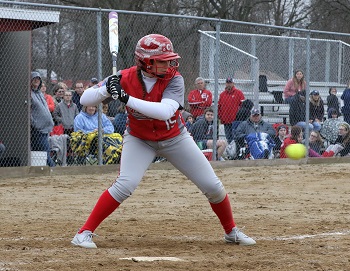
PHOTOS: (Top) Constantine players celebrate as Kim Maddox (15) crosses the plate to score a run. (Middle) Maddox eyes an approaching pitch during a game this spring. (Photos courtesy of JoeInsider.com.)