

Gladstone Coach Smith Built Champions
October 24, 2016
By Dennis Grall
Special for Second Half
ESCANABA — Gerry Smith put his life into helping area youngsters get a foot into the athletic doorway, and in the process touched the lives of so many people.
 “Smitty” died Oct. 15 following a lengthy illness.
“God got a great softball coach,” said retired Gladstone athletic director Matt Houle. “He was unique and old school, but his love for kids and the game always showed clearly. He had such a passion for the game of softball and just loved working with kids.”
Smith, 70, worked at Mead Paper Co. for more than 30 years and was IBEW 979’s business agent for 21 years. But he will perhaps be most remembered for his 43 years on softball and baseball fields throughout the area. He spent 11 years as Gladstone High School’s head softball coach, directing the Braves to MHSAA titles in 2004 and 2009. He was 290-77-1, but missed much of the 2008 season because of shoulder surgery. The Braves were 31-10 under interim manager John Malloch, which would give Smith an overall 321-87-1 record.
 “He put a lot of trust into people he asked to help him out,” said Ashley Hughes, who succeeded Smith in 2014 and guided the Braves to the MHSAA Division 3 title that year.
Hughes, who joined Smith on the softball staff when she became a teacher at her alma mater in 2009, also pitched for Smith and the Braves before getting a softball scholarship to Lake Superior State University.
She recalled Smith sought her services when she returned to Gladstone. “Hey kiddo, how about helping us out this year,” is how Hughes remembers that conversation.
He then told her, “I’m going to teach you everything I know and in a few years this will all be yours,” Hughes related.
“For me to come as head coach after Smitty, there was so much pressure. I wanted to live up to everything he had provided for this program,” Hughes said. “I didn’t want to disappoint him. He put a lot of faith in me.”
She said Smith also had an impact when she was a player. “He was so in your face in such a positive light. He wanted you to be successful, whether you had never touched a ball or had the ability to go on to play college ball. He was a spit-fire. He was so intense.
“He just exuded passion, at practice, at games. He had so much love for the game. That is something I’ve held onto because I too loved that game. To have someone like Smitty be so passionate and intense helped me become passionate and gave me the drive to be like that.”
Bill Buchmiller and Smith were partners for 40 years and he became godfather to Buchmiller’s children. In addition to guiding the Braves’ high school varsity, they served as American Legion coaches in the early stages of Gladstone’s program, worked together as Little League coaches and were softball teammates.
“He took a program from nothing to two state championships,” said Buchmiller. “He always encouraged the group. He may have broke them down a little bit but he always built them back up. He was a hard guy to get to know, but once you got to know him, he was a great guy.”
Smith used the knowledge he had gleaned from many years as a player and infused that into his players. “He just dwelled on the basics of softball. If you had to play small ball to win, that is what he played,” said Buchmiller.
 “He covered all the different bases of softball. He stressed defense. He told (hitting coach) Al Verbrigghe, ‘You give me one run Al and we’ll win the ball game with my defense. Give me a run and we’ll manage somehow.’”
Theresa Shepeck, who joined Smith on the GHS staff in 2003, agreed with that assessment.
“Smitty always thought the short game was the way to go,” she said. “It was about bunting, not the long ball. You get a runner on one, you bunt her to two. You get somebody on three, then you suicide (bunt) her home.”
Shepeck said his players thrived on his various idiosyncrasies, such as finding tourney lodging in rather inexpensive motels and using a wad of cash to pay for the team’s rooms. “The kids just yukked it up,” she said with a laugh.
“He always put the kids first. If somebody made a mistake, it was never their fault; it is my (Smith’s) fault, the coaching staff’s fault. If one of us coaches made a mistake, he took that blame. It was always his fault, his responsibility,” said Shepeck.
The players appreciated how he used them in games and practices. “His philosophy was to put the best nine on the field, period,” she said. “He walked on a lot of toes, he had a lot of hurt feelings (of parents), but I think the kids respected that. Nobody ever doubted how they fit in. He was there to win.
“He was a little man (about 5-foot-6) but had a huge heart. He was all about the kids and the coaching staff. It was an honor to learn from him, to be in his presence, to be a mentor to the kids.”
Hughes agreed, noting “he had a way of figuring out what the team needs are and re-arranging the players (duties). He knew the players’ strengths and was always looking out for the entire team.”
Smith’s career record likely could have included more wins if he didn’t use the season’s first month to shuffle personnel while building for the postseason. It paid off when it counted the most as the Braves reached at least the Quarterfinal level each of his 11 seasons.
“He was definitely not afraid to experiment,” said Hughes. “He knew the rules of the game and he was always looking for more (from his players). He was an aggressive coach, and the girls who love the sport really grasped at that. He utilized every player on his roster.
“He didn’t have to say too much, but you always wanted to answer him and make him proud and prove to him that you can come through.”
Houle summed up Smith’s legacy when he said, “He was the person that put Gladstone High School on the map in high school activities. He will be dearly missed by so many. He touched so many lives.”
 Denny Grall retired in 2012 after 39 years at the Escanaba Daily Press and four at the Green Bay Press-Gazette, plus 15 months for WLST radio in Escanaba; he served as the Daily Press sports editor from 1970-80 and again from 1984-2012. Grall was inducted into the Upper Peninsula Sports Hall of Fame in 2002 and serves as its executive secretary. E-mail him at [email protected] with story ideas for the Upper Peninsula.
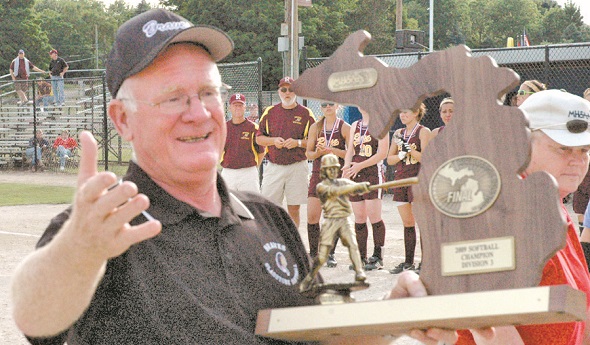
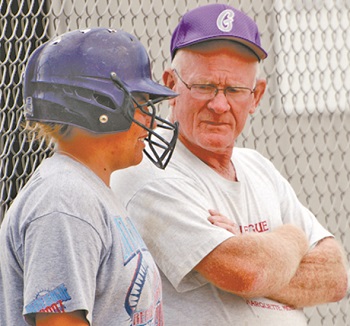
PHOTOS: (Top) Gladstone High School softball manager Gerry Smith holds the Division 3 championship trophy after the Braves won the 2009 title in Battle Creek. Smith, who also led the Braves to the 2004 crown, died Oct. 15. (Middle) Smith talks with catcher Jordan Kowalski at a practice prior to the 2011 Division 3 Semifinals. (Photos courtesy of Escanaba Daily Press.)
No More Surprises: Marysville Brings Back Talent, Experience from 2021 Run
By
Paul Costanzo
Special for MHSAA.com
April 27, 2022
Kate Westmiller and her Marysville softball teammates proved a year ago what most coaches preach –rankings don’t matter.
 The Vikings weren’t even an honorable mention entering the 2021 season, and entered the postseason outside of the top 10, before making a run to the MHSAA Division 2 Final.
Despite that run, and returning the vast majority of players from last year’s team, the Vikings find themselves outside the top 10 of the preseason Michigan High School Softball Coaches Association Division 2 poll.
They’re happy to prove everyone wrong again.
“We’ve kind of always been used to that,” said Westmiller, a senior infielder. “You say ‘Marysville’ and people say, ‘Who’s that? Where’s that?’ But we definitely can compete. Last year, it was our own little Cinderella story. But it’s better to be the underdogs because nobody expects you to do well. We definitely hope we start to get on people’s radars a little bit.”
It’s a bit of a surprise the Vikings aren’t on the radar already after making their first Semifinal appearance since 2007 and first Final appearance since 1991. They’re received honorable mention in the preseason poll, but 10 of the 14 players from last year’s Final – an 8-5 loss to Owosso – are back.
“I wasn’t necessarily looking for the rankings, but a couple people sent it to me,” Marysville coach Ryan Rathje said. “We did lose some important pieces from last year, but we don’t really worry about (the rankings) because we can’t control it. We’re not going to lose any sleep over that, but it’s definitely motivation.”
The graduated losses – Kristen Smith, Calle Perrin and Mackenzie Smith – are certainly big ones. Both Kristen Smith and Perrin started the Final and had home runs. Kristen Smith also served as the Vikings’ main pitcher throughout last year, although the returning Megan Liniarski has plenty of experience in that regard, as well.
One unexpected loss was that of sophomore Avery Woodard, who is out for the year with an injury. Woodard was a starter for the Vikings as a freshman.
 But that still leaves six starters from the 2021 Final – Westmiller, Kaitlyn Cain, Avery Wolters, Anna Oles, Brandi Bassett and Meghan Winston. When you add Emma Curtis and Kylie Parent, the Vikings bring back eight players who hit better than .380 a year ago.
“We were really surprised and excited with how we did last year, and we had a lot of important girls who left, and we’re definitely going to miss them,” Westmiller said. “But if we all work together, we can reach some of the goals we set. We want to try and win our District, and potentially win the Regional. In the (Macomb Area Conference White) we’re facing a little harder competition, as far as our league, but I think that will definitely help us during the postseason. During our postseason run last year, we were just so close, so I think one of the biggest goals is to become that close again.”
Marysville is 4-2 to start the year, and has battled the elements to simply get on the field. Rathje said that as of Monday night, he had not had one regular practice outside with his entire team.
While the weather has played the biggest role in that, Rathje and a handful of his players had a hand in it, as well.
The Vikings basketball team made its first run to the Division 2 Quarterfinals this winter. Rathje is also the girls basketball coach at Marysville, and five players – Cain, Winston, Oles, Wolter and Kara Miller – play on both teams. Ryan Quain, who also plays softball, joined the basketball team for the postseason.
“I think that’s a big credit to the girls we have,” Rathje said. “The girls are obviously athletic, hard-working and super smart. They don’t shy away from the moment. They know how to play the right way and just go out there with confidence. It’s been a lot of fun to be along for the ride with them. I’ve been blessed with some fantastic athletes.”
Rathje, who has been coaching both sports at the varsity level for 19 years, also gave credit to his assistant coaches, many of whom have head coaching experience in basketball or baseball/softball, such as Tom Valko, Ryan Biewer, Mark Dickinson and Shawn Winston.
That didn’t surprise Westmiller, who said her coach never shines the spotlight on himself, even though he deserves it.
“He’s taught me so much,” she said. “He’s teaching us life lessons and how to be better for your community and society. He’s helped me grow as a student and an athlete. He’s been a mentor for me. He’s very shy. He doesn’t like to take a lot of the credit for things. In reality, he’s doing a lot. He’s allowing us to come in early if we want to. He takes no time for himself – this man is so selfless. He’s amazing. I can definitely say he’s turned into an amazing mentor for me, and I will keep this coach/player relationship for the rest of my life.”
Westmiller and several of her teammates have just one season left with Rathje, and they’re hoping to end on another high note. Having done it before, together, certainly should help.
“These girls in volleyball and basketball and softball last year, I think that no moment is too big for them,” Rathje said. “That’s a really big part of it. A lot of times, it’s mistakes that are the difference in those games. I always tell them to go in there and control what you can control. I think that experience is priceless, and to have that confidence that they have, you can’t really duplicate that.”
 Paul Costanzo served as a sportswriter at The Port Huron Times Herald from 2006-15, including three years as lead sportswriter, and prior to that as sports editor at the Hillsdale Daily News from 2005-06. He can be reached at [email protected] with story ideas for Genesee, Lapeer, St. Clair, Sanilac, Huron, Tuscola, Saginaw, Bay, Arenac, Midland and Gladwin counties.
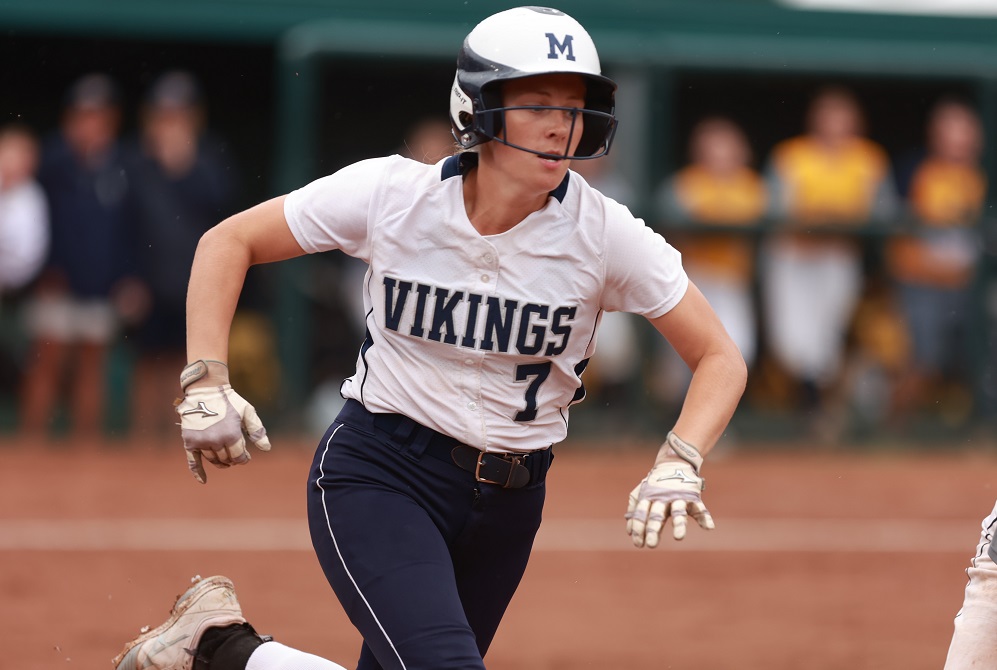
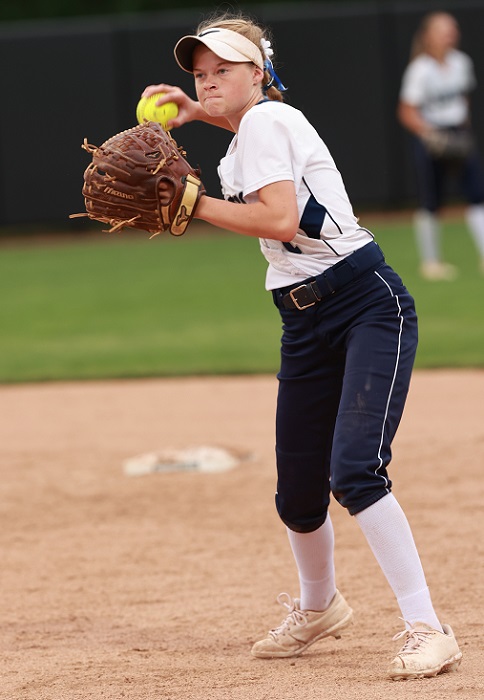
PHOTOS (Top) Kaitlyn Cain sprints to first base during last season’s Division 1 Final against Owosso. (Middle) Kate Westmiller, here warming up before the start of an inning last year, is another key contributor back for the reigning Division 1 runner-up. (Click for more from Hockey Weekly Action Photos.)