

Gladstone Coach Smith Built Champions
October 24, 2016
By Dennis Grall
Special for Second Half
ESCANABA — Gerry Smith put his life into helping area youngsters get a foot into the athletic doorway, and in the process touched the lives of so many people.
 “Smitty” died Oct. 15 following a lengthy illness.
“God got a great softball coach,” said retired Gladstone athletic director Matt Houle. “He was unique and old school, but his love for kids and the game always showed clearly. He had such a passion for the game of softball and just loved working with kids.”
Smith, 70, worked at Mead Paper Co. for more than 30 years and was IBEW 979’s business agent for 21 years. But he will perhaps be most remembered for his 43 years on softball and baseball fields throughout the area. He spent 11 years as Gladstone High School’s head softball coach, directing the Braves to MHSAA titles in 2004 and 2009. He was 290-77-1, but missed much of the 2008 season because of shoulder surgery. The Braves were 31-10 under interim manager John Malloch, which would give Smith an overall 321-87-1 record.
 “He put a lot of trust into people he asked to help him out,” said Ashley Hughes, who succeeded Smith in 2014 and guided the Braves to the MHSAA Division 3 title that year.
Hughes, who joined Smith on the softball staff when she became a teacher at her alma mater in 2009, also pitched for Smith and the Braves before getting a softball scholarship to Lake Superior State University.
She recalled Smith sought her services when she returned to Gladstone. “Hey kiddo, how about helping us out this year,” is how Hughes remembers that conversation.
He then told her, “I’m going to teach you everything I know and in a few years this will all be yours,” Hughes related.
“For me to come as head coach after Smitty, there was so much pressure. I wanted to live up to everything he had provided for this program,” Hughes said. “I didn’t want to disappoint him. He put a lot of faith in me.”
She said Smith also had an impact when she was a player. “He was so in your face in such a positive light. He wanted you to be successful, whether you had never touched a ball or had the ability to go on to play college ball. He was a spit-fire. He was so intense.
“He just exuded passion, at practice, at games. He had so much love for the game. That is something I’ve held onto because I too loved that game. To have someone like Smitty be so passionate and intense helped me become passionate and gave me the drive to be like that.”
Bill Buchmiller and Smith were partners for 40 years and he became godfather to Buchmiller’s children. In addition to guiding the Braves’ high school varsity, they served as American Legion coaches in the early stages of Gladstone’s program, worked together as Little League coaches and were softball teammates.
“He took a program from nothing to two state championships,” said Buchmiller. “He always encouraged the group. He may have broke them down a little bit but he always built them back up. He was a hard guy to get to know, but once you got to know him, he was a great guy.”
Smith used the knowledge he had gleaned from many years as a player and infused that into his players. “He just dwelled on the basics of softball. If you had to play small ball to win, that is what he played,” said Buchmiller.
 “He covered all the different bases of softball. He stressed defense. He told (hitting coach) Al Verbrigghe, ‘You give me one run Al and we’ll win the ball game with my defense. Give me a run and we’ll manage somehow.’”
Theresa Shepeck, who joined Smith on the GHS staff in 2003, agreed with that assessment.
“Smitty always thought the short game was the way to go,” she said. “It was about bunting, not the long ball. You get a runner on one, you bunt her to two. You get somebody on three, then you suicide (bunt) her home.”
Shepeck said his players thrived on his various idiosyncrasies, such as finding tourney lodging in rather inexpensive motels and using a wad of cash to pay for the team’s rooms. “The kids just yukked it up,” she said with a laugh.
“He always put the kids first. If somebody made a mistake, it was never their fault; it is my (Smith’s) fault, the coaching staff’s fault. If one of us coaches made a mistake, he took that blame. It was always his fault, his responsibility,” said Shepeck.
The players appreciated how he used them in games and practices. “His philosophy was to put the best nine on the field, period,” she said. “He walked on a lot of toes, he had a lot of hurt feelings (of parents), but I think the kids respected that. Nobody ever doubted how they fit in. He was there to win.
“He was a little man (about 5-foot-6) but had a huge heart. He was all about the kids and the coaching staff. It was an honor to learn from him, to be in his presence, to be a mentor to the kids.”
Hughes agreed, noting “he had a way of figuring out what the team needs are and re-arranging the players (duties). He knew the players’ strengths and was always looking out for the entire team.”
Smith’s career record likely could have included more wins if he didn’t use the season’s first month to shuffle personnel while building for the postseason. It paid off when it counted the most as the Braves reached at least the Quarterfinal level each of his 11 seasons.
“He was definitely not afraid to experiment,” said Hughes. “He knew the rules of the game and he was always looking for more (from his players). He was an aggressive coach, and the girls who love the sport really grasped at that. He utilized every player on his roster.
“He didn’t have to say too much, but you always wanted to answer him and make him proud and prove to him that you can come through.”
Houle summed up Smith’s legacy when he said, “He was the person that put Gladstone High School on the map in high school activities. He will be dearly missed by so many. He touched so many lives.”
 Denny Grall retired in 2012 after 39 years at the Escanaba Daily Press and four at the Green Bay Press-Gazette, plus 15 months for WLST radio in Escanaba; he served as the Daily Press sports editor from 1970-80 and again from 1984-2012. Grall was inducted into the Upper Peninsula Sports Hall of Fame in 2002 and serves as its executive secretary. E-mail him at [email protected] with story ideas for the Upper Peninsula.
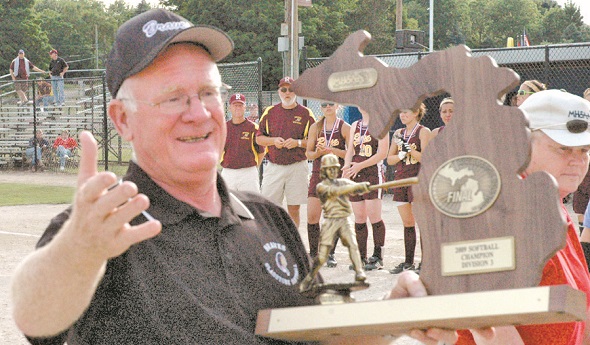
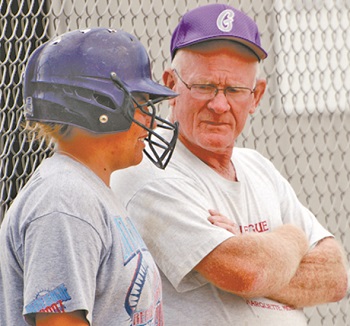
PHOTOS: (Top) Gladstone High School softball manager Gerry Smith holds the Division 3 championship trophy after the Braves won the 2009 title in Battle Creek. Smith, who also led the Braves to the 2004 crown, died Oct. 15. (Middle) Smith talks with catcher Jordan Kowalski at a practice prior to the 2011 Division 3 Semifinals. (Photos courtesy of Escanaba Daily Press.)
Richmond, Ida Earn Saturday Return
June 15, 2017
By Geoff Kimmerly
Second Half editor
EAST LANSING – Even reigning champions get a little nervous returning to the diamond of their greatest accomplishment.
But it took Richmond only a couple innings to get comfortable again at Secchia Stadium while kicking off Thursday’s Division 2 Semifinals.
The Blue Devils, ranked No. 2 at the end of the regular season and expected to reach this point all season after emerging to win their first title a year ago, will get a chance to play for another thanks to a 4-2 win over No. 3 Escanaba – last year’s Semifinal opponent as well.
Richmond had won its last three games all in extra innings, but put up four runs during the third Thursday. Escanaba rallied for two runs in the fifth inning before sophomore pitcher Erin Shuboy – the star of last season’s championship run – finished locking down the Eskymos for the second year in a row.
“Making it here once is something special. And now to be here twice … I think the returners got rid of the jitters a little bit, (and) all of the other people are starting to settle in,” Richmond senior shortstop Carley Barjaktarovich said. “They score a couple of runs (and you tell yourself) relax, you’ve got a little bit of cushion. You’ve got another at bat. I wasn’t nervous at all. I know Erin; she’s going to bear down and she’s going to get it done. And we go back in and we have our bats.”
Richmond (33-4) will face Ida (36-7) in Saturday’s first championship game, at 10 a.m.
A year ago, the Blue Devils entered the tournament as honorable mentions in the final state rankings, but reached MSU and downed Escanaba 6-2 in a Semifinal.
The teams should have recognized a number of faces in the opposing dugout. Longtime Richmond coach Howard Stuart also caught up with Saginaw Swan Valley’s Tom Kennelly, whose top-ranked Vikings were downed by Escanaba in Tuesday’s Quarterfinal, and felt as prepared as possible heading into the rematch.
Richmond got to Eskymos senior starting pitcher Katie Ross only in the third inning, and freshman Gabbi Salo threw three scoreless to finish the game. But that one frame was enough. A walk, infield single by Barjaktarovich and error loaded the bases, and after a fielder’s choice knocked in the first run junior catcher Evelyn Swantek doubled in the next three.
Escanaba scored its two runs in the fifth inning and loaded the bases again with two outs. But Shuboy got a pop out to end that rally and allowed only one hit in each of the final two innings.
“I felt sorry for (Escanaba), because I thought that was a great team,” Stuart said. “We just had one good inning. We had one key hit, and that’s all it took.”
Barjaktarovich finished 2 for 3, and junior leftfielder Emma Caperton also had a double. Shuboy struck out seven and gave up four hits.
Sophomore rightfielder Lexi Chaillier and senior centerfielder Emily Bruntjens drove in runs for Escanaba (33-5). Junior Maddie Griffin walked twice and scored.
Ida 3, Stevensville Lakeshore 2
How did it feel for unranked Ida to down No. 6 Lakeshore in its first Semifinal since 2006, to make its first MHSAA Final in softball since that spring more than a decade ago?
“This is what you play for. This is what they started out wanting when they were kids. Look at their parents – they wanted the same thing, and here we are,” Ida coach Dawn Forter said, pointing out an enthusiastic bunch waiting to greet the team. “I’m numb. I’m proud of every one of those kids, all 15.”
 The Bluestreaks came back after Lakeshore jumped in with a run in the first inning, scoring one in the fourth and two in the fifth, and then withstood a last-inning Lancers rally to close out the victory.
Lakeshore scored that run when junior leftfielder Karlee Lambert misplayed a single by senior Olivia Freehling. But Lambert certainly made up for the brief miscue with a pair of triples, the second setting up her score on junior Hannah Tuller’s triple. Tuller kept going and scored on a throwing error to take the advantage up to 3-1.
“That’s a hard-hit ball and the field plays fast, and it got to (Lambert) a little quicker than she thought it was going to. She stuck with it though – she knocked it down,” Forter said of Freehling’s hit. “That’s the way every kid wearing a Bluestreak shirt has been all year. If they make a mistake on one side, they pick it up on the other.”
Ida’s first run came when senior Mallorie Duvall drove in senior Brooklyn Woelmer in the fourth inning. Woelmer, Lambert and Duvall all were 2 for 3 at the plate, and junior Lauren Kreps gave up only one earned run throwing all seven innings.
Junior third baseman Cassidy Zavoral and freshman designated player Sierra Ciesielski were 1 for 3 and scored for the Lancers (33-7-1). Junior Taylor Simon struck out four allowing only two earned runs while tossing a complete game.
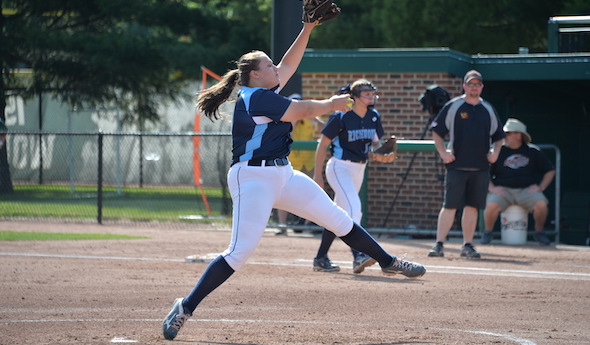
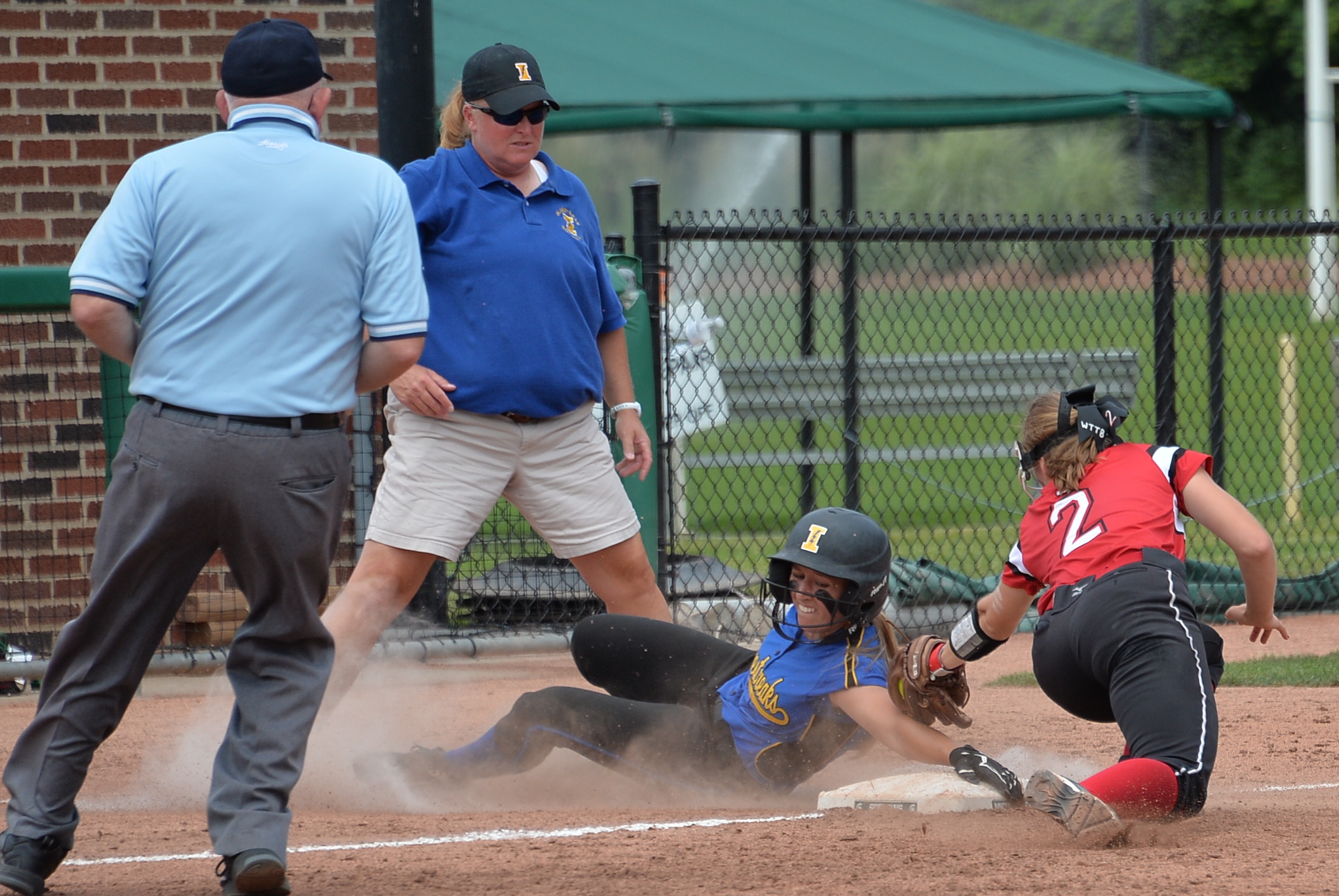
PHOTOS: (Top) Richmond pitcher Erin Shuboy prepares to fire during Thursday's Division 2 Semifinal win over Escanaba. (Middle) Ida's Karlee Lambert gets to third base ahead of a tag after hitting one of her two triples Thursday.