

Gladstone Coach Smith Built Champions
October 24, 2016
By Dennis Grall
Special for Second Half
ESCANABA — Gerry Smith put his life into helping area youngsters get a foot into the athletic doorway, and in the process touched the lives of so many people.
 “Smitty” died Oct. 15 following a lengthy illness.
“God got a great softball coach,” said retired Gladstone athletic director Matt Houle. “He was unique and old school, but his love for kids and the game always showed clearly. He had such a passion for the game of softball and just loved working with kids.”
Smith, 70, worked at Mead Paper Co. for more than 30 years and was IBEW 979’s business agent for 21 years. But he will perhaps be most remembered for his 43 years on softball and baseball fields throughout the area. He spent 11 years as Gladstone High School’s head softball coach, directing the Braves to MHSAA titles in 2004 and 2009. He was 290-77-1, but missed much of the 2008 season because of shoulder surgery. The Braves were 31-10 under interim manager John Malloch, which would give Smith an overall 321-87-1 record.
 “He put a lot of trust into people he asked to help him out,” said Ashley Hughes, who succeeded Smith in 2014 and guided the Braves to the MHSAA Division 3 title that year.
Hughes, who joined Smith on the softball staff when she became a teacher at her alma mater in 2009, also pitched for Smith and the Braves before getting a softball scholarship to Lake Superior State University.
She recalled Smith sought her services when she returned to Gladstone. “Hey kiddo, how about helping us out this year,” is how Hughes remembers that conversation.
He then told her, “I’m going to teach you everything I know and in a few years this will all be yours,” Hughes related.
“For me to come as head coach after Smitty, there was so much pressure. I wanted to live up to everything he had provided for this program,” Hughes said. “I didn’t want to disappoint him. He put a lot of faith in me.”
She said Smith also had an impact when she was a player. “He was so in your face in such a positive light. He wanted you to be successful, whether you had never touched a ball or had the ability to go on to play college ball. He was a spit-fire. He was so intense.
“He just exuded passion, at practice, at games. He had so much love for the game. That is something I’ve held onto because I too loved that game. To have someone like Smitty be so passionate and intense helped me become passionate and gave me the drive to be like that.”
Bill Buchmiller and Smith were partners for 40 years and he became godfather to Buchmiller’s children. In addition to guiding the Braves’ high school varsity, they served as American Legion coaches in the early stages of Gladstone’s program, worked together as Little League coaches and were softball teammates.
“He took a program from nothing to two state championships,” said Buchmiller. “He always encouraged the group. He may have broke them down a little bit but he always built them back up. He was a hard guy to get to know, but once you got to know him, he was a great guy.”
Smith used the knowledge he had gleaned from many years as a player and infused that into his players. “He just dwelled on the basics of softball. If you had to play small ball to win, that is what he played,” said Buchmiller.
 “He covered all the different bases of softball. He stressed defense. He told (hitting coach) Al Verbrigghe, ‘You give me one run Al and we’ll win the ball game with my defense. Give me a run and we’ll manage somehow.’”
Theresa Shepeck, who joined Smith on the GHS staff in 2003, agreed with that assessment.
“Smitty always thought the short game was the way to go,” she said. “It was about bunting, not the long ball. You get a runner on one, you bunt her to two. You get somebody on three, then you suicide (bunt) her home.”
Shepeck said his players thrived on his various idiosyncrasies, such as finding tourney lodging in rather inexpensive motels and using a wad of cash to pay for the team’s rooms. “The kids just yukked it up,” she said with a laugh.
“He always put the kids first. If somebody made a mistake, it was never their fault; it is my (Smith’s) fault, the coaching staff’s fault. If one of us coaches made a mistake, he took that blame. It was always his fault, his responsibility,” said Shepeck.
The players appreciated how he used them in games and practices. “His philosophy was to put the best nine on the field, period,” she said. “He walked on a lot of toes, he had a lot of hurt feelings (of parents), but I think the kids respected that. Nobody ever doubted how they fit in. He was there to win.
“He was a little man (about 5-foot-6) but had a huge heart. He was all about the kids and the coaching staff. It was an honor to learn from him, to be in his presence, to be a mentor to the kids.”
Hughes agreed, noting “he had a way of figuring out what the team needs are and re-arranging the players (duties). He knew the players’ strengths and was always looking out for the entire team.”
Smith’s career record likely could have included more wins if he didn’t use the season’s first month to shuffle personnel while building for the postseason. It paid off when it counted the most as the Braves reached at least the Quarterfinal level each of his 11 seasons.
“He was definitely not afraid to experiment,” said Hughes. “He knew the rules of the game and he was always looking for more (from his players). He was an aggressive coach, and the girls who love the sport really grasped at that. He utilized every player on his roster.
“He didn’t have to say too much, but you always wanted to answer him and make him proud and prove to him that you can come through.”
Houle summed up Smith’s legacy when he said, “He was the person that put Gladstone High School on the map in high school activities. He will be dearly missed by so many. He touched so many lives.”
 Denny Grall retired in 2012 after 39 years at the Escanaba Daily Press and four at the Green Bay Press-Gazette, plus 15 months for WLST radio in Escanaba; he served as the Daily Press sports editor from 1970-80 and again from 1984-2012. Grall was inducted into the Upper Peninsula Sports Hall of Fame in 2002 and serves as its executive secretary. E-mail him at [email protected] with story ideas for the Upper Peninsula.
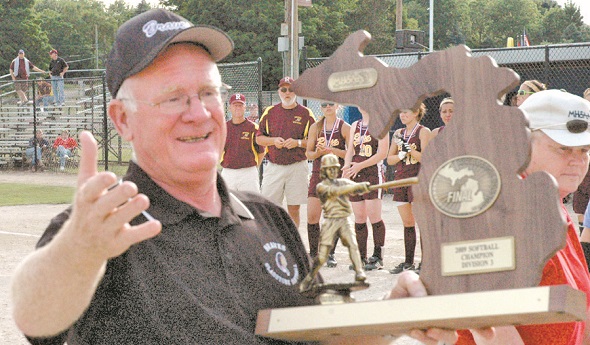
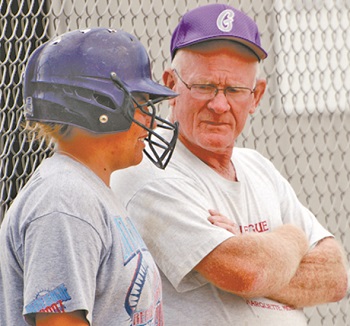
PHOTOS: (Top) Gladstone High School softball manager Gerry Smith holds the Division 3 championship trophy after the Braves won the 2009 title in Battle Creek. Smith, who also led the Braves to the 2004 crown, died Oct. 15. (Middle) Smith talks with catcher Jordan Kowalski at a practice prior to the 2011 Division 3 Semifinals. (Photos courtesy of Escanaba Daily Press.)
Preview: 4 Take Next Step for 1st Time
June 10, 2015
By Geoff Kimmerly
Second Half editor
Most teams journeying to Secchia Stadium at Michigan State University this weekend will be doing so for the first time, as this is only the second season MSU has hosted MHSAA Softball Finals weekend.
But for Caledonia, Carleton Airport, St. Clair and Montague, the trip will be a little more special – all four will be playing in an MHSAA Semifinal for the first time in their histories.
See below for a schedule of this weekend’s games, plus glances at all 16 teams that will take the field beginning Thursday.
Semifinals – Thursday
Division 1
Caledonia vs. Farmington Hills Mercy, 3 p.m.
Warren Regina vs. Mattawan, 5:30 p.m.
Division 2
Frankenmuth vs. Carleton Airport, 10 a.m.
Wayland vs. St. Clair, 12:30 p.m.
Semifinals – Friday
Division 3
Pinconning vs. Monroe St. Mary Catholic Central, 3 p.m.
Bronson vs. Montague, 5:30 p.m.
Division 4
Kalamazoo Christian vs. Hillman, 10 a.m.
Holton vs. Unionville-Sebewaing, 12:30 p.m.
Finals – Saturday
Division 1: 12:30 p.m.
Division 2: 10 a.m.
Division 3: 5:30 p.m.
Division 4: 3 p.m.
Tickets cost $8 per round and include admission to baseball and girls soccer games that day also at MSU’s Old College Field. Radio broadcasts of all games can be heard online at MHSAAnetwork.com. All games will be streamed live online at MHSAA.TV and viewable on subscription basis.
All statistics below are through at least the regular season, with most through teams' Regionals. (Click for links to brackets and scores.)
DIVISION 1
CALEDONIA
Record/rank: 33-4, No. 3
Coach: Tom Kaechele, 14th season (288-165)
League finish: First in Ottawa-Kent Conference White.
Championship history: Has never played in an MHSAA Final.
Players to watch: Samantha Gehrls, fr. P (.582, 35 R, 10 2B, 14 HR, 56 RBI, 19-1 pitching, 1.11 ERA, 159 K); Ashley Miller, sr. SS (.454, 53 R, 9 3B, 12 SB); Hannah Horvath, jr. 2B (.443, 49 R, 11 2B, 31 RBI, 13 SB).
Outlook: Caledonia won its first Regional title last weekend and eclipsed 30 wins for the second straight season despite replacing graduated all-state pitcher Morgan Swift. Freshman Gehrls has been phenomenal keying this program-best run; the Fighting Scots eliminated No. 4 Hudsonville in the Regional Final and honorable mention Midland in the Quarterfinal. She’s surrounded by strong bats – six Scots are hitting at least .396, including junior catcher Lexi Lieske (.396), junior first baseman McKenna Dixon (.406) and senior designated player Danielle Oracz (.451).
FARMINGTON HILLS MERCY
Record/rank: 27-3, No. 5
Coach: Alec Lesko, first season (27-3)
League finish: First in Detroit Catholic League Central.
Championship history: Division 1 runner-up 2002.
Players to watch: Abby Krzywiecki, jr. 1B/P (.594, 12 HR, 56 RBI, 10-1 pitching, 2.98 ERA); Alex Sobczak, sr. C (.436, 55 R, 6 HR, 33 RBI, 11 SB); Sophia VanAcker, soph. LF (.545, 32 R, 26 RBI, 11 SB);
Outlook: Mercy won its first Regional title since 2007 with a team that should have an opportunity at multiple trips to Finals weekend. Sobczak was an all-state first-teamer last season but is one of only two seniors who start and three total on the team. Krzywiecki earned all-state honorable mention last season and will finish this one with multiple entries in the MHSAA records for her offensive prowess. She provides another strong arm to ace junior Andrea Elmore, who came into the week 15-2 with a 1.44 ERA and 143 strikeouts in just under 112 innings pitched.
MATTAWAN
Record/rank: 31-12, honorable mention
Coach: Alicia Smith, 15th season (400-177-1)
League finish: First in Southwestern Michigan Athletic Conference East.
Championship history: Division 1 champion 2013 and 2011, runner-up 2012.
Players to watch: Joanna Bartz, soph. 3B (.433, 51 R, 13 2B, 12 HR, 63 RBI); Genny Soltesz, jr. 2B (.544, 66 R, 15 SB); Alexis Taube, soph. SS (.504, 49 R, 16 2B, 11 HR, 65 RBI).
Outlook: Mattawan was an extra-inning run in the 2012 Final from winning three straight titles, and after a year away is back at Finals weekend. Bartz earned an all-state honorable mention last season as a freshman, and she and Taube are the main run producers in a lineup loaded with five hitters batting .at least .433. The team has scored 415 runs – good for 11th in MHSAA history – and despite playing a loaded regular-season schedule and having to eliminate No. 1 Portage Central and No. 10 Plymouth during the playoffs. Junior first baseman Amber Mazahem (.455) and freshman pitcher Emily Koperdak (.441) are among additional top hitters, with Koperdak also 19-8 with a 3.28 ERA.
WARREN REGINA
Record/rank: 25-16, honorable mention
Coach: Diane Laffey, 45th season (1,116-439-3)
League finish: Third in Detroit Catholic League Central.
Championship history: Five MHSAA titles (most recent 2007).
Players to watch: Gina Munson, sr. C/3B (.333, 31 RBI); Marissa Tiano, sr. P/DP (.403, 13 2B, 25 RBI); Riley Hison, sr. 2B (.431, 37 R, 22 RBI).
Outlook: Regina won its 19th straight District title this spring, but is back at the Finals for the first time since finishing a run of four straight MHSAA titles from 2004-07. Laffey is the winningest coach in Michigan softball history, predating the start of the MHSAA tournament by more than a decade. Regina may have more losses than anyone left in Division 1, but it also has handed Mercy its only three losses this season. Munson earned an all-state honorable mention in 2014 and catches Tiano and junior Nicole Roeske, who was 10-6 with a 2.84 ERA entering the week.
DIVISION 2
CARLETON AIRPORT
Record/rank: 36-4, honorable mention
Coach: John Warren, 21st season (520-222)
League finish: Tied for first in Huron League.
Championship history: Has never played in an MHSAA Final.
Players to watch: Emily Bindus, jr. P (.513, 37 R, 17 2B, 52 RBI, 23-1 pitching, 0.75 ERA, 216 K); Lauren French, sr. SS (.439, 52 R, 14 2B, 48 RBI); Alyssa Lang, soph. 2B (.496, 54 R, 16 2B, 39 RBI).
Outlook: Airport has been surging over a few years to reach this point, winning its first Regional title since 2009 and earning its first Semifinal berth after winning a third straight District and second league title in three seasons. The Jets scored in double figures in nearly half its wins, 16, with five hitters scoring at least 30 runs total this season. Senior catcher Carleigh Cousino adds another big bat, entering the week hitting .437 with 33 runs scored and 38 driven in. Airport has won 25 of its last 26 games; that only loss was in the regular-season finale, 1-0 to Division 3 No. 1 Monroe St. Mary.
FRANKENMUTH
Record/rank: 36-3-1, No. 10
Coach: Brad Walraven, sixth season (186-49)
League finish: First in Tri-Valley Conference East.
Championship history: Class C champion 1991, Division 3 runner-up 2011.
Players to watch: Amariah Wright, sr. P/1B (.472, 13 2B, 6 HR, 58 RBI, 22-1 pitching, 1.00 ERA, 198 K); Andrea Perlberg, sr. 3B (.440, 51 R, 35 SB); Makenzie Sipes, sr. 2B (.409, 38 R, 31 RBI).
Outlook: The Eagles eliminated honorable mention Saginaw Swan Valley in the Regional Final and then No. 6 Escanaba in the Quarterfinal with a lineup boasting six strong seniors led by one of the most successful coaches in MHSAA history in Walraven (1,093-302 in 36 seasons overall). Senior Kayla Brooks (13-2, 1.74 ERA) gives the team deeper pitching than most and also plays first base – she made the all-state first team last season – and senior left fielder Alyssa Jarlock adds a .371 average to the middle of the lineup. Sophomore shortstop Hannah Karwat is the lone non-senior among the top six, cleaning up with a .394 average.
ST. CLAIR
Record/rank: 23-12, unranked
Coach: Kevin Mahn, ninth season (196-93-1)
League finish: Third in Macomb Area Conference Red.
Championship history: Has never played in an MHSAA Final.
Players to watch: Chelsea Schweiger, sr. CF (.500, 41 R, 15 SB); Hannah Gomola, sr. P (.453, 32 R, 10 2B, 30 RBI); Avary Humes, sr. SS (.408, 12 2B, 32 R).
Outlook: St. Clair made Quarterfinals in 2012 and 2013 and won a District title last season before breaking through this spring for its first Semifinal berth. The Saints eliminated No. 7 Croswell-Lexington in the Regional Final and have outscored its five tournament opponents by a combined 51-14. Schweiger earned an all-state honorable mention last season and is one of five senior starters. Another, Miranda Greig, hits .367 and was 8-5 pitching with a 2.63 ERA heading into this week.
WAYLAND
Record/rank: 34-2, No. 1
Coach: Cheri Ritz, 20th season (670-132)
League finish: First in O-K Gold.
Championship history: Division 2 champion 2006.
Players to watch: Mallory Teunissen, sr. P/OF (.349, 30-2 pitching, 0.23 ERA, 365 K); Abby Merice, fr. P/OF (.509, 43 R, 11 2B, 38 RBI, 17 SB); Morgan Teunissen, sr. 1B (.422, 41 R, 20 RBI, 11 SB); Caroline Miller, sr. 2B (.450, 47 R, 34 RBI, 15 SB).
Outlook: The Wildcats returned to the Semifinals in 2014 for the second time in three seasons and fell by a run in 10 innings; they could take the next step led by Mallory Teunissen, who is striking out an average of two batters per inning. Wayland has an argument as the best team of the regular season, having shut out both Division 1 No. 1 Portage Central and eventual semifinalist Mattawan. The lineup is a mix of strong seniors, one of only two juniors, and dynamic underclassmen; senior shortstop Hailey Houck (.414, 40 RBI) and freshman outfielder Sydney Urban (.418, 38 RBI) are among more dangerous hitters.
DIVISION 3
BRONSON
Record/rank: 36-7, unranked
Coach: Becky Gray, 10th season (294-86-1)
League finish: First in Berrien-Cass-St. Joseph Conference East.
Championship history: Has never played in an MHSAA Final.
Players to watch: Kinslea Blouin, sr. SS (.556, 52 R, 15 2B, 68 RBI, 16 SB); Skyler Sobeski, sr. P (.547, 62 R, 20 2B, 11 HR, 65 RBI, 24-3 pitching, 0.65 ERA, 209 K); Kelsey Robinson, jr. CF (.486, 63 R, 23 SB).
Outlook: Bronson has won 17 straight including 5-0 and 5-1 wins over No. 5 Buchanan near the end of the regular season; the Vikings outscored their five playoff opponents by a combined 44-1 and haven’t given up a run since Parchment scored the lone one in Bronson’s first District game. Sobeski was all-state first team and Blouin earned an honorable mention last season, but Hannah Hoover (.352) is the only other upperclassmen. There are nine underclassmen including eight freshmen, four who start.
MONROE ST. MARY CATHOLIC CENTRAL
Record/rank: 35-5, No. 1
Coach: John Morningstar, first season (35-5)
League finish: Tied for first in Huron League.
Championship history: Three runner-up finishes (most recent 2007).
Players to watch: Meghan Beaubien, soph. P; Ellie Cepo, sr. C. (Statistics not submitted.)
Outlook: St. Mary won its first league title since 2008 and first District and Regional titles since that last runner-up season of 2007. The Kestrels eliminated No. 3 Napoleon in the Quarterfinal, and two of its losses were to teams playing in semifinals in bigger-school divisions (Airport and Mercy). They haven’t given up a run in five MHSAA tournament victories. Beaubien made the all-state first team last season as a freshman.
MONTAGUE
Record/rank: 22-12, unranked
Coach: Doug Rice, second season (36-24)
League finish: Third in West Michigan Conference.
Championship history: Has never played in an MHSAA Final.
Players to watch: Kenadee Shugars, sr. P (.422, 50 R, 7 HR, 38 RBI, 14-10 pitching, 2.61 ERA, 208 K); Linze Neubauer, sr. 1B (.432, 31 R, 33 RBI); Hannah Smith, soph. 2B (.410, 33 R).
Outlook: Montague has improved eight wins so far from Rice’s first to second season and will play in the Semifinals for the first time in program history. The Wildcats have won eight straight and 12 of their last 13 games after starting the spring 7-8. All 11 regulars hit at least .293 and seven hit at least .362; sophomore McKenna Lohman and junior Brandi Rice add punch in the middle of the lineup hitting .396 and .390, respectively. Shugars had 21 extra-base hits total entering the week – nine doubles and five triples to go with her seven home runs.
PINCONNING
Record/rank: 30-13, No. 8
Coach: Fred Yanoski, third season (79-42)
League finish: First in North East Michigan Conference.
Championship history: Three MHSAA titles (most recent 2000), one runner-up finish.
Players to watch: Josie Lavrack, sr. OF (.471, 56 R, 13 2B, 28 RBI); Gabby Yanoski, sr. 2B (.420, 50 R, 51 RBI); Malinda Talaga, sr. SS (.413, 46 R, 10 2B, 6 HR, 50 RBI).
Outlook: Pinconning has a rich softball tradition, with 27 straight league titles, but is returning to Finals weekend for the first time since 2004 after winning its first Regional title since 2010. The Spartans advanced in part by eliminating honorable mention Harrison, No. 4 Saginaw Valley Lutheran and No. 7 Reese. Talaga earned an all-state honorable mention last season and is among a strong group of five seniors, four who start. Junior Danielle Amlotte (20-10, 2.86 ERA) and sophomore Tegan Ferguson (9-3, 2.22) have handled the pitching duties, and junior Kayla Gauthier (.407, 48 RBI) adds another big bat to a lineup that had 25 home runs total entering the week.
DIVISION 4
HILLMAN
Record/rank: 30-3, honorable mention
Coach: Rich Price, first season (30-3)
League finish: Second in North Star League.
Championship history: 1996 Class D runner-up.
Players to watch: Vanessa Schook, soph. P/SS (.528, 45 R, 14 2B, 22 SB, 10-1 pitching, 1.31 ERA); Morgan Armon, soph. SS/3B (.500, 37 R, 23 RBI); Alissa Jones, sr. CF (.500, 35 R, 14 2B).
Outlook: Price took over the program this season after nine years as an assistant and has led the team to its first Regional title since 1999 and first Semifinal since 1996. Five regulars hit at least .400 and six hit at least .363 including the team’s three seniors, Jones, Eden Hunt (.403) and Courtney Sauer (.363). Schook is expected to get the start pitching, but has split those duties with sophomore third baseman Morgan Dove (.435, 14-2 pitching, 2.42 ERA); they are two of eight underclassmen on the roster.
HOLTON
Record/rank: 37-0, No. 3
Coach: Kirk Younts, first season (37-0)
League finish: First in Central State Activities Association Silver.
Championship history: Has never played in an MHSAA Final.
Players to watch: Ashley Friend, sr. C (.661, 18 2B, 63 RBI); Rachel Younts, sr. P (.320, 13 2B, 26-0 pitching, 0.84 ERA, 185 K); Jacki Stone, sr. OF (.617, 52 R, 17 2B, 50 RBI).
Outlook: Holton has made a Semifinal once before, in 2013, and can finish off one of the most tremendous seasons in MHSAA history if its closes with a championship. The Red Devils advanced by beating No. 7 Coleman in the Quarterfinal and won a league filled with larger opponents while keeping opponents at two runs or fewer in 29 games. Stone made the all-state first team last season, and Friend and Rachel Younts earned honorable mentions. The lineup opens with two more .400-plus hitters in sophomore rightfielder Emily Larabee (.487, 60 R) and senior shortstop Katie Wildfong (.431, 60 R), who also was 8-0 pitching with a 1.60 ERA heading into the week.
KALAMAZOO CHRISTIAN
Record/rank: 28-14, No. 8
Coach: Terry Reynolds, second season (56-31)
League finish: First in Kalamazoo Valley Association.
Championship history: Seven MHSAA titles (most recent 2013), three runner-up finishes.
Players to watch: Kara Gjeltema, jr. SS (.541, 48 R, 17 2B, 9 HR, 66 RBI); McKena Razenberg, jr. OF (.504, 63 R, 32 RBI, 24 SB); Aliyah Lemmer, soph. P (.369, 14 2B, 37 RBI, 15-13, 2.61 ERA).
Outlook: Kalamazoo Christian was Division 4 runner-up last season after winning the title in 2013, and no team in MHSAA history has played in more softball championship games. Gjeltema and senior second baseman Hannah Rozeveld (.285, 35 R, 25 RBI) are returning all-state first-team selections, and those two plus Lemmer and Razenberg played in last season’s Final, a one-run loss to Rogers City. Junior Haley Sikkenga provides another useful pitching option, sitting at 12-1 with a 3.35 ERA heading into this week.
UNIONVILLE-SEBEWAING
Record/rank: 36-3, No. 1
Coach: Steve Bohn, fourth season (154-13)
League finish: First in Greater Thumb Conference West.
Championship history: Three MHSAA titles (most recent 2009), three runner-up finishes.
Players to watch: Breanna Dinsmoore, sr. C (.479, 52 R, 15 2B, 11 HR, 55 RBI); Nicole Bauer, jr. P/1B (.463, 33 R, 17 2B, 46 RBI, 23-0 pitching, 0.38 ERA, 191 K); Erica Treiber, sr. CF/P (.429, 15 R in 12 games, 4-1 pitching, 1.27 ERA).
Outlook: After two straight runner-up finishes in Division 3, one a one-run loss and the other coming after nine innings, USA is back in Division 4 where it won its most recent title in 2009 and finished runner-up in 2011. The Patriots have eliminated No. 6 Ubly, No. 9 Grosse Pointe Woods University Liggett and No. 10 Waterford Our Lady during this run. Treiber also is back after losing most of her season to an injury – she, Dinsmoore and Bauer all made the Division 3 all-state first team last season. Two others hit better than .400 – junior second baseman Kayla Gremel (.414, 30 RBI) and freshman outfielder Brianna Osentowske (.417), who was promoted when Treiber was injured in April.
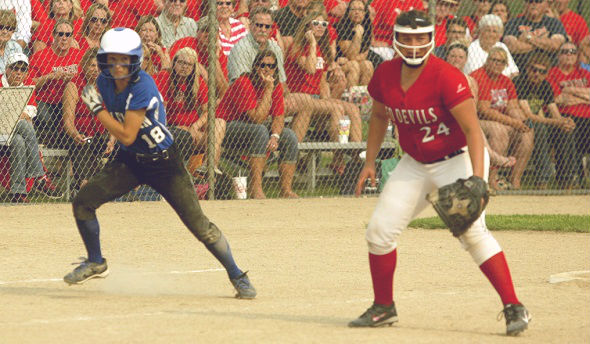
PHOTO: Holton third baseman Kaitlynn Mock anticipates a play as a Coleman runner turns toward home during their Quarterfinal on Tuesday. Holton won to remain undefeated and advance to a Division 4 Semifinal. (Click to see more from HighSchoolSportsScene.com).