


MHSA(Q&)A: Frankenmuth softball coach Brad Walraven
May 31, 2012
 By Brian Spencer
Second Half
Brad Walraven initially wanted to coach baseball. And he planned on staying in his first softball job, at Bay City All Saints, just four seasons – long enough to coach his younger sister through her graduation from the school.
But though the last 33 seasons weren’t part of his original plan, there’s no question they’ve worked out well for hundreds of athletes who have come under his leadership.
Walraven has won four MHSAA softball championships and is among only six high school coaches in his sport nationwide with at least 1,000 career wins, according to the National Federation of State High School Associations. Walraven achieved that milestone when his Frankenmuth team swept Essexville-Garber 7-2 and 7-0 on May 21.
The victories made the Eagles 27-4 this season – and Walraven 1,000-276 in 33 seasons total, including the first 30 at All Saints. In MHSAA history, his career wins total is behind that only of Warren Regina’s Diane Laffey, who has a 1,048-395-3 record heading into this week’s District tournaments.
Walraven also has won 25 District and 16 Regional championships, and taken 10 teams into MHSAA Finals championship games – including the Eagles last season in Division 3. Frankenmuth now is 32-4 this spring, heading into Saturday’s District on its home diamond.
You started out coaching with the plan of sticking in it for four years. What about the game of softball and coaching it has kept you around for 33?
My priorities in coaching and philosophies have changed (over the years). In my fourth year of coaching, my sister was a senior. That year we turned the program around and started winning games. They were competing. The competition has had me coming back since, along with learning more about the game.
Did you always want to coach softball? If not, what did you want to do?
No; the funny thing is that I graduated from Bay City All Saints after I won a state championship in baseball. After I graduated, I wanted the baseball job at Bay City All Saints, but they said I was too young to coach baseball. However, they did want me to stick around, and they gave me the softball job.
In your 33 years of coaching, what has been the most important piece of advice you’ve been given?
I read this somewhere; if you just keep working hard, good things happen to good people. Though my philosophies have changed, this philosophy has been pretty solid. I’ve also had girls come back from playing with me that say how I had taught them discipline, and that they have carried that with them to the next steps in their lives. As a coach, hearing that from past players is very rewarding.
Are there specific seasons or teams that stick out more than the rest? If so, why?
In 1999, we won states at Bay City All Saints. We set the state record with a 44-3 record. This record I believe is still intact. (All Saints’ 44 wins that spring is now tied with the 2007 White Lake Lakeland team for the most in one season.)
Last year (2011), Frankenmuth got to the Finals and lost in Battle Creek (to Clinton, 4-2 in the Division 3 championship game). It was the first time Frankenmuth had been there since 1991.
What piece of advice can you give to aspiring coaches?
Listening is an important skill. Learn from other coaches. If you think you know it all, you don’t. Every time you go to clinics, you pick up something and learn something new. You must be able to adapt. Every season is different, as you get a new set of players and personalities to deal with.
How long do you plan on coaching?
This is a very open-ended date. I was actually going to quit three times in my career for various reasons, but I’m glad that I stuck it out. Given that my health stays good and I continue to wake up every morning excited about coaching, I would love at least another five years in Frankenmuth.
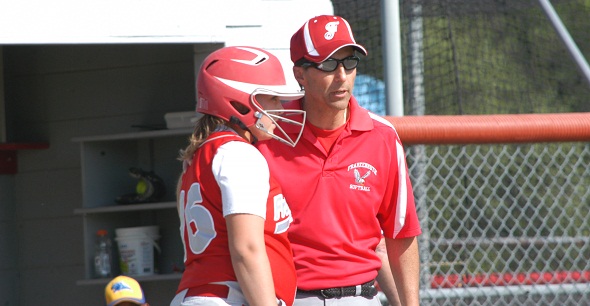
PHOTOS courtesy of The Frankenmuth News.
South Lyon Follows Freshman Phenom to 1st Finals Win
By
Perry A. Farrell
Special for MHSAA.com
June 19, 2021
EAST LANSING – Allen Park was never able to solve South Lyon pitcher Ava Bradshaw on Saturday.
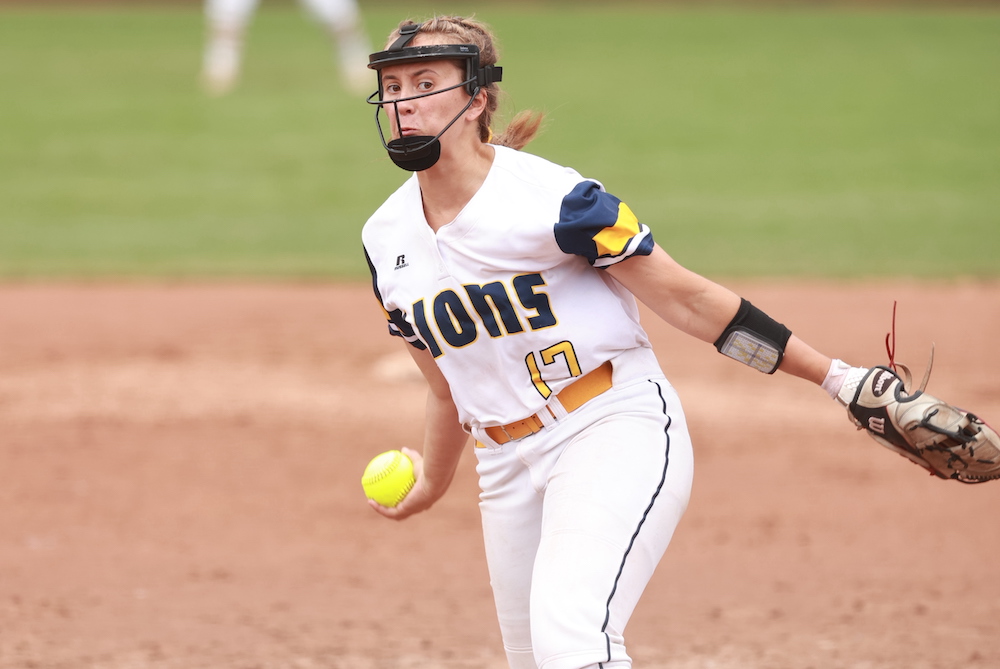
The freshman showed unbelievable poise on the mound and led the Lions (30-6-2) to the Division 1 championship with a 5-0 victory over the Jaguars at Secchia Stadium.
She was in trouble only in the seventh inning, when Molly Hool led off with a double. But Bradshaw got the next three batters, striking out the last to clinch the program’s first Finals title.
“She’s got the fire,’’ said Allen Park coach Mike Kish. “She has Division I stuff and she’s only a freshman. She has the spin and a rise ball. It’s hard to lay off.
“We have a team that loves each other. We’ll be back. We’re a young team. We can’t let her win again. This was the first time both of us were here, and after the Semifinals I thought we were confident.’’
Bradshaw scattered three hits. She said getting a lead just allowed her to pitch.
“I was a mess last night (Friday),’’ said Bradshaw. “My rise ball was working for me. It was on and that obviously helps. I had a great defense behind me. Every ball that was hit, I knew it was going to be caught. When you have that kind of confidence in your defense, it’s easier to pitch.’’
 “This is the stuff we practice, being on the big stage in pressure situations. We played some of the top teams in the state, and we’ve always excelled. We practice pressure situations.”
Bradshaw got the scoring started with an RBI double after Grace Walters reached on an error. Julia Duncan’s single scored another run to make it 2-0 in the first inning.
Not long after, the game went into a rain delay for 20 minutes, giving the Jaguars (32-11) a chance to regroup.
Bradshaw didn’t need it.
“She’s always a mess before a game,’’ said coach Dan DePaulis. “The way she trains, the way she plans for things. She’s a competitor. She attacks hitters. She’s just a really special kid.’’
After a rocky first inning, Allen Park pitcher Morgan Sizemore settled down and kept Allen Park in the game while the offense had a hard time solving Bradshaw, who pitched with minor stress.
She continually kept the Jaguars off balance and got great plays behind her. She also continued adding to the offense – after South Lyon loaded the bases on singles in the bottom of the fifth inning, Bradshaw’s sacrifice fly produced a run to make it 3-0.
The Lions tacked on insurance in the bottom of the sixth inning on a two-run double by Riley Bourlier.
“I thought we had a chance to do this after Regionals,’’ said Bourlier. “Ava is phenomenal, and it’s a pleasure to play with her.’’
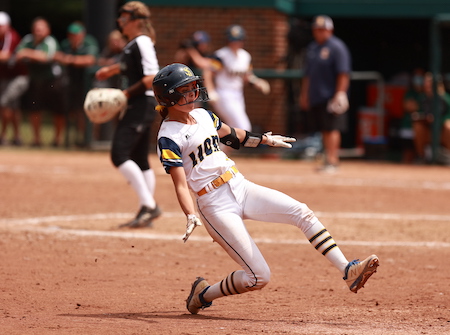
PHOTOS: (Top) South Lyon pitcher Ava Bradshaw is set to fire during Saturday's Division 1 Final. (Middle) Riley Bourlier slides into third base during a Lions rally.