


MHSA(Q&)A: Frankenmuth softball coach Brad Walraven
May 31, 2012
 By Brian Spencer
Second Half
Brad Walraven initially wanted to coach baseball. And he planned on staying in his first softball job, at Bay City All Saints, just four seasons – long enough to coach his younger sister through her graduation from the school.
But though the last 33 seasons weren’t part of his original plan, there’s no question they’ve worked out well for hundreds of athletes who have come under his leadership.
Walraven has won four MHSAA softball championships and is among only six high school coaches in his sport nationwide with at least 1,000 career wins, according to the National Federation of State High School Associations. Walraven achieved that milestone when his Frankenmuth team swept Essexville-Garber 7-2 and 7-0 on May 21.
The victories made the Eagles 27-4 this season – and Walraven 1,000-276 in 33 seasons total, including the first 30 at All Saints. In MHSAA history, his career wins total is behind that only of Warren Regina’s Diane Laffey, who has a 1,048-395-3 record heading into this week’s District tournaments.
Walraven also has won 25 District and 16 Regional championships, and taken 10 teams into MHSAA Finals championship games – including the Eagles last season in Division 3. Frankenmuth now is 32-4 this spring, heading into Saturday’s District on its home diamond.
You started out coaching with the plan of sticking in it for four years. What about the game of softball and coaching it has kept you around for 33?
My priorities in coaching and philosophies have changed (over the years). In my fourth year of coaching, my sister was a senior. That year we turned the program around and started winning games. They were competing. The competition has had me coming back since, along with learning more about the game.
Did you always want to coach softball? If not, what did you want to do?
No; the funny thing is that I graduated from Bay City All Saints after I won a state championship in baseball. After I graduated, I wanted the baseball job at Bay City All Saints, but they said I was too young to coach baseball. However, they did want me to stick around, and they gave me the softball job.
In your 33 years of coaching, what has been the most important piece of advice you’ve been given?
I read this somewhere; if you just keep working hard, good things happen to good people. Though my philosophies have changed, this philosophy has been pretty solid. I’ve also had girls come back from playing with me that say how I had taught them discipline, and that they have carried that with them to the next steps in their lives. As a coach, hearing that from past players is very rewarding.
Are there specific seasons or teams that stick out more than the rest? If so, why?
In 1999, we won states at Bay City All Saints. We set the state record with a 44-3 record. This record I believe is still intact. (All Saints’ 44 wins that spring is now tied with the 2007 White Lake Lakeland team for the most in one season.)
Last year (2011), Frankenmuth got to the Finals and lost in Battle Creek (to Clinton, 4-2 in the Division 3 championship game). It was the first time Frankenmuth had been there since 1991.
What piece of advice can you give to aspiring coaches?
Listening is an important skill. Learn from other coaches. If you think you know it all, you don’t. Every time you go to clinics, you pick up something and learn something new. You must be able to adapt. Every season is different, as you get a new set of players and personalities to deal with.
How long do you plan on coaching?
This is a very open-ended date. I was actually going to quit three times in my career for various reasons, but I’m glad that I stuck it out. Given that my health stays good and I continue to wake up every morning excited about coaching, I would love at least another five years in Frankenmuth.
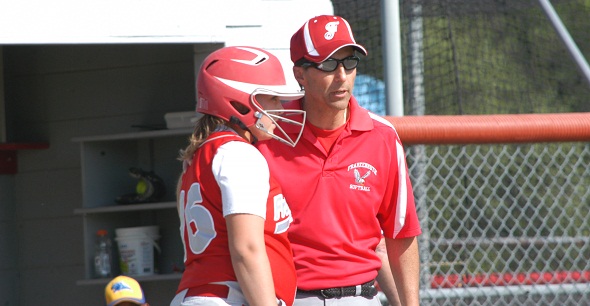
PHOTOS courtesy of The Frankenmuth News.
Owosso Softball Rallies for School's 1st Finals Title
By
Perry A. Farrell
Special for MHSAA.com
June 19, 2021
EAST LANSING – Owosso High School sports hadn’t done much on the state finals level over the last couple of years – until Saturday.
Surviving two Marysville homers and two errors, junior pitcher Macy Irelan kept the Vikings at bay enough to lead the Trojans to an 8-5 victory that clinched the Division 2 softball championship at Michigan State’s Secchia Stadium.
The championship was Owosso's first MHSAA Finals title in any sport.
Irelan won all 37 games for the Trojans (37-3) this season, but none bigger than Saturday’s.
“We fell behind, but we wanted to come back to show we deserved this,’’ said Irelan, who had an 0.55 ERA coming into the game. “It was a good team win. How the game worked out and how it went, we were going to do our best.’’
No-hit through two innings with four strikeouts, Marysville’s hitters looked like they were in for a long morning against Owosso’s Irelan.
That all changed in the third inning when pitcher Kirsten Smith helped her own cause with a three-run homer.
“I can’t tell you how many years this game took off my life,’’ said Owosso coach JoEllen Smith, who has led the program to 808 wins since taking over in 1983. “That was a huge emotion. Then we had a couple of plays that went against us. Our kids muscled through it. Postseason has been huge for us. They’ve never given up.’’
 Owosso got on the board first on an RBI double up the centerfield gap by first baseman Reyn Tuttle in the first inning. Jamie Maier stretched the lead to 2-0 on a blast over the centerfield field fence to lead off the second.
Irelan had the Marysville hitters under control until the third inning. She gave up singles to Brandi Bassett and Avery Woodard before Smith stunned Owosso with a three-run homer over the centerfield fence to give the Vikings a 3-2 lead.
“Give Owosso credit; their pitcher is tremendous,’’ said Marysville coach Ryan Rathje. “We got some hits off her and put the ball in play. Owosso has some strong bats throughout their lineup. They were able to come up with some key hits, and they had some good defensive plays.’’
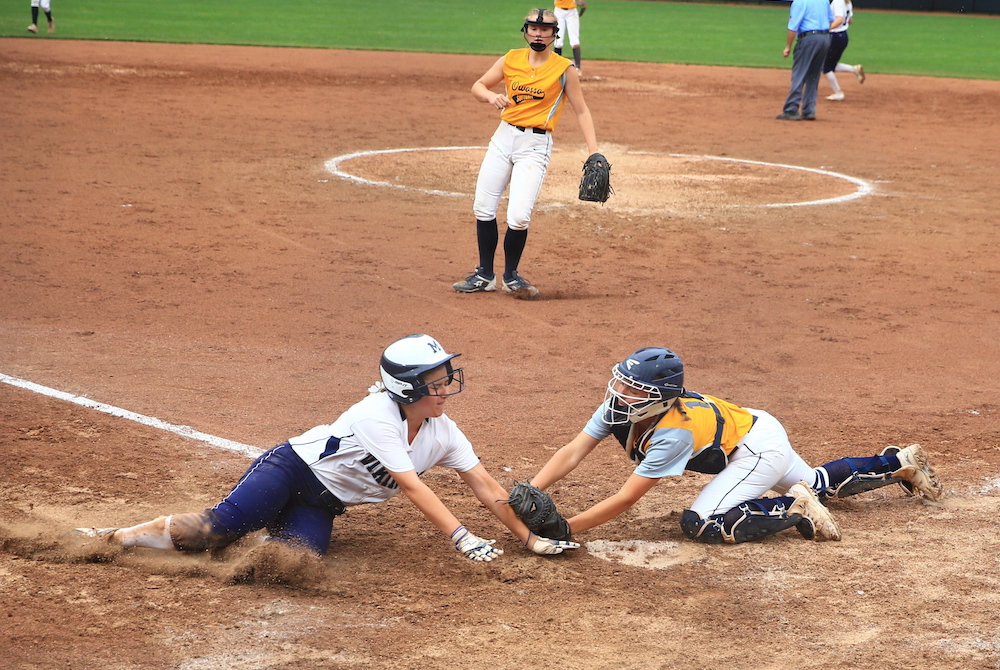
Marysville (31-7) – making its first championship game appearance since 1991 – continued to pound the ball, getting a homer from Callie Perrin to make it 4-2 in the fourth inning. Avery Wolters followed with a double. An error made it 5-2 and it would’ve been worse, but the Vikings had a runner thrown out at home.
Owosso began its comeback in the bottom of the fourth inning, leading off with three-straight singles followed by Madyson Rainey’s hit driving in a run to make it 5-3. Irelan came through with a double to center to tie the game at 5-5 with Marysville still looking for the inning’s first out. Owosso then took a 6-5 lead on a bounce-out to complete the four-run rally.
The Trojans added two more runs in the fifth inning. Kendall Anderson doubled and scored when Sydney Somers laced a singled to center. A throw trying to catch Somers at second went into the outfield, and she eventually scored as well.
Marysville led off the seventh inning with consecutive hits to put runners at first and third. But Irelan got two pop flies and a strikeout to seal the victory.
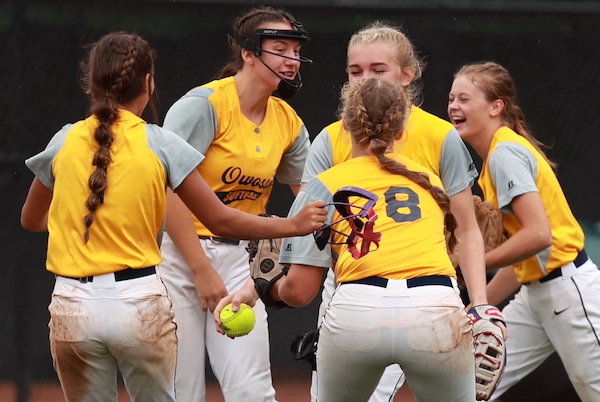
PHOTOS: (Top) Owosso catcher Karley Kincaid gets a tag down as a Marysville runner reaches for the plate. (Middle) The Trojans celebrate after the last out of Saturday's Division 2 Final.