


MHSA(Q&)A: Frankenmuth softball coach Brad Walraven
May 31, 2012
 By Brian Spencer
Second Half
Brad Walraven initially wanted to coach baseball. And he planned on staying in his first softball job, at Bay City All Saints, just four seasons – long enough to coach his younger sister through her graduation from the school.
But though the last 33 seasons weren’t part of his original plan, there’s no question they’ve worked out well for hundreds of athletes who have come under his leadership.
Walraven has won four MHSAA softball championships and is among only six high school coaches in his sport nationwide with at least 1,000 career wins, according to the National Federation of State High School Associations. Walraven achieved that milestone when his Frankenmuth team swept Essexville-Garber 7-2 and 7-0 on May 21.
The victories made the Eagles 27-4 this season – and Walraven 1,000-276 in 33 seasons total, including the first 30 at All Saints. In MHSAA history, his career wins total is behind that only of Warren Regina’s Diane Laffey, who has a 1,048-395-3 record heading into this week’s District tournaments.
Walraven also has won 25 District and 16 Regional championships, and taken 10 teams into MHSAA Finals championship games – including the Eagles last season in Division 3. Frankenmuth now is 32-4 this spring, heading into Saturday’s District on its home diamond.
You started out coaching with the plan of sticking in it for four years. What about the game of softball and coaching it has kept you around for 33?
My priorities in coaching and philosophies have changed (over the years). In my fourth year of coaching, my sister was a senior. That year we turned the program around and started winning games. They were competing. The competition has had me coming back since, along with learning more about the game.
Did you always want to coach softball? If not, what did you want to do?
No; the funny thing is that I graduated from Bay City All Saints after I won a state championship in baseball. After I graduated, I wanted the baseball job at Bay City All Saints, but they said I was too young to coach baseball. However, they did want me to stick around, and they gave me the softball job.
In your 33 years of coaching, what has been the most important piece of advice you’ve been given?
I read this somewhere; if you just keep working hard, good things happen to good people. Though my philosophies have changed, this philosophy has been pretty solid. I’ve also had girls come back from playing with me that say how I had taught them discipline, and that they have carried that with them to the next steps in their lives. As a coach, hearing that from past players is very rewarding.
Are there specific seasons or teams that stick out more than the rest? If so, why?
In 1999, we won states at Bay City All Saints. We set the state record with a 44-3 record. This record I believe is still intact. (All Saints’ 44 wins that spring is now tied with the 2007 White Lake Lakeland team for the most in one season.)
Last year (2011), Frankenmuth got to the Finals and lost in Battle Creek (to Clinton, 4-2 in the Division 3 championship game). It was the first time Frankenmuth had been there since 1991.
What piece of advice can you give to aspiring coaches?
Listening is an important skill. Learn from other coaches. If you think you know it all, you don’t. Every time you go to clinics, you pick up something and learn something new. You must be able to adapt. Every season is different, as you get a new set of players and personalities to deal with.
How long do you plan on coaching?
This is a very open-ended date. I was actually going to quit three times in my career for various reasons, but I’m glad that I stuck it out. Given that my health stays good and I continue to wake up every morning excited about coaching, I would love at least another five years in Frankenmuth.
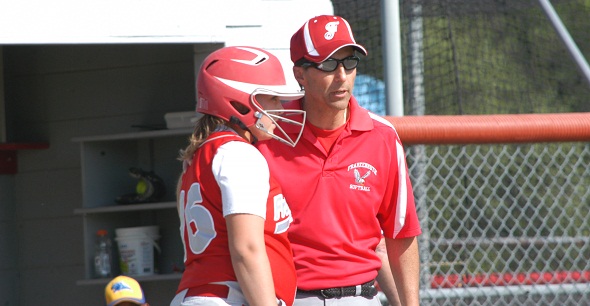
PHOTOS courtesy of The Frankenmuth News.

In Memoriam: Haack, Locke, Newton
By
Geoff Kimmerly
MHSAA.com senior editor
August 17, 2016
From time to time, we receive news of the passing of people who have played major roles in the near-century history of MHSAA athletics. Below are notes on a few who left us this summer but made major contributions.
Ray Haack, St. Joseph – Haack taught and coached at Reese High School before serving in the U.S. Navy during World War II, then was employed by St. Joseph High School from 1946-86. According to his obituary, Haack built a 198-86 record coaching the Bears’ boys basketball team from 1951-66. He led the 1951 and 1953 teams to Class B championships. He died July 6 at the age of 96.
Ralph Locke, Albion – Locke was an MHSAA registered official for 38 years, for basketball during his entire tenure and for football beginning in 1986. He officiated a number of MHSAA tournament contests, mostly in football but also boys basketball, and worked Semifinal and the Class AA Final for football (Detroit Catholic Central 27, Rockford 23) in 1998. He died July 29 at age 61.
Bill Newton, Farmington – Newton led Farmington to an unexpected first MHSAA ice hockey championship in 2014, his first season as varsity coach, as his team upset reigning champion Bloomfield Hills Cranbrook Kingswood in the Quarterfinal. His teams finished 44-33-4 over three seasons with a league title this past winter, and he resigned at the end of last season in part to continue his fight against cancer, according to a report by the Farmington Observer & Eccentric. Newton had previously coached as a varsity assistant for four years and junior varsity assistant for two, the report said. He died Aug. 6 at age 55.