


MHSA(Q&)A: Beal City volleyball coach Kelly David
October 6, 2012
By Geoff Kimmerly
Second Half editor
 When people in Michigan’s volleyball community hear the name Kelly David, they might think first of the standout from just a few seasons ago. A four-sport standout for the Aggies, she set the volleyball team into the 2009 Class D Semifinals before going on to play at St. Clair Community College.
David, 20, graduated from high school a little more than two years ago, but is continuing to have an impact on the volleyball court – although now from the sideline as coach of the No. 3-ranked team in Class D. She took over the Beal City program this fall from her former coach, Randy Gallagher and has the Aggies 26-5-1.
Coaching has come naturally for the former floor leader, who already has gained valuable experiences and knowledge to share with her players. She previously coached at the junior high and club levels, the former for her aunt Sue Frederiksen – who coaches Almont’s varsity and is a member of the Michigan Interscholastic Volleyball Coaches Association Hall of Fame.
David is majoring in elementary education at Central Michigan University and sees teaching and coaching in her future for many years to come.
Why did you decide to become a coach?
I played at St. Clair (Community College) for two years, and my aunt had always been into coaching. I ended up coaching her seventh grade volleyball team for two years, and I coached in the Skippers AAU program over there. I found out I liked coaching more than playing.
How have you approached coaching a team that includes players who were freshmen when you were a senior in high school?
Going into it, I knew I wasn’t their friend; I was their coach. I wasn’t close to any of the girls except my sister (Monica, a senior). The people who coached me or were my teachers, (who said) go to class, do this, and you knew they received ultimate respect. I had helped out in previous years, and I knew what I had to do to gain that respect. And (my players) have listened to me.
Did you anticipate questions about you taking over the program only a few years out of high school?
I knew in my head, but I didn’t think it would be a problem in people’s minds. "She’s young, her sister is on the team;" that’s the stuff people might second guess. But I knew how to control the team, and having my sister on it wasn’t a big teal. So far (issues) haven’t happened. I’ve coached teams in previous years, and I’d always been the leader when I did play. I think that helps.
What were your goals coming into the season?
I had a lot of goals. Obviously, I wanted us to go far, like in the past. The biggest thing I noticed playing college from high school, the players knew the game of volleyball. They were smart. They had the same athletic ability as those I played against in high school, but they were just smarter. Knowing how to position the ball on the court, knowing the game, and I wanted to teach (my players) the game of volleyball. It’s important to know the game, and then we can work around the obstacles.
What did you learn by watching your aunt coach?
Just how strong you have to be. When I watch her coach, she’s very enthusiastic. But when someone does something wrong, she lets them know. That’s an important thing.
When did you first know you were interested in coaching?
When I was in high school, when I played, I’d help the other players. I noticed that was something I liked to do. I’d watch someone and pick up things they could fix. I thought about it in high school, and once I actually did it with the seventh graders, it wasn’t a job for me. It’s fun. Coaching is something I want to do. They want to be playing volleyball – that’s why they’re on the team. Everyone wants to be there, and we’re trying to accomplish the same thing.
What has been the biggest challenge during your first season?
The biggest challenge is handling the pressure. I know the team can do well. We’re ranked third in the state right now. But it’s getting them to perform the way they can perform, getting them to come together at the right time.
I’d also like to mention that Beal City (already) had a great program, from (former coaches) Randy Gallagher and before I came, Kelly Knuth. I’m just happy to step in and try to continue what they did.
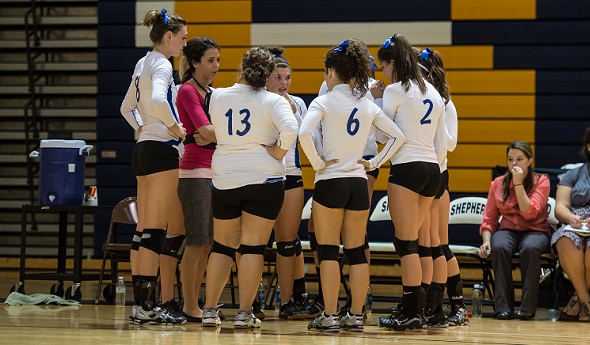
PHOTO: Beal City huddles during a break in its match against Shepherd this season. (Click to see more from HighSchoolSportsScene.com).
St Philip Adds to Record Title Total
By
Paul Costanzo
Special for MHSAA.com
January 16, 2021
BATTLE CREEK – For most programs, a five-year gap between MHSAA Finals appearances is a sign of incredible strength.
For Battle Creek St. Philip volleyball, it must have felt like an eternity.
The state’s winningest program made its way back to the top Saturday, defeating Auburn Hills Oakland Christian 25-8, 25-15, 22-25, 22-25, 17-15 in the Division 4 Final at Kellogg Arena. It’s the 21st title for the Tigers, and first since 2014.
“I think it’s about time we got another one for Coach (Vicky) Groat,” St. Philip senior Harleen Deol said. “It’s been a dream since fifth grade, so it’s a dream come true my senior year.”
St. Philip dominated the sport after the turn of the century, making 15 straight Finals appearances and winning 10 titles – including a record nine straight – from 2002-15.
“I think in the past – I don’t think our team would take it for granted – I think our supporters took it for granted,” said Groat, who has now won 11 titles as St. Philip coach. “I’ve had many people say, ‘Oh, you’re always going to win state. St. Phil, we’re tired of St. Phil, they recruit.’ We don’t recruit, our numbers are going down – we have 10 total players in our program. … We preach about it at the start of every year, our goal is to win a state title. That’s what you want to strive for, and these kids believed in it.”
It took everything the Tigers had to get No. 21, as Oakland Christian pushed them deep into the fifth set. The back-and-forth final frame ended with a Lancer attack going long, followed by St. Philp jubilation.
“It was mentally and physically draining,” said St. Philip junior Brooke Dzwik, who had 37 kills in the match. “But at the end of the day, when you work your tail off and leave it all on the court, it makes the reward so much greater. We were able to do it for our senior, Harleen, and we reminded the youngers of that multiple times in the huddles. Everybody just was working, and that helped.”
Groat looked to the sky before being embraced by her assistant coaches.
“It feels like the first time,” Groat said. “I’ll never forget (2005), that was my first title as coach, but this is extra special, with the break (because of COVID-19).
Volleyball teams, and all fall sports teams, paused activity for nearly two months because of rising COVID-19 metrics. Teams returned to practice two weeks ago and restarted the tournament with Quarterfinals on Tuesday.
 Early on Saturday, it didn’t appear as if St. Philip would have much trouble collecting title No. 21. The Tigers rolled through the first set, winning 15 of the final 16 points. While the second was tighter, it was never in doubt, as Oakland Christian didn’t have any answers for the Tigers’ attack.
Midway through that set, after a back-row attack found a hole in the back of the Lancers’ defense, Dzwik had her 13th kill of the match. Oakland Christian, meanwhile, had scored 14 points as a team.
“She did all right,” Groat said with a laugh. “Brooke has been our main hitter this year, and today we kind of relied on her a lot. Besides Brooke, Harleen in the middle played a great game … to complement Brooke. But Brooke is an outstanding volleyball player. She sees the court so well, she wants it so bad, she pushes her teammates. I preach we’re a team, it’s not about individuals. We have 10 girls out there who bust their behind and help Brooke out.”
Oakland Christian flipped a switch in the third set, however, winning a back-and-forth affair to extend the match. They kept that momentum going in the fourth, turning what had looked like a St. Philip walkover into a toss-up.
“I didn’t want them to go down like this,” Oakland Christian coach Brian Theut said. “We’ve been through a lot of stuff this year, and this wasn’t how we were going to end it. Today, what was that final chapter going to be in the book that we wrote this year. I knew our seniors deserved a better way out, so I just kept telling them to hang in there. That third game, I knew if we could just get one, get a couple points in a row, I knew we had it. I just wanted to give us a chance, and that fifth set, it was anyone’s game. I wanted us to compete and show that we could.”
Oakland Christian was led by senior libero Olivia Colletti, who had 36 digs. Katie Hopkins had 27 assists, guiding a balanced Lancers attack, led by Anna Frazee’s 10 kills. Kylie Morga added nine kills, while Kaylee Page had eight.
“I am extremely proud of my team,” Page said. “This has been our dream, our goal, and we got to where we wanted. We may not have gotten the outcome we desired, but we laid it all out on the floor, every single girl – our whole bench, all our fans, our parents. We are so incredibly blessed to be where we are now, and that’s all I could ask for. Of course I want to win, but I’m proud of how we played.”
Dzwik added 32 digs to her match-high kill total. Rachel Myers had 51 assists, while Bailey Fancher had 29 digs, Kate Doyle had 20, and Deol had 16 kills.
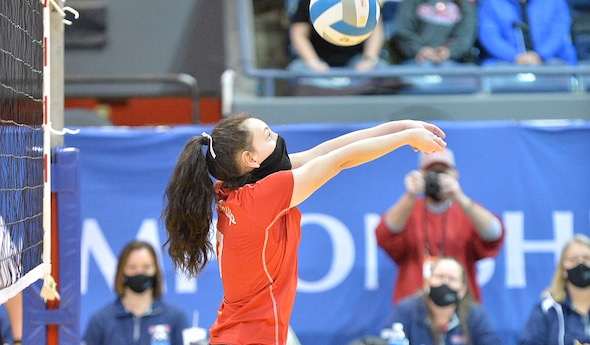
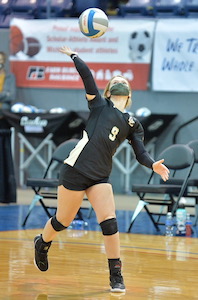
PHOTOS: (Top) Battle Creek St. Philip’s Rachel Myers controls possession for the Tigers during the Division 4 Final. (Middle) Abigail Franey serves for Oakland Christian. (Click for more from Hockey Weekly Action Photos.)