


MHSA(Q&)A: Beal City volleyball coach Kelly David
October 6, 2012
By Geoff Kimmerly
Second Half editor
 When people in Michigan’s volleyball community hear the name Kelly David, they might think first of the standout from just a few seasons ago. A four-sport standout for the Aggies, she set the volleyball team into the 2009 Class D Semifinals before going on to play at St. Clair Community College.
David, 20, graduated from high school a little more than two years ago, but is continuing to have an impact on the volleyball court – although now from the sideline as coach of the No. 3-ranked team in Class D. She took over the Beal City program this fall from her former coach, Randy Gallagher and has the Aggies 26-5-1.
Coaching has come naturally for the former floor leader, who already has gained valuable experiences and knowledge to share with her players. She previously coached at the junior high and club levels, the former for her aunt Sue Frederiksen – who coaches Almont’s varsity and is a member of the Michigan Interscholastic Volleyball Coaches Association Hall of Fame.
David is majoring in elementary education at Central Michigan University and sees teaching and coaching in her future for many years to come.
Why did you decide to become a coach?
I played at St. Clair (Community College) for two years, and my aunt had always been into coaching. I ended up coaching her seventh grade volleyball team for two years, and I coached in the Skippers AAU program over there. I found out I liked coaching more than playing.
How have you approached coaching a team that includes players who were freshmen when you were a senior in high school?
Going into it, I knew I wasn’t their friend; I was their coach. I wasn’t close to any of the girls except my sister (Monica, a senior). The people who coached me or were my teachers, (who said) go to class, do this, and you knew they received ultimate respect. I had helped out in previous years, and I knew what I had to do to gain that respect. And (my players) have listened to me.
Did you anticipate questions about you taking over the program only a few years out of high school?
I knew in my head, but I didn’t think it would be a problem in people’s minds. "She’s young, her sister is on the team;" that’s the stuff people might second guess. But I knew how to control the team, and having my sister on it wasn’t a big teal. So far (issues) haven’t happened. I’ve coached teams in previous years, and I’d always been the leader when I did play. I think that helps.
What were your goals coming into the season?
I had a lot of goals. Obviously, I wanted us to go far, like in the past. The biggest thing I noticed playing college from high school, the players knew the game of volleyball. They were smart. They had the same athletic ability as those I played against in high school, but they were just smarter. Knowing how to position the ball on the court, knowing the game, and I wanted to teach (my players) the game of volleyball. It’s important to know the game, and then we can work around the obstacles.
What did you learn by watching your aunt coach?
Just how strong you have to be. When I watch her coach, she’s very enthusiastic. But when someone does something wrong, she lets them know. That’s an important thing.
When did you first know you were interested in coaching?
When I was in high school, when I played, I’d help the other players. I noticed that was something I liked to do. I’d watch someone and pick up things they could fix. I thought about it in high school, and once I actually did it with the seventh graders, it wasn’t a job for me. It’s fun. Coaching is something I want to do. They want to be playing volleyball – that’s why they’re on the team. Everyone wants to be there, and we’re trying to accomplish the same thing.
What has been the biggest challenge during your first season?
The biggest challenge is handling the pressure. I know the team can do well. We’re ranked third in the state right now. But it’s getting them to perform the way they can perform, getting them to come together at the right time.
I’d also like to mention that Beal City (already) had a great program, from (former coaches) Randy Gallagher and before I came, Kelly Knuth. I’m just happy to step in and try to continue what they did.
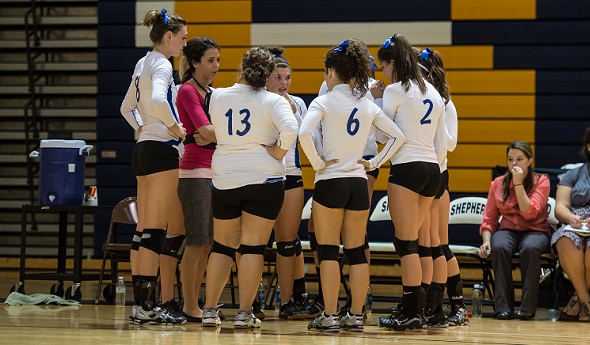
PHOTO: Beal City huddles during a break in its match against Shepherd this season. (Click to see more from HighSchoolSportsScene.com).
Novi Holds On to Claim Class A Again
November 19, 2016
By Geoff Kimmerly
Second Half editor
BATTLE CREEK – At the start of the second set Saturday, just like many times this season, Novi senior Ally Cummings stood surrounded on the court by teammates who still have another season of high school volleyball ahead of them.
During those rotations, Cummings was the only player on the floor who knew what it was like for the Wildcats to finish a season not in the Class A championship match.
They played in their third straight Saturday, and as it should be, against one of their toughest opponents this fall in Rockford. But that made Novi only enjoy the afternoon more, as it won its second straight championship by downing the Rams 3-1.
Adding in this fall’s 53-1 record, the Wildcats are 158-10 over the last three seasons. Cummings, senior Emmy Robinson and junior Erin O’Leary have been the lineup’s constants throughout the run.
“It just really comes down to the chemistry on the team,” Cummings said. “If you have an amazing team with amazing players, but the chemistry is off, you’re not going to be successful. The past four years I’ve played here, it’s been like family for us. So I’m sure even when I graduate, and these people start to graduate as well, it’s still going to be as successful.”
Novi – top-ranked entering the postseason for the second year in a row – talks about creating its own pressure and blocking out the “outside noise” of others’ expectations.
Trying to match this season’s success would be an impressive goal.
The lone loss was to No. 2 Clarkston, 2-1, and the Wildcats gave up only seven sets this season – including the second of the championship match to Rockford. Only No. 6 Northville in the District Final also took a set from Novi during the postseason.
During coach Jennifer Cottrill’s first two years running the program, 2012 and 2013, Novi won league titles but lost to Northville in District Finals.
“It’s overwhelming. (This success is) not something that you ever expect, not something that we ever really talk about,” Cottrill said. “We just try to stay in the moment. But if you take a step back, it’s amazing, and it’s all because of the players in the program who have changed the culture and have tremendous leadership skills, expectations of themselves and their teammates … and we’re a family.
“We love each other, from top to bottom, and we like to win. So that motivates you to keep winning, when you have that success.”
But Rockford didn't make adding to it easy Saturday.
 The Rams (48-9-1) entered the postseason ranked No. 5 and had beaten four of the top 10 teams in Class A and the top two in Class B entering the weekend. Following junior setter Hailey Delacher, who had 43 assists, Rockford forced many of the 11 lead changes and 29 ties over the four sets before falling 25-23, 20-25, 25-22, 25-22.
Cottrill noted that Rockford’s quick sets and two strong middles in junior Olivia Rademacher (12 kills, five blocks) and senior Cassandra Smigel (11 kills, four blocks) gave her team the most trouble. Junior outside hitter Sara Majerle added 11 kills as well, and junior libero Mykayla Vallad had 27 digs.
“I think we are just a good team, and we are a very well-balanced team. Five good hitters and we play good defense, and I think we did a good job of blocking today as well,” said Rockford coach Kelly Delacher, also Hailey’s dad.
O’Leary had 33 assists, with junior Abryanna Cannon leading with 20 kills, Cummings adding 10 and four blocks and Robinson tallying seven blocks. Junior libero Claire Pinkerton had 21 digs.
In Cannon, O’Leary and Hailey Delacher, the Class A Final may have featured three candidates for next year’s Miss Volleyball Award – while setting up the potential for another narrative twist.
Novi faced Romeo in the 2014 Final and then again in 2015, losing the first time but winning the rematch. With both of Saturday’s finalists expected to return so much next fall, it wouldn’t be shocking to see them meet again with the championship on the line.
Combined, the teams graduate only nine seniors – five for Novi and four from Rockford.
“Those seniors provided us with great leadership, and we really got on their backs at the end of the season this year. They will be tough to replace,” Kelly Delacher said. “That being said, I have a great group of juniors and I’m excited about a couple of sophomores coming in. I feel like we can be competitive next year as well.”
Novi will be prepared.
“All they know is pressure. All they’ve known is that target on your back, everyone coming for you, you get everyone’s best game,” Cottrill said of her team. “So you get used to it, and you get stronger mentally playing with a target on your back. I’m not saying it’s easy. But you get accustomed to it.”
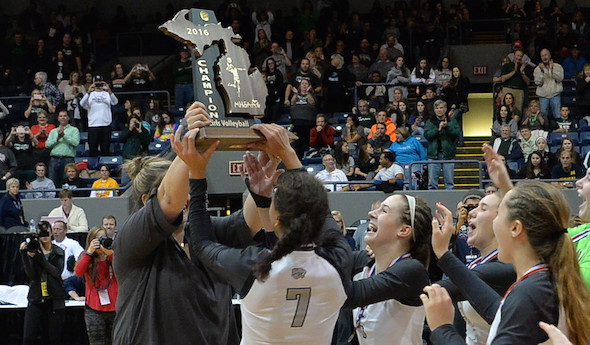
PHOTOS: (Top) Novi coach Jennifer Cottrill hoists the Class A championship trophy as her players surround her Saturday. (Middle) The Wildcats' Abryanna Cannon attempts to tip the ball over the net with Rockford's Olivia Rademacher (5) and Zoe Anderson (13) defending.