


MHSA(Q&)A: Beal City volleyball coach Kelly David
October 6, 2012
By Geoff Kimmerly
Second Half editor
 When people in Michigan’s volleyball community hear the name Kelly David, they might think first of the standout from just a few seasons ago. A four-sport standout for the Aggies, she set the volleyball team into the 2009 Class D Semifinals before going on to play at St. Clair Community College.
David, 20, graduated from high school a little more than two years ago, but is continuing to have an impact on the volleyball court – although now from the sideline as coach of the No. 3-ranked team in Class D. She took over the Beal City program this fall from her former coach, Randy Gallagher and has the Aggies 26-5-1.
Coaching has come naturally for the former floor leader, who already has gained valuable experiences and knowledge to share with her players. She previously coached at the junior high and club levels, the former for her aunt Sue Frederiksen – who coaches Almont’s varsity and is a member of the Michigan Interscholastic Volleyball Coaches Association Hall of Fame.
David is majoring in elementary education at Central Michigan University and sees teaching and coaching in her future for many years to come.
Why did you decide to become a coach?
I played at St. Clair (Community College) for two years, and my aunt had always been into coaching. I ended up coaching her seventh grade volleyball team for two years, and I coached in the Skippers AAU program over there. I found out I liked coaching more than playing.
How have you approached coaching a team that includes players who were freshmen when you were a senior in high school?
Going into it, I knew I wasn’t their friend; I was their coach. I wasn’t close to any of the girls except my sister (Monica, a senior). The people who coached me or were my teachers, (who said) go to class, do this, and you knew they received ultimate respect. I had helped out in previous years, and I knew what I had to do to gain that respect. And (my players) have listened to me.
Did you anticipate questions about you taking over the program only a few years out of high school?
I knew in my head, but I didn’t think it would be a problem in people’s minds. "She’s young, her sister is on the team;" that’s the stuff people might second guess. But I knew how to control the team, and having my sister on it wasn’t a big teal. So far (issues) haven’t happened. I’ve coached teams in previous years, and I’d always been the leader when I did play. I think that helps.
What were your goals coming into the season?
I had a lot of goals. Obviously, I wanted us to go far, like in the past. The biggest thing I noticed playing college from high school, the players knew the game of volleyball. They were smart. They had the same athletic ability as those I played against in high school, but they were just smarter. Knowing how to position the ball on the court, knowing the game, and I wanted to teach (my players) the game of volleyball. It’s important to know the game, and then we can work around the obstacles.
What did you learn by watching your aunt coach?
Just how strong you have to be. When I watch her coach, she’s very enthusiastic. But when someone does something wrong, she lets them know. That’s an important thing.
When did you first know you were interested in coaching?
When I was in high school, when I played, I’d help the other players. I noticed that was something I liked to do. I’d watch someone and pick up things they could fix. I thought about it in high school, and once I actually did it with the seventh graders, it wasn’t a job for me. It’s fun. Coaching is something I want to do. They want to be playing volleyball – that’s why they’re on the team. Everyone wants to be there, and we’re trying to accomplish the same thing.
What has been the biggest challenge during your first season?
The biggest challenge is handling the pressure. I know the team can do well. We’re ranked third in the state right now. But it’s getting them to perform the way they can perform, getting them to come together at the right time.
I’d also like to mention that Beal City (already) had a great program, from (former coaches) Randy Gallagher and before I came, Kelly Knuth. I’m just happy to step in and try to continue what they did.
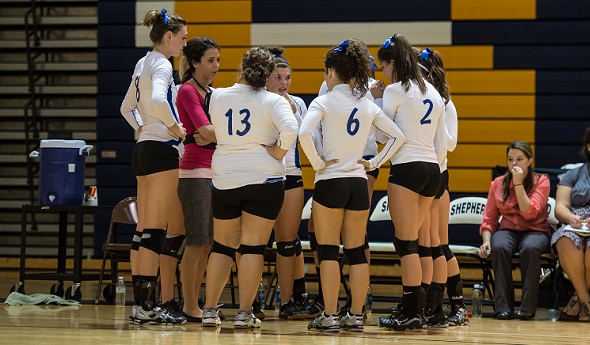
PHOTO: Beal City huddles during a break in its match against Shepherd this season. (Click to see more from HighSchoolSportsScene.com).
Class A Final Rematch Goes to Novi
November 21, 2015
By Geoff Kimmerly
Second Half editor
BATTLE CREEK – Novi was plenty familiar with Romeo heading into Saturday’s Class A Final at Kellogg Arena.
And the Wildcats had more or less memorized last season’s championship match loss to the Bulldogs. “I watched that game … a lot,” Novi senior Victoria Iacobelli said. “Too many times to count.”
But she and her teammates also were more familiar with the stage of an MHSAA Finals weekend after last year advancing for the first time since 2007. And that made all the difference in reversing last season’s result.
The top-ranked Wildcats won the first set this time and then the final two to down Romeo in four – 25-16, 20-25, 25-21, 25-17.
“Obviously last year was a new environment, so there were a lot more nerves coming in,” Iacobelli said. “So we knew this year we had to stay calm and come in with confidence, whether that meant passing well and serving well, or just playing our system and trusting the girls on our team to do what they’ve got to do. And that’s what we did.
“We started strong, and that was a large contributor … confidence.”
Understanding the significance of Saturday, aside from the obvious – Novi winning its first MHSAA title in the sport in only its third trip past the Regionals Final – requires a brief review of last season’s championship match.
Romeo won in five sets after Novi got behind 2-0 and fought back to even. Recently-awarded Miss Volleyball Gia Milana cemented her status as favorite with 29 kills, including six in the final game.
 This time, Novi won convincingly the first set before Romeo drew even winning the second. The third set was close, and at the end of the afternoon Milana again had 29 kills including a couple that simply were jaw-dropping – but by the midway point of the fourth set, it was clear Novi was surging toward the decisive finish. Wildcats juniors Ally Cummings and Emmy Robinson combined to block one final Milana attack back across the net for the final point.
“There’s obviously a little more motivation coming in from last year. (A rematch) wasn’t necessarily on our minds through the postseason, but I know as soon as Thursday was over and Romeo was our opponent, there was a lot more motivation,” Iacobelli said.
Milana’s kills will again tie for sixth most in an MHSAA Final during the rally scoring era that began in 2004-05. But Novi senior Paulina Iacobelli also will make the list with 20, and she didn't have a hitting error. Cummings had 17 and 21 digs and Victoria Iacobelli added 13 kills and six aces.
Sophomore Erin O’Leary’s 47 assists also tied how many she had in the 2014 match – and again for eighth-most in an MHSAA Final.
Romeo entered the tournament ranked No. 6 and ended 48-8-1. Milana will graduate among the top hitters in MHSAA history with her kills this fall ranking among the top 10 for one season. Senior setter Breanna Olley added 39 assists and 15 digs.
“I’m honestly happy for them because they really deserve it,” Milana said. “We just needed to say ‘No.’ We didn’t say no; we played with them instead of at them. We didn’t go after them. We stepped back and let them take the wheel and do whatever they wanted.”
Novi finished 55-2, its only losses this season to Farmington Hills Mercy, an honorable mention in the final Class A coaches poll, and Class B champion Ann Arbor Gabriel Richard.
“I thought if we played our game that we could defeat them. But they’re teenage girls; you’re never quite sure what you’re going to get and how the nerves are going to play into it, and the emotions,” Novi coach Jennifer Cottrill said. “I was confident in our team and our ability to win, and I’m just happy that they went out and performed the way I know they can.
“That was a tough loss last year. They were just so hungry this year."
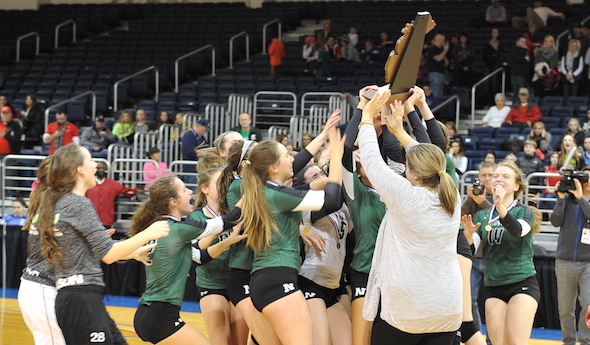
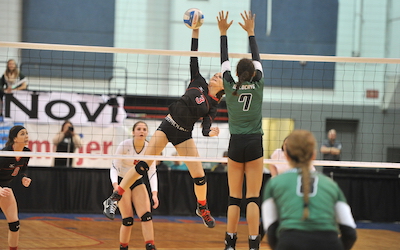
PHOTOS: (Top) Novi celebrates as coach Jennifer Cottrill hoists the team’s first championship trophy in volleyball. (Middle) Romeo’s Payton Klein follows through on a kill attempt while Novi’s Kathryn Ellison puts up a block.