


MHSA(Q&)A: Beal City volleyball coach Kelly David
October 6, 2012
By Geoff Kimmerly
Second Half editor
 When people in Michigan’s volleyball community hear the name Kelly David, they might think first of the standout from just a few seasons ago. A four-sport standout for the Aggies, she set the volleyball team into the 2009 Class D Semifinals before going on to play at St. Clair Community College.
David, 20, graduated from high school a little more than two years ago, but is continuing to have an impact on the volleyball court – although now from the sideline as coach of the No. 3-ranked team in Class D. She took over the Beal City program this fall from her former coach, Randy Gallagher and has the Aggies 26-5-1.
Coaching has come naturally for the former floor leader, who already has gained valuable experiences and knowledge to share with her players. She previously coached at the junior high and club levels, the former for her aunt Sue Frederiksen – who coaches Almont’s varsity and is a member of the Michigan Interscholastic Volleyball Coaches Association Hall of Fame.
David is majoring in elementary education at Central Michigan University and sees teaching and coaching in her future for many years to come.
Why did you decide to become a coach?
I played at St. Clair (Community College) for two years, and my aunt had always been into coaching. I ended up coaching her seventh grade volleyball team for two years, and I coached in the Skippers AAU program over there. I found out I liked coaching more than playing.
How have you approached coaching a team that includes players who were freshmen when you were a senior in high school?
Going into it, I knew I wasn’t their friend; I was their coach. I wasn’t close to any of the girls except my sister (Monica, a senior). The people who coached me or were my teachers, (who said) go to class, do this, and you knew they received ultimate respect. I had helped out in previous years, and I knew what I had to do to gain that respect. And (my players) have listened to me.
Did you anticipate questions about you taking over the program only a few years out of high school?
I knew in my head, but I didn’t think it would be a problem in people’s minds. "She’s young, her sister is on the team;" that’s the stuff people might second guess. But I knew how to control the team, and having my sister on it wasn’t a big teal. So far (issues) haven’t happened. I’ve coached teams in previous years, and I’d always been the leader when I did play. I think that helps.
What were your goals coming into the season?
I had a lot of goals. Obviously, I wanted us to go far, like in the past. The biggest thing I noticed playing college from high school, the players knew the game of volleyball. They were smart. They had the same athletic ability as those I played against in high school, but they were just smarter. Knowing how to position the ball on the court, knowing the game, and I wanted to teach (my players) the game of volleyball. It’s important to know the game, and then we can work around the obstacles.
What did you learn by watching your aunt coach?
Just how strong you have to be. When I watch her coach, she’s very enthusiastic. But when someone does something wrong, she lets them know. That’s an important thing.
When did you first know you were interested in coaching?
When I was in high school, when I played, I’d help the other players. I noticed that was something I liked to do. I’d watch someone and pick up things they could fix. I thought about it in high school, and once I actually did it with the seventh graders, it wasn’t a job for me. It’s fun. Coaching is something I want to do. They want to be playing volleyball – that’s why they’re on the team. Everyone wants to be there, and we’re trying to accomplish the same thing.
What has been the biggest challenge during your first season?
The biggest challenge is handling the pressure. I know the team can do well. We’re ranked third in the state right now. But it’s getting them to perform the way they can perform, getting them to come together at the right time.
I’d also like to mention that Beal City (already) had a great program, from (former coaches) Randy Gallagher and before I came, Kelly Knuth. I’m just happy to step in and try to continue what they did.
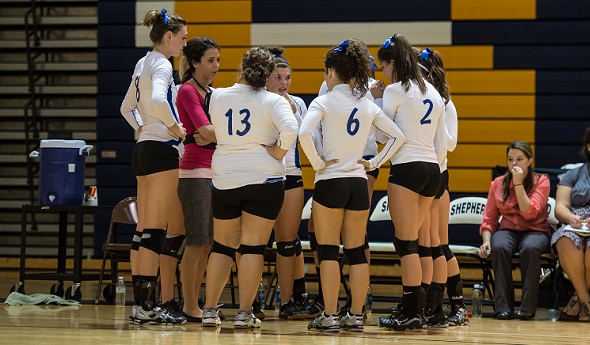
PHOTO: Beal City huddles during a break in its match against Shepherd this season. (Click to see more from HighSchoolSportsScene.com).
Preview: Stage Set for Repeat Greatness
November 19, 2014
By Geoff Kimmerly
Second Half editor
Two reigning champions will return this weekend to the MHSAA's Volleyball Finals at Battle Creek's Kellogg Arena.
One features this season's Miss Volleyball. The other has earned an opportunity to define dominance like no other volleyball team in MHSAA history.
Pontiac Notre Dame Prep's Katherine Carlson will attempt to lead the Fighting Irish to a repeat in Class B, while Battle Creek St. Philip did not enter the Class D tournament as the favorite but can leave with a record ninth straight Finals championship.
See below for breakdowns of all 16 teams playing this weekend, beginning with Class B and C Semifinals on Thursday. Click for the full schedule and also for the broadcast schedule and links to all matches available live on MHSAA.tv.
Class A
GRAND HAVEN
Record/rank:
Coach: Aaron Smaka, eighth season (300-128-4)
League finish: First in Ottawa-Kent Conference Red
Championship game history: Has never played in an MHSAA Final.
Best wins: 3-0 over No. 7 East Kentwood, 2-0, 2-0 and 2-1 over honorable mention Holland West Ottawa, 2-0, 3-2 and 2-0 over honorable mention Byron Center, 2-0, 2-0 and 2-0 over honorable mention Portage Central, 2-0 over Class B No. 2 North Branch, 2-0 over Class B No. 10 Grand Rapids South Christian.
Players to watch: Emily Lachmann, 6-0 jr. OH (443 kills, 121 aces, 454 digs); Katie Cole, 5-9 soph. S (1,731 assists, 292 digs); Autumn Monsma, 5-10 sr. OH (494 kills, 409 digs); Amy Kober, 6-1 sr. OP (326 kills, 72 blocks, 329 digs).
Finals forecast: Grand Haven is back in the Semifinals for the second time in three seasons and has won at least 42 matches in all three. Four hitters are at least 6-foot tall, with junior middle Ally Knoll leading the team with 109 blocks. Mason in the Quarterfinal was the only team to take a set from Grand Haven during the postseason. The run is even more impressive considering the team graduated three all-staters after last season.
NOVI
Record/rank: 53-5-1, No. 2
Coach: Jennifer Cottrill, third season (124-18-2)
League finish: First in Kensington Lakes Activities Association (Kensington Conference and overall)
Championship game history: Has never played in an MHSAA Final.
Best wins: 2-1 over No. 4 Lake Orion, 2-1 over No. 1 Temperance-Bedford, 2-0 and 2-0 over No. 8 Romeo, 2-0 over honorable mention Birmingham Seaholm, 3-1 over honorable mention White Lake Lakeland in Regional Final.
Players to watch: Victoria Iacobelli, 5-9 jr. OH (604 kills, 516 digs); Paulina Iacobelli, 5-9 jr. OH (465 kills, 62 aces, 601 digs); Erin O’Leary, 5-10 fr. S (1,305 assists, 61 aces, 35 blocks).
Finals forecast: Novi is back in the Semifinals for the second time in program history; the Wildcats also advanced in 2007 before falling in a five-set match to Bloomfield Hills Marian. This team is built for multiple runs – its top two hitters and setter should return in 2015, and they’re surrounded in the starting lineup this season by three seniors and a senior libero. Cottrill brings a variety of experience as a former four-year starter at Eastern Michigan University and coach at Ypsilanti Lincoln, Pinckney and Lakeland.
ROMEO
Record/rank: 43-8-1, No. 8
Coach: Stacy Williams, ninth season (235-132-33)
League finish: First in Macomb Area Conference Red
Championship game history: Lower Peninsula Class A runner-up 1997.
Best wins: 2-0 over No.6 Bloomfield Hills Marian, 2-1, 2-0, 2-0 over honorable mention White Lake Lakeland; 2-1 over honorable mention Birmingham Seaholm, 3-1 over No. 5 Clarkston in Regional Final, 3-1 over honorable mention Farmington Hills Mercy in Quarterfinal, 3-0 and 3-2 over Class B No. 9 Marysville.
Players to watch: Gia Milana, 6-1 jr. OH/MB (472 kills, .440 hitting %, 65 aces, 232 digs); Jodie Kelly, 5-10 soph. OH/L (319 kills, 230 digs, 40 blocks); Lauren Korth, 5-10 sr. S (1,006 assists, 217 kills, 54 aces.
Finals forecast: Romeo took the next step this fall after making the Quarterfinals in 2013, with this Semifinal appearance its first since 1999. Milana was an all-state third-team selection as a sophomore and is the top hitter in a lineup with four starters at .300 success or better. The Bulldogs have won 15 straight matches since a loss to No. 2 Novi and also own a two-game sweep of Class D Semifinalist Waterford Our Lady.
TEMPERANCE BEDFORD
Record/rank: 71-5-2, No. 1
Coach: Jodi Manore, 30th season (1,814-298-52)
League finish: First in Southeastern Conference
Championship game history: Three MHSAA titles (most recent 2005), five runner-up finishes.
Best wins: 2-0 over No. 4 Lake Orion, 2-1 and 2-0 over No. 6 Bloomfield Hills Marian, 2-0 over No. 9 Mattawan, 2-0 and 2-0 over honorable mention White Lake Lakeland, 2-1 over honorable mention Portage Central, 2-0, 3-1 and 3-2 (District Final) over honorable mention Saline, 2-0 and 2-0 over Class B No. 3 Chelsea, 2-0 and 2-0 over Class B No. 7 Mount Morris, 2-0 over Class C No. 1 Monroe St. Mary Catholic Central.
Players to watch: Nicole Rightnowar 5-11 sr. MH (575 kills, .382 hitting %, 213 blocks, 542 digs, 82 aces); Kayla Gwozdz, 5-11 sr. OH (546 kills, .375 hitting %, 555 digs); Chloe Lamb, 6-0 sr. RT (313 kills, 143 blocks); Isabelle Marciniak, 5-11 jr. S (1,591 assists, 95 aces, 370 digs)
Finals forecast: Bedford has made the Semifinals four of the last five seasons and was runner-up in 2012 with Rightnowar and Gwozdz in the lineup. Rightnowar is a four-year standout and was a Miss Volleyball candidate this fall; she made the all-state first team as a junior and will continue her career at Indiana-Purdue at Fort Wayne. Gwozdz was an all-state second teamer last season. Manore is closing in on the MHSAA record for volleyball coaching wins, needing only 19 to break it while carrying an incredible .838 winning percentage over two tenures as coach (she also coached the University of Toledo for 14 years).
Class B
BATTLE CREEK HARPER CREEK
Record/rank: 55-8-2, unranked
Coach: Terra King, ninth season (293-201-52)
League finish: First in Interstate 8 Conference
Championship game history: Has never played in an MHSAA Final.
Best wins: 3-1 over No. 6 Ann Arbor Gabriel Richard in Quarterfinal, 3-2 over Class A honorable mention DeWitt, 2-0 over Class D No. 2 Mendon, 2-0 over Class D No. 3 Battle Creek St. Philip, 2-0 and 2-0 over Class D No. 5 Waterford Our Lady, 2-0 over Class C No. 7 Concord.
Players to watch: Olivia Leson, 5-9 jr. OH (496 kills, .412 hitting %, 314 digs); Charley Andrews, 5-10 soph. MB (496 kills, .412 hitting %, 167 blocks); Katie Wade, 5-7 soph. S (606 assists, 71 aces); Edrie Ganey, 5-7 jr. S (794 assists, 301 digs, 74 aces).
Finals forecast: Harper Creek will carry its longest playoff run and first Regional title just a few miles downtown for the first time with a starting lineup featuring no seniors aside from libero Kendall Latshaw. Harper Creek has nearly doubled last season’s 29 wins and has had success in the recent past with this fall’s District title its third in five seasons. Leson earned an all-state honorable mention as a sophomore and combines with Andrews to give the Beavers two dangerous finishers for its two-setter system.
LAKE ODESSA LAKEWOOD
Record/rank: 50-8, No. 5
Coach: Kellie Rowland, 17th season (871-134)
League finish: First in Greater Lansing Activities Conference
Championship game history: Class B champion 2012, Class B runner-up 1995.
Best wins: 2-0 and 3-2 (Regional Final) over No. 10 Grand Rapids South Christian, 2-0 and 3-1 (Quarterfinal) over honorable mention Ada Forest Hills Eastern, 2-0 and 2-0 over Class A No. 3 Grand Haven.
Players to watch: Vanessa Reynhout, sr. MB (573 kills, .470 hitting %, 220 blocks, 62 aces); Charlie Smith, jr. OH (212 kills, 56 blocks, 148 digs); Gabie Shellenbarger, soph. S (998 assists, 202 digs); Gracie Shellenbarger, sr. OH (228 kills, 174 digs).
Finals forecast: This lineup is much different than the one that claimed the team’s first MHSAA title two seasons ago, although Reynhout, Smith and junior libero Karly Morris did see time in that championship match win over North Branch. Lakewood's 50 wins are the second-most in six seasons since Rowland returned as coach in 2009, and Reynhout and Gracie Shellenbarger are the only seniors in the main playing group. The Vikings have won 11 straight since losing to Class A honorable mention Portage Central.
NORTH BRANCH
Record/rank: 59-7-4, No. 2
Coach: James D. Fish, 15th season (859-140-44)
League finish: First in Tri-Valley Conference East
Championship game history: Class B champion 2009, three runner-up finishes.
Best wins: 3-0, 2-1 and 2-0 (District Final) over No. 7 Mount Morris, 3-0 over honorable mention Cadillac in the Quarterfinal, 3-0 and 3-0 (District Semifinal) over honorable mention Frankenmuth, 2-1 over Class A No. 4 Lake Orion, 2-1 over Class A honorable mention Farmington Hills Mercy, 2-0 over Class A honorable mention Byron Center, 2-0 over Class A honorable mention Holland West Ottawa.
Players to watch: Laura Willson, 6-1 sr. OH (726 kills, .380 hitting %, 96 aces, 88 blocks); Victoria Severance, 6-0 sr. MH (228 kills, .355 hitting %, 82 blocks); Mady Ruhlman, 5-5 sr. L (636 digs, 278 digs); Madee Miner, 5-7 soph. S (1,241 assists, 88 aces, 257 digs); Calla McNulty, 5-11 sr. OH (89 aces, 160 kills).
Finals forecast: North Branch finished runner-up to Lakewood in 2012 and with Willson its second-best hitter in that championship match. She made the all-state first team in 2013 and was a Miss Volleyball candidate this fall. Ruhlman, Severance and McNulty also saw time in that 2012 Final and have helped the Broncos to a third straight Regional title; with a Semifinal win the team would have at least 60 for the third straight season as well.
PONTIAC NOTRE DAME PREP
Record/rank: 57-5, No. 1
Coach: Betty Wroubel, 21st season (829-193-81)
League finish: First in Detroit Catholic League Central
Championship game history: Class B champions 2013 and Fall 2007.
Best wins: 2-0 and 3-0 (Regional Final) over No. 9 Marysville, 3-0 and 3-0 (Quarterfinal) over honorable mention Dearborn Divine Child, 3-0 over No. 6 Ann Arbor Gabriel Richard, 2-0 and 2-0 over Battle Creek Harper Creek, 2-0 over Class A No. 1 Temperance-Bedford, 2-0 and 2-0 over Class C No. 7 Concord, 3-0 over Class A honorable mention Farmington Hills Mercy, 2-0 over Class A honorable mention DeWitt, 2-0 over Class C No. 9 Ubly.
Players to watch: Katherine Carlson, 5-11 sr. OH (991 kills, .527 hitting percentage, 62 blocks, 111 aces, 415 digs); Hannah Antosz, 5-7 sr. S (632 assists, 215 digs, 77 aces); Ashley Knutson, 5-7 sr. S (929 assists, 211 kills, 373 digs); Emma Kowalkowski, 5-6 jr. DS (85 aces, 806 digs).
Finals forecast: Notre Dame Prep is favored to repeat as Class B champion with three players back after earning all-state honors in 2013 including Carlson, recently named Miss Volleyball for this season. She’s over 1,000 kills for the second straight season and will continue her career at Valparaiso University. Kowalkowski made the all-state second team last season and Knutson earned an honorable mention, and Antosz also started in last season’s Final.
Class C
MONROE ST. MARY CATHOLIC CENTRAL
Record/rank: 43-8-2, No. 1
Coach: Diane E. Tuller, 17th season (593-188-51)
League finish: Tied for first in Huron League
Championship game history: Four MHSAA titles (most recent 2012), two runner-up finishes.
Best wins: 2-0 over No. 4 Morley-Stanwood, 2-1 over Class B No. 7 Mount Morris, 3-0, 2-1 and 2-0 over Class B No. 4 New Boston Huron, 2-0 over Class D No. 6 Plymouth Christian.
Players to watch: Cassandra Haut, 6-2 sr. MH (604 kills, .444 hitting %, 86 aces); Madeline Pietraniec, 5-8 sr. OH (236 kills); Sydney McGinn, 5-10 sr. S (1,206 assists, 284 digs); Skylar Iott, 6-1 jr. MH (334 kills, 75 aces, 314 digs).
Finals forecast: If the recent pattern holds, St. Mary could be unbeatable this weekend; the Kestrels also won Class C in 2012 and 2010 and are back after making the Class B Quarterfinals a year ago. Haut made the all-state first team in Class B and was a Miss Volleyball finalist this fall; she’ll continue at Eastern Michigan University. She’s also one of three starters taller than 6-foot, which allowed St. Mary to again match up well with the Class A and B teams that made up the majority of the regular-season schedule.
ROSCOMMON
Record/rank: 49-11-2, No. 3
Coach: Heather Compton, 11th season (413-109-28)
League finish: First in Jack Pine Conference
Championship game history: Has never played in an MHSAA Final.
Best wins: 2-1 and 3-0 (Quarterfinal) over honorable mention Calumet, 3-0 over No. 5 Traverse City St. Francis in Regional Final, 2-0 over Class D No. 9 Onaway, 2-0 over Class D No. 1 Leland.
Players to watch: Katie Tozer, 5-10 sr. MH (500 kills, .444 hitting %, 90 aces, 89 blocks); Lauren Shores, 5-10 jr. MH (248 kills, .383 hitting %, 58 blocks); Reagan Moffit, 6-0 sr. OH (437 kills, .409 hitting %, 191 digs); Logan Hutek, 5-9 sr. S (1,250 assists, 192 kills, 204 digs).
Finals forecast: Roscommon has followed up last season’s 56-5-2 finish in Class B with its first Regional title and third District championship in nine seasons. Tozer earned an all-state honorable mention in Class B last season and remains the top hitter for a team that also has a number of impressive losses – including to Class A Clarkston, Lake Orion and Saline and Class B Mount Morris, North Branch and Chelsea.
SCHOOLCRAFT
Record/rank: 45-10-1, No. 2
Coach: Erin Onken, third season (122-37-4)
League finish: First in Kalamazoo Valley Association
Championship game history: Class C champion 2008.
Best wins: 3-1 over No. 8 Grand Rapids NorthPointe Christian in the Regional Final, 3-0 over honorable mention Ravenna in the Quarterfinal.
Player to watch: Marianne Douglas, sr. OH. (Statistics not submitted.)
Finals forecast: Schoolcraft has won Regional titles the last three seasons and took the next step after falling to Mendon in five sets in their 2013 Quarterfinal. Douglas made the all-state third team last season and is one of four senior starters.
UNIONVILLE-SEBEWAING
Record/rank: 43-7-2, honorable mention
Coach: Teresa Rose, seventh season (238-69-29)
League finish: First in Greater Thumb Conference West
Championship game history: Has never played in an MHSAA Final.
Best wins: 3-0 over No. 9 Ubly in District Semifinal, 2-1 and 3-1 (Quarterfinal) over Brown City, 2-0 over St. Louis.
Players to watch: Erica Treiber, 6-1 sr. MH (676 kills, .487 hitting %, 72 aces, 239 blocks, 511 digs); Sam Ewald, sr. MH (217 kills, 45 blocks); Morgan Thomas, sr. S (557 assists, 42 aces, 217 digs), Jessica Marker, sr. RS (124 kills, 61 assists, 71 blocks).
Finals forecast: Unionville-Sebewaing has won three straight Regional titles and is headed to the Semifinals for the third time in Rose’s seven seasons as coach – while led by one of the most intriguing players in the state. Treiber will leave the thumb to continue her career next fall at the University of Tennessee and also was a Miss Volleyball finalist this fall.
Class D
BATTLE CREEK ST. PHILIP
Coach: Vicky Groat, 17th season (960-189-80)
League finish: First in Southern Central Athletic Association
Championship game history: 19 MHSAA titles (most recent 2013), eight runner-up finishes.
Best wins: 2-0 and 3-0 (Quarterfinal) over No. 2 Mendon, 3-1, 3-1, 2-1 and 3-0 (Regional Final) over No. 4 Camden-Frontier; 2-0, 2-0 and 2-0 over honorable mention Climax-Scotts.
Players to watch: Emily Schaub, 5-8 sr. S (1,316 assists, 146 kills, 104 aces, 419 digs); Abby McKinzie, 5-8 jr. OH (634 kills, 501 digs, 62 aces); Anna Lehouiller, 6-0 jr. MH (155 kills, 63 blocks); Megan Parker, 5-7 sr. OH (444 kills, 547 digs, 64 aces).
Finals forecast: Gone are three more all-staters from last season (that makes six over two seasons), and St. Philip is back in the Semifinals after sweeping No. 2 Mendon on Tuesday. A ninth-straight title would set an MHSAA record; the Tigers are tied with Marysville 1997-2004 for longest championship streak. Schaub made the all-state first team last season and has plenty of experience leading a title run.
LELAND
Record/rank: 42-12-4, No. 1
Coach: Laurie Glass, 20th season (781-241-79)
League finish: Second in Northwest Conference
Championship game history: Four MHSAA titles (most recent 2006), five runner-up finishes.
Best wins: 3-0 over honorable mention Mount Pleasant Sacred Heart in the Quarterfinal, 2-0 and 2-0 over Class C honorable mention Charlevoix, 2-0 over Traverse City Central.
Players to watch: Maddie Trumbull, 5-10 jr. OH (520 kills, 288 digs); Eva Grobbel, 5-11 jr. MB (244 kills,35 blocks); Jessica Fleis, 5-6 sr. S (1,017 assists, 91 aces, 190 digs); Whitney Schaub, 5-4 sr. L (460 digs, 65 aces).
Finals forecast: Leland returns to the Semifinals for the second straight season after playing at least six matches against teams from all six classes – with impressive results. The Comets finished 3-2-1 against Class A teams, 5-3-1 against Class B, 14-7-1 against Class C and 19-0-1 against Class D programs. Leland graduated three players who earned all-state recognition last season, but Schaub made the third team and is one of a number of strong servers – four have at least 65 aces, and senior Erica Ongaro had a team-high 166 through the Regional.
ONAWAY
Record/rank: 34-16-5, No. 9
Coach: Steve Watson, 12th season (359-179-53)
League finish: First in Ski Valley Conference
Championship game history: Has never played in an MHSAA Final.
Best wins: 3-0 over No. 10 Pickford in the Regional Final, 3-0 over No. 8 Stephenson in the Quarterfinal.
Players to watch: Lexi Szymoniak, 5-8 sr. OH (549 kills, 83 aces, 31 blocks, 702 digs); Taylor Ehrke, 5-8 soph. S (849 assists, 125 kills, 373 digs); Elise Arkwood, 5-4 sr. MH (181 kills, 76 aces, 351 digs); Ashley LaLonde, 5-4 sr. RS (406 digs, 85 aces).
Finals forecast: Onaway is on an excellent three-year run, making its second trip to the Semifinals after winning its third league and District titles during that time. Szymoniak made the all-state second team last season and Ehrke made the third. The Cardinals have beaten two straight ranked teams to reach Battle Creek, and also split earlier this season with top-ranked Leland – the only Class D team not to fall to the Comets.
WATERFORD OUR LADY
Record/rank: 27-21-5, No. 6
Coach: Stephanie Swearingen, sixth season (137-56-23)
League finish: First in Detroit Catholic League AA
Championship game history: Class D runner-up 2013.
Best wins: 3-0 and 3-0 (Quarterfinal) over No. 7 Marine City Cardinal Mooney, 3-2 over No. 6 Plymouth Christian in the Regional Final.
Players to watch: Courtney Wightman, 5-11 jr. OH (408 kills, 36 blocks); Lindsay Wightman, 5-7 soph. OH (300 kills, 108 aces, 487 digs); Rebekah Collier, 6-1 jr. MB (158 kills, 106 blocks); Beth Meehan, 5-5 jr. S (1,039 assists, 289 digs).
Finals forecast: Our Lady’s record is a bit deceiving; subtract a 1-9 run midseason against mostly Class A teams, and the Lakers fall right into place with four sweeps in five postseason matches. Courtney Wightman made the all-state first team last season in leading Our Lady to its first championship match, and Lindsay Wightman made the all-state second team as a freshman.
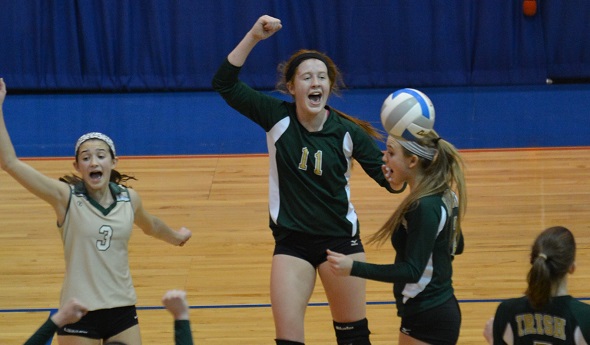
PHOTO: Pontiac Notre Dame Prep, including this season's Miss Volleyball Katherine Carlson (11), celebrates during last year's Class B Semifinal; Notre Dame went on to win the Class B championship.