


MHSA(Q&)A: Beal City volleyball coach Kelly David
October 6, 2012
By Geoff Kimmerly
Second Half editor
 When people in Michigan’s volleyball community hear the name Kelly David, they might think first of the standout from just a few seasons ago. A four-sport standout for the Aggies, she set the volleyball team into the 2009 Class D Semifinals before going on to play at St. Clair Community College.
David, 20, graduated from high school a little more than two years ago, but is continuing to have an impact on the volleyball court – although now from the sideline as coach of the No. 3-ranked team in Class D. She took over the Beal City program this fall from her former coach, Randy Gallagher and has the Aggies 26-5-1.
Coaching has come naturally for the former floor leader, who already has gained valuable experiences and knowledge to share with her players. She previously coached at the junior high and club levels, the former for her aunt Sue Frederiksen – who coaches Almont’s varsity and is a member of the Michigan Interscholastic Volleyball Coaches Association Hall of Fame.
David is majoring in elementary education at Central Michigan University and sees teaching and coaching in her future for many years to come.
Why did you decide to become a coach?
I played at St. Clair (Community College) for two years, and my aunt had always been into coaching. I ended up coaching her seventh grade volleyball team for two years, and I coached in the Skippers AAU program over there. I found out I liked coaching more than playing.
How have you approached coaching a team that includes players who were freshmen when you were a senior in high school?
Going into it, I knew I wasn’t their friend; I was their coach. I wasn’t close to any of the girls except my sister (Monica, a senior). The people who coached me or were my teachers, (who said) go to class, do this, and you knew they received ultimate respect. I had helped out in previous years, and I knew what I had to do to gain that respect. And (my players) have listened to me.
Did you anticipate questions about you taking over the program only a few years out of high school?
I knew in my head, but I didn’t think it would be a problem in people’s minds. "She’s young, her sister is on the team;" that’s the stuff people might second guess. But I knew how to control the team, and having my sister on it wasn’t a big teal. So far (issues) haven’t happened. I’ve coached teams in previous years, and I’d always been the leader when I did play. I think that helps.
What were your goals coming into the season?
I had a lot of goals. Obviously, I wanted us to go far, like in the past. The biggest thing I noticed playing college from high school, the players knew the game of volleyball. They were smart. They had the same athletic ability as those I played against in high school, but they were just smarter. Knowing how to position the ball on the court, knowing the game, and I wanted to teach (my players) the game of volleyball. It’s important to know the game, and then we can work around the obstacles.
What did you learn by watching your aunt coach?
Just how strong you have to be. When I watch her coach, she’s very enthusiastic. But when someone does something wrong, she lets them know. That’s an important thing.
When did you first know you were interested in coaching?
When I was in high school, when I played, I’d help the other players. I noticed that was something I liked to do. I’d watch someone and pick up things they could fix. I thought about it in high school, and once I actually did it with the seventh graders, it wasn’t a job for me. It’s fun. Coaching is something I want to do. They want to be playing volleyball – that’s why they’re on the team. Everyone wants to be there, and we’re trying to accomplish the same thing.
What has been the biggest challenge during your first season?
The biggest challenge is handling the pressure. I know the team can do well. We’re ranked third in the state right now. But it’s getting them to perform the way they can perform, getting them to come together at the right time.
I’d also like to mention that Beal City (already) had a great program, from (former coaches) Randy Gallagher and before I came, Kelly Knuth. I’m just happy to step in and try to continue what they did.
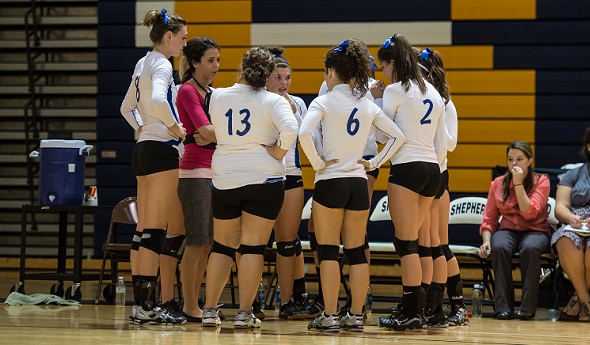
PHOTO: Beal City huddles during a break in its match against Shepherd this season. (Click to see more from HighSchoolSportsScene.com).
Block Party: 2025 Girls Volleyball Week 10 Report
By
Geoff Kimmerly
MHSAA.com senior editor
October 29, 2025
League championships have been all but decided, Districts are assigned and brackets drawn, and we’re only a few days from the start of this season’s MHSAA Girls Volleyball Tournament.
That means we’ll be coming back shortly, as our “Block Party” schedule moves up the next edition to Monday so we can preview some of the most intriguing District brackets across the state and all four divisions.
Until then, below are a few more regular-season observations as teams continued with their final tune-ups:
Week in Review
The countdown of last week’s five most intriguing results:
1. Rockford d. Farmington Hills Mercy (24-18, 23-25, 15-6) The East vs. West Challenge at Lowell was another opportunity for the Division 1 top-ranked Rams (40-1-1) to show their superiority among the state’s elite – which they did, not only defeating then-No. 2 Mercy (18-4-2) but also new No. 2 Bloomfield Hills and No. 7 Utica Eisenhower among others.
2. South Lyon East d. Farmington Hills Mercy (25-19, 18-25, 25-13) Outside of Rockford, there may be no team hotter than Division 1 No. 5 South Lyon East (37-7-1), which has won 11 straight and followed this with a sweep through the Lakes Valley Conference Tournament.
3. Bloomfield Hills Marian d. Detroit Country Day (25-16, 25-16) The Division 1 No. 4 Mustangs (43-5-0) have won 20 of their last 23 matches, and went 3-0 at the Country Day quad Monday including this sweep of the Division 2 top-ranked Yellowjackets (16-8-0).
4. Grand Rapids Forest Hills Northern d. Tecumseh (25-21, 25-21) The Division 1 No. 6 Huskies (33-8-1) handed just the second defeat this season to Division 2 No. 6 Tecumseh (51-2-0).
5. Plymouth Christian Academy d. Ubly (25-20, 25-21) A 5-0 run through the Mt. Morris Tournament by Division 3 No. 2 PCA (37-8-1) including this win over the Division 4 No. 3 Bearcats (25-10-4), plus sweeps of Charlevoix and much larger Holt, Essexville Garber and Cadillac.
Watch List
With an eye toward November, here are two teams in each division making sparks:
DIVISION 1
East Grand Rapids (29-10-0) The Pioneers are among honorable mentions in Division 1 again this week, and despite a pair of losses to Division 2 No. 3 Grand Rapids Christian over the last eight days bounced back to defeat No. 4 Grand Rapids Catholic Central and Division 4 No. 2 Fowler heading into these final few days of the regular season. EGR already has bested last year’s record of 26-16-5 and will enter its District next week as the second seed to Forest Hills Northern. Eight of the team’s losses have come against top-10 teams in Divisions 1 and 2.
Zeeland East (29-4-0) Although the Chix did lose out on a league title Monday falling in five sets to Division 2 No. 5 Holland Christian, that was the team’s first defeat since facing Holland Christian on Sept. 23 – and the only other losses this season came to Division 1 No. 10 Grand Haven. Zeeland East also is among honorable mentions this week and seeded second in a District behind another honorable mention in Byron Center. The Chix do have an early-season win over Holland Christian and have defeated Division 2 honorable mention Marshall and Division 3 No. 6 Kalamazoo Christian among others.
DIVISION 2
Detroit Country Day (16-8-0) The reigning Division 2 champion has been ranked No. 1 this season for all but two weeks, and moved back into the top spot this week after a four-set win over Bloomfield Hills on Oct. 21 – which avenged a loss from the season-opening quad Aug. 26. All eight losses have come against Division 1 opponents, with six to teams ranked or receiving honorable mention currently. Country Day is seeded first in its District, which empties into a Regional that could include No. 2 North Branch or No. 7 Imlay City.
Holland Christian (23-8-0) As noted above, the Maroons have clinched a share of a league championship, in the Ottawa-Kent Conference Black and with Spring Lake to finish the schedule. The closing run to secure the title came after a four-match losing streak that included three defeats to ranked Division 1 teams at the Jenison Invitational, and seven of the team’s losses total have come to ranked or honorable mention opponents. The Zeeland East win noted above also gave Holland Christian one more this season than last, and the Maroons will head into District play a top seed.
DIVISION 3
Byron (28-3-1) The Eagles have won nine straight matches including all four Saturday at the Marine City Cardinal Mooney Invitational, and they already have five more victories than last season – when Byron reached the Regional Finals. They’ve played several matches against Division 1 and 2 opponents this fall, with two of their defeats coming from teams in those divisions, and they also have notable victories over Alma and New Boston Huron among larger-enrollment foes. Byron also will be a top seed in its District.
Morley Stanwood (27-12-0) With eight wins over its last 10 matches, Morley Stanwood has joined the list of honorable mention teams in Division 3 the last two weeks. The schedule has included showdowns with several ranked opponents, with losses to No. 1 Roscommon, No. 2 Plymouth Christian Academy, No. 3 Kingsley and twice to No. 10 Beal City. That schedule has paid off as Morley Stanwood will enter its District as a top seed but with Central State Activities Association rival Kent City the second seed and after Kent City won two of three meetings this fall including in Saturday’s league tournament.
DIVISION 4
Mount Pleasant Sacred Heart (23-8-6) The 2022 Division 4 champion also made the Quarterfinals in 2023 and the Semifinals a year ago, and has prepped for another potential extended run facing a slate of larger schools and several that also are ranked. Sacred Heart is No. 4 in Division 4, and half of its losses this season are to Division 3 No. 10 Beal City, with the rest to Division 1 honorable mention Traverse City Central and three other Division 1 or two schools. Meanwhile, the Irish also have wins over Division 4 No. 2 Fowler and honorable mention Grand Rapids Sacred Heart.
Wakefield-Marenisco (19-7-0) The Cardinals opened this season with a 3-4 showing at the Copper Mountain Conference tournament, but have since avenged two of those losses and another early-season defeat in downing Ewen-Trout Creek last week. W-M has won eight straight matches since falling to No. 5 Crystal Falls Forest Park at the Trojans’ invitational on Sept. 20, and three losses this season have come against Lake Linden-Hubbell (23-5-0). The Cardinals are seeded second in their District to Forest Park and Thursday against Ironwood can equal their 20 victories of a year ago.
Can’t-Miss Contests
Be on the lookout for results of these matches and tournaments coming up:
Thursday – ABCD quad at Traverse City Central – This annual event will see the Division 1 honorable mention Trojans (26-7-0) host Division 3 No. 3 Kingsley (47-4-1) and No. 8 Traverse City St. Francis (24-14-0), and Division 4 Leland (12-25-1).
Thursday – Essexville Garber quad – The Dukes (38-11-3) will welcome Midland Dow (19-12-5), Yale (23-21-1) and Saginaw Valley Lutheran (43-10-3).
Thursday – Buckley quad – The Bears (27-5-1) will host an impressive Division 4 crew of No. 10 Onekama (30-8-3), Bellaire (19-7-4) and Traverse City Christian (24-12-2).
Saturday – Temperance Bedford Spooktacular – The field for this year’s regular-season finale includes Division 4 No. 7 Adrian Lenawee Christian, Division 2 No. 10 Flat Rock and Division 3 No. 4 Hanover Horton among others.
Saturday – Grand Blanc Tournament – The Bobcats will close the regular season with Division 2 No. 2 North Branch and Division 1 Oxford among those in the field.
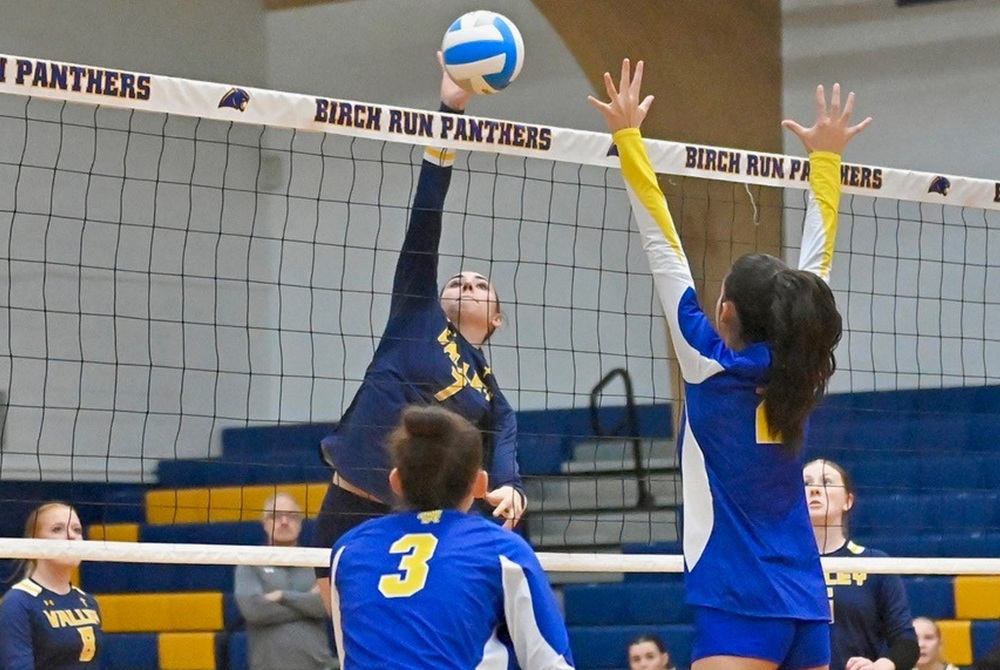
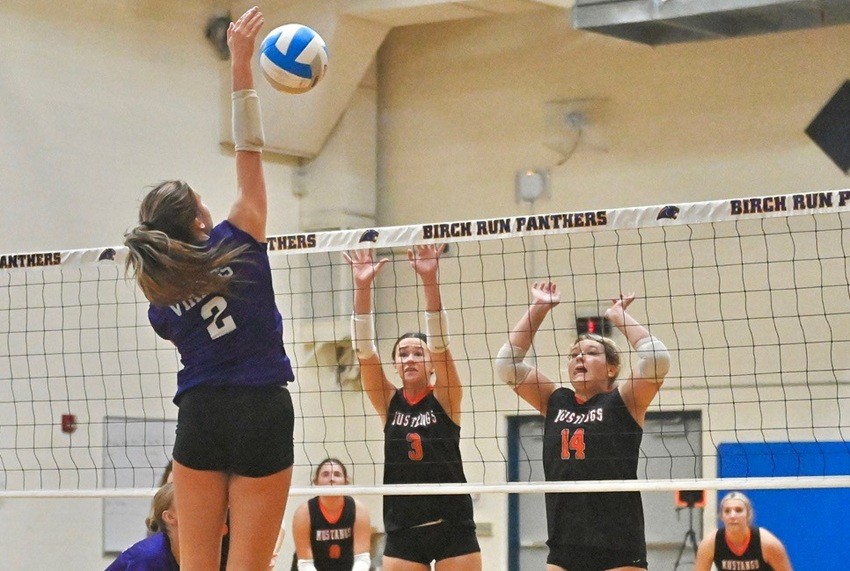
PHOTOS (Top) Saginaw Valley Lutheran’s Grace Parker (7) elevates to get to the ball as Birch Run’s Teagan Abraham (2) sets up to block Tuesday. (Middle) Saginaw Swan Valley’s Hadley Wagner connects on a kill attempt while Clio’s Alaina Gliniecki (3) and Kelcy Sperling (14) get ready at the net, also Tuesday at Birch Run. (Photos by Terry Lyons.)