


MHSA(Q&)A: Beal City volleyball coach Kelly David
October 6, 2012
By Geoff Kimmerly
Second Half editor
 When people in Michigan’s volleyball community hear the name Kelly David, they might think first of the standout from just a few seasons ago. A four-sport standout for the Aggies, she set the volleyball team into the 2009 Class D Semifinals before going on to play at St. Clair Community College.
David, 20, graduated from high school a little more than two years ago, but is continuing to have an impact on the volleyball court – although now from the sideline as coach of the No. 3-ranked team in Class D. She took over the Beal City program this fall from her former coach, Randy Gallagher and has the Aggies 26-5-1.
Coaching has come naturally for the former floor leader, who already has gained valuable experiences and knowledge to share with her players. She previously coached at the junior high and club levels, the former for her aunt Sue Frederiksen – who coaches Almont’s varsity and is a member of the Michigan Interscholastic Volleyball Coaches Association Hall of Fame.
David is majoring in elementary education at Central Michigan University and sees teaching and coaching in her future for many years to come.
Why did you decide to become a coach?
I played at St. Clair (Community College) for two years, and my aunt had always been into coaching. I ended up coaching her seventh grade volleyball team for two years, and I coached in the Skippers AAU program over there. I found out I liked coaching more than playing.
How have you approached coaching a team that includes players who were freshmen when you were a senior in high school?
Going into it, I knew I wasn’t their friend; I was their coach. I wasn’t close to any of the girls except my sister (Monica, a senior). The people who coached me or were my teachers, (who said) go to class, do this, and you knew they received ultimate respect. I had helped out in previous years, and I knew what I had to do to gain that respect. And (my players) have listened to me.
Did you anticipate questions about you taking over the program only a few years out of high school?
I knew in my head, but I didn’t think it would be a problem in people’s minds. "She’s young, her sister is on the team;" that’s the stuff people might second guess. But I knew how to control the team, and having my sister on it wasn’t a big teal. So far (issues) haven’t happened. I’ve coached teams in previous years, and I’d always been the leader when I did play. I think that helps.
What were your goals coming into the season?
I had a lot of goals. Obviously, I wanted us to go far, like in the past. The biggest thing I noticed playing college from high school, the players knew the game of volleyball. They were smart. They had the same athletic ability as those I played against in high school, but they were just smarter. Knowing how to position the ball on the court, knowing the game, and I wanted to teach (my players) the game of volleyball. It’s important to know the game, and then we can work around the obstacles.
What did you learn by watching your aunt coach?
Just how strong you have to be. When I watch her coach, she’s very enthusiastic. But when someone does something wrong, she lets them know. That’s an important thing.
When did you first know you were interested in coaching?
When I was in high school, when I played, I’d help the other players. I noticed that was something I liked to do. I’d watch someone and pick up things they could fix. I thought about it in high school, and once I actually did it with the seventh graders, it wasn’t a job for me. It’s fun. Coaching is something I want to do. They want to be playing volleyball – that’s why they’re on the team. Everyone wants to be there, and we’re trying to accomplish the same thing.
What has been the biggest challenge during your first season?
The biggest challenge is handling the pressure. I know the team can do well. We’re ranked third in the state right now. But it’s getting them to perform the way they can perform, getting them to come together at the right time.
I’d also like to mention that Beal City (already) had a great program, from (former coaches) Randy Gallagher and before I came, Kelly Knuth. I’m just happy to step in and try to continue what they did.
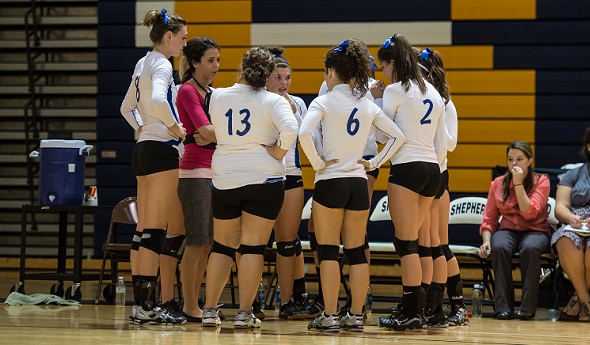
PHOTO: Beal City huddles during a break in its match against Shepherd this season. (Click to see more from HighSchoolSportsScene.com).
St. Philip Adds to 'Tradition'
November 17, 2012
By Geoff Kimmerly
Second Half editor
BATTLE CREEK – The Battle Creek St. Philip volleyball team rushed the Kellogg Arena floor Saturday just as it has many of the other 17 times the Tigers have won the MHSAA Class D championship.
There’s no reason to do differently. As the saying goes, winning doesn't graduate. And it surely doesn't get old.
Beal City made it a little tougher than some others over the years. But like in all 72 of its wins this fall, St. Philip swept the Aggies to launch the latest celebration.
The Tigers finished this season with a 25-21, 25-15, and 25-18 victory to add another to their record championship total and pull it within one more of tying the longest volleyball title winning streak in MHSAA history.
“It’s seriously the same every time. We have the same excitement every time. It’s always special. We never get tired of it,” Tigers senior setter Lenae Lesiow said. “It’s obviously the best feeling in the world.
“It’s just tradition. We really know we have so many people supporting us. And we just want to make people proud, make ourselves proud, make our coach proud.”
Every team is different, and every coach is hesitant to compare them. But this Tigers team finished 73-2-1, setting a school record for wins and ranking as the 10th-most successful volleyball team in MHSAA history.
Beal City coach Kelly David, who has been immersed in Class D volleyball as both a player and now in her first season running the program, said this was, in her opinion, the best St. Philip team to come through.
And that made how her Aggies (45-11-1) hung close even more impressive.
Beal City was playing in its first MHSAA Final in any girls sport. Only three years ago, David was the setter as the Aggies made the Semifinals but lost to the Tigers in four games.
This time, Beal City played nearly point for point through the first and halfway into the second.
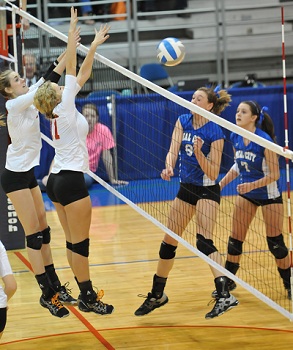 But eventually, St. Philip’s all-state hitting duo of senior Amanda McKinzie and junior Sierra Hubbard-Neil became the Aggies’ undoing.
McKinzie, named Miss Volleyball on Monday, finished with 19 kills, one short of making the MHSAA Finals record book. Hubbard-Neil, a sure contender for the statewide award next season, had 18 kills
She caught fire in the second game, while McKinzie unloaded powerful finishing shots in the third.
“They were close that whole first game, and I think we were a little bit nervous knowing, ‘Wow, they are so close,’” McKinzie said.
“We just had to relax and play our game,” Hubbard-Neil added. “When either of us as a hitter starts getting going, our setter will nail us. She just starts feeding us when we’re hot.”
Lesiow totaled 32 assists. McKinzie and senior Natalie Gallagher both had nine digs.
Beal City was led by junior middle Addie Schumacher, who had seven kills and five digs. Junior Melanie Schafer had six kills and nine digs, and senior Jade Kennedy had eight digs and 23 assists.
Kennedy and senior Monica David – the coach’s sister – were freshman call-ups for the 2009 Semifinal.
“Being freshmen, we were just part of the team and we got to cheer on our teammates,” Monica David said. “It was awesome coming back as a senior and being one of the leaders out there and being a big part of the team.”
And it couldn’t have hurt to be part of her sister’s first team as a coach.
“I lucked out having a good group of girls to start with," Kelly David said. “It’s hard to believe we’re in the Finals my first year, and it’s a lot of fun. But it’s the girls, not me. It’s the girls that got here, and I’m just excited for them.”
Groat’s program has plenty of family ties as well. With eight MHSAA championships, she’s now just one short of tying the total of her mother Sheila Guerra, her predecessor who died in 2006.
Groat found a card earlier this week that she’d gotten from her mom the year before her death. On the back was written the number “8,” and she had no idea why but thought about that over the last few days. “Maybe she knew something back then that she’s trying to tell me,” Groat said.
Another title win next season would tie Marysville’s record streak from 1997-2004. But the Tigers will have to do it with a number of new contributors.
They’ll graduate seven from this team, including four-year players McKinzie and middle Casey Gallagher and three-year players Sam Ellis and Natalie Gallagher.
“They’re like family to me. I watched them grow from little awkward freshmen to fine young ladies as seniors, and in June when they graduate it’s going to be a sad day because we’ve spent a lot of time together,” Groat said. “They’re part of my life forever.”
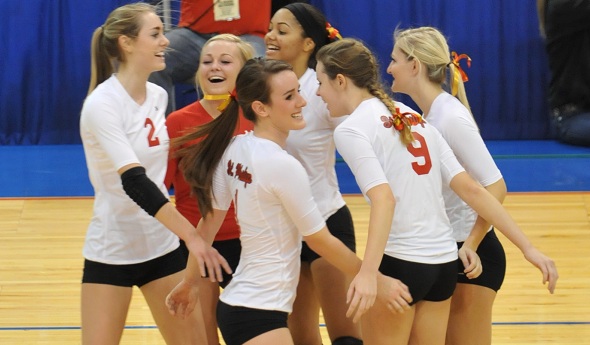
PHOTOS: (Top) Battle Creek St. Philip celebrates briefly after a point on the way to celebrating another Class D championship. (Middle) Jaclyn Behnke (11) and Amanda McKinzie block a kill attempt by Beal City's Addie Schumacher.