

Southwest 10 Conference Welcoming Volleyball Athletes as Legacy Officials
By
Steve Vedder
Special for MHSAA.com
November 13, 2024
Instead of just hitting a volleyball, Gracie Smith now finds herself enjoying the larger picture.
The Decatur senior has spent the last six years playing volleyball at different levels. But thanks to an innovative new program undertaken by the Southwest 10 Conference, Smith now sees the sport through an entirely new light.
She's one of 13 varsity volleyball players at three schools who've added another paragraph to their resume: officiating.
The players have become MHSAA-registered officials cleared to work Southwest 10 Conference middle school and freshman matches as part of the MHSAA Legacy Program. Smith said the program has contributed much to her love of the game by helping her better understand the officials during her own varsity matches and providing her opportunities to give back to the community and help out a sport in dire need of new officials – in addition to adding a bit of spending money to her budget.
"I am excited about trying this," Smith said. "I can make some extra cash, be at the same level of officials who do our games and take what I've learned on the court and put that knowledge to use.
"I definitely think I'll do this again next year. I can earn a few extra bucks, and I can give something back to the game"
Eric Frohriep, president of the All-Star Officials Association and assigner of officials to Southwest 10 matches, said the project was borne out of a necessity to attract new officials to the sport.
He sent inquires to conference schools looking for high school-aged players willing to undergo officials training that included viewing a video and power point zoom presentation on YouTube. Twenty-three players wound up attending a clinic this past summer, and 13 from Centreville, Decatur and White Pigeon took the next step by registering as officials. They were eligible to work mostly middle school games this fall.
Frohriep hopes the numbers will grow but is more than content with the program's initial steps. He said volleyball is in critical need of attracting new officials to replace those retiring or moving on. He estimates the average age of volleyball officials to be about 60, and the existing cadre of officials is being spread too thin, including a dwindling number of Southwest 10 Conference officials willing to work several nights a week plus weekend tournaments.
"We absolutely have to," he said of attracting new officials. "For those who retire, we're not replacing them fast enough. We've got to lure new officials to maintain the amount of officials we need."
If the new recruits' reactions are any indication, the program is off to a solid start. Decatur senior setter Sienna Potter said it beats other teenage money-making endeavors from babysitting to working at the mall, plus keeps athletes around a sport they love.
"It was fun," said Potter, who worked a handful of both middle school and freshman matches this fall. "I definitely think officiating can be in my future. There's a big need for referees, and I think this was a good idea. I like the money, but I think it also builds my skill in talking to officials at our games. I liked it a lot. It's something interesting, and the money helps out."
Decatur senior Abby Baushke, who has played volleyball competitively for eight years, worked four middle school matches this fall. The experience left her with a more insightful view of the officials she sees at her own varsity matches.
"Plus it helps me give back to the community and helps players understand the sport better," said Baushke, a Wayne State volleyball commit. "I think (officiating) is easier for us because we've played the game. I've learned that it's hard to make quick calls because the game goes so fast. I've played club for four years, and this definitely can be useful to me besides making money."
White Pigeon athletic director Brooke McClure, a former volleyball official, said the program was successful enough that the Southwest 10 elected to start similar programs in basketball and wrestling this winter. Baseball, track, softball and soccer will follow in the spring.
"It's definitely win-win," she said. "There is a shortage of referees and I think, No. 1, these girls are thinking about the game they love and can see the value in that. They're going to learn what it's like to spend a day in officials' shoes. If we can get more girls involved, then this is our contribution to that."
White Pigeon junior Mercede McDaniel, who has played the sport since fourth grade, admits there was a bit of trepidation as she eased into the program, but that was quickly replaced with the confidence of being a registered official.
"It's a nice way to see volleyball," she said. "I was a little nervous at first in trying this, but I love the game. I definitely liked it."
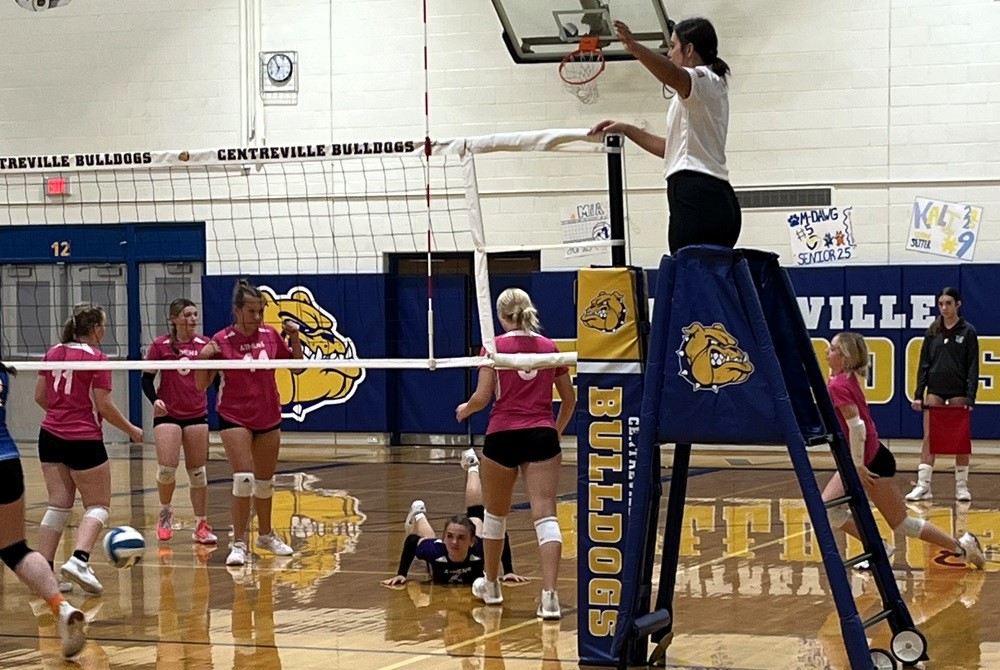
PHOTO Centreville’s Mary Stears stands adjacent and above the net as she officiates a match this fall. (Photo courtesy of the Centreville athletic department.)
Cadillac Star Stays on Pitch as Rising Referee
By
Tom Spencer
Special for MHSAA.com
September 14, 2020
There are very few female referees available to officiate high school soccer in northern Michigan.
 But for Bill Anderson, a registered assignor who schedules officials out of the Cadillac area, there has been Little.
Alexus Little that is. And he’s darn glad he’s had her for 15 to 20 games each boys fall and girls spring seasons the past four years.
“I think her greatest asset is a natural ability to stay calm and see the entire field,” Anderson said. “She has repeatedly demonstrated an ability to take a moment and see how things play out before blowing the whistle or raising the flag.
“It has been a pleasure to work with Lexi from the beginning and watch her develop, and gain confidence in her ability.”
Little, a former four-year player at Cadillac High School who graduated in 2017, loves officiating the game she has played since she was an 8-year- old. She started officiating with the Michigan State Youth Soccer Association. Anderson assigned her those matches as well.
“It is the most fun job I’ve ever had, and it is super convenient for varying schedules,” she said. “You get to learn more about the game of soccer, watch plenty of games, stay active, and meet a ton of referees that share the love of the game and may have even officiated your own games.”
Little, a big challenge for high school defenses as a striker, sees herself in almost every girls soccer player she refs.
“When I played I was a center striker so my playing style was pretty scrappy and aggressive, yet still heavily based on footwork and constant runs with my teammates,” she said. “I see players like me all the time during the girls season.”
 Anderson recalls her playing days similarly.
“She was a no-nonsense, hold-her-ground type of player who wasn't afraid to play with her back to goal and challenge defenders to come get her,” Anderson recalled. “More than once I blew the whistle and received a little dirty look from her, because she felt she could have kept going despite being fouled.”
As a senior, Little earned Division 2 all-state honorable mention. She now attends the University of Michigan. COVID-19 is allowing her to stay home, go to school and earn money refereeing fall soccer. She also refereed in the Ann Arbor area during her freshman year of college.
“I love to stay involved with soccer,” she said. “I’ve been doing it since middle school, and it's a fun and active way to earn some money.
“Being a referee also allows me to pick up games that fit my schedule.”
Little is among a just a handful of female soccer referees in the northern Lower Peninsula, that group also including Grand Traverse Area Soccer Association members Josephine Arrowood and Amanda Field.
“It can be a bit intimidating at times,” she said. “Most referees are men, so I feel like I lack authority in the eyes of the players/coaches/parents as a young woman, and even more so during boys games where most of the players are much taller than me.
“But, there have been several instances where I have received compliments from coaches or spectators passing by after a game related to being a young female officiating because they claim to not see that very often and would like to see more of it.”
Anderson agrees.
“When doing a boys game, I think there is still a general tendency to see if the female is up to the challenge,” he said. “However, she doesn't let that bother her and it doesn't take long for others to realize she is more than capable.”
Little gets a lot of satisfaction out of the game of soccer and recommends others get involved in officiating.
“The types of games where I am very glad I’m a referee are the ones where I get to watch crazy talent and skill from players I never would have seen play otherwise,” she noted.
 Tom Spencer is a longtime MHSAA-registered basketball and soccer official, and former softball and baseball official, and he also has coached in the northern Lower Peninsula area. He previously has written for the Saginaw News, Bay County Sports Page and Midland Daily News. He can be reached at [email protected] with story ideas for Manistee, Wexford, Missaukee, Roscommon, Ogemaw, Iosco, Alcona, Oscoda, Crawford, Kalkaska, Grand Traverse, Benzie, Leelanau, Antrim, Otsego, Montmorency, Alpena, Presque Isle, Cheboygan, Charlevoix and Emmet counties.
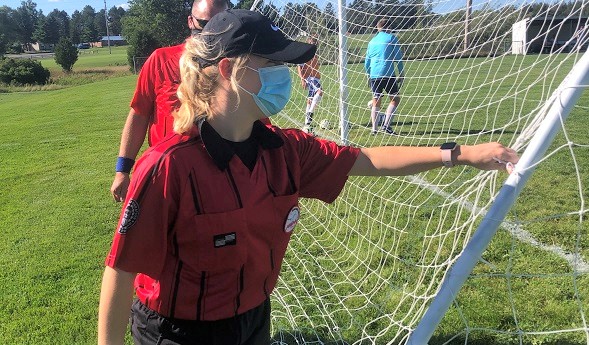
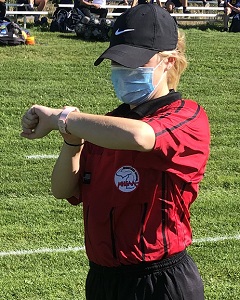
PHOTOS: (Top) Alexus Miller inspects the nets with officiating partner Jeremy Barrett before a game this season. (Middle) Miller checks her watch during a break in the action. (Photos courtesy of Tom Spencer.)