

After Amputation, Wesaw's Return to Wrestling Provides Purpose, Self-Confidence
By
Scott Hassinger
Special for MHSAA.com
March 13, 2026
DOWAGIAC – Weski Wesaw found a purpose three years ago once he began competing for the Dowagiac wrestling team.
 Wesaw, a senior and the Chieftains' varsity starter at 150 pounds this winter, overcame a traumatic and life-altering event in junior high school to become a Regional qualifier on the mats.
During the summer before seventh grade, Wesaw was diagnosed with osteosarcoma, an aggressive primary bone cancer most common in children, teens and older adults.
"I found out I had bone cancer in my knee. The doctors told me I had two options,” Wesaw said. “They gave me the option to keep my leg ... or I could choose amputation.
“My aunt chose to keep her leg when she had cancer, and it spread throughout her body and she passed away due to it.”
Wesaw's desire to be active and participate in sports were two more big reasons he chose amputation.
"I had dreams and goals so I leaned towards amputation because they told me it was the only way I could compete in sports, was with its removal or a prosthetic," Wesaw said.
Wesaw went through rehabilitation but struggled for a long period with a bit of depression while adjusting to his new normal.
"I had always been an athlete. I played everything as a kid – lacrosse, football, baseball and wrestling,” Wesaw said. “Being a kid, then not being able to do things you once did, that's very difficult. Your friend group changes a bit too."
During his sophomore year, Wesaw and one of the school's athletic directors approached Dowagiac's varsity wrestling coach Colin Burandt with the idea of Wesaw trying wrestling again.
Burandt was aware of Wesaw at an early age when he participated in Dowagiac's Youth Wrestling Club.
"After everything happened to Weski, he was kind've reclusive a little bit. He felt kind've out of place as a freshman, but he came into his sophomore year with more drive and approached me about joining the team,” Burandt said. “We just got after it, and it's been awesome seeing how he has developed a new purpose through the sport."
 Wesaw admits that wrestling has changed his outlook on everything.
"Wrestling has had a big impact on my life. I wanted a purpose to come to school,” Wesaw said. “I had competed in MyWay when I was a kid with two legs, and I knew how to wrestle. Going back into it with just one leg was similar to learning to ride a bike again."
One of the biggest adjustments Wesaw had to make was learning how to shoot using his own style.
"Instead of using your knee to shoot, I had to figure out my own way to be able to move and slide through perfectly,” Wesaw said “When I'm on the mat, I just do what my mind tells me to do. I can adapt and match my opponent's energy. It's been a long process that has taken all the way up to my senior year to get the hang of things. Now I've gotten to the point where I can leave everything out on the mat.”
Wesaw finished with a win-loss record of 23-18 this season. He earned third place at the Division 3 Individual District Tournament at Dowagiac. The top four place finishers in each of the 14 weight classes advanced to the Belding Regional, where he was eliminated in the second round.
"Having the home crowd cheering for me in Districts was huge. I was really nervous,” Wesaw said. “Before every match I just told myself that I got this, and I left everything out there on the mat. My goal was to get to the state meet, and I fell just a bit short of that goal. I gave it my all, and the determination to reach my goal is what really drove me."
Wesaw also played a key factor as Dowagiac won its ninth-straight Team District title before losing in Team Regionals.
"I get butterflies just thinking about the big meets. We've been successful because everyone on this team brought something different to the table," Wesaw said.
"Self-confidence is a very important thing in wrestling. I have become much more confident in myself thanks to the great support I've received from my friends, family and the community. I just have to give a lot of thanks to them along with my coaches who have accepted me for who I am and made me into the person I am today," Wesaw said. "I approach everything I do with 100-percent effort so I have no regrets. I want to look back and know I have made a big impact on this program."
 Wesaw was one of Dowagiac's most versatile grapplers and comes from a wrestling family.
"My dad was a wrestler and my uncle wrestled and later became a boxer. Even my little sister is on our wrestling team," Wesaw said. "My uncle (Eric Ortiz) has really helped me with my moves and helping me to think straight and remain calmer in my matches.”
Wesaw plans to continue wrestling in college and plans to pursue a double major in business and engineering.
One of his biggest inspirations is Anthony Robles.
Robles is an American wrestler who attended and competed for Arizona State, where he won a national championship in the 125-pound division in 2011 despite being born with just one leg. His story helped spawn the movie “Unstoppable.”
"Coaching someone like (Wesaw) is really no different than coaching anyone else,” Burandt said. “My approach is that every kid on our team is different. With Weski, his style is tailored to what he can do on top and offensive moves. With him there aren't necessarily challenges, but he just has to do what fits him best like working for a lot of reversals in a match.
“He's developed a pretty good shot from when he first began. Our strategy is for him to be aggressive in that first period. He's quick, very resilient, battles through the latter periods and is stronger than many of his opponents. Confidence in his ability, game planning and executing that plan and being a team player are some of his other assets.
"Weski is a great teammate, and everyone loves him. The other kids see his hard work and resiliency. They just view him as another guy on the team, and he's no different than anyone else. His mindset is great. He never makes excuses, and he just goes after it and figures things out on the way."
 Scott Hassinger is a contributing sportswriter for Leader Publications and previously served as the sports editor for the Three Rivers Commercial-News from 1994-2022. He can be reached at [email protected] with story ideas for Berrien, Cass, St. Joseph and Branch counties.
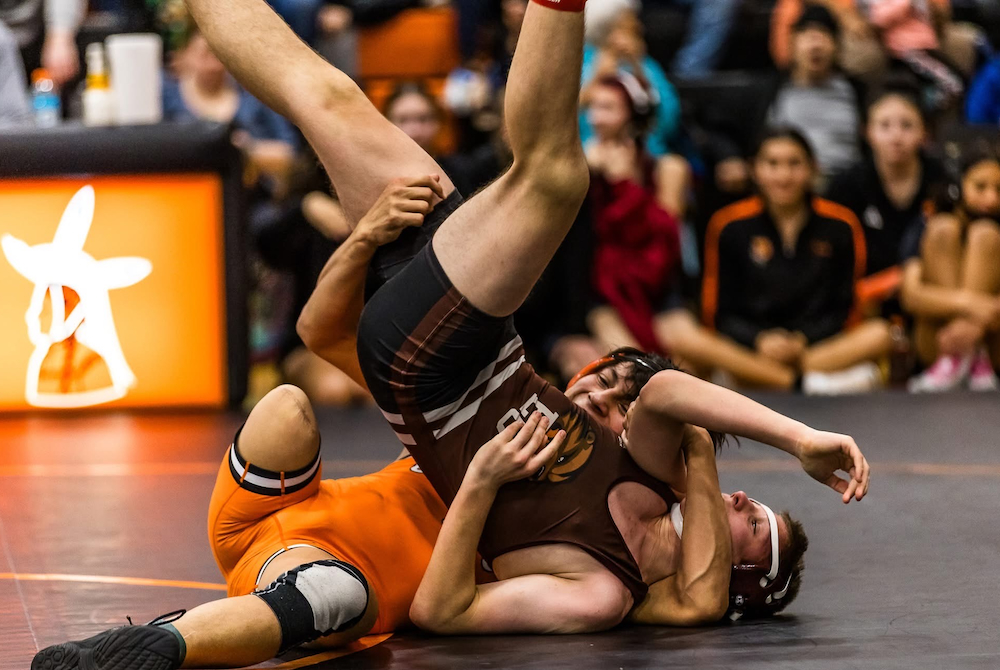
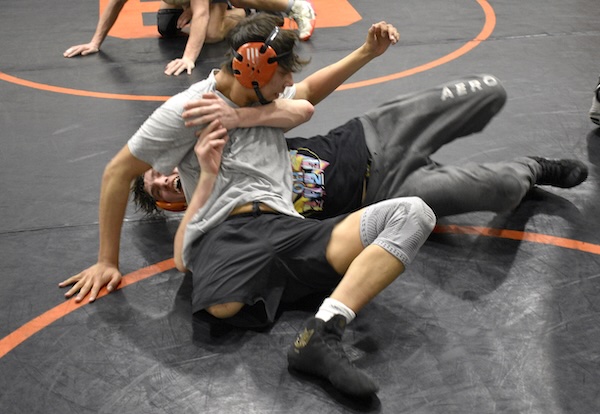
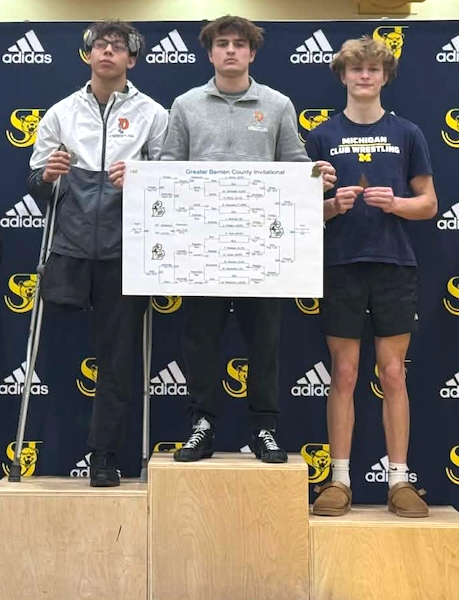
PHOTOS (Top) Dowagiac’s Weski Wesaw, in orange, works toward a pin during a tournament this season. (Middle) Wesaw, top position, works on a move against a practice partner during the week of Individual Regionals. (Below) Wesaw, far left, stands on the podium after earning a second-place finish at the Greater Berrien County Invitational. (Match and podium photos courtesy of Dowagiac’s athletic department. Practice photo by Scott Hassinger.)
'Bigger, Stronger, Faster' Greenville Climbing Among Wrestling's Elite
By
Dean Holzwarth
Special for MHSAA.com
January 19, 2023
GREENVILLE – Several factors have contributed to the current success of the Greenville wrestling team.
 However, one aspect of the program has been quite noticeable.
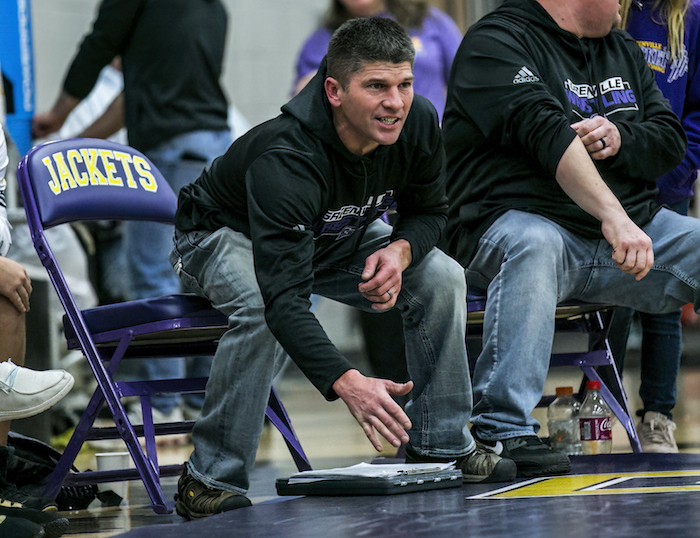
“I’ve received compliments by referees and other coaches just about how much bigger, stronger and faster they look now,” Yellow Jackets wrestling coach Brett Peterman said. “Greenville athletics, and the culture with Rick Court and our strength program, has changed. He has done an amazing job of getting the kids into lifting, and we have a great coaching staff."
“A lot of the sports are getting better now because of it, and our strength programs are loaded with kids now lifting, including at the middle school level.”
The Yellow Jackets recently jumped into the top 10 of the Division 2 state rankings after winning their fifth invitational of the season last week at Hudsonville Unity Christian.
An enhanced strength program, coupled with a diligent work ethic by a relatively young group, has signaled a turnaround for the better.
“We just have a great group of kids,” Peterman said. “The kids are coachable, they work hard and we are just seeing the results of that.”
Junior standout Nayte Dobson, who’s currently unbeaten at 24-0 wrestling at 157 and 165 pounds, said Court is a valuable piece to the winning puzzle that has been constructed.
“He always has good enthusiasm and good energy no matter what,” said Dobson, who placed seventh at last year’s Division 2 Individual Finals.
 “He gives us time to work out, whether it’s zero hour, or after school. Whenever you want to work out, he’s there. He will come from his house to unlock the doors.”
Court’s workouts are specifically designed to help the wrestlers reach their full potential and give them an advantage.
“He puts us through good workouts that involve speed and acceleration training,” Dobson said. “You can definitely see the bursts we have out on the mat.”
The list of accomplishments so far this season has included wins at the Greenville Invitational, the Hudsonville Invitational, the Unity Christian Invitational, the Fruitport Invitational and the Pinckney Duals.
“There have been some good teams in those tournaments and good challenges for the kids,” Peterman said. “Winning is good, but the work never stops.”
Peterman anticipated success this season, despite the departure of key seniors.
The addition of a large incoming freshman class has boosted numbers and anticipation for the future.
“I thought we could have a good year,” Peterman said. “We had a lot of returners, including a few state qualifiers and some who fell just short.
“They worked hard in the offseason, and with the freshmen coming in, I figured we would be pretty good. I was amazed that we had 23 freshmen come in. That’s a big group.”
The Yellow Jackets possess talent up and down the weight classes, with several wrestlers posting impressive records.
 Sophomore Caleb Lewis, a backup last season, has emerged and is 26-0 at 106 pounds.
Other top performers include junior Liam Dailey (23-2) at 138/144 pounds, sophomore Case Johnson (24-2) at 215 pounds, sophomore Kamden Witte (23-3) at 113 pounds and freshman Alex Buskirk (26-1) at 126 pounds.
“We are a very young team, but they’ve come in with a chip on their shoulder and they are working hard every day,” Dobson said. “How they work in the wrestling loft is showing out on the mat right now, and we are just giving them guidance and helping them out when we can.
“I expected this, and I knew this was going to be a good year for us because of the guys coming back and the freshmen.”
The Yellow Jackets will wrestle at the Ottawa-Kent Conference White championships, against a field that includes eight-time reigning team champion Lowell.
“It’s tough when you have a powerhouse like Lowell in your conference,” Peterman said. “There’s a possibility that we will see them several times in the upcoming weeks, and it will be a big challenge. We are going to do what’s right for the team on Friday and see how the results come about.”
The Red Arrows provide Greenville with a measuring stick, and they are eager to see how they fare against the best in the state.
“Lowell is just stacked all around and it’s going to be tough, but we also have to get through Byron Center, which has gone both ways this season,” Dobson said. “If we can see improvement from last year’s Districts to now against Lowell, then it gives us a good checkpoint of where we are at.”
 Dean Holzwarth has covered primarily high school sports for Grand Rapids-based WOOD-TV for five years after serving at the Grand Rapids Press and MLive for 16 years along with shorter stints at the Ionia Sentinel and WZZM. Contact him at [email protected] with story ideas for Allegan, Kent and Ottawa counties.
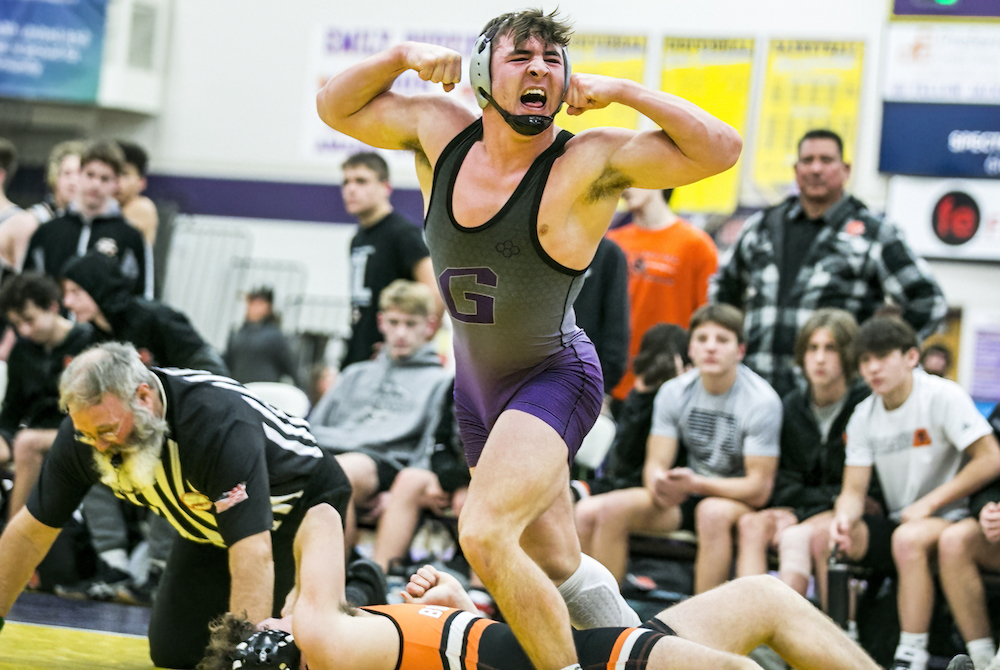
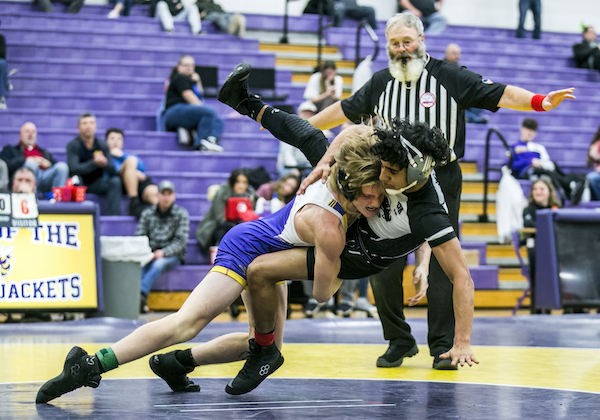
PHOTOS (Top) Greenville wrestler Isaac Daily celebrates a win during a match this season. (Middle) Yellow Jackets coach Brett Peterman guides one of his competitors. (Below) Greenville's Troy Courtney takes down an opponent. (Photos by Jamie McNinch Photography.)