

After Amputation, Wesaw's Return to Wrestling Provides Purpose, Self-Confidence
By
Scott Hassinger
Special for MHSAA.com
March 13, 2026
DOWAGIAC – Weski Wesaw found a purpose three years ago once he began competing for the Dowagiac wrestling team.
 Wesaw, a senior and the Chieftains' varsity starter at 150 pounds this winter, overcame a traumatic and life-altering event in junior high school to become a Regional qualifier on the mats.
During the summer before seventh grade, Wesaw was diagnosed with osteosarcoma, an aggressive primary bone cancer most common in children, teens and older adults.
"I found out I had bone cancer in my knee. The doctors told me I had two options,” Wesaw said. “They gave me the option to keep my leg ... or I could choose amputation.
“My aunt chose to keep her leg when she had cancer, and it spread throughout her body and she passed away due to it.”
Wesaw's desire to be active and participate in sports were two more big reasons he chose amputation.
"I had dreams and goals so I leaned towards amputation because they told me it was the only way I could compete in sports, was with its removal or a prosthetic," Wesaw said.
Wesaw went through rehabilitation but struggled for a long period with a bit of depression while adjusting to his new normal.
"I had always been an athlete. I played everything as a kid – lacrosse, football, baseball and wrestling,” Wesaw said. “Being a kid, then not being able to do things you once did, that's very difficult. Your friend group changes a bit too."
During his sophomore year, Wesaw and one of the school's athletic directors approached Dowagiac's varsity wrestling coach Colin Burandt with the idea of Wesaw trying wrestling again.
Burandt was aware of Wesaw at an early age when he participated in Dowagiac's Youth Wrestling Club.
"After everything happened to Weski, he was kind've reclusive a little bit. He felt kind've out of place as a freshman, but he came into his sophomore year with more drive and approached me about joining the team,” Burandt said. “We just got after it, and it's been awesome seeing how he has developed a new purpose through the sport."
 Wesaw admits that wrestling has changed his outlook on everything.
"Wrestling has had a big impact on my life. I wanted a purpose to come to school,” Wesaw said. “I had competed in MyWay when I was a kid with two legs, and I knew how to wrestle. Going back into it with just one leg was similar to learning to ride a bike again."
One of the biggest adjustments Wesaw had to make was learning how to shoot using his own style.
"Instead of using your knee to shoot, I had to figure out my own way to be able to move and slide through perfectly,” Wesaw said “When I'm on the mat, I just do what my mind tells me to do. I can adapt and match my opponent's energy. It's been a long process that has taken all the way up to my senior year to get the hang of things. Now I've gotten to the point where I can leave everything out on the mat.”
Wesaw finished with a win-loss record of 23-18 this season. He earned third place at the Division 3 Individual District Tournament at Dowagiac. The top four place finishers in each of the 14 weight classes advanced to the Belding Regional, where he was eliminated in the second round.
"Having the home crowd cheering for me in Districts was huge. I was really nervous,” Wesaw said. “Before every match I just told myself that I got this, and I left everything out there on the mat. My goal was to get to the state meet, and I fell just a bit short of that goal. I gave it my all, and the determination to reach my goal is what really drove me."
Wesaw also played a key factor as Dowagiac won its ninth-straight Team District title before losing in Team Regionals.
"I get butterflies just thinking about the big meets. We've been successful because everyone on this team brought something different to the table," Wesaw said.
"Self-confidence is a very important thing in wrestling. I have become much more confident in myself thanks to the great support I've received from my friends, family and the community. I just have to give a lot of thanks to them along with my coaches who have accepted me for who I am and made me into the person I am today," Wesaw said. "I approach everything I do with 100-percent effort so I have no regrets. I want to look back and know I have made a big impact on this program."
 Wesaw was one of Dowagiac's most versatile grapplers and comes from a wrestling family.
"My dad was a wrestler and my uncle wrestled and later became a boxer. Even my little sister is on our wrestling team," Wesaw said. "My uncle (Eric Ortiz) has really helped me with my moves and helping me to think straight and remain calmer in my matches.”
Wesaw plans to continue wrestling in college and plans to pursue a double major in business and engineering.
One of his biggest inspirations is Anthony Robles.
Robles is an American wrestler who attended and competed for Arizona State, where he won a national championship in the 125-pound division in 2011 despite being born with just one leg. His story helped spawn the movie “Unstoppable.”
"Coaching someone like (Wesaw) is really no different than coaching anyone else,” Burandt said. “My approach is that every kid on our team is different. With Weski, his style is tailored to what he can do on top and offensive moves. With him there aren't necessarily challenges, but he just has to do what fits him best like working for a lot of reversals in a match.
“He's developed a pretty good shot from when he first began. Our strategy is for him to be aggressive in that first period. He's quick, very resilient, battles through the latter periods and is stronger than many of his opponents. Confidence in his ability, game planning and executing that plan and being a team player are some of his other assets.
"Weski is a great teammate, and everyone loves him. The other kids see his hard work and resiliency. They just view him as another guy on the team, and he's no different than anyone else. His mindset is great. He never makes excuses, and he just goes after it and figures things out on the way."
 Scott Hassinger is a contributing sportswriter for Leader Publications and previously served as the sports editor for the Three Rivers Commercial-News from 1994-2022. He can be reached at [email protected] with story ideas for Berrien, Cass, St. Joseph and Branch counties.
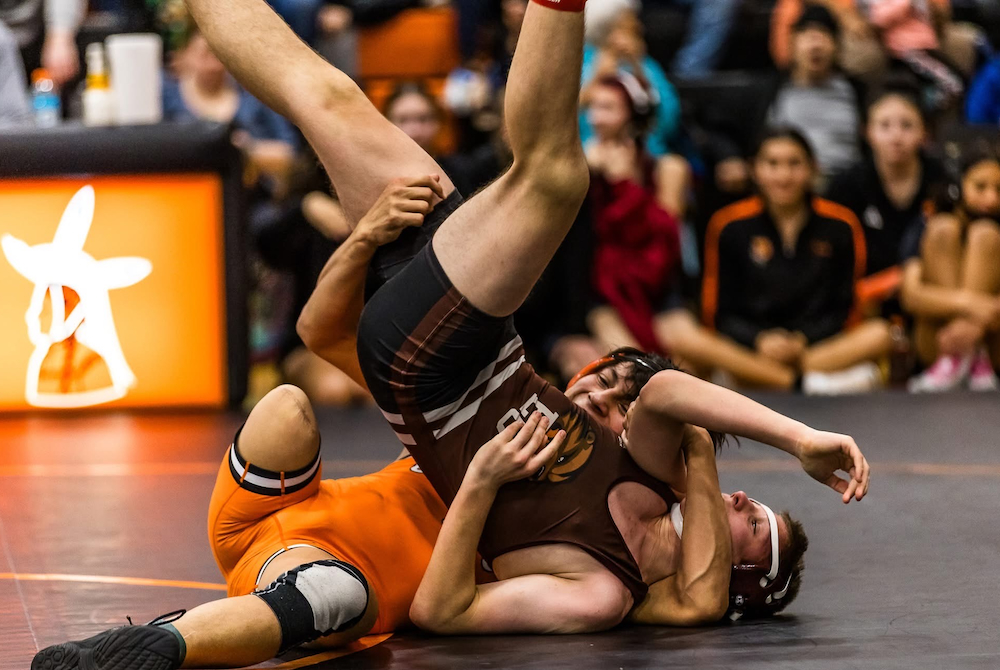
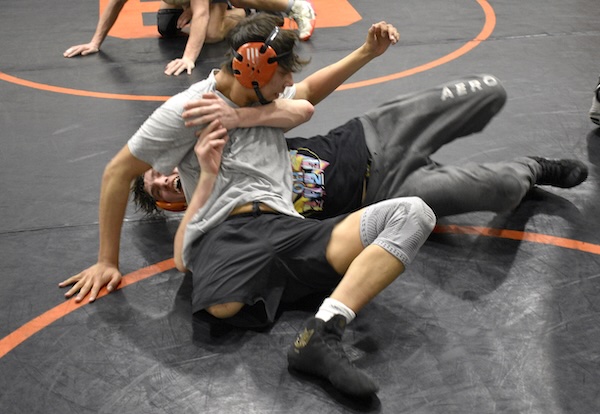
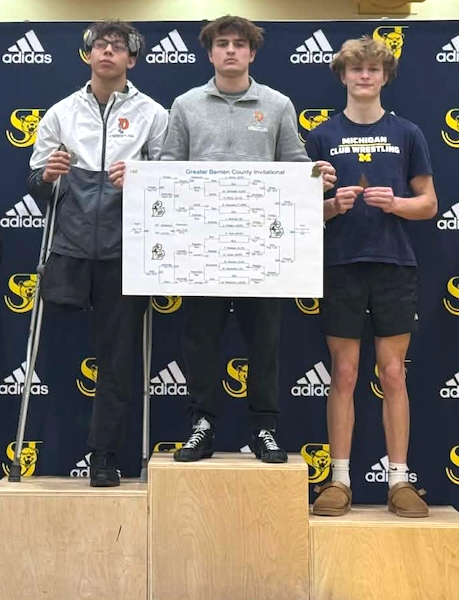
PHOTOS (Top) Dowagiac’s Weski Wesaw, in orange, works toward a pin during a tournament this season. (Middle) Wesaw, top position, works on a move against a practice partner during the week of Individual Regionals. (Below) Wesaw, far left, stands on the podium after earning a second-place finish at the Greater Berrien County Invitational. (Match and podium photos courtesy of Dowagiac’s athletic department. Practice photo by Scott Hassinger.)
Title IX at 50: Harrold's Achievement Heralds Growth of Girls Wrestling
By
Geoff Kimmerly
MHSAA.com senior editor
January 11, 2022
This March, for the first time, 14 championships and 112 medals total will be awarded to the highest achievers from a girls-only division at the MHSAA Individual Wrestling Finals – the latest of history-making steps over the last 30 years of girls competing on the high school mat in Michigan.
There have been many heroes along the way, as participation has grown to see more than 400 girls wrestle at MHSAA member schools during the 2019-20 season, the last not interrupted by COVID-19 (and 283 took the mat last year despite reduced participation across the sport after a late start due to the coronavirus.)
About 900 athletes open the annual Individual Finals with a “grand march” to kick off the now two-day event. First among Michigan girls to join the parade was a pioneer from a now-closed high school who, by competing at Joe Louis Arena on March 11, 1999, took a major first step toward cultivating the opportunities of today.
Saginaw Buena Vista’s Cynthia Harrold, then a senior, brought a 29-7 record into the Finals and competed in Division 3 at 103 pounds. She lost both of her matches, but not without plenty of deserved fanfare for her accomplishments in making the journey. Many matches are wrestled simultaneously at the Finals, especially during the early rounds, and so many photographers swarmed to capture her matches that the adjacent mats needed to be shut down to accommodate the media crowd.
According to a Detroit Free Press report published that Thursday highlighting the start of the tournament, Harrold had won 98 matches over her four-year high school career. She also played softball and ran track, and previously was a cheerleader before turning her winter sports focus completely toward wrestling.
She was set to join the grand march that day in Detroit with 895 other wrestlers, all boys. The following year, three girls qualified for the Individual Finals. Martin’s Amy Berridge in 2004, Goodrich’s CC Weber in 2009 and Clawson’s Katlyn Pizzo in 2017 would become the first to place at the state championship wrestling tournaments, bringing additional spotlight to girls achieving at the high school level.
With interest continuing to grow, the Michigan Wrestling Association (the sport’s high school coaches association) began sponsoring a Girls Wrestling Finals in 2019 – with momentum from that event leading to the creation of the MHSAA girls individual championship division at Ford Field to debut this season.
Second Half's weekly Title IX Celebration posts are sponsored by Michigan Army National Guard.
Previous Title IX at 50 Spotlights
Dec. 20: Competitive Cheer Gives Michigan Plenty to Cheer About - Read
Dec. 14: Evelyn's Game Had Plenty of Magic - Read
Dec. 7: Council Term Ends, But Leinaar Leaves Lasting Impact - Read
Nov. 30: Basketball Season Ready to Add to Rich Tradition - Read
Nov. 23: Marysville Builds Winning Streak Yet to be Challenged - Read
Nov. 16: Wroubel Has Championed Girls School Sports from Their Start - Read
Nov. 9: Pioneer's Joyce Legendary in Michigan, National Swim History - Read
Nov. 2: Royal Oak's Finch Leading Way on Football Field - Read
Oct. 26: Coach Clegg Sets Championship Standard at Grand Blanc - Read
Oct. 19: Rockford Girls Set Pace, Hundreds After Have Continued to Chase - Read
Oct. 12: Bedford Volleyball Pioneer Continues Blazing Record-Setting Trail - Read
Oct. 5: Warner Paved Way to Legend Status with Record Rounds - Read
Sept. 28: Taylor Kennedy Gymnasts Earn Fame as 1st Champions - Read
Sept. 21: Portage Northern Star Byington Becomes Play-by-Play Pioneer - Read
Sept. 14: Guerra/Groat Legacy Continues to Serve St. Philip Well - Read
Sept. 7: Best-Ever Conversation Must Include Leland's Glass - Read
Aug. 31: We Will Celebrate Many Who Paved the Way - Read
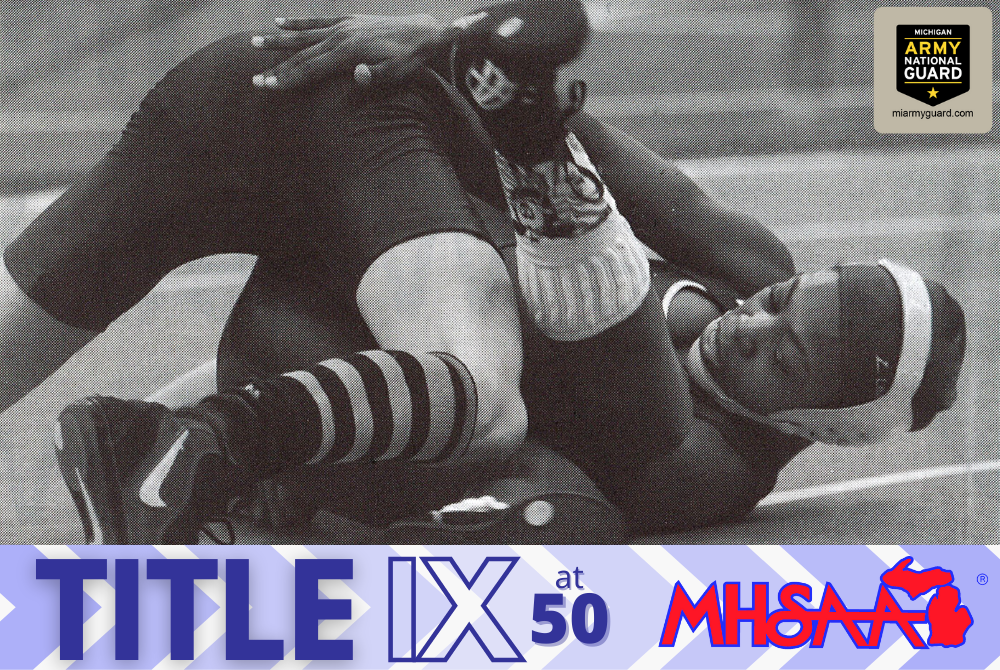
(Photo courtesy of the Detroit News.)