

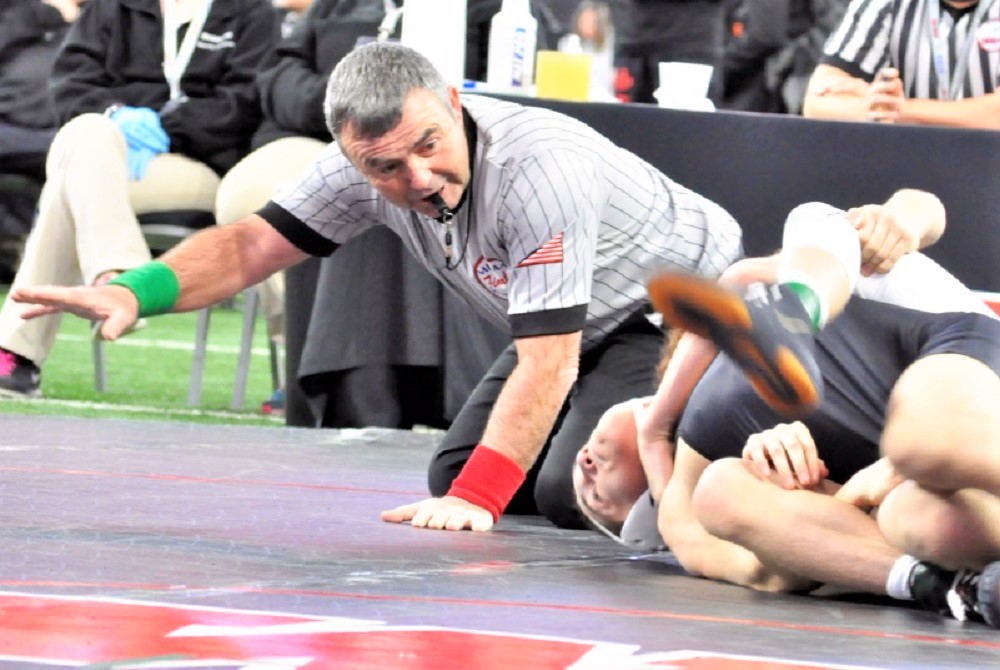
Be the Referee: Wrestling Inspections
By
Sam Davis
MHSAA Director of Officials
January 27, 2022
Be The Referee is a series of short messages designed to help educate people on the rules of different sports, to help them better understand the art of officiating, and to recruit officials.
Below is this week's segment – Wrestling Inspections - Listen
Before every individual or team wrestling event, each participant must be inspected by the referee or other authorized personnel. They are looking for any skin infections or evidence of a communicable disease.
A typical inspection will check a wrestler’s mouth for braces, fingernails, hairlines, underarms, back/shoulder area, behind the knee and more.
All inspections are done in the same manner for all wrestlers at a tournament site, both male and female wrestlers. Inspections generally should take place in an area not readily visible by the public because of modesty concerns for the wrestlers.
No wrestler is allowed to compete until they have gone through and passed the inspection.
Skin inspections are done with the goal of keeping all participants as safe as possible and preventing the spread of contagious skin conditions.
Previous editions
Dec. 16: Ball Over Backboard - Listen
Dec. 9: Winter Officials Mechanics - Listen
Nov. 26: Instant Replay - Listen
Nov. 11: Tourney Selection - Listen
Nov. 4: Receiver Carried Out of End Zone – Listen
Oct. 28: Volleyball Back-Row Block – Listen
Oct. 21: Soccer Disallowed Goal – Listen
Sept 30: Field Goal Falls Short – Listen
Sept. 23: Volleyball Obstruction – Listen
Sept. 16: Catch or No Catch – Listen
Sept. 9: Intentional Grounding – Listen
Sept. 2: Pass Interference – Listen
Aug. 26: Protocols and Mechanics – Listen

Be the Referee: Football Rules Changes
August 23, 2018
In this week's edition, assistant director Brent Rice discusses a pair of rules changes coming to high school football this fall.
Be The Referee is a series of short messages designed to help educate people on the rules of different sports, to help them better understand the art of officiating, and to recruit officials.
Below is this week's segment – Football Rules Changes - Listen
The biggest rules changes in high school football across the country this year involve player safety.
When any required player equipment is missing or worn improperly, an official's time-out shall be declared, and the player must come out of the game for one down. This includes players not wearing knee or thigh pads or rolling their pant legs up over their knees and equipment such as shoulder pads or back pads being exposed.
The other change continues to hone the definition of a defenseless player, this time affecting the quarterback once he has thrown the ball and becomes a passer. Until that time, he is defined as a runner. As a passer, he continues to be defenseless until the pass ends or he moves to participate in the play.
The penalty for hitting a defenseless player is 15 yards.