

Belleville Twins March to Finals Together
By
Tom Markowski
Special for Second Half
March 2, 2016
BELLEVILLE – Caleb Brown continues to be haunted by what he considers a grim disappointment in his Belleville wrestling career.
 Last season, Brown lost during what those in the wrestling fraternity call the “blood round.” This is the consolation round, a match for fourth place, at the Individual Wrestling Regionals. Brown lost by one point in the 152-pound weight class to an opponent he had defeated earlier in the season and, thus, missed qualifying for the MHSAA Finals.
He was devastated but not consumed by it. For one, that was his junior season. Brown rededicated himself during the offseason. He continued to run cross country to keep his weight down and also increase his endurance.
This season Brown broke through barriers, claiming the Wayne County and Division 1 Regional championships at 152.
As proud as he is of reaching this point, it’s made even more special by the fact that he’ll enter The Palace of Auburn Hills on Thursday with his twin brother Chris. Chris Brown competes at 130. Last season he qualified for the MHSAA Finals at 119 and won a first-round match before losing his next.
“It’s really cool,” Caleb said. “I missed out last year. Being a senior, it’s cool.
“(Winning the regional) didn’t hit me right away. I was just talking about it with my teammates, and that’s when it hit me. I was really focused on winning the match.”
Caleb is 44-4 this season and will face Kyle Minor of Roseville in Thursday’s first round.
Chris is 47-2 and will go against Lee Grabowski of Brighton.
The Browns say having a twin who competes in the same sports is an advantage, if for no other reason than it enhances one’s competitive nature.
They both started wrestling in middle school by chance.
 “We played football in the beginning,” Chris said. “The coach told us to wrestle to keep in shape. I was terrible in the beginning. But we’ve never been known as quitters. I like the individualism. You can’t use the excuse your team lost it for you.”
Once they entered high school, the Browns gravitated even more toward the sport. But it wasn’t until their sophomore season that they became proficient at it.
For Chris, there was one match that showed he could compete against the best.
“My sophomore year was my first on varsity,” he said. “I went against a ranked opponent, and I won by a point. That was huge for my confidence.”
Coinciding with the Browns’ rise was the return of Derek Phillips as coach. Phillips started coaching in 1994 and stayed 11 seasons before taking time off to help raise two children. He remained within the school district as a teacher, but the time commitment of teaching and coaching together was not conducive to spending quality time with his sons.
In 2013, Phillips returned. He has been a mentor for the Browns and a third senior MHSAA Finals qualifier, David Tooley (215).
Phillips was the one who encouraged the Browns to compete in cross country.
“It goes hand in hand,” Phillips said of the two sports. “I love it. They come into the wrestling season in shape. All three have over 100 wins and all three are good students. They’re a coach’s dream.”
Tooley is a little different. It’s not because he plays football instead of competing in cross country. And it’s not because he’s a three-sport athlete (also plays baseball). It’s his warm-up routine that causes many to take a second look, scratch their heads or both.
It’s more than a routine. It’s a dance. Sort of. He got the idea from watching a wrestler from Southgate Anderson who competed against his brother, Mark Tooley, when the elder Tooley wrestled for Belleville in 2011.
“It’s like no other,” David Tooley said. “It’s an active movement. It’s like a dance, and it’s a little embarrassing.”
Whatever works.
 The Browns’ warmup routines are a little less flamboyant, but they do get a kick out of watching their teammate go through his routine. Chris likes to listen to music just before his matches. Caleb prefers listening to his coach, receiving last-minute instructions.
Away from the mat, the Browns are constantly challenging each other. Take running, for example.
“We try to one-up each other,” Chris said. “We’ve always been competitive. I’m faster than he is, when we run cross country. We’re not too far apart though.”
Caleb judges a person’s speed all together differently.
“He might beat me in cross country,” he said. “But if it’s a true test of speed, I’m faster.”
 Tom Markowski is a columnist and directs website coverage for the State Champs! Sports Network. He previously covered primarily high school sports for the The Detroit News from 1984-2014, focusing on the Detroit area and contributing to statewide coverage of football and basketball. Contact him at [email protected] with story ideas for Oakland, Macomb and Wayne counties.
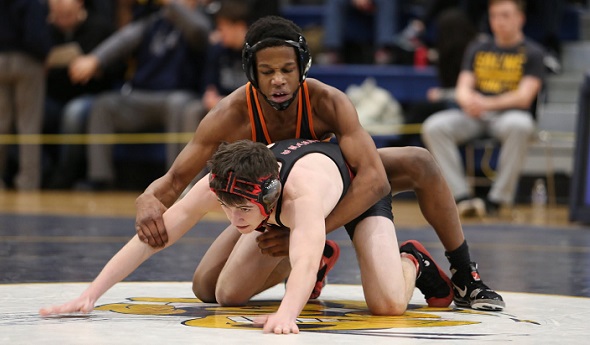
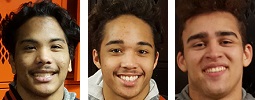
PHOTOS: (Top) Chris Brown works to gain control during one of his Division 1 Regional matches Feb. 20. (Middle) Caleb Brown, Chris Brown, David Tooley.(Below) Caleb Brown works an opponent toward a potential pin during one of his Regional matches. (Top and below photos by Douglas Chapman.)
D1 Preview: Power-Packed Brackets
February 22, 2019
By Geoff Kimmerly
Second Half editor
This weekend’s Division 1 team wrestling field at Kalamazoo’s Wings Event Center is power-packed again, and that might be an understatement.
 Detroit Catholic Central is wrestling for its third straight Division 1 title, but four other teams that have won at least one championship over the last 13 seasons also will compete. The eight teams at Friday’s Quarterfinals have a combined 80 Individual Finals qualifiers who will go on to Ford Field next weekend as well.
Below is a look at all eight teams competing in Division 1, listed by seed. Quarterfinal matches begin at 2:15 p.m. Friday, with Semifinals at 9:30 a.m. Saturday and the championship match that afternoon at 3:45 p.m. All matches this weekend will be viewable live on a subscription basis on MHSAA.tv. For Friday’s schedule and results throughout, check the MHSAA Wrestling page.
#1 Detroit Catholic Central
Record/rank: 23-1, No. 1
League finish: First in Detroit Catholic League
Coach: Mitch Hancock, 12th season (270-45)
Championship history: Thirteen MHSAA championships (most recent 2018), two runner-up finishes.
Individual Finals qualifiers: 103 Anthony Walker (26-9) fr., 112 Caleb White (19-7) jr., 130 Camden Trupp (35-6) soph., 135 Joshua Edmond (33-2) jr., 140 Marc Shaeffer (18-4) jr., 140 Derek Gilcher (28-2) jr., 145 Logan Sanom (33-3) jr., 145 Kevon Davenport (31-1) sr., 152 Cameron Amine (33-0) sr., 152 Joseph Urso (36-7) sr., 160 Manuel Rojas (24-7) fr., 189 Easton Turner (34-3) sr., 215 Brendin Yatooma (35-3) jr., 285 Steven Kolcheff (32-3) jr.
Outlook: The Shamrocks are seeking their third straight Division 1 title and sixth in eight seasons, and haven’t lost to an in-state opponent in three seasons. DCC hasn’t given up a team point during this MHSAA Tournament, shutting out all four opponents through the District and Regional. Edmond, Gilcher, Davenport and Turner were Individual Finals champions last year with Amine and Kolcheff runners-up and Yatooma, Sanom and Shaeffer placers. Davenport will be seeking his fourth title and Amine his third next weekend at Ford Field.
#2 Brighton
Record/rank: 31-0, No. 2
League finish: First in Kensington Lakes Activities Association West and overall
Coach: Tony Greathouse, sixth season (151-27)
Championship history: Division 1 champion 2015, runner-up 2018.
Individual Finals qualifiers: 103 Aiden Smith (33-15) fr., 119 Sam Freeman (43-4) jr., 119 Mason Shrader (29-5) soph., 125 Eddie Homrock (49-2) jr., 135 Zach Johnson (39-6) soph., 140 Rhett Newton (14-2) sr., 152 Victor Grabowski (40-10) sr., 152 Harley Berne (28-8) jr., 160 Dane Donabedian (44-9) jr., 171 River Shettler (46-2) sr., 189 Greyson Stevens (46-4) jr., 215 Luke Stanton (25-1) jr., 285 Colby Ford (40-14) sr.
Outlook: The Bulldogs enter seeded second for the second straight season. Brighton shut out two postseason opponents and defeated No. 10 Holt in the Regional Final to get back to Kalamazoo, after finishing first in a league that included two more top-five teams in Division 1. Stanton, Shrader, Homrock, Johnson, Donabedian, Grabowski and Shettler all were Finals placers a year ago, Shettler a runner-up. Brighton defeated possible Semifinal opponent Davison by 11 in its season opener.
#3 Davison
Record/rank: 15-2, No. 3
League finish: First in Saginaw Valley League
Coach: Roy Hall, 21st season (538-97-1)
Championship history: Eight MHSAA championships (most recent 2006), five runner-up finishes.
Individual Finals qualifiers: Aden Williams (21-4) fr., 112 Owen Payne (25-10) fr., 119 Steven Garty (31-6) sr., 119 Andrew Chambal (34-3) jr., 125 Jaron Wilson (8-1) jr., 140 James Johnston (30-5) soph., 145 Landon Kish (20-16) soph., 152 Brian Case (18-7) sr., 160 Alex Facundo (33-2) soph., 171 Jay Nivison (23-9) jr., 189 Cal Stefanko (28-2) sr., 189 Trevor McGowan (20-8) sr., 215 Jimmy Colley (11-3) fr.
Outlook: Davison has reached the Semifinals six straight seasons and will wrestle Friday in its eighth straight Quarterfinal. Chambal and Facundo are reigning Finals champions and Stefanko was a runner-up last season, and Garty, Case and Nivison also were placers. Nine upperclassmen bolster a lineup that fell to Detroit Catholic Central by only six points Dec. 21.
#4 Westland John Glenn
Record/rank: 29-5, No. 4
League finish: First in KLAA East
Coach: Bill Polk, 21st season (423-124)
Championship history: Has not appeared in an MHSAA Final.
Individual Finals qualifiers: 103 Josh Mars (40-13) fr., 112 Ty Cowen (45-12) soph., 125 Caleb Meekins (49-4) sr., 135 Kyle Borthwell (44-4) sr., 145 Brenten Polk (49-5) sr., 160 Graden Bowen (37-16) sr.
Outlook: John Glenn will wrestle in its third straight Quarterfinal and has missed making its first Semifinal the last two seasons by a combined six points. The Rockets edged No. 8 Temperance Bedford by two points in last week’s Regional Final. Meekins and Brenten Polk were Individual Finals placers last season and help lead a lineup with 13 upperclassmen – including eight seniors – expected to start.
#5 Hartland
Record/rank: 29-3, No. 5
League finish: Second in KLAA West
Coach: Todd Cheney, 27th season (761-109-2)
Championship history: Division 1 champion 2016, five runner-up finishes.
Individual Finals qualifiers: 103 Patrick Wlodyga (43-9) fr., 119 Wyatt Nault (27-4) jr., 119 Ethan Kinch (31-10) fr., 130 Kyle Kantola (45-0) sr., 135 Corey Cavanaugh (38-4) sr., 135 Bryce Cheney (39-10) soph., 145 Devon Pietila (32-20) sr., 152 Avery Dickerson (41-7) fr., 160 Tanner Culver (37-5) sr., 160 Reece Potter (21-2) sr., 215 Jon Hartman (31-20) sr.
Outlook: Hartland has moved up two seeds from last season as it prepares for its 18th straight Quarterfinal appearance. After navigating the KLAA, the Eagles didn’t give up more than 16 points in any of four District or Regional matches. Kantola was an Individual Finals runner-up last season, and Nault, Cavanaugh, Culver and Potter all were placers as well.
#6 Rockford
Record/rank: 30-2, unranked
League finish: First in Ottawa-Kent Conference Red
Coach: Brian Richardson, 10th season (210-109)
Championship history: Two MHSAA titles (most recent 2009), three runner-up finishes.
Individual Finals qualifiers: 130 Trenton Wachter (47-1) soph., 135 Evan Kaser (38-11) jr., 140 Connor White (41-5) sr., 145 Jack Richardson (40-4) sr., 160 Noah Anderson (12-1) sr., 171 Cole Gleason (33-9) soph., 189 Tyler Waterstrat (35-5) sr.
Outlook: Rockford is coming off its third straight District title and returning to the Quarterfinals for the first time since finishing Division 1 runner-up in 2010. White and Richardson were both Individual Finals placers a year ago and two of eight senior starters expected to take the mat.
#7 Macomb Dakota
Record/rank: 27-5, No. 6
League finish: First in Macomb Area Conference Red
Coach: Ed Skowneski, seventh season (207-45)
Championship history: Has not appeared in an MHSAA Final.
Individual Finals qualifiers: 112 Brendan Ferretti (49-0) soph., 119 Nick Alayan (45-3) sr., 125 Justin Tiburcio (37-3) sr., 125 Bradley Weiand (34-15) jr., 130 Andrew Barrett (37-12) sr., 140 Brandon Alkazir (38-14) sr., 145 David McFadden (25-21) soph., 160 Eli Andary (42-12) sr., 171 Dustin Solomon (49-3) sr.
Outlook: This will be Dakota’s fourth straight Quarterfinal and sixth in seven seasons under Skowneski. Ten upperclassmen including seven seniors bolster the lineup after the team made the Semifinals a year ago for the second straight season. Alayan will be seeking his first individual championship next weekend after finishing runner-up the last two seasons, and Ferretti, Tiburcio and Solomon also were placers in 2018.
#8 Clarkston
Record/rank: 26-5, No. 7
League finish: First in Oakland Activities Association Red
Coach: Joe Wood, second season (44-15)
Championship history: Class A champion 1991, runner-up 1995.
Individual Finals qualifiers: 125 Cole Wiegers (40-8) sr., 130 Mackenzie Hanselman (36-11) sr., 135 Conor Donahue (38-6) sr., 135 Grady Castle (35-9) soph., 140 Ethan Polick (35-10) sr., 145 Jacob Billette (37-7) sr., 160 Devin Trevino (42-4) sr.
Outlook: Clarkston is competing at the Quarterfinals for the first time since 2007, with a two-point Regional Semifinal win over No. 9 Oxford the key victory of this run. Billette was a Finals placer last season and this winter is one of six seniors holding down the middle weights.
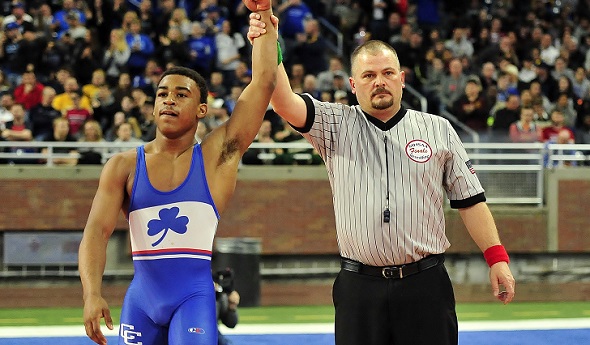
PHOTO: Josh Edmond, here at last season’s Individual Finals, is one of four returning champions leading DCC on its quest for another team title. (Click for more from HighSchoolSportsScene.com.)