

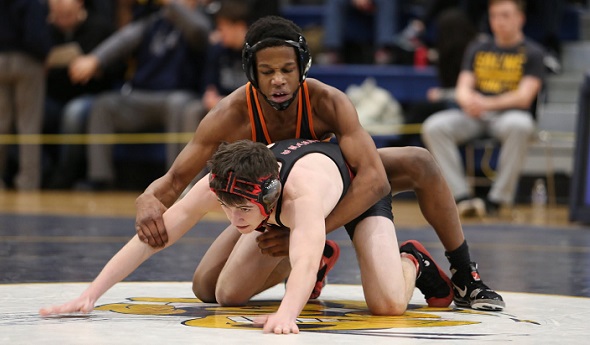
Belleville Twins March to Finals Together
By
Tom Markowski
Special for Second Half
March 2, 2016
BELLEVILLE – Caleb Brown continues to be haunted by what he considers a grim disappointment in his Belleville wrestling career.
 Last season, Brown lost during what those in the wrestling fraternity call the “blood round.” This is the consolation round, a match for fourth place, at the Individual Wrestling Regionals. Brown lost by one point in the 152-pound weight class to an opponent he had defeated earlier in the season and, thus, missed qualifying for the MHSAA Finals.
He was devastated but not consumed by it. For one, that was his junior season. Brown rededicated himself during the offseason. He continued to run cross country to keep his weight down and also increase his endurance.
This season Brown broke through barriers, claiming the Wayne County and Division 1 Regional championships at 152.
As proud as he is of reaching this point, it’s made even more special by the fact that he’ll enter The Palace of Auburn Hills on Thursday with his twin brother Chris. Chris Brown competes at 130. Last season he qualified for the MHSAA Finals at 119 and won a first-round match before losing his next.
“It’s really cool,” Caleb said. “I missed out last year. Being a senior, it’s cool.
“(Winning the regional) didn’t hit me right away. I was just talking about it with my teammates, and that’s when it hit me. I was really focused on winning the match.”
Caleb is 44-4 this season and will face Kyle Minor of Roseville in Thursday’s first round.
Chris is 47-2 and will go against Lee Grabowski of Brighton.
The Browns say having a twin who competes in the same sports is an advantage, if for no other reason than it enhances one’s competitive nature.
They both started wrestling in middle school by chance.
 “We played football in the beginning,” Chris said. “The coach told us to wrestle to keep in shape. I was terrible in the beginning. But we’ve never been known as quitters. I like the individualism. You can’t use the excuse your team lost it for you.”
Once they entered high school, the Browns gravitated even more toward the sport. But it wasn’t until their sophomore season that they became proficient at it.
For Chris, there was one match that showed he could compete against the best.
“My sophomore year was my first on varsity,” he said. “I went against a ranked opponent, and I won by a point. That was huge for my confidence.”
Coinciding with the Browns’ rise was the return of Derek Phillips as coach. Phillips started coaching in 1994 and stayed 11 seasons before taking time off to help raise two children. He remained within the school district as a teacher, but the time commitment of teaching and coaching together was not conducive to spending quality time with his sons.
In 2013, Phillips returned. He has been a mentor for the Browns and a third senior MHSAA Finals qualifier, David Tooley (215).
Phillips was the one who encouraged the Browns to compete in cross country.
“It goes hand in hand,” Phillips said of the two sports. “I love it. They come into the wrestling season in shape. All three have over 100 wins and all three are good students. They’re a coach’s dream.”
Tooley is a little different. It’s not because he plays football instead of competing in cross country. And it’s not because he’s a three-sport athlete (also plays baseball). It’s his warm-up routine that causes many to take a second look, scratch their heads or both.
It’s more than a routine. It’s a dance. Sort of. He got the idea from watching a wrestler from Southgate Anderson who competed against his brother, Mark Tooley, when the elder Tooley wrestled for Belleville in 2011.
“It’s like no other,” David Tooley said. “It’s an active movement. It’s like a dance, and it’s a little embarrassing.”
Whatever works.
 The Browns’ warmup routines are a little less flamboyant, but they do get a kick out of watching their teammate go through his routine. Chris likes to listen to music just before his matches. Caleb prefers listening to his coach, receiving last-minute instructions.
Away from the mat, the Browns are constantly challenging each other. Take running, for example.
“We try to one-up each other,” Chris said. “We’ve always been competitive. I’m faster than he is, when we run cross country. We’re not too far apart though.”
Caleb judges a person’s speed all together differently.
“He might beat me in cross country,” he said. “But if it’s a true test of speed, I’m faster.”
 Tom Markowski is a columnist and directs website coverage for the State Champs! Sports Network. He previously covered primarily high school sports for the The Detroit News from 1984-2014, focusing on the Detroit area and contributing to statewide coverage of football and basketball. Contact him at [email protected] with story ideas for Oakland, Macomb and Wayne counties.
PHOTOS: (Top) Chris Brown works to gain control during one of his Division 1 Regional matches Feb. 20. (Middle) Caleb Brown, Chris Brown, David Tooley.(Below) Caleb Brown works an opponent toward a potential pin during one of his Regional matches. (Top and below photos by Douglas Chapman.)
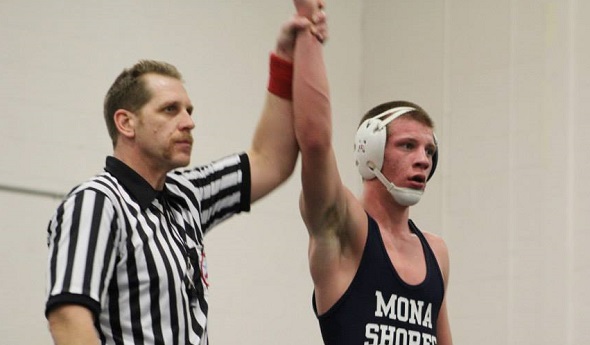
Shores' Karel Blazes Smart Path to Stardom
January 5, 2016
By Tom Kendra
Special for Second Half
Samuel Karel is not only the epitome of a true student-athlete. He is also proof that there are many different roads to becoming a high school all-stater.
 Especially in wrestling.
“You don’t always have to be the most athletic or the most naturally talented to win the match,” explained Karel, a senior returning all-state wrestler for Muskegon Mona Shores, who is 15-3 with 10 pins this season at 160 pounds.
“You can put in time and effort and find a way to come out ahead.”
Karel has certainly done that, improving from a mediocre grappler as a freshman to a legitimate MHSAA title contender as a senior. But his ascent has been aided by an often overlooked skill in athletics, an intangible which has decided more games and matches than anything else in prep sports but is not as readily apparent as size and speed.
That skill is intelligence.
In addition to pursuing his championship dream on the mat, Karel sports a gaudy 4.24 grade-point average while juggling a class load featuring four Advanced Placement classes – AP Statistics, AP Literature, AP Environmental Science and AP Microeconomics.
Mona Shores coach Blake Groenhout said Karel brings that cerebral approach to the wrestling mat, which has enabled him to figure out a way to beat many opponents who possess superior athletic ability.
“Samuel’s biggest strength is that he is a real technician,” explained Groenhout, who said Karel has always been good on his feet but has improved on the mat. “He works really hard, and he’s always thinking ahead and is able to pull off some big wins in that way.”
A great example of that came at last year’s Division 1 Individual Finals, when Karel found himself in the infamous “blood round” where a victory would make him an all-stater as a top-eight placer at 152 pounds. Unfortunately, his opponent had beaten him 9-2 just one week earlier at Individual Regionals.
This time, Karel fought a smarter match.
The low-scoring bout turned into a chess match, which played into Karel’s hands. Karel scored a takedown in the first period, while his opponent evened the score in the second – and the score remained 2-2 until just a handful of seconds remained. With overtime looking like a certainty, Karel was able to get away for an escape and a 3-2 victory as time expired.
“I was jumping around and going crazy after that,” Karel said with a laugh.
It was quite an achievement for someone who couldn’t even manage a winning record his freshman year, finishing 14-14 at 145 pounds. He improved to 28-10 his sophomore year at 160 pounds, including city and Ottawa-Kent Conference Black titles, but fell one win short of making it to the MHSAA Finals. He finished 44-9 last year at 152 pounds, repeating as city and conference champion and capping things off with his 8th-place finish at The Palace of Auburn Hills.
Making all-state was a notable athletic achievement since most of his accolades have come as a student.
Karel was one of three Muskegon-area high school seniors to be named a National Merit Scholarship semifinalist this fall. He will find out this spring if he is a finalist for a National Merit Scholarship pool, which totals $32 million.
He credits his experience in sports – both as a standout and team captain on the wrestling team and as a reserve and role player on the Sailors’ football team – for giving him discipline and resilience to be successful in school and the rest of his life.
“Wrestling can get boring, working on the same things over and over, so you have to find a way to keep it new and fresh,” said Karel. “I try to have fun in the room every day and try to think back to what motivated me when I first started wrestling.”
Two more secret weapons for Karel are his family and faith.
 The youngest of Paul and Deb Karel’s four children, he has plenty of support from older sisters Martha and Lydia, both students at Lee University in Tennessee, and older brother Simon, a freshman offensive lineman at Trinity College near Chicago.
The Karels have been fixtures in the Mona Shores district for almost 20 years and even longer at Olivet Evangelical Free Church, where Samuel plays guitar and drums at church services (“Music takes away my stress,” he explained).
Karel also will be heading out of state for college, as he will join the club wrestling program at Liberty University in Lynchburg, Va. He plans to major in mathematics and then pursue a career as a mathematician (possibly working for the National Security Agency) or an actuary.
For right now, he is focused on making the most of his final high school season on the mat.
Karel reached the coveted 100-win plateau last month at the Grand Rapids Forest Hills Northern Invitational. Last week, he finished 3-1 at Grandville’s tournament to improve to 15-3 with 10 pins this season.
As a team captain, he also wants to help two of his teammates try to close out their senior seasons as all-state wrestlers. Sean Halverson is 11-2 at 112 pounds, and Nick Brown is 10-6 at 215 pounds. Those two, along with Karel, form the “Big 3” for Mona Shores wrestling, Groenhout said.
“I made him a captain as a junior, which is rare, but he has such great dedication and enthusiasm for the sport,” Groenhout explained. “He is the one who sets the standard. Our younger guys, like (standout freshman) Josh Hill, they all want to be like Sam.”
 Tom Kendra worked 23 years at The Muskegon Chronicle, including five as assistant sports editor and the final six as sports editor through 2011. E-mail him at [email protected] with story ideas for Muskegon, Oceana, Mason, Lake, Oceola, Mecosta and Newaygo counties.
PHOTOS: (Top) Mona Shores senior Samuel Karel, the youngest of Deb and Steve Karel's four children, has won more than 100 matches already in his career, with most of his senior season still to come. (Middle) Karel is a standout on and off the wrestling mat. The senior returning all-stater, also a National Merit Scholarship semifinalist, recently won his 100th career match. (Photos courtesy of the Karel family.)