

Davison's Olson Joins Mat Legends
March 7, 2015
By Nick Hankins
Special for Second Half
AUBURN HILLS – It takes many people and a lot of time to build a legend.
That’s why Lincoln Olson was so quick to hand out credit for the incredible feat he accomplished Saturday night at The Palace of Auburn Hills.
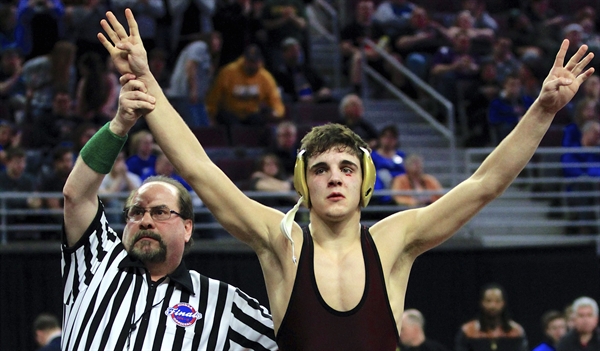
Olson became the 20th wrestler in MHSAA history win four Individual Finals championships when he beat Walled Lake Central’s Daniel Shear by technical fall, 24-9, at 135 pounds.
“I feel ecstatic right now,” Olson said. “This is something I have been working for my whole life. I am so grateful for all the people who have helped me get here. My coaches (Roy Hall and Paul Donahoe) and my father, I wouldn’t be the wrestler I am without them. They mean the world to me, they gave me everything I needed to achieve this goal. All my coaches have been by my side this whole journey.”
Olson also finished his high school career with eight straight technical fall wins at MHSAA Finals.
“That has been my philosophy my whole life. I know I have a gas tank and a motor, and my conditioning I have been working on my whole life,” Olson said. “That really separates me from other guys; that third period when they are tired, I just keep going.”
103
Champion: Mike Mars, Westland John Glenn, Fr. (51-2)
Decision, 8-4, over Elijuh Weaver, Roseville, Soph. (29-4)
Mars got a little revenge, and won an MHSAA title along the way.
He beat Weaver 8-4 to win his first Finals championship.
“This feels unbelievable,” Mars said “I knew he was going to be tough to beat. He beat me the last time we wrestled at the beginning of the season. I worked hard all year to win a championship.”
112
Champion: Augustine Facundo, Davison, Fr. (38-8)
Decision, 9-4, over Donte Rivera-Garcia, Southgate Anderson, Soph. (54-3)
All year long, Facundo wrestled behind returning MHSAA champ and teammate Max Johnson in the 112-pound weight class.
But both wrestled in the MHSAA tournament and qualified for the Finals.
And when Johnson was upset in the Semifinal round by Rivera-Garcia, Facundo came back and avenged Johnson’s loss with a 9-4 win.
“It is awesome,” Facundo said. “It is such a rush to be a state champion. My dad and coaches put in a lot of hard work to get me to this point. I just stayed aggressive and rough to push the pace and win.”
119
Champion: Noah Gonser, Grand Blanc, Sr. (56-3)
Decision, 9-2, over Brendan Hazelton, Harrison Township L’Anse Creuse, Sr. (57-2)
It’s always great to end your career a winner. That’s what Gonser did by beating Hazelton for his 56th win of the year and first MHSAA title.
“I feel great about that match,” Gonser said. “This is a great end to my high school career. It has not hit me yet, but I am very excited to be a state champ.
“Last night I was in bed looking at the ceiling and said ‘God, I’m in the Finals.’ I don’t think this has all hit me yet. ”
125
Champion: Ben Freeman, Walled Lake Central, Soph. (44-0)
Decision, 10-7, over Romeo Riley, Kalamazoo Central, Sr. (44-2)
Sometime winning your second MHSAA title can be harder than earning your first.
Walled Lake Central sophomore Ben Freeman felt that this year, but came through with a hard-fought win over Riley.
Freeman won at 103 pounds last year.
“This is an awesome feeling,” Freeman said “It feels like a weight was lifted off my shoulders. I have been working all year to win this title. I deserve to win this title because of all the sacrifices I have made.”
130
Champion: Trevor Zdebski, Detroit Catholic Central, Sr. (46-5)
Fall, 4:53, over Abe Ajami, Dearborn Fordson, Jr. (45-5)
Trevor Zdebski seconded Freeman’s sentiments on nerves the second time around.
Zdebski won his second title Saturday, but admitted afterward that it wasn’t easy, on the mat, or in his stomach.
“It is extremely nerve-wracking wrestling in the Finals,” Zdebski said. ”I was able to turn that pressure and nervousness and turn it into fuel to get it done. What more could I ask for, to cap off my senior season with a state championship!”
140
Champion: Dylan Steward, Grand Ledge, Jr. (44-2)
Decision, 9-4, over Nathan Atienza, Livonia Franklin, Soph. (49-4)
Sometime a loss earlier in the MHSAA tournament can act as motivation as the tournament moves on.
That was the case for Grand Ledge junior Dylan Steward.
“Nobody was going to stop me from winning a state title,” Steward said. “I lost at Regionals and worked hard to get that title.”
Steward won two of his matches at the Finals by major decision.
145
Champion: Dillon Ellsworth, Lapeer, Sr. (53-2)
Decision, 5-4 UTB, over Logan Parks, Southgate Anderson, Sr. (56-1)
Many coaches say to their wrestlers that they need to wrestle a full six minutes.
For Lapeer senior Dillon Ellsworth, he needed to wrestle a full nine minutes to beat Parks in the ultimate tiebreaker.
“I feel pretty good,” Ellsworth said. “I tried to push the pace of that match. It is pretty cool I got to win it my senior year and go out with a win at The Palace.”
152
Champion: Blake Montrie, Temperance Bedford, Jr. (46-1)
Decision, 7-5 SV-1, over Tyler Grimsley, New Baltimore Anchor Bay, Sr. (57-1)
Montrie went for it all in overtime, and it paid off as he threw Grimsley in a head-and-arm for the sudden victory.
“This is the greatest moment of my life,” Montrie said. “It’s a privilege to have my father in the corner and share this moment with him.
“I beat Grimsley at Grappler Fall Classic this year and I stuck with the same game plan to win a state championship.”
160
Champion: Myles Amine, Detroit Catholic Central, Sr. (47-0)
Decision, 7-6 SV-1 over Milik Dawkins, Flint Carman-Ainsworth, Sr. (53-2)
Amine was a little surprised by his opponent.
Dawkins came after the returning MHSAA champion and pushed him – until Amine held off the challenge and claimed the sudden victory on a technical violation.
“It is very exciting to win two state championship,” Amine said. “When I came to Catholic Central, I never dreamed of having this much success as a team or individual. It is really special to have my family share this with me.”
171
Champion: Nicholas Brish, Brighton, Sr. (48-2)
Decision, 5-2, over Andrew Price, Rochester Hills Stoney Creek, Sr. (51-3)
There is a lot of hard work and pressure that goes in every MHSAA championship, but Brighton’s Nicholas Brish said he had some fun. He won his first title with a 5-2
“I have had a fun year going after it this year,” Brish said. “Coach (Tony) Greathouse always tells us to push the pace in our matches, so that is what I did for six minutes.
“It has been the greatest season ever for me, and this weekend ended on a great note.”
189
Champion: Alex Sovel, Walled Lake Central, Sr. (47-4)
Decision, 2-1, over Nick May, Kalamazoo Loy Norrix, Jr. (48-4)
Sovel made his first MHSAA Finals only last season, earning a seventh place in his debut.
But Saturday, he closed his high school career with a memorable finish.
“I finally got it,” Sovel said. “I have told myself do whatever it takes this season, and it paid off today. It was special to have my brother Charles in the corner to share this moment.”
Charles Sovel was an MHSAA Finals placer as a senior in 2012.
215
Champion: Luke Ready, Brighton, Jr. (52-2)
Decision, 3-0, over Antonio Balabani, Macomb Dakota, Sr. (52-5)
Strength was on display when these two took to the mat and as they battled the full six minutes.
“It is an awesome feeling to accomplish our team goals and my personal goals in the same year,” said Ready, whose team won the Division 1 title last weekend in Battle Creek.
“Our coaching staff has been excellent this year. We have young coaches in (wrestling) with the team, and that is the reason we were able to accomplish our goals this year.”
285
Champion: Dan Perry, Lapeer, Jr. (61-0)
Decision, 3-2, over Ali Wahab, Dearborn Heights Crestwood, Jr. (59-1)
It was the battle of the unbeatens at heavyweight. And they are both juniors.
Perry edged Wahab by a mere point in a battle of wrestlers who had a combined 119-0 record coming into the final match.
“This is an amazing feeling,” Perry said. “I have been working for this for years and I finally did it. I went out with the mindset to be physical, and I knew I was going to win.”
He wasn’t the only Perry to place this weekend; senior brother Jacob finished fifth at 189.
“It is great to have my brother wrestle with me,” Dan Perry said. “I have someone there that can push me day in and day out mentally and physically to make me a better person and wrestler.”
PHOTO: Davison's Lincoln Olson is awarded his final high school win Saturday, and with it a fourth MHSAA title. (Click to see more at HighSchoolSportsScene.com.)
Rep Council Wrap-Up: Spring 2021
By
Geoff Kimmerly
MHSAA.com senior editor
May 6, 2021
The addition of a girls division to the Individual Wrestling Tournament series and approval of a common start date for all Fall sports highlighted actions taken by the Representative Council of the Michigan High School Athletic Association during its annual Spring Meeting on May 3.
The Spring Meeting of the 19-member legislative body of the Association’s more than 1,500 member schools is generally the busiest of its sessions each year. The Council considered 19 committee proposals and dealt with a variety of eligibility rule, postseason tournament and operational issues.
Beginning with the 2021-22 school year, a championship division for female competitors who participate on MHSAA member school teams will be added to the Individual Wrestling Tournament series. There will be 14 champions awarded, based on weight classes established by the National Federation of State High School Associations. Qualifiers will be determined via a sectional format, and girls will continue to compete on boys teams during regular-season and team tournament competition; girls also may choose to compete in the boys individual tournament instead of the girls bracket. A total of 401 girls competed in wrestling for MHSAA member schools during the 2019-20 school year, up from 250 in 2017-18 and then 327 in 2018-19. The girls division proposal had been put forth by the MHSAA Wrestling Committee.
The Council also voted to move the start of all Fall sports practices to the same day. Those sports now may begin on the 16th Monday before Thanksgiving. Previously, football started on a Monday and all other sports began Wednesday. For the upcoming school year, the Fall sports start date is Aug. 9, 2021.
As it has during most meetings over the 2020-21 school year, the Council continued to discuss possible adjustments because of the COVID-19 pandemic and disruption it has caused to Michigan high school athletics. Notably, the Council approved an extension of the waiver of the previous academic record regulation for sports played in Fall 2021. This is the third extension of the waiver. The previous academic record regulation requires participants to have received credit for at least 66 percent of a full credit load during the previous semester. As COVID-19 has resulted in various academic scheduling adjustments, schools will continue to determine if athletes have met the credit level necessary to be eligible for athletics this fall.
The Council also made permanent the allowance for cooperative programs in nine sports among schools of the same public school district regardless of the 3,500-student enrollment maximum. Those co-op programs were first allowed as part of a two-year experiment beginning with the 2016-17 school year to increase possibilities for participation in those sports – baseball, bowling, girls competitive cheer, cross country, golf, soccer, softball, tennis and wrestling. Schools taking part in these co-op programs must continue to show a demonstrated history of inadequate numbers of participants and apply for renewal every two years.
Here is a summary of other notable actions taken by the Representative Council at the Spring Meeting, which will take effect during the 2021-22 school year:
Athletic Equity
• The Council approved an Athletic Equity Committee recommendation to publish the following statement to suggest to local schools that they review nicknames and school logos that are considered offensive or hurtful to minority groups or demonstrate an insensitive bias:
“The MHSAA recognizes the importance of equity in high school sports. Schools and mascots are rich in tradition and unique to each community. Although we understand the tradition of those individual communities, we also wish to support and foster an environment of inclusion. It is in this spirit that the MHSAA encourages member schools and communities to evaluate and reconsider names and mascots that may be offensive to groups of individuals.”
Officials
• The Council approved an Officials Review Committee recommendation to adjust the officials rating system with the hope of encouraging more ratings and providing a more specific understanding of an official’s overall body of work. Instead of the current overall 1-5 rating system, officials will receive specific feedback in four categories: judgment, presence and demeanor, attitude and effort, and administration and communication.
Sport Matters
• In bowling, the Council approved a Bowling Committee recommendation to adopt the Phantom oil pattern for the 2021-22 season.
• In competitive cheer, the Council approved a Girls Competitive Cheer Committee recommendation to study a new choreography chart that will award points based on a variety of skills while also awarding a range of points to benefit both small and large teams which have various skill levels.
• Also in cheer, the Council approved a pair of Committee technical recommendations; the first allows for a connected tumbling skill to be considered a new variety point for Round 3, and the second allows four difficulty points for a one-leg flair at the elevator level for middle school competition.
• In golf, the Council approved the Golf Committee recommendation to require the use of the iWanamaker scoring program and app during the regular season, beginning in Fall 2021. The program and app became required during Regional and Finals play during the Fall 2020 season.
• In softball, the Council approved a Girls Softball Committee recommendation to add a suspended game policy to MHSAA playing rule adoptions in the MHSAA Handbook. This policy – which mirrors that approved for baseball in 2020 – provides a game will be suspended any time it is called before it reaches regulation, or if called any time when the score is tied.
• In tennis, the Council approved a Tennis Committee recommendation regarding instances when a seeded player withdraws from Regional or Finals competition before the first match is played. In those instances, the players seeded lower in that flight than the player who withdrew will move up one seed and be placed on the previously-determined lines for those seeds within the flight bracket. However, non-seeded players already drawn into the bracket will not be moved.
• Also in wrestling, the Council approved a late-arrival skin check on days – especially during weekends – when teams may be competing in multiple regular-season duals. An athlete who misses the scheduled morning skin check may, with coach’s notification to the official beforehand, receive a skin check upon later arrival to the event but prior to the start of the dual in which the wrestler may compete. This will allow an individual the opportunity to participate if that wrestler missed the scheduled morning inspection due to educational reasons or unforeseen circumstances.
The Council also discussed possible topics for presentation during this fall’s Update Meeting statewide tour, and took action to clarify Handbook language regarding a variety of topics. The Association’s $11.5 million budget for the 2021-22 school year also was approved.
The Representative Council is the 19-member legislative body of the MHSAA. All but five are elected by member schools. Four members are appointed by the Council to facilitate representation of females and minorities, and the 19th position is occupied by the Superintendent of Public Instruction or designee.
The MHSAA is a private, not-for-profit corporation of voluntary membership by more than 1,500 public and private senior high schools and junior high/middle schools which exists to develop common rules for athletic eligibility and competition. No government funds or tax dollars support the MHSAA, which was the first such association nationally to not accept membership dues or tournament entry fees from schools. Member schools which enforce these rules are permitted to participate in MHSAA tournaments, which attract more than 1.4 million spectators each year.