

Hudson's Hamdan Wins Clash of Champs
By
Paul Costanzo
Special for MHSAA.com
March 4, 2017
AUBURN HILLS – Hudson sophomore Jordan Hamdan didn’t just want to win a Division 4 title Saturday at The Palace of Auburn Hills – he also wanted to impress his older brother, Roddy.
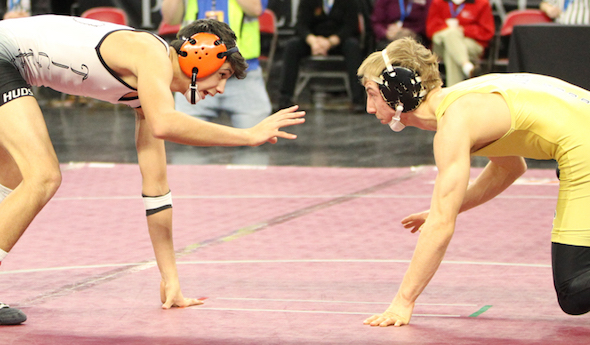
Hamdan accomplished both, defeating Jackson Lumen Christi’s Spencer Good 3-2 in a matchup of returning MHSAA champions in the 119-pound Final.
“It means more, because he kind of helped me get this good,” said Hamdan, who had his brother – a Division 4 champion in 2013 – in his corner as an assistant coach during the match. “We’ve been always wrestling with each other since we were really young, and I’ve been looking up to him. So it was kind of a big deal to me – I wanted to impress him.”
Hamdan scored an early takedown in the match, then was forced to switch up his strategy as Good clamped down defensively on his feet.
“I knew I was ahead, and I knew he couldn’t hold me down,” Hamdan said. “So I had to keep it even and keep it close since I couldn’t score on my feet, and then I knew he wouldn’t be able to score if I was still being offensive in the third period.”
Hamdan and Good, a senior, were each looking for their second title, as they both won at 112 a year ago – Hamdan in Division 4 and Good in Division 3. With two titles in two years as a high schooler, Hamdan is now thinking big.
“It was kind of like a dream more than a goal,” Hamdan said. “And I guess my dream is becoming a reality, slowly. It’s a process. I’ve been working out all summer, in the season and offseason for this, and getting prepared as much as I possibly can for this tournament.”
103
Champion: Reese Fry, Manchester, Jr. (51-1)
Major decision, 10-0, over Jamison Ward, Carson City-Crystal, Fr. (52-3)
Fry learned some lessons in his first two trips to the Palace.
“(I learned) how to push myself,” Fry said. “How to develop and just grow as a wrestler – fundamentally and mentally.”
Fry turned those lessons into a Finals title, as he defeated Carson City-Crystal’s freshman sensation Jamison Ward.
The Manchester junior controlled the match throughout, scoring a takedown in each period, and taking Ward to his back in the second.
“I kept in control,” Fry said. “I just wrestled the match I wanted to wrestle.”
112
Champion: Noah Comar, Clinton, Soph. (51-0)
Decision, 3-1 (OT), over Tucker Sholl, Hudson, Soph. (33-3)
It was a Hudson wrestler that stopped Comar’s title bid a year ago. He wasn’t going to let a Tiger get in his way again.
Comar scored a takedown in overtime to defeat returning champion Tucker Sholl and finish off a perfect sophomore season. Comar lost in the 2016 112-pound Final against Sholl’s teammate, Jordan Hamdan.
“My strategy was just to push the pace and catch him off guard,” Comar said. “I guess it worked, because I got the ankle and got a takedown. I had to push the pace. My greatest defense was my offense. … It was sweet revenge.”
125
Champion: Skyler Crespo, Mendon, Fr. (52-1)
Decision, 3-1, over Robert LeFevre, Erie Mason, Sr. (48-5)
Crespo couldn’t stop moving after winning the 125-pound title. Despite just finishing a hard-fought match against returning champion Robert LeFevre, Crespo still found the energy to jog in place.
“I’m so excited,” he said. “There’s been a lot of time and work put into this.”
The Mendon freshman capped off a remarkable first high school season by taking LeFevre down in the first period, and holding him off the rest of the way. Now, the inevitable four-time champion discussions will begin, and Crespo is ready for them.
“Get back to work as soon as I can,” Crespo said. “Monday morning, I’ll be doing something. Running or whatever it is.”
130
Champion: Robert Rogers, Burton Bentley, Jr. (43-1)
Decision, 9-4, over Nick Felt, Shelby, Soph. (49-2)
Rogers claimed his second straight title, jumping out to a 7-2 lead before holding off big-move attempts from Shelby’s Felt.
“In those situations, most people are going to throw,” Rogers said. “I’ve been in those situations before, and I’ve been on the big stage, so I know what it takes to win. With 20 seconds left, I’m not going to let you do your moves; I’m going to do mine.”
While Rogers called upon his big-match experience in the waning moments, he didn’t let his status as a returning champion allow him to get overconfident.
“You have to come in here thinking that you could win or lose,” he said. “You can’t just come in here thinking, ‘Oh, I’m a returning state champion and I’m going to win.’ I came in thinking, ‘You know what, I’m just another guy on the chart, and anyone can beat me.’ So I had to go out there and show everyone that I can beat them.”
135
Champion: Ethan Woods, Manchester, Sr. (49-2)
Decision, 5-0, over Jayce Kuehnlein, St. Louis, Jr. (45-6)
After falling one win short of a title in each of the last two years, Ethan Woods climbed to the top of the podium as a senior.
“It feels great,” an emotional Woods said. “Everything that I’ve worked for my whole life finally paid off. I put so much time in training for this my whole life. I could have wrestled better and I should have, but I did what I needed to win, and I finally accomplished what I set out to do, and it feels great.”
Woods got an early takedown, and controlled the match throughout, even if the scoring may not have been there.
“Each year, my confidence and composure has built and developed, and I’m able to handle all the pressure and the nerves,” Woods said. “Obviously I still put a lot of pressure on myself, because I just won but I don’t feel like I wrestled as good as I could have. But I think (three previous trips to the MHSAA Finals) helped me prepare mentally.”
140
Champion: Sean O’Hearon, Springport, Sr. (42-0)
Technical fall, 26-11 (4:46), over Braxton Seida, Carson City-Crystal, Soph. (49-5)
O’Hearon put on a takedown clinic on his way to a dominant victory.
The Springport senior took Carson City-Crystal’s Seida down 12 times – and added a reversal – on his way to his second straight title.
“I came into the state meet basically making it my goal to tech every single person here,” O’Hearon said. “I guess I was able to do that, so that’s a win.”
Making the title more special was the fact O’Hearon was able to share it with his cousin, Austin, who won the 145-pound title in Division 2 for Eaton Rapids.
“It’s even more awesome because my cousin won, too,” Sean O’Hearon said. “In my senior year, we both win, that’s something not many people can have.”
145
Champion: Konnor Holton, St. Louis, Sr. (46-3)
Decision, 6-4 (OT), over Noah Niemen, Blissfield, Sr. (29-3)
For the first time since 1967, St. Louis has a Finals champion. Konnor Holton got a takedown in overtime to knock off Noah Niemen and become the Sharks’ second MHSAA title winner.
“I knew he was going to get deep, and I knew that if I got into a scramble position, it was my match,” Holton said. “I knew as soon as I got him uncomfortable, it was my match.”
Holton held a 4-3 lead late in the match, but was hit for fleeing the mat to tie things up and send it to overtime. He bounced back in the extra period, however, capitalizing on his second trip to the Finals after falling a win short a year ago.
“I can’t even describe it right now,” Holton said. “My heart is all over the place.”
152
Champion: Gerrit Yates, Hesperia, Jr. (37-1)
Pin, 2:22, over Zack Menck, Lawton, Jr. (54-4)
Yates decided to add basketball to his winter athletics load this year. While he thinks it may be hurting him a bit on the mat, you’d be hard-pressed to tell.
Yates came through in his third straight Finals appearance, winning by second-period pin.
“It’s great to win it, but I didn’t wrestle near my ability,” Yates said. “Probably right after this, I’m going to go work in the wrestling room some more, get in the weight room.”
Menck held a 6-5 lead in the match after one period, but Yates took him straight to his back from their feet early in the second to earn the pin.
“The whole match, he was wrestling kind of defensive, staying back and then jumping at me,” Yates said. “I kind of timed it, as soon as I saw him faking, I sat back and tossed him because I saw it coming. I knew I had to go for something big.”
160
Champion: Tanner Gonzales, Manistique, Sr. (46-0)
Decision, 5-4 (2 OT), over Johnathon Stid, Dansville, Sr. (38-7)
As Gonzales recognized the fans who had made the long trip to the Palace from the Upper Peninsula, one of them shouted to him, “Manistique in the house!”
“I’m the third U.P. champ, and they haven’t had one in a while,” Gonzales said. “So it’s exciting for the whole U.P. and Manistique. It’s a small town, and they’ve never had a state champ in anything.”
Now they do, as Gonzales scored a reversal late in the second period of the second overtime and held on for the win.
“Just hang on,” Gonzales said of his strategy for the final seven seconds. “I hadn’t had a stall call yet, so if I took a stall call, I wasn’t too worried about it.”
171
Champion: Dylan Smith, Bad Axe, Sr. (47-4)
Decision, 3-2, over David Erwin, Bronson, Sr. (53-3)
A third-period takedown lifted Smith to Bad Axe’s first championship since 1991.
“It’s amazing,” Smith said. “I came in and got sixth last year. This is a lot better feeling.”
Smith and Bronson’s Erwin were tied at 1 in the third period before Smith’s takedown gave him a 3-1 lead. Erwin was able to get away and pull within one, but Smith fought him off.
“I was ready for the shot,” Smith said. “Coach was expecting it. I was ready to sprawl off his quick shot.”
189
Champion: Tylor Grames, Hudson, Sr. (41-12)
Decision, 5-3 (OT), over Erik Birchmeier, New Lothrop, Sr. (31-3)
A week ago Grames knocked off Birchmeier to kick off Hudson’s march to a team title.
On Saturday, he needed extra time, but again came out on top against the returning champion from New Lothrop.
“I changed it up from wanting the team to do good, to inspiring everyone that was up there watching to want to do good,” Grames said. “Last week when we wrestled he would post a lot, and I capitalized by making my shots. This week, he barely posted, which made it five times harder.”
Grames had to fight off a near takedown from Birchmeier late in regulation to force overtime.
“Fear,” Grames said. “Fear. I really wanted to make my hometown proud, and I was scared that I wouldn’t, so that’s what drove me on.”
215
Champion: Devon Kozel, Bangor, Sr. (48-1)
Decision, 9-3, over Nick Cooper, Springport, Sr. (40-4)
Kozel was a runner-up a year ago, but he left little doubt Saturday night against returning champion Cooper of Springport.
“I had to redeem myself,” Kozel said.
Kozel had three takedowns and a reversal to control the match and earn a third straight win against Cooper.
“Just have to stay tough on our feet,” Kozel said. “I know where you have to win the match at.”
285
Champion: Logan Kennedy, Decatur, Sr. (58-2)
Decision, 6-4, over Zach Bailey, Hudson, Sr. (41-10)
Losing wasn’t an option for Kennedy.
After finishing as a runner-up a year ago, and falling behind late in his title match Saturday against Hudson’s Bailey, Kennedy turned up the pace to force overtime and eventually win his first MHSAA championship.
“I just knew I had to something,” Kennedy said. “He’d already been hit with a warning for stalling, so I thought if I went at him, I could get another stalling call and send it to overtime. I love wrestling in the third period because I feel so much better than the other wrestlers.”
He continued that aggression into overtime, where he finished off a dream season.
“It’s been my dream my whole entire life,” he said. “Ever since I started wrestling, I knew I wanted to be a state champion.”
PHOTO: Hudson’s Jordan Hamdan (left) and Jackson Lumen Christi’s Spencer Good face off in the Division 4 Final at 119 pounds Saturday. (Click for more from HighSchoolSportsScene.com.)
Rep Council Wrap-Up: Spring 2021
By
Geoff Kimmerly
MHSAA.com senior editor
May 6, 2021
The addition of a girls division to the Individual Wrestling Tournament series and approval of a common start date for all Fall sports highlighted actions taken by the Representative Council of the Michigan High School Athletic Association during its annual Spring Meeting on May 3.
The Spring Meeting of the 19-member legislative body of the Association’s more than 1,500 member schools is generally the busiest of its sessions each year. The Council considered 19 committee proposals and dealt with a variety of eligibility rule, postseason tournament and operational issues.
Beginning with the 2021-22 school year, a championship division for female competitors who participate on MHSAA member school teams will be added to the Individual Wrestling Tournament series. There will be 14 champions awarded, based on weight classes established by the National Federation of State High School Associations. Qualifiers will be determined via a sectional format, and girls will continue to compete on boys teams during regular-season and team tournament competition; girls also may choose to compete in the boys individual tournament instead of the girls bracket. A total of 401 girls competed in wrestling for MHSAA member schools during the 2019-20 school year, up from 250 in 2017-18 and then 327 in 2018-19. The girls division proposal had been put forth by the MHSAA Wrestling Committee.
The Council also voted to move the start of all Fall sports practices to the same day. Those sports now may begin on the 16th Monday before Thanksgiving. Previously, football started on a Monday and all other sports began Wednesday. For the upcoming school year, the Fall sports start date is Aug. 9, 2021.
As it has during most meetings over the 2020-21 school year, the Council continued to discuss possible adjustments because of the COVID-19 pandemic and disruption it has caused to Michigan high school athletics. Notably, the Council approved an extension of the waiver of the previous academic record regulation for sports played in Fall 2021. This is the third extension of the waiver. The previous academic record regulation requires participants to have received credit for at least 66 percent of a full credit load during the previous semester. As COVID-19 has resulted in various academic scheduling adjustments, schools will continue to determine if athletes have met the credit level necessary to be eligible for athletics this fall.
The Council also made permanent the allowance for cooperative programs in nine sports among schools of the same public school district regardless of the 3,500-student enrollment maximum. Those co-op programs were first allowed as part of a two-year experiment beginning with the 2016-17 school year to increase possibilities for participation in those sports – baseball, bowling, girls competitive cheer, cross country, golf, soccer, softball, tennis and wrestling. Schools taking part in these co-op programs must continue to show a demonstrated history of inadequate numbers of participants and apply for renewal every two years.
Here is a summary of other notable actions taken by the Representative Council at the Spring Meeting, which will take effect during the 2021-22 school year:
Athletic Equity
• The Council approved an Athletic Equity Committee recommendation to publish the following statement to suggest to local schools that they review nicknames and school logos that are considered offensive or hurtful to minority groups or demonstrate an insensitive bias:
“The MHSAA recognizes the importance of equity in high school sports. Schools and mascots are rich in tradition and unique to each community. Although we understand the tradition of those individual communities, we also wish to support and foster an environment of inclusion. It is in this spirit that the MHSAA encourages member schools and communities to evaluate and reconsider names and mascots that may be offensive to groups of individuals.”
Officials
• The Council approved an Officials Review Committee recommendation to adjust the officials rating system with the hope of encouraging more ratings and providing a more specific understanding of an official’s overall body of work. Instead of the current overall 1-5 rating system, officials will receive specific feedback in four categories: judgment, presence and demeanor, attitude and effort, and administration and communication.
Sport Matters
• In bowling, the Council approved a Bowling Committee recommendation to adopt the Phantom oil pattern for the 2021-22 season.
• In competitive cheer, the Council approved a Girls Competitive Cheer Committee recommendation to study a new choreography chart that will award points based on a variety of skills while also awarding a range of points to benefit both small and large teams which have various skill levels.
• Also in cheer, the Council approved a pair of Committee technical recommendations; the first allows for a connected tumbling skill to be considered a new variety point for Round 3, and the second allows four difficulty points for a one-leg flair at the elevator level for middle school competition.
• In golf, the Council approved the Golf Committee recommendation to require the use of the iWanamaker scoring program and app during the regular season, beginning in Fall 2021. The program and app became required during Regional and Finals play during the Fall 2020 season.
• In softball, the Council approved a Girls Softball Committee recommendation to add a suspended game policy to MHSAA playing rule adoptions in the MHSAA Handbook. This policy – which mirrors that approved for baseball in 2020 – provides a game will be suspended any time it is called before it reaches regulation, or if called any time when the score is tied.
• In tennis, the Council approved a Tennis Committee recommendation regarding instances when a seeded player withdraws from Regional or Finals competition before the first match is played. In those instances, the players seeded lower in that flight than the player who withdrew will move up one seed and be placed on the previously-determined lines for those seeds within the flight bracket. However, non-seeded players already drawn into the bracket will not be moved.
• Also in wrestling, the Council approved a late-arrival skin check on days – especially during weekends – when teams may be competing in multiple regular-season duals. An athlete who misses the scheduled morning skin check may, with coach’s notification to the official beforehand, receive a skin check upon later arrival to the event but prior to the start of the dual in which the wrestler may compete. This will allow an individual the opportunity to participate if that wrestler missed the scheduled morning inspection due to educational reasons or unforeseen circumstances.
The Council also discussed possible topics for presentation during this fall’s Update Meeting statewide tour, and took action to clarify Handbook language regarding a variety of topics. The Association’s $11.5 million budget for the 2021-22 school year also was approved.
The Representative Council is the 19-member legislative body of the MHSAA. All but five are elected by member schools. Four members are appointed by the Council to facilitate representation of females and minorities, and the 19th position is occupied by the Superintendent of Public Instruction or designee.
The MHSAA is a private, not-for-profit corporation of voluntary membership by more than 1,500 public and private senior high schools and junior high/middle schools which exists to develop common rules for athletic eligibility and competition. No government funds or tax dollars support the MHSAA, which was the first such association nationally to not accept membership dues or tournament entry fees from schools. Member schools which enforce these rules are permitted to participate in MHSAA tournaments, which attract more than 1.4 million spectators each year.